SUBSCRIBE TO OUR FREE NEWSLETTER
Daily news & progressive opinion—funded by the people, not the corporations—delivered straight to your inbox.
5
#000000
#FFFFFF
To donate by check, phone, or other method, see our More Ways to Give page.
Daily news & progressive opinion—funded by the people, not the corporations—delivered straight to your inbox.
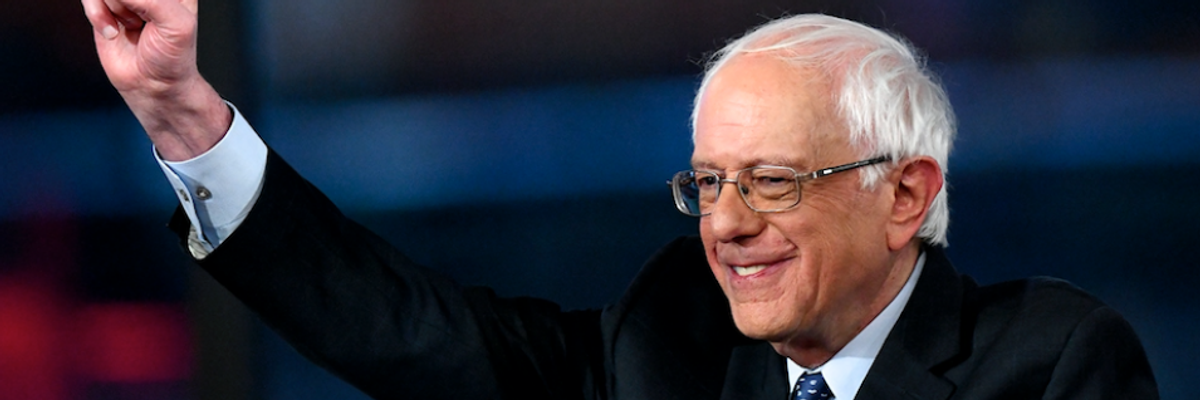
In another poll from a crucial state, California, conducted by the Public Policy Institute of California, 39% of Latinos in California said they prefer Sanders, compared to 21% for Biden and 5% for Warren. (Photo: Mark Makela / Stringer/ Getty Images)
Suburban women, as Nicole Goodkind writes in Fortune, "[were] crucial to President Donald Trump's election in 2016 and will be equally crucial to his reelection campaign next year." Recent polling and actual election results, however, show Trump cannot take them for granted, and the same can be said for more centrist Democrats.
Goodkind is referring to data released from the Federal Election Commission and analyzed by the Center for Responsive Politics that reveals women are getting involved in elections earlier than in previous cycles. Fortune reports, "More than 1 million [women] have already donated $131 million itemized to presidential candidates."
And while there's no one candidate that's won the hearts and minds of all women voters, it's Bernie Sanders who has made the most progress.
"Of all the potential 2020 candidates," Goodkind writes, "Sanders has taken in the most money from women, raising about $17.1 million in itemized contributions, or 40% of his total funds."
Many of those women are from the suburbs, the same ones Trump needs to win. Sanders received "over $13 million in small-dollar donations from nearly 280,000 suburban women. Combining small- and large-dollar donations, Sanders earned more than any other presidential candidate amongst suburban women with a total of $15 million from small and large donors alike."
These numbers challenge the prevailing wisdom that Democrats must be aggressively moderate to win elections, a position that gained traction last week following Democratic state-level wins in Kentucky, Virginia and Pennsylvania. Sen. Mark Warner, D-Va., told The Hill on Friday that candidates in his state won because they "ran on more moderate issues."
He added that candidates "had very much followed in the traditional Virginia Democratic model of we're going to give you responsible government, it's going to be fiscally responsible."
"I happen to believe that America is a center-right country and that people want us to work across the aisle, and what they're most interested in is problem solving rather than rhetoric," Sen. Dianne Feinstein, D-Calif., who endorsed Joe Biden, explained to The Hill.
Brad Bannon, a Democratic strategist and consultant, isn't so sure. "This is bad news for Biden, it shows he's got a problem with the female vote," he told Fortune, regarding the new data about suburban women. "And when you look at the polls, women are significantly more likely to be voting for [Sen. Elizabeth] Warren or Sanders than Biden."
Suburban women aren't the only counterintuitive demographic for a candidate whose supporters are often referred to as "Bernie Bros" and assumed to be young, leftist white men. In addition to Fortune's reporting, Foreign Policy examined political contributions from U.S. national security agency staff, also using data from the Center for Responsive Politics. Per Foreign Policy:
When combining contribution amounts together, Sanders is the biggest beneficiary of national security support, followed by [Mayor Pete] Buttigieg and Warren. Democratic front-runner Biden and President Donald Trump trail behind those candidates, ranking no higher than third for any one department.
When broken down by sector of government, Buttigieg had the highest support from the State Department and Sanders from the military.
Sanders, The New York Times reported this weekend, "has collected more money from Latino voters than any other candidate in the Democratic field, raising three times as much from the group as Barack Obama did in 2008."
According to a set of new surveys from The New York Times and Siena College, the Vermont senator is attracting "28% of the Democratic primary vote in six swing states."
In another poll from a crucial state, California, conducted by the Public Policy Institute of California, 39% of Latinos in California said they prefer Sanders, compared to 21% for Biden and 5% for Warren.
Anthony Mercado, a 48-year-old maintenance worker, explained Sanders' appeal to Latinos to The New York Times: "We're a community of struggle, and this is a man who knows struggle.. .. Latinos have been promised things and then the winds change. But he's been saying the same things ever since he started."
Dear Common Dreams reader, It’s been nearly 30 years since I co-founded Common Dreams with my late wife, Lina Newhouser. We had the radical notion that journalism should serve the public good, not corporate profits. It was clear to us from the outset what it would take to build such a project. No paid advertisements. No corporate sponsors. No millionaire publisher telling us what to think or do. Many people said we wouldn't last a year, but we proved those doubters wrong. Together with a tremendous team of journalists and dedicated staff, we built an independent media outlet free from the constraints of profits and corporate control. Our mission has always been simple: To inform. To inspire. To ignite change for the common good. Building Common Dreams was not easy. Our survival was never guaranteed. When you take on the most powerful forces—Wall Street greed, fossil fuel industry destruction, Big Tech lobbyists, and uber-rich oligarchs who have spent billions upon billions rigging the economy and democracy in their favor—the only bulwark you have is supporters who believe in your work. But here’s the urgent message from me today. It's never been this bad out there. And it's never been this hard to keep us going. At the very moment Common Dreams is most needed, the threats we face are intensifying. We need your support now more than ever. We don't accept corporate advertising and never will. We don't have a paywall because we don't think people should be blocked from critical news based on their ability to pay. Everything we do is funded by the donations of readers like you. When everyone does the little they can afford, we are strong. But if that support retreats or dries up, so do we. Will you donate now to make sure Common Dreams not only survives but thrives? —Craig Brown, Co-founder |
Suburban women, as Nicole Goodkind writes in Fortune, "[were] crucial to President Donald Trump's election in 2016 and will be equally crucial to his reelection campaign next year." Recent polling and actual election results, however, show Trump cannot take them for granted, and the same can be said for more centrist Democrats.
Goodkind is referring to data released from the Federal Election Commission and analyzed by the Center for Responsive Politics that reveals women are getting involved in elections earlier than in previous cycles. Fortune reports, "More than 1 million [women] have already donated $131 million itemized to presidential candidates."
And while there's no one candidate that's won the hearts and minds of all women voters, it's Bernie Sanders who has made the most progress.
"Of all the potential 2020 candidates," Goodkind writes, "Sanders has taken in the most money from women, raising about $17.1 million in itemized contributions, or 40% of his total funds."
Many of those women are from the suburbs, the same ones Trump needs to win. Sanders received "over $13 million in small-dollar donations from nearly 280,000 suburban women. Combining small- and large-dollar donations, Sanders earned more than any other presidential candidate amongst suburban women with a total of $15 million from small and large donors alike."
These numbers challenge the prevailing wisdom that Democrats must be aggressively moderate to win elections, a position that gained traction last week following Democratic state-level wins in Kentucky, Virginia and Pennsylvania. Sen. Mark Warner, D-Va., told The Hill on Friday that candidates in his state won because they "ran on more moderate issues."
He added that candidates "had very much followed in the traditional Virginia Democratic model of we're going to give you responsible government, it's going to be fiscally responsible."
"I happen to believe that America is a center-right country and that people want us to work across the aisle, and what they're most interested in is problem solving rather than rhetoric," Sen. Dianne Feinstein, D-Calif., who endorsed Joe Biden, explained to The Hill.
Brad Bannon, a Democratic strategist and consultant, isn't so sure. "This is bad news for Biden, it shows he's got a problem with the female vote," he told Fortune, regarding the new data about suburban women. "And when you look at the polls, women are significantly more likely to be voting for [Sen. Elizabeth] Warren or Sanders than Biden."
Suburban women aren't the only counterintuitive demographic for a candidate whose supporters are often referred to as "Bernie Bros" and assumed to be young, leftist white men. In addition to Fortune's reporting, Foreign Policy examined political contributions from U.S. national security agency staff, also using data from the Center for Responsive Politics. Per Foreign Policy:
When combining contribution amounts together, Sanders is the biggest beneficiary of national security support, followed by [Mayor Pete] Buttigieg and Warren. Democratic front-runner Biden and President Donald Trump trail behind those candidates, ranking no higher than third for any one department.
When broken down by sector of government, Buttigieg had the highest support from the State Department and Sanders from the military.
Sanders, The New York Times reported this weekend, "has collected more money from Latino voters than any other candidate in the Democratic field, raising three times as much from the group as Barack Obama did in 2008."
According to a set of new surveys from The New York Times and Siena College, the Vermont senator is attracting "28% of the Democratic primary vote in six swing states."
In another poll from a crucial state, California, conducted by the Public Policy Institute of California, 39% of Latinos in California said they prefer Sanders, compared to 21% for Biden and 5% for Warren.
Anthony Mercado, a 48-year-old maintenance worker, explained Sanders' appeal to Latinos to The New York Times: "We're a community of struggle, and this is a man who knows struggle.. .. Latinos have been promised things and then the winds change. But he's been saying the same things ever since he started."
Suburban women, as Nicole Goodkind writes in Fortune, "[were] crucial to President Donald Trump's election in 2016 and will be equally crucial to his reelection campaign next year." Recent polling and actual election results, however, show Trump cannot take them for granted, and the same can be said for more centrist Democrats.
Goodkind is referring to data released from the Federal Election Commission and analyzed by the Center for Responsive Politics that reveals women are getting involved in elections earlier than in previous cycles. Fortune reports, "More than 1 million [women] have already donated $131 million itemized to presidential candidates."
And while there's no one candidate that's won the hearts and minds of all women voters, it's Bernie Sanders who has made the most progress.
"Of all the potential 2020 candidates," Goodkind writes, "Sanders has taken in the most money from women, raising about $17.1 million in itemized contributions, or 40% of his total funds."
Many of those women are from the suburbs, the same ones Trump needs to win. Sanders received "over $13 million in small-dollar donations from nearly 280,000 suburban women. Combining small- and large-dollar donations, Sanders earned more than any other presidential candidate amongst suburban women with a total of $15 million from small and large donors alike."
These numbers challenge the prevailing wisdom that Democrats must be aggressively moderate to win elections, a position that gained traction last week following Democratic state-level wins in Kentucky, Virginia and Pennsylvania. Sen. Mark Warner, D-Va., told The Hill on Friday that candidates in his state won because they "ran on more moderate issues."
He added that candidates "had very much followed in the traditional Virginia Democratic model of we're going to give you responsible government, it's going to be fiscally responsible."
"I happen to believe that America is a center-right country and that people want us to work across the aisle, and what they're most interested in is problem solving rather than rhetoric," Sen. Dianne Feinstein, D-Calif., who endorsed Joe Biden, explained to The Hill.
Brad Bannon, a Democratic strategist and consultant, isn't so sure. "This is bad news for Biden, it shows he's got a problem with the female vote," he told Fortune, regarding the new data about suburban women. "And when you look at the polls, women are significantly more likely to be voting for [Sen. Elizabeth] Warren or Sanders than Biden."
Suburban women aren't the only counterintuitive demographic for a candidate whose supporters are often referred to as "Bernie Bros" and assumed to be young, leftist white men. In addition to Fortune's reporting, Foreign Policy examined political contributions from U.S. national security agency staff, also using data from the Center for Responsive Politics. Per Foreign Policy:
When combining contribution amounts together, Sanders is the biggest beneficiary of national security support, followed by [Mayor Pete] Buttigieg and Warren. Democratic front-runner Biden and President Donald Trump trail behind those candidates, ranking no higher than third for any one department.
When broken down by sector of government, Buttigieg had the highest support from the State Department and Sanders from the military.
Sanders, The New York Times reported this weekend, "has collected more money from Latino voters than any other candidate in the Democratic field, raising three times as much from the group as Barack Obama did in 2008."
According to a set of new surveys from The New York Times and Siena College, the Vermont senator is attracting "28% of the Democratic primary vote in six swing states."
In another poll from a crucial state, California, conducted by the Public Policy Institute of California, 39% of Latinos in California said they prefer Sanders, compared to 21% for Biden and 5% for Warren.
Anthony Mercado, a 48-year-old maintenance worker, explained Sanders' appeal to Latinos to The New York Times: "We're a community of struggle, and this is a man who knows struggle.. .. Latinos have been promised things and then the winds change. But he's been saying the same things ever since he started."