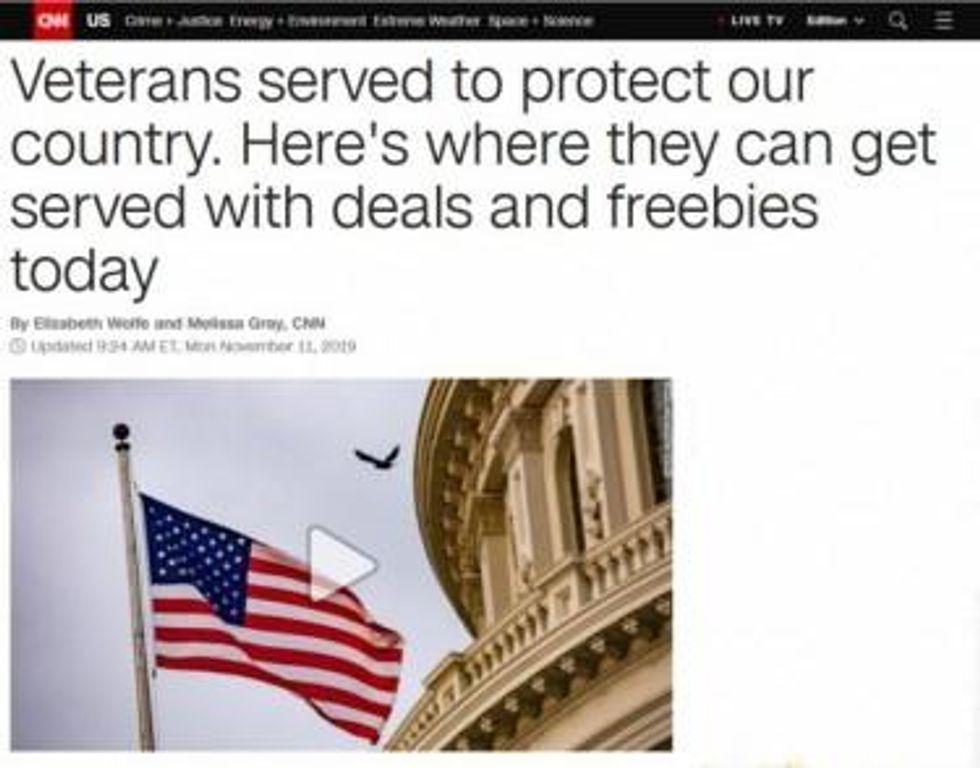
unlike on Memorial Day, when it may be more appropriate to tell veterans to have a "meaningful day"...on Veterans Day, it's entirely acceptable and encouraged to tell a veteran, "Thank you for your service."
And, the magazine added, be sure to spell Veterans Day without an apostrophe!
It was a missed opportunity, to put it mildly, for those who recall the roots of the holiday. In 1918, the armistice agreement that ended World War I was signed. As David Swanson, board member of Veterans for Peace, noted this time last year (Let's Try Democracy, 11/8/18), the Armistice Day resolution Congress passed in 1926 called for "exercises designed to perpetuate peace through good will and mutual understanding." Later, Congress added that November 11 was to be "a day dedicated to the cause of world peace." It was only after Hiroshima and Nagasaki, Korea and the Cold War, and the placing of US bases all over the planet that Armistice Day was renamed Veterans Day in 1954. And groups like Veterans for Peace (in some places forbidden to march in Veterans Day parades) have been trying to reclaim it ever since.
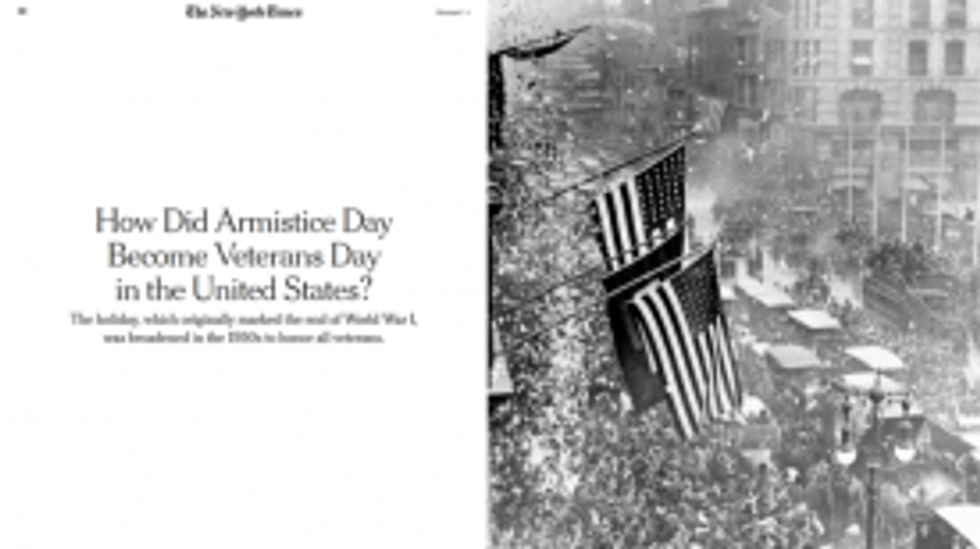
A new study out of the University of Alabama (Journalist's Resource, 11/8/19) suggests media's images of veterans are a bit fuzzy. The school's Veterans and Media Lab found that the photographs newspapers use to represent veterans (year round), for one thing, feature 14% female vets, when women are just 8% of living vets nationwide--but also 20% of news photos focus on World War II veterans, though most living male vets served in Vietnam, and for women, it's since September 11, 2001. Lead author Steven Parrott said:
When I ask my 20-year-old students what they picture when they picture who a veteran is, it's a World War II veteran, and I'm asking: "Why does that happen when World War II veterans are a minority? Why don't they think about a 28-year-old who's probably in their own classroom?"
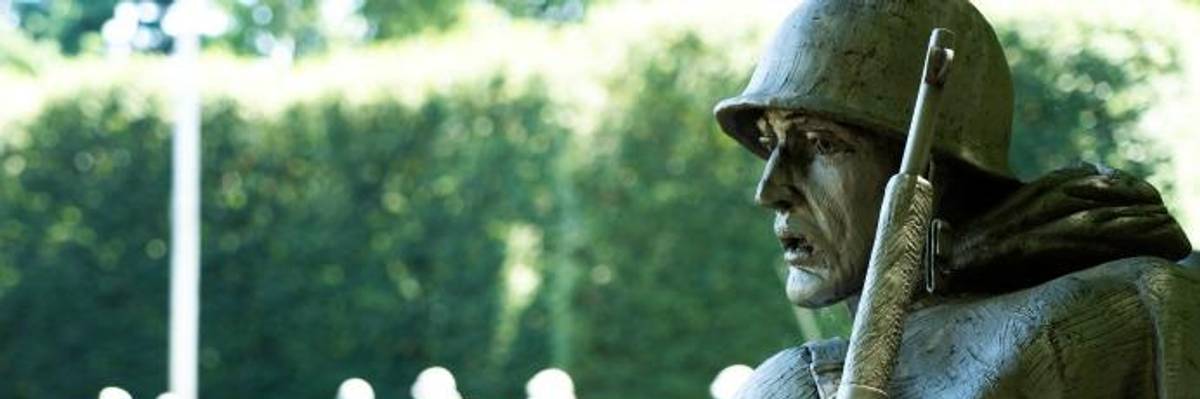
A more accurate, less sepia-toned vision of who veterans are and what their lives are like might make it harder for media to dodge what Swanson and others say they hear from the veterans they listen to: that the only real way to honor veterans is to create fewer of them.
unlike on Memorial Day, when it may be more appropriate to tell veterans to have a "meaningful day"...on Veterans Day, it's entirely acceptable and encouraged to tell a veteran, "Thank you for your service."
And, the magazine added, be sure to spell Veterans Day without an apostrophe!
It was a missed opportunity, to put it mildly, for those who recall the roots of the holiday. In 1918, the armistice agreement that ended World War I was signed. As David Swanson, board member of Veterans for Peace, noted this time last year (Let's Try Democracy, 11/8/18), the Armistice Day resolution Congress passed in 1926 called for "exercises designed to perpetuate peace through good will and mutual understanding." Later, Congress added that November 11 was to be "a day dedicated to the cause of world peace." It was only after Hiroshima and Nagasaki, Korea and the Cold War, and the placing of US bases all over the planet that Armistice Day was renamed Veterans Day in 1954. And groups like Veterans for Peace (in some places forbidden to march in Veterans Day parades) have been trying to reclaim it ever since.
A new study out of the University of Alabama (Journalist's Resource, 11/8/19) suggests media's images of veterans are a bit fuzzy. The school's Veterans and Media Lab found that the photographs newspapers use to represent veterans (year round), for one thing, feature 14% female vets, when women are just 8% of living vets nationwide--but also 20% of news photos focus on World War II veterans, though most living male vets served in Vietnam, and for women, it's since September 11, 2001. Lead author Steven Parrott said:
When I ask my 20-year-old students what they picture when they picture who a veteran is, it's a World War II veteran, and I'm asking: "Why does that happen when World War II veterans are a minority? Why don't they think about a 28-year-old who's probably in their own classroom?"
A more accurate, less sepia-toned vision of who veterans are and what their lives are like might make it harder for media to dodge what Swanson and others say they hear from the veterans they listen to: that the only real way to honor veterans is to create fewer of them.
unlike on Memorial Day, when it may be more appropriate to tell veterans to have a "meaningful day"...on Veterans Day, it's entirely acceptable and encouraged to tell a veteran, "Thank you for your service."
And, the magazine added, be sure to spell Veterans Day without an apostrophe!
It was a missed opportunity, to put it mildly, for those who recall the roots of the holiday. In 1918, the armistice agreement that ended World War I was signed. As David Swanson, board member of Veterans for Peace, noted this time last year (Let's Try Democracy, 11/8/18), the Armistice Day resolution Congress passed in 1926 called for "exercises designed to perpetuate peace through good will and mutual understanding." Later, Congress added that November 11 was to be "a day dedicated to the cause of world peace." It was only after Hiroshima and Nagasaki, Korea and the Cold War, and the placing of US bases all over the planet that Armistice Day was renamed Veterans Day in 1954. And groups like Veterans for Peace (in some places forbidden to march in Veterans Day parades) have been trying to reclaim it ever since.
A new study out of the University of Alabama (Journalist's Resource, 11/8/19) suggests media's images of veterans are a bit fuzzy. The school's Veterans and Media Lab found that the photographs newspapers use to represent veterans (year round), for one thing, feature 14% female vets, when women are just 8% of living vets nationwide--but also 20% of news photos focus on World War II veterans, though most living male vets served in Vietnam, and for women, it's since September 11, 2001. Lead author Steven Parrott said:
When I ask my 20-year-old students what they picture when they picture who a veteran is, it's a World War II veteran, and I'm asking: "Why does that happen when World War II veterans are a minority? Why don't they think about a 28-year-old who's probably in their own classroom?"
A more accurate, less sepia-toned vision of who veterans are and what their lives are like might make it harder for media to dodge what Swanson and others say they hear from the veterans they listen to: that the only real way to honor veterans is to create fewer of them.