SUBSCRIBE TO OUR FREE NEWSLETTER
Daily news & progressive opinion—funded by the people, not the corporations—delivered straight to your inbox.
5
#000000
#FFFFFF
To donate by check, phone, or other method, see our More Ways to Give page.
Daily news & progressive opinion—funded by the people, not the corporations—delivered straight to your inbox.
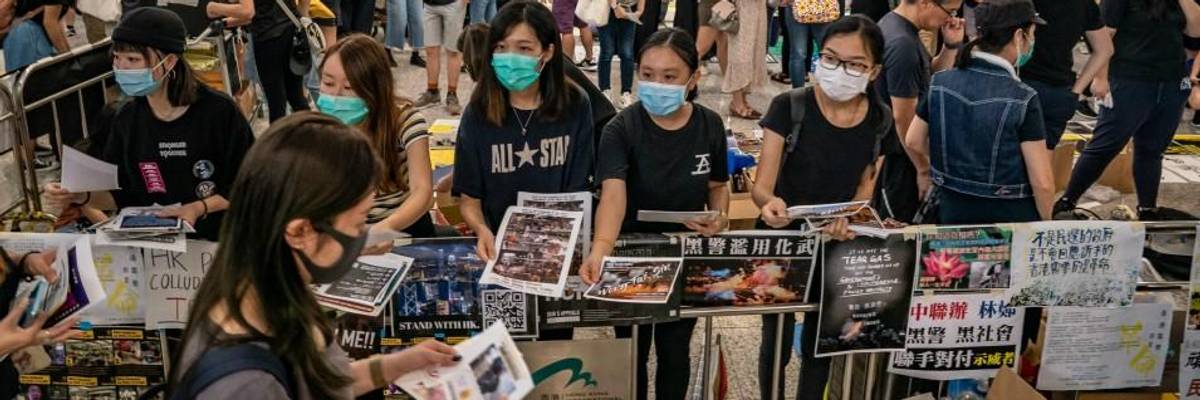
Pro-democracy protesters hand out leaflets at the arrival hall of the Hong Kong International Airport during a demonstration on Aug. 11, 2019. Rallies on the streets of Hong Kong against a controversial extradition bill began on June 9. (Photo: Anthony Kwan/Getty Images)
As United Nations high commissioner for human rights, I have been closely following the outbreak of mass protests across every region of the world this year. Demonstrators have taken to the streets for weeks on end, seeking to reclaim their economic, social, civil, political, and cultural rights and pushing back against inequalities in all these spheres.
My own experience as a head of state and as high commissioner for human rights demonstrates that the broadest possible dialogue is the only clear exit lane out of mass protest situations.
We have witnessed inspiring peaceful, even celebratory demonstrations--and we have also witnessed the use of force by security forces as well as violence by pockets of protesters, including in my own country, Chile, and of course in Hong Kong.
My own experience as a head of state and as high commissioner for human rights demonstrates that the broadest possible dialogue is the only clear exit lane out of mass protest situations.
As I have urged governments from Lebanon to Guinea, Iran to Chile, Sudan to Bolivia, Iraq to Zimbabwe and others, serious divisions, fears, frustrations with economic, social, political, and other inequalities must all be acknowledged and tackled in a process that is open and inclusive.
On November 24, Hong Kong voted in its district council elections; a record 71.2 percent of registered electors exercised their right peacefully after months of unrest, violence, and chaos.
The people of Hong Kong delivered a loud and very clear demand to be heard. It is now time to tackle difficult issues--with renewed resolve, clarity, and courage. There is not a moment to lose.
I urge the government to prioritize a long-overdue process of meaningful, inclusive dialogue, by making a concerted effort to bring to the table community leaders, student groups, business groups, trade unions, political leaders from various parties, civil society organizations, academics, legal professionals, minority groups, and others.
It is now time to listen directly to people from all walks of life, to work together with sincere resolve to address their concerns and grievances. Young people, especially, need to be heard.
I appeal to all sides to unequivocally condemn violence that has led to serious injury and death. And I appeal to the government to take important confidence-building measures, including a proper independent and impartial judge-led investigation into reports of excessive use of force by the police.
Such steps will take clarity and courage, and involve compromises, but they are crucial to restore trust, repair rifts, and make it possible to find peaceful resolutions to untenable situations.
Hongkongers have long had a reputation for resilience, adaptability, and pragmatism, and have--for decades--set a high standard with their courageous, persistent exercise of their rights to freedom of expression and peaceful assembly. The resort to extreme violence by a small proportion of the protesters--including against police officers, as well as harassment of some of their family members--is thus deeply regrettable.
I appeal to the government to take important confidence-building measures, including a proper independent and impartial judge-led investigation into reports of excessive use of force by the police.
Global experience shows that if governments and security forces treat their people as enemies, enemies is what they may become. The use of force breaks trust--in institutions, in leaders, and in the rule of law that places like Hong Kong, and my own country Chile, hold so dear. This is the case in many parts of the world.
In all such cases, by merely condemning the violence by some protesters while relying solely on security measures to respond to the protests--without inclusive efforts to address the demands put forth by large segments of the population--governments end up increasing the feeling among many that they are not being heard, and cause their grievances to fester and expand.
For these reasons, accountability is key--both in the case of allegations of excessive force by police and violence by individuals leading to death, serious injury, or major damage.
Calling for an independent investigation into the use of force by police does not tarnish the image of police and security forces, nor does it punish officers who have had to make immense personal sacrifices.
On the contrary, it sends a message that this is a force that works hard to comply with the rule of law and guidelines on the use of force, and is open to an examination of its conduct, and that it values accountability where those rules were not strictly followed.
We have much to learn from other societies that have recovered from periods of violence and social turmoil. For instance, in Tunisia, the National Dialogue Quartet brought together business, trade unions, the bar council, and human rights defenders in a common platform for dialogue with the government--and was awarded the Nobel Peace Prize or its work.
In Thailand and other countries, truth and reconciliation commissions have helped to defuse tensions and polarization that had led to political violence.
My office stands ready to offer advice and guidelines based on our experience and work in human rights around the world--in carving a peaceful, sustainable path forward.
Dear Common Dreams reader, It’s been nearly 30 years since I co-founded Common Dreams with my late wife, Lina Newhouser. We had the radical notion that journalism should serve the public good, not corporate profits. It was clear to us from the outset what it would take to build such a project. No paid advertisements. No corporate sponsors. No millionaire publisher telling us what to think or do. Many people said we wouldn't last a year, but we proved those doubters wrong. Together with a tremendous team of journalists and dedicated staff, we built an independent media outlet free from the constraints of profits and corporate control. Our mission has always been simple: To inform. To inspire. To ignite change for the common good. Building Common Dreams was not easy. Our survival was never guaranteed. When you take on the most powerful forces—Wall Street greed, fossil fuel industry destruction, Big Tech lobbyists, and uber-rich oligarchs who have spent billions upon billions rigging the economy and democracy in their favor—the only bulwark you have is supporters who believe in your work. But here’s the urgent message from me today. It's never been this bad out there. And it's never been this hard to keep us going. At the very moment Common Dreams is most needed, the threats we face are intensifying. We need your support now more than ever. We don't accept corporate advertising and never will. We don't have a paywall because we don't think people should be blocked from critical news based on their ability to pay. Everything we do is funded by the donations of readers like you. When everyone does the little they can afford, we are strong. But if that support retreats or dries up, so do we. Will you donate now to make sure Common Dreams not only survives but thrives? —Craig Brown, Co-founder |
As United Nations high commissioner for human rights, I have been closely following the outbreak of mass protests across every region of the world this year. Demonstrators have taken to the streets for weeks on end, seeking to reclaim their economic, social, civil, political, and cultural rights and pushing back against inequalities in all these spheres.
My own experience as a head of state and as high commissioner for human rights demonstrates that the broadest possible dialogue is the only clear exit lane out of mass protest situations.
We have witnessed inspiring peaceful, even celebratory demonstrations--and we have also witnessed the use of force by security forces as well as violence by pockets of protesters, including in my own country, Chile, and of course in Hong Kong.
My own experience as a head of state and as high commissioner for human rights demonstrates that the broadest possible dialogue is the only clear exit lane out of mass protest situations.
As I have urged governments from Lebanon to Guinea, Iran to Chile, Sudan to Bolivia, Iraq to Zimbabwe and others, serious divisions, fears, frustrations with economic, social, political, and other inequalities must all be acknowledged and tackled in a process that is open and inclusive.
On November 24, Hong Kong voted in its district council elections; a record 71.2 percent of registered electors exercised their right peacefully after months of unrest, violence, and chaos.
The people of Hong Kong delivered a loud and very clear demand to be heard. It is now time to tackle difficult issues--with renewed resolve, clarity, and courage. There is not a moment to lose.
I urge the government to prioritize a long-overdue process of meaningful, inclusive dialogue, by making a concerted effort to bring to the table community leaders, student groups, business groups, trade unions, political leaders from various parties, civil society organizations, academics, legal professionals, minority groups, and others.
It is now time to listen directly to people from all walks of life, to work together with sincere resolve to address their concerns and grievances. Young people, especially, need to be heard.
I appeal to all sides to unequivocally condemn violence that has led to serious injury and death. And I appeal to the government to take important confidence-building measures, including a proper independent and impartial judge-led investigation into reports of excessive use of force by the police.
Such steps will take clarity and courage, and involve compromises, but they are crucial to restore trust, repair rifts, and make it possible to find peaceful resolutions to untenable situations.
Hongkongers have long had a reputation for resilience, adaptability, and pragmatism, and have--for decades--set a high standard with their courageous, persistent exercise of their rights to freedom of expression and peaceful assembly. The resort to extreme violence by a small proportion of the protesters--including against police officers, as well as harassment of some of their family members--is thus deeply regrettable.
I appeal to the government to take important confidence-building measures, including a proper independent and impartial judge-led investigation into reports of excessive use of force by the police.
Global experience shows that if governments and security forces treat their people as enemies, enemies is what they may become. The use of force breaks trust--in institutions, in leaders, and in the rule of law that places like Hong Kong, and my own country Chile, hold so dear. This is the case in many parts of the world.
In all such cases, by merely condemning the violence by some protesters while relying solely on security measures to respond to the protests--without inclusive efforts to address the demands put forth by large segments of the population--governments end up increasing the feeling among many that they are not being heard, and cause their grievances to fester and expand.
For these reasons, accountability is key--both in the case of allegations of excessive force by police and violence by individuals leading to death, serious injury, or major damage.
Calling for an independent investigation into the use of force by police does not tarnish the image of police and security forces, nor does it punish officers who have had to make immense personal sacrifices.
On the contrary, it sends a message that this is a force that works hard to comply with the rule of law and guidelines on the use of force, and is open to an examination of its conduct, and that it values accountability where those rules were not strictly followed.
We have much to learn from other societies that have recovered from periods of violence and social turmoil. For instance, in Tunisia, the National Dialogue Quartet brought together business, trade unions, the bar council, and human rights defenders in a common platform for dialogue with the government--and was awarded the Nobel Peace Prize or its work.
In Thailand and other countries, truth and reconciliation commissions have helped to defuse tensions and polarization that had led to political violence.
My office stands ready to offer advice and guidelines based on our experience and work in human rights around the world--in carving a peaceful, sustainable path forward.
As United Nations high commissioner for human rights, I have been closely following the outbreak of mass protests across every region of the world this year. Demonstrators have taken to the streets for weeks on end, seeking to reclaim their economic, social, civil, political, and cultural rights and pushing back against inequalities in all these spheres.
My own experience as a head of state and as high commissioner for human rights demonstrates that the broadest possible dialogue is the only clear exit lane out of mass protest situations.
We have witnessed inspiring peaceful, even celebratory demonstrations--and we have also witnessed the use of force by security forces as well as violence by pockets of protesters, including in my own country, Chile, and of course in Hong Kong.
My own experience as a head of state and as high commissioner for human rights demonstrates that the broadest possible dialogue is the only clear exit lane out of mass protest situations.
As I have urged governments from Lebanon to Guinea, Iran to Chile, Sudan to Bolivia, Iraq to Zimbabwe and others, serious divisions, fears, frustrations with economic, social, political, and other inequalities must all be acknowledged and tackled in a process that is open and inclusive.
On November 24, Hong Kong voted in its district council elections; a record 71.2 percent of registered electors exercised their right peacefully after months of unrest, violence, and chaos.
The people of Hong Kong delivered a loud and very clear demand to be heard. It is now time to tackle difficult issues--with renewed resolve, clarity, and courage. There is not a moment to lose.
I urge the government to prioritize a long-overdue process of meaningful, inclusive dialogue, by making a concerted effort to bring to the table community leaders, student groups, business groups, trade unions, political leaders from various parties, civil society organizations, academics, legal professionals, minority groups, and others.
It is now time to listen directly to people from all walks of life, to work together with sincere resolve to address their concerns and grievances. Young people, especially, need to be heard.
I appeal to all sides to unequivocally condemn violence that has led to serious injury and death. And I appeal to the government to take important confidence-building measures, including a proper independent and impartial judge-led investigation into reports of excessive use of force by the police.
Such steps will take clarity and courage, and involve compromises, but they are crucial to restore trust, repair rifts, and make it possible to find peaceful resolutions to untenable situations.
Hongkongers have long had a reputation for resilience, adaptability, and pragmatism, and have--for decades--set a high standard with their courageous, persistent exercise of their rights to freedom of expression and peaceful assembly. The resort to extreme violence by a small proportion of the protesters--including against police officers, as well as harassment of some of their family members--is thus deeply regrettable.
I appeal to the government to take important confidence-building measures, including a proper independent and impartial judge-led investigation into reports of excessive use of force by the police.
Global experience shows that if governments and security forces treat their people as enemies, enemies is what they may become. The use of force breaks trust--in institutions, in leaders, and in the rule of law that places like Hong Kong, and my own country Chile, hold so dear. This is the case in many parts of the world.
In all such cases, by merely condemning the violence by some protesters while relying solely on security measures to respond to the protests--without inclusive efforts to address the demands put forth by large segments of the population--governments end up increasing the feeling among many that they are not being heard, and cause their grievances to fester and expand.
For these reasons, accountability is key--both in the case of allegations of excessive force by police and violence by individuals leading to death, serious injury, or major damage.
Calling for an independent investigation into the use of force by police does not tarnish the image of police and security forces, nor does it punish officers who have had to make immense personal sacrifices.
On the contrary, it sends a message that this is a force that works hard to comply with the rule of law and guidelines on the use of force, and is open to an examination of its conduct, and that it values accountability where those rules were not strictly followed.
We have much to learn from other societies that have recovered from periods of violence and social turmoil. For instance, in Tunisia, the National Dialogue Quartet brought together business, trade unions, the bar council, and human rights defenders in a common platform for dialogue with the government--and was awarded the Nobel Peace Prize or its work.
In Thailand and other countries, truth and reconciliation commissions have helped to defuse tensions and polarization that had led to political violence.
My office stands ready to offer advice and guidelines based on our experience and work in human rights around the world--in carving a peaceful, sustainable path forward.