SUBSCRIBE TO OUR FREE NEWSLETTER
Daily news & progressive opinion—funded by the people, not the corporations—delivered straight to your inbox.
5
#000000
#FFFFFF
To donate by check, phone, or other method, see our More Ways to Give page.
Daily news & progressive opinion—funded by the people, not the corporations—delivered straight to your inbox.
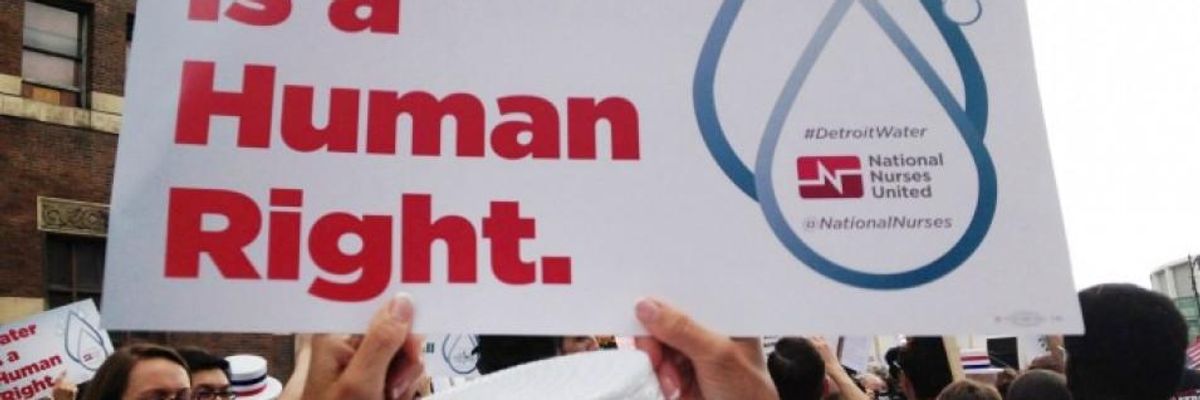
Ensuring access to water as a human right is crucial, especially given the number of localities across the United States grappling with privatized water during a public health emergency. (Photo: uusc4all/flickr/cc)
Wash your hands. The earliest, most frequent directive around coronavirus has been issued by public health experts including the World Health Organization to the Centers for Disease Control and Prevention. But what does that mean for people without access to water?
A pandemic exposes all of our broken structures, from lack of healthcare to a government that responds more to the whims of Wall Street than the common good. There's lots to be fixed. Fortunately, organizers the world over have been highlighting these systemic failures time and time again, paving a path through the crisis that's rooted in justice, not disaster capitalism. Organizers in Detroit are offering one such path.
In 2014, the Detroit Water and Sewage Department began what the ACLU called "the largest residential water shutoff in U.S. history," ending water services to more than 20,000 city residents that it said hadn't paid their bills. There's no excuse for shutting off the water, payment or not, but the ACLU also reported that sloppy billing from the department also left people who had been in payment vulnerable to shutoffs. The United Nations declared that the city Detroit was violating human rights by turning the water off without a care for health needs.
Now, six years later, Detroiters may finally be getting the relief they deserve. Local organizers have been fighting the city's aggressive shutoff program this entire time, but their demands became even more urgent in the face of coronavirus.
The People's Water Board, a coalition of groups in Detroit advocating for the protection, access, and conservation of water, petitioned Michigan Governor Gretchen Whitmer to declare a moratorium on shutoffs, pointing out that the state had particular reason to fear the pandemic thanks to lack of water access.
"It should not take an outbreak to realize that lack of water and sanitation poses a danger to the public health of those impacted by shutoffs, and everyone in our state," they wrote.
Finally, after pressure, Detroit announced a plan to pause shutoffs and restore water to the thousands of city residents who have already been cut off. The Coronavirus Water Restart Plan will reconnect the 3,000 Detroit households without water, or facing a potential shutoff in 10 days, for $25 a month for the duration of the crisis.
And while the plan is an improvement on current circumstances, the People's Water Board has already highlighted a number of potential frailties -- it doesn't address the root cause of water costs in Detroit, or the fact that water is necessary at all times, not just during a pandemic.
"What happens after we get through this outbreak?" Nicole Hill, a volunteer with Michigan Welfare Rights remarked in a People's Water Board statement. "Are you going to go back out and shut these people off? Are you going to give them an incredible hike to their bill?"
Ensuring access to water as a human right is crucial, especially given the number of localities across the United States grappling with privatized water during a public health emergency. The Guardian reports that 90 U.S. cities and states have suspended shutoffs, protecting an estimated 57 million Americans from turning on an empty tap. But just one in five water departments, The Guardian reports, have explicitly said they would turn on water for households that don't currently have it, leaving them vulnerable in the midst of a pandemic.
The problem is widespread. A first-of-its-kind study from Food and Water Watch estimated that 15 million people in the United States experienced a water shutoff in 2016. Unsurprisingly, they also found these shutoffs have a strong inequality angle -- the highest shutoff rates were in lower-income cities with higher poverty and unemployment rates.
As cities and states grapple with the spread of coronavirus, turning the water back on is the absolute least they can do -- organizers have been calling for practical measures, from cash payments to rent and mortgage suspensions to paid leave for everyone. There's no reason to make those shutoffs temporary, either. Water is a human right, not a commodity.
Dear Common Dreams reader, It’s been nearly 30 years since I co-founded Common Dreams with my late wife, Lina Newhouser. We had the radical notion that journalism should serve the public good, not corporate profits. It was clear to us from the outset what it would take to build such a project. No paid advertisements. No corporate sponsors. No millionaire publisher telling us what to think or do. Many people said we wouldn't last a year, but we proved those doubters wrong. Together with a tremendous team of journalists and dedicated staff, we built an independent media outlet free from the constraints of profits and corporate control. Our mission has always been simple: To inform. To inspire. To ignite change for the common good. Building Common Dreams was not easy. Our survival was never guaranteed. When you take on the most powerful forces—Wall Street greed, fossil fuel industry destruction, Big Tech lobbyists, and uber-rich oligarchs who have spent billions upon billions rigging the economy and democracy in their favor—the only bulwark you have is supporters who believe in your work. But here’s the urgent message from me today. It's never been this bad out there. And it's never been this hard to keep us going. At the very moment Common Dreams is most needed, the threats we face are intensifying. We need your support now more than ever. We don't accept corporate advertising and never will. We don't have a paywall because we don't think people should be blocked from critical news based on their ability to pay. Everything we do is funded by the donations of readers like you. When everyone does the little they can afford, we are strong. But if that support retreats or dries up, so do we. Will you donate now to make sure Common Dreams not only survives but thrives? —Craig Brown, Co-founder |
Wash your hands. The earliest, most frequent directive around coronavirus has been issued by public health experts including the World Health Organization to the Centers for Disease Control and Prevention. But what does that mean for people without access to water?
A pandemic exposes all of our broken structures, from lack of healthcare to a government that responds more to the whims of Wall Street than the common good. There's lots to be fixed. Fortunately, organizers the world over have been highlighting these systemic failures time and time again, paving a path through the crisis that's rooted in justice, not disaster capitalism. Organizers in Detroit are offering one such path.
In 2014, the Detroit Water and Sewage Department began what the ACLU called "the largest residential water shutoff in U.S. history," ending water services to more than 20,000 city residents that it said hadn't paid their bills. There's no excuse for shutting off the water, payment or not, but the ACLU also reported that sloppy billing from the department also left people who had been in payment vulnerable to shutoffs. The United Nations declared that the city Detroit was violating human rights by turning the water off without a care for health needs.
Now, six years later, Detroiters may finally be getting the relief they deserve. Local organizers have been fighting the city's aggressive shutoff program this entire time, but their demands became even more urgent in the face of coronavirus.
The People's Water Board, a coalition of groups in Detroit advocating for the protection, access, and conservation of water, petitioned Michigan Governor Gretchen Whitmer to declare a moratorium on shutoffs, pointing out that the state had particular reason to fear the pandemic thanks to lack of water access.
"It should not take an outbreak to realize that lack of water and sanitation poses a danger to the public health of those impacted by shutoffs, and everyone in our state," they wrote.
Finally, after pressure, Detroit announced a plan to pause shutoffs and restore water to the thousands of city residents who have already been cut off. The Coronavirus Water Restart Plan will reconnect the 3,000 Detroit households without water, or facing a potential shutoff in 10 days, for $25 a month for the duration of the crisis.
And while the plan is an improvement on current circumstances, the People's Water Board has already highlighted a number of potential frailties -- it doesn't address the root cause of water costs in Detroit, or the fact that water is necessary at all times, not just during a pandemic.
"What happens after we get through this outbreak?" Nicole Hill, a volunteer with Michigan Welfare Rights remarked in a People's Water Board statement. "Are you going to go back out and shut these people off? Are you going to give them an incredible hike to their bill?"
Ensuring access to water as a human right is crucial, especially given the number of localities across the United States grappling with privatized water during a public health emergency. The Guardian reports that 90 U.S. cities and states have suspended shutoffs, protecting an estimated 57 million Americans from turning on an empty tap. But just one in five water departments, The Guardian reports, have explicitly said they would turn on water for households that don't currently have it, leaving them vulnerable in the midst of a pandemic.
The problem is widespread. A first-of-its-kind study from Food and Water Watch estimated that 15 million people in the United States experienced a water shutoff in 2016. Unsurprisingly, they also found these shutoffs have a strong inequality angle -- the highest shutoff rates were in lower-income cities with higher poverty and unemployment rates.
As cities and states grapple with the spread of coronavirus, turning the water back on is the absolute least they can do -- organizers have been calling for practical measures, from cash payments to rent and mortgage suspensions to paid leave for everyone. There's no reason to make those shutoffs temporary, either. Water is a human right, not a commodity.
Wash your hands. The earliest, most frequent directive around coronavirus has been issued by public health experts including the World Health Organization to the Centers for Disease Control and Prevention. But what does that mean for people without access to water?
A pandemic exposes all of our broken structures, from lack of healthcare to a government that responds more to the whims of Wall Street than the common good. There's lots to be fixed. Fortunately, organizers the world over have been highlighting these systemic failures time and time again, paving a path through the crisis that's rooted in justice, not disaster capitalism. Organizers in Detroit are offering one such path.
In 2014, the Detroit Water and Sewage Department began what the ACLU called "the largest residential water shutoff in U.S. history," ending water services to more than 20,000 city residents that it said hadn't paid their bills. There's no excuse for shutting off the water, payment or not, but the ACLU also reported that sloppy billing from the department also left people who had been in payment vulnerable to shutoffs. The United Nations declared that the city Detroit was violating human rights by turning the water off without a care for health needs.
Now, six years later, Detroiters may finally be getting the relief they deserve. Local organizers have been fighting the city's aggressive shutoff program this entire time, but their demands became even more urgent in the face of coronavirus.
The People's Water Board, a coalition of groups in Detroit advocating for the protection, access, and conservation of water, petitioned Michigan Governor Gretchen Whitmer to declare a moratorium on shutoffs, pointing out that the state had particular reason to fear the pandemic thanks to lack of water access.
"It should not take an outbreak to realize that lack of water and sanitation poses a danger to the public health of those impacted by shutoffs, and everyone in our state," they wrote.
Finally, after pressure, Detroit announced a plan to pause shutoffs and restore water to the thousands of city residents who have already been cut off. The Coronavirus Water Restart Plan will reconnect the 3,000 Detroit households without water, or facing a potential shutoff in 10 days, for $25 a month for the duration of the crisis.
And while the plan is an improvement on current circumstances, the People's Water Board has already highlighted a number of potential frailties -- it doesn't address the root cause of water costs in Detroit, or the fact that water is necessary at all times, not just during a pandemic.
"What happens after we get through this outbreak?" Nicole Hill, a volunteer with Michigan Welfare Rights remarked in a People's Water Board statement. "Are you going to go back out and shut these people off? Are you going to give them an incredible hike to their bill?"
Ensuring access to water as a human right is crucial, especially given the number of localities across the United States grappling with privatized water during a public health emergency. The Guardian reports that 90 U.S. cities and states have suspended shutoffs, protecting an estimated 57 million Americans from turning on an empty tap. But just one in five water departments, The Guardian reports, have explicitly said they would turn on water for households that don't currently have it, leaving them vulnerable in the midst of a pandemic.
The problem is widespread. A first-of-its-kind study from Food and Water Watch estimated that 15 million people in the United States experienced a water shutoff in 2016. Unsurprisingly, they also found these shutoffs have a strong inequality angle -- the highest shutoff rates were in lower-income cities with higher poverty and unemployment rates.
As cities and states grapple with the spread of coronavirus, turning the water back on is the absolute least they can do -- organizers have been calling for practical measures, from cash payments to rent and mortgage suspensions to paid leave for everyone. There's no reason to make those shutoffs temporary, either. Water is a human right, not a commodity.