SUBSCRIBE TO OUR FREE NEWSLETTER
Daily news & progressive opinion—funded by the people, not the corporations—delivered straight to your inbox.
5
#000000
#FFFFFF
To donate by check, phone, or other method, see our More Ways to Give page.
Daily news & progressive opinion—funded by the people, not the corporations—delivered straight to your inbox.
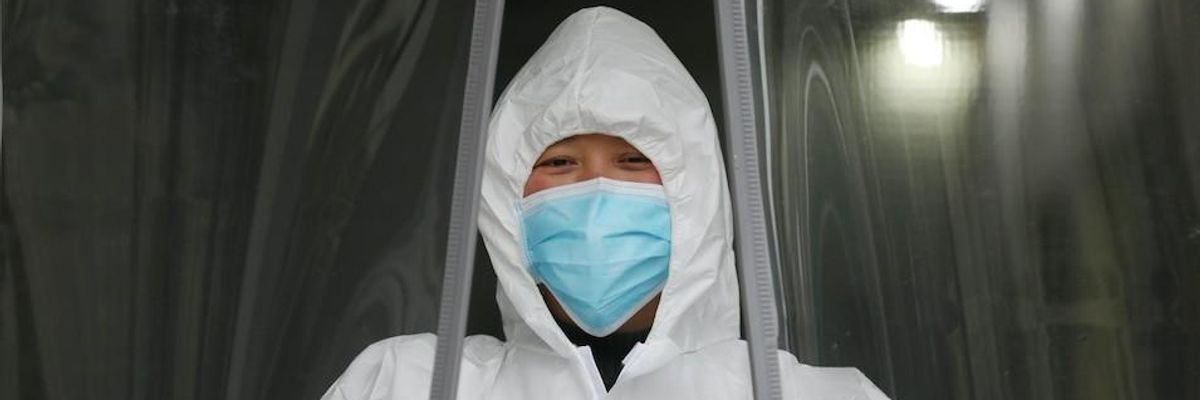
A medical staffmember walks out of an aisle in a hospital in Wuhan in central China's Hubei province Monday, Jan. 27, 2020. (Photo: Feature China/Barcroft Media/Getty Images)
There is an old saying that politics stops at the water's edge. Never really true, it is even less appropriate today. Domestic politics and international relations interact with each other, often in subtle or unseen ways to the detriment of us all.
President Trump's insistence on calling the virus the China virus is not only misleading and a source and intensifier of ethnic conflict. It is also an accelerant of the pathogen.
Covid- 19's damage is likely to be reduced only if the political economic and cultural response becomes as nimble as the virus itself.
On Tuesday, Iranian Foreign Minister Javad Zarif called the United States' refusal to lift sanctions "medical terrorism," as CODEPINK called on European countries to disregard the sanctions. Medical terrorism is an appropriate label for hostile acts intended to so injure their victims that they will seek overthrow of their own government.
As in the case of the refusal to extend paid sick leave and universal healthcare, the continuation and intensification of sanctions against Iran inflicts harm on innocent civilians and potentially on an entire region.
Mark Weisbrot , co-director of the Center for Economic and Policy Research warned that continued sanctions against Iran could have devastating consequences for other nations in the region as they work to stop the spread of the virus.
"There can... be no question that the sanctions have affected Iran's ability to contain the outbreak," said Weisbrot, "leading in turn to more infections, and possibly to the virus' spread beyond Iran's borders."
"If the U.S. government is going to assist other countries, let alone provide some kind of leadership role during this global crisis, the first thing it should do is 'cause no harm,'" Weisbrot added. "Economic sanctions, as the U.S. is applying against Iran, Cuba, Venezuela, and other countries, cause immense harm."
Not only is there the strong possibility of leakage of the virus beyond immediate cites of outbreak, government and health officials lose significant information about the virus' case fatality rate and transmissibility
Covid- 19 is a dress rehearsal for similarly dangerous problems in the immediate future. Thus far the US is failing. How about beginning a new chapter. There is an acute lack of test kits. As for lack of adequate testing, that is a major issue because, as the Times newsletter "The Interpreter" explained Thursday, China and South Korea have shown that "testing early, often, and widely makes all the difference."
Some have claimed that no numbers from China can be trusted. Skepticism is appropriate given the ways in which the Chinese authorities withheld information in the early stages of this crisis. The US, however, is in no position to complain about withholding politically embarrassing statistical information. China scholars Otto Kolbl and Maximilian Mayer maintain plausibly that with subsequent interactions among governments and the WHO greater transparency has been achieved. I would add that China doubtless recognizes that accurate numbers help everyone surmount this crisis.
Here is where China could help even more directly. Kolbl and Mayer report that China has the capacity to test 200,000 samples per day. They might be willing to test our samples until we develop sufficient capacity. India also has a modern pharmaceutical industry and the capacity to make these kits. Since most commercial sir traffic is grounded, transportation capacity is not an issue.
At this moment such suggestions are the stuff of fantasies. One major reason, however, is the faith in America as a beacon on a hill and the long standing scapegoating of racial minorities especially in periods of crisis. These not only feed physical attacks on minorities but also constrain and corrupt our foreign policy. I look forward to a world in which peace, climate, and social justice advocates organize across borders and demand transparency and responsiveness of governments in the face of climate chaos and global pandemics.
Dear Common Dreams reader, It’s been nearly 30 years since I co-founded Common Dreams with my late wife, Lina Newhouser. We had the radical notion that journalism should serve the public good, not corporate profits. It was clear to us from the outset what it would take to build such a project. No paid advertisements. No corporate sponsors. No millionaire publisher telling us what to think or do. Many people said we wouldn't last a year, but we proved those doubters wrong. Together with a tremendous team of journalists and dedicated staff, we built an independent media outlet free from the constraints of profits and corporate control. Our mission has always been simple: To inform. To inspire. To ignite change for the common good. Building Common Dreams was not easy. Our survival was never guaranteed. When you take on the most powerful forces—Wall Street greed, fossil fuel industry destruction, Big Tech lobbyists, and uber-rich oligarchs who have spent billions upon billions rigging the economy and democracy in their favor—the only bulwark you have is supporters who believe in your work. But here’s the urgent message from me today. It's never been this bad out there. And it's never been this hard to keep us going. At the very moment Common Dreams is most needed, the threats we face are intensifying. We need your support now more than ever. We don't accept corporate advertising and never will. We don't have a paywall because we don't think people should be blocked from critical news based on their ability to pay. Everything we do is funded by the donations of readers like you. When everyone does the little they can afford, we are strong. But if that support retreats or dries up, so do we. Will you donate now to make sure Common Dreams not only survives but thrives? —Craig Brown, Co-founder |
There is an old saying that politics stops at the water's edge. Never really true, it is even less appropriate today. Domestic politics and international relations interact with each other, often in subtle or unseen ways to the detriment of us all.
President Trump's insistence on calling the virus the China virus is not only misleading and a source and intensifier of ethnic conflict. It is also an accelerant of the pathogen.
Covid- 19's damage is likely to be reduced only if the political economic and cultural response becomes as nimble as the virus itself.
On Tuesday, Iranian Foreign Minister Javad Zarif called the United States' refusal to lift sanctions "medical terrorism," as CODEPINK called on European countries to disregard the sanctions. Medical terrorism is an appropriate label for hostile acts intended to so injure their victims that they will seek overthrow of their own government.
As in the case of the refusal to extend paid sick leave and universal healthcare, the continuation and intensification of sanctions against Iran inflicts harm on innocent civilians and potentially on an entire region.
Mark Weisbrot , co-director of the Center for Economic and Policy Research warned that continued sanctions against Iran could have devastating consequences for other nations in the region as they work to stop the spread of the virus.
"There can... be no question that the sanctions have affected Iran's ability to contain the outbreak," said Weisbrot, "leading in turn to more infections, and possibly to the virus' spread beyond Iran's borders."
"If the U.S. government is going to assist other countries, let alone provide some kind of leadership role during this global crisis, the first thing it should do is 'cause no harm,'" Weisbrot added. "Economic sanctions, as the U.S. is applying against Iran, Cuba, Venezuela, and other countries, cause immense harm."
Not only is there the strong possibility of leakage of the virus beyond immediate cites of outbreak, government and health officials lose significant information about the virus' case fatality rate and transmissibility
Covid- 19 is a dress rehearsal for similarly dangerous problems in the immediate future. Thus far the US is failing. How about beginning a new chapter. There is an acute lack of test kits. As for lack of adequate testing, that is a major issue because, as the Times newsletter "The Interpreter" explained Thursday, China and South Korea have shown that "testing early, often, and widely makes all the difference."
Some have claimed that no numbers from China can be trusted. Skepticism is appropriate given the ways in which the Chinese authorities withheld information in the early stages of this crisis. The US, however, is in no position to complain about withholding politically embarrassing statistical information. China scholars Otto Kolbl and Maximilian Mayer maintain plausibly that with subsequent interactions among governments and the WHO greater transparency has been achieved. I would add that China doubtless recognizes that accurate numbers help everyone surmount this crisis.
Here is where China could help even more directly. Kolbl and Mayer report that China has the capacity to test 200,000 samples per day. They might be willing to test our samples until we develop sufficient capacity. India also has a modern pharmaceutical industry and the capacity to make these kits. Since most commercial sir traffic is grounded, transportation capacity is not an issue.
At this moment such suggestions are the stuff of fantasies. One major reason, however, is the faith in America as a beacon on a hill and the long standing scapegoating of racial minorities especially in periods of crisis. These not only feed physical attacks on minorities but also constrain and corrupt our foreign policy. I look forward to a world in which peace, climate, and social justice advocates organize across borders and demand transparency and responsiveness of governments in the face of climate chaos and global pandemics.
There is an old saying that politics stops at the water's edge. Never really true, it is even less appropriate today. Domestic politics and international relations interact with each other, often in subtle or unseen ways to the detriment of us all.
President Trump's insistence on calling the virus the China virus is not only misleading and a source and intensifier of ethnic conflict. It is also an accelerant of the pathogen.
Covid- 19's damage is likely to be reduced only if the political economic and cultural response becomes as nimble as the virus itself.
On Tuesday, Iranian Foreign Minister Javad Zarif called the United States' refusal to lift sanctions "medical terrorism," as CODEPINK called on European countries to disregard the sanctions. Medical terrorism is an appropriate label for hostile acts intended to so injure their victims that they will seek overthrow of their own government.
As in the case of the refusal to extend paid sick leave and universal healthcare, the continuation and intensification of sanctions against Iran inflicts harm on innocent civilians and potentially on an entire region.
Mark Weisbrot , co-director of the Center for Economic and Policy Research warned that continued sanctions against Iran could have devastating consequences for other nations in the region as they work to stop the spread of the virus.
"There can... be no question that the sanctions have affected Iran's ability to contain the outbreak," said Weisbrot, "leading in turn to more infections, and possibly to the virus' spread beyond Iran's borders."
"If the U.S. government is going to assist other countries, let alone provide some kind of leadership role during this global crisis, the first thing it should do is 'cause no harm,'" Weisbrot added. "Economic sanctions, as the U.S. is applying against Iran, Cuba, Venezuela, and other countries, cause immense harm."
Not only is there the strong possibility of leakage of the virus beyond immediate cites of outbreak, government and health officials lose significant information about the virus' case fatality rate and transmissibility
Covid- 19 is a dress rehearsal for similarly dangerous problems in the immediate future. Thus far the US is failing. How about beginning a new chapter. There is an acute lack of test kits. As for lack of adequate testing, that is a major issue because, as the Times newsletter "The Interpreter" explained Thursday, China and South Korea have shown that "testing early, often, and widely makes all the difference."
Some have claimed that no numbers from China can be trusted. Skepticism is appropriate given the ways in which the Chinese authorities withheld information in the early stages of this crisis. The US, however, is in no position to complain about withholding politically embarrassing statistical information. China scholars Otto Kolbl and Maximilian Mayer maintain plausibly that with subsequent interactions among governments and the WHO greater transparency has been achieved. I would add that China doubtless recognizes that accurate numbers help everyone surmount this crisis.
Here is where China could help even more directly. Kolbl and Mayer report that China has the capacity to test 200,000 samples per day. They might be willing to test our samples until we develop sufficient capacity. India also has a modern pharmaceutical industry and the capacity to make these kits. Since most commercial sir traffic is grounded, transportation capacity is not an issue.
At this moment such suggestions are the stuff of fantasies. One major reason, however, is the faith in America as a beacon on a hill and the long standing scapegoating of racial minorities especially in periods of crisis. These not only feed physical attacks on minorities but also constrain and corrupt our foreign policy. I look forward to a world in which peace, climate, and social justice advocates organize across borders and demand transparency and responsiveness of governments in the face of climate chaos and global pandemics.