SUBSCRIBE TO OUR FREE NEWSLETTER
Daily news & progressive opinion—funded by the people, not the corporations—delivered straight to your inbox.
5
#000000
#FFFFFF
To donate by check, phone, or other method, see our More Ways to Give page.
Daily news & progressive opinion—funded by the people, not the corporations—delivered straight to your inbox.
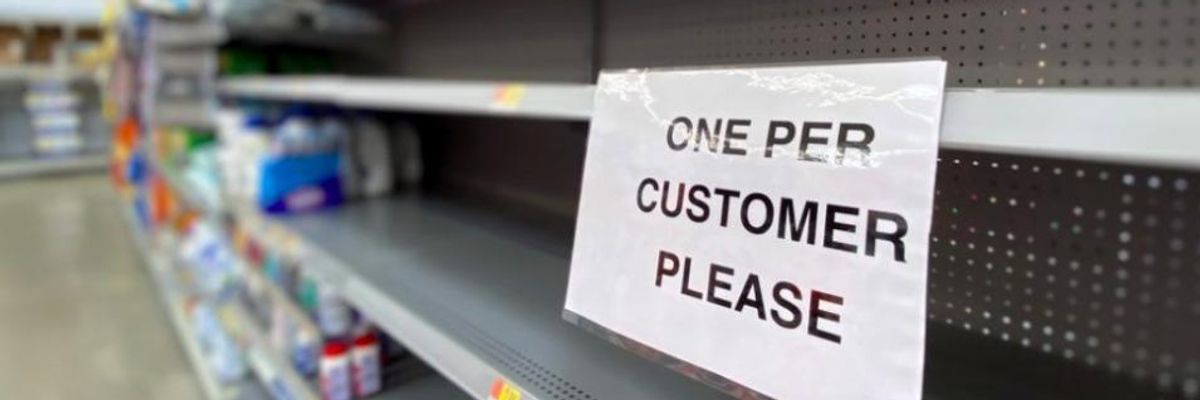
The coronavirus pandemic has led to shortages of household essentials in many stores. (Photo: Shutterstock)
Many years ago, bestselling author Michael Pollan explained there's a trade-off between efficiency and resilience.
For example, your grocery store probably did not have a warehouse full of toilet paper backstock sitting around somewhere when their customers bought out their entire supply. It would be expensive and inefficient to keep a huge supply of toilet paper on hand in the unlikely chance it would ever be needed.
It would be inefficient -- but if they'd done it, they might not have an empty toilet paper aisle right now.
I went to business school 20 years ago. We learned about the efficiency of "just-in-time" supply management.
The goal was to cut costs by ordering inventory "just in time." That way you don't pay for all the extra, costly warehouses to store weeks or months of supplies. The example we were given was that if a certain large corporation's supply chain shut down, they'd only have enough materials on hand to keep up production for four days.
Efficient? Yes. Resilient? No.
In business school, most classes were focused on one main goal: how to maximize profit. I took a single elective that had one unit on ethics, narrowly interpreted as following the law and doing things like recalling tainted products so your customers don't die.
Right now, efficiency could be deadly.
Hospitals have enough beds, medical personnel, and equipment to handle a normal volume of patients, but nothing like this. They'd been cutting them back for years in the name of profit and efficiency.
Now there's talk of converting empty college dormitories into hospitals, recruiting med students and retired physicians to help, and 3-D printing equipment.
My business school taught social Darwinism: survival of the fittest. The beauty of capitalism, we were taught, is that everyone competes for business and the competition drives innovation, while the least efficient companies go out of business.
It was an outlook that Ayn Rand would endorse: the most generous way to behave is to be selfish, because by doing your part to compete, you are doing your part to drive innovation and efficiency for everyone.
This crisis is pulling back the curtain on unfettered laissez-faire capitalism, showing that we are actually interconnected. And it's far more serious than toilet paper.
A stark shortage of personal protective equipment has left health care workers without enough to go around. In my town, hospitals are organizing to receive donations from anyone who has a box of face masks, hand sanitizer, and gloves at home.
In short, they're relying on community resilience where for-profit efficiency failed.
In normal times, we justify a form of capitalism in which competition means accepting inequality and suffering in the name of improving efficiency for all. We accept that some face poverty, hunger, and homelessness, and we're okay with it because of a myth that it's natural, or better for everyone (or else caused by the moral failings of those who suffer).
Continuing to believe that myth now will cause millions of deaths worldwide. Instead, our only hope is pulling together to help others through shared sacrifice and collective action.
Resilience isn't always profitable. But we need it now more than ever.
Dear Common Dreams reader, It’s been nearly 30 years since I co-founded Common Dreams with my late wife, Lina Newhouser. We had the radical notion that journalism should serve the public good, not corporate profits. It was clear to us from the outset what it would take to build such a project. No paid advertisements. No corporate sponsors. No millionaire publisher telling us what to think or do. Many people said we wouldn't last a year, but we proved those doubters wrong. Together with a tremendous team of journalists and dedicated staff, we built an independent media outlet free from the constraints of profits and corporate control. Our mission has always been simple: To inform. To inspire. To ignite change for the common good. Building Common Dreams was not easy. Our survival was never guaranteed. When you take on the most powerful forces—Wall Street greed, fossil fuel industry destruction, Big Tech lobbyists, and uber-rich oligarchs who have spent billions upon billions rigging the economy and democracy in their favor—the only bulwark you have is supporters who believe in your work. But here’s the urgent message from me today. It's never been this bad out there. And it's never been this hard to keep us going. At the very moment Common Dreams is most needed, the threats we face are intensifying. We need your support now more than ever. We don't accept corporate advertising and never will. We don't have a paywall because we don't think people should be blocked from critical news based on their ability to pay. Everything we do is funded by the donations of readers like you. When everyone does the little they can afford, we are strong. But if that support retreats or dries up, so do we. Will you donate now to make sure Common Dreams not only survives but thrives? —Craig Brown, Co-founder |
Many years ago, bestselling author Michael Pollan explained there's a trade-off between efficiency and resilience.
For example, your grocery store probably did not have a warehouse full of toilet paper backstock sitting around somewhere when their customers bought out their entire supply. It would be expensive and inefficient to keep a huge supply of toilet paper on hand in the unlikely chance it would ever be needed.
It would be inefficient -- but if they'd done it, they might not have an empty toilet paper aisle right now.
I went to business school 20 years ago. We learned about the efficiency of "just-in-time" supply management.
The goal was to cut costs by ordering inventory "just in time." That way you don't pay for all the extra, costly warehouses to store weeks or months of supplies. The example we were given was that if a certain large corporation's supply chain shut down, they'd only have enough materials on hand to keep up production for four days.
Efficient? Yes. Resilient? No.
In business school, most classes were focused on one main goal: how to maximize profit. I took a single elective that had one unit on ethics, narrowly interpreted as following the law and doing things like recalling tainted products so your customers don't die.
Right now, efficiency could be deadly.
Hospitals have enough beds, medical personnel, and equipment to handle a normal volume of patients, but nothing like this. They'd been cutting them back for years in the name of profit and efficiency.
Now there's talk of converting empty college dormitories into hospitals, recruiting med students and retired physicians to help, and 3-D printing equipment.
My business school taught social Darwinism: survival of the fittest. The beauty of capitalism, we were taught, is that everyone competes for business and the competition drives innovation, while the least efficient companies go out of business.
It was an outlook that Ayn Rand would endorse: the most generous way to behave is to be selfish, because by doing your part to compete, you are doing your part to drive innovation and efficiency for everyone.
This crisis is pulling back the curtain on unfettered laissez-faire capitalism, showing that we are actually interconnected. And it's far more serious than toilet paper.
A stark shortage of personal protective equipment has left health care workers without enough to go around. In my town, hospitals are organizing to receive donations from anyone who has a box of face masks, hand sanitizer, and gloves at home.
In short, they're relying on community resilience where for-profit efficiency failed.
In normal times, we justify a form of capitalism in which competition means accepting inequality and suffering in the name of improving efficiency for all. We accept that some face poverty, hunger, and homelessness, and we're okay with it because of a myth that it's natural, or better for everyone (or else caused by the moral failings of those who suffer).
Continuing to believe that myth now will cause millions of deaths worldwide. Instead, our only hope is pulling together to help others through shared sacrifice and collective action.
Resilience isn't always profitable. But we need it now more than ever.
Many years ago, bestselling author Michael Pollan explained there's a trade-off between efficiency and resilience.
For example, your grocery store probably did not have a warehouse full of toilet paper backstock sitting around somewhere when their customers bought out their entire supply. It would be expensive and inefficient to keep a huge supply of toilet paper on hand in the unlikely chance it would ever be needed.
It would be inefficient -- but if they'd done it, they might not have an empty toilet paper aisle right now.
I went to business school 20 years ago. We learned about the efficiency of "just-in-time" supply management.
The goal was to cut costs by ordering inventory "just in time." That way you don't pay for all the extra, costly warehouses to store weeks or months of supplies. The example we were given was that if a certain large corporation's supply chain shut down, they'd only have enough materials on hand to keep up production for four days.
Efficient? Yes. Resilient? No.
In business school, most classes were focused on one main goal: how to maximize profit. I took a single elective that had one unit on ethics, narrowly interpreted as following the law and doing things like recalling tainted products so your customers don't die.
Right now, efficiency could be deadly.
Hospitals have enough beds, medical personnel, and equipment to handle a normal volume of patients, but nothing like this. They'd been cutting them back for years in the name of profit and efficiency.
Now there's talk of converting empty college dormitories into hospitals, recruiting med students and retired physicians to help, and 3-D printing equipment.
My business school taught social Darwinism: survival of the fittest. The beauty of capitalism, we were taught, is that everyone competes for business and the competition drives innovation, while the least efficient companies go out of business.
It was an outlook that Ayn Rand would endorse: the most generous way to behave is to be selfish, because by doing your part to compete, you are doing your part to drive innovation and efficiency for everyone.
This crisis is pulling back the curtain on unfettered laissez-faire capitalism, showing that we are actually interconnected. And it's far more serious than toilet paper.
A stark shortage of personal protective equipment has left health care workers without enough to go around. In my town, hospitals are organizing to receive donations from anyone who has a box of face masks, hand sanitizer, and gloves at home.
In short, they're relying on community resilience where for-profit efficiency failed.
In normal times, we justify a form of capitalism in which competition means accepting inequality and suffering in the name of improving efficiency for all. We accept that some face poverty, hunger, and homelessness, and we're okay with it because of a myth that it's natural, or better for everyone (or else caused by the moral failings of those who suffer).
Continuing to believe that myth now will cause millions of deaths worldwide. Instead, our only hope is pulling together to help others through shared sacrifice and collective action.
Resilience isn't always profitable. But we need it now more than ever.