SUBSCRIBE TO OUR FREE NEWSLETTER
Daily news & progressive opinion—funded by the people, not the corporations—delivered straight to your inbox.
5
#000000
#FFFFFF
To donate by check, phone, or other method, see our More Ways to Give page.
Daily news & progressive opinion—funded by the people, not the corporations—delivered straight to your inbox.
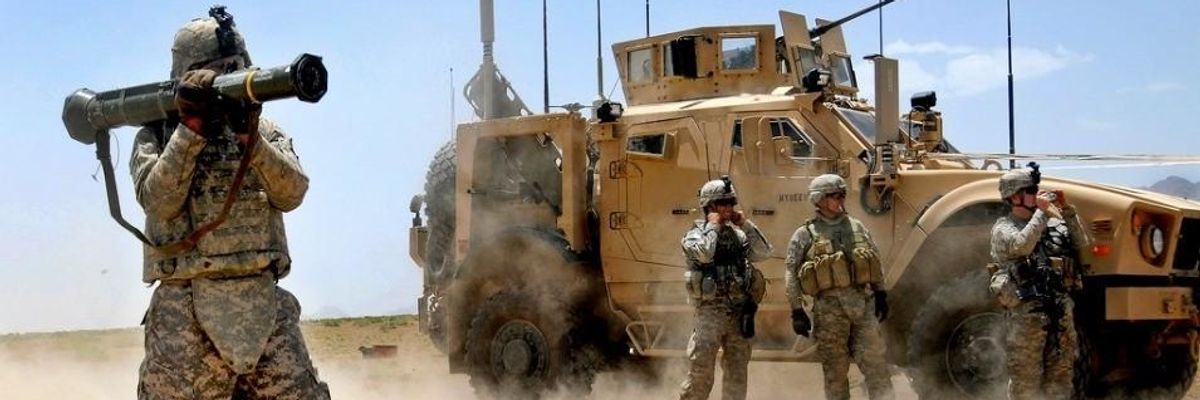
A U.S. soldier fires an anti-tank rocket during a live-fire exercise in Zabul province, Afghanistan, in July 2010. (Photo: U.S. Army/flickr/cc)
Not least among the victims claimed by the coronavirus pandemic was a poetry recital that was to have occurred in March at a theater in downtown Boston.
I had been invited to read aloud a poem, and I chose "On a Soldier Fallen in the Philippines," written in 1899 by William Vaughn Moody (1869-1910). You are unlikely to have heard of the poet or his composition. Great literature, it is not. Yet its message is memorable.
The subject of Moody's poem is death, a matter today much on all our minds. It recounts the coming home of a nameless American soldier, killed in the conflict commonly but misleadingly known as the Philippine Insurrection.
In 1898, U.S. troops landed in Manila to oust the Spanish overlords who had ruled the Philippines for more than three centuries. They accomplished this mission with the dispatch that a later generation of U.S. forces demonstrated in ousting regimes in Kabul and Baghdad. Yet as was the case with the Afghanistan and Iraq wars of our own day, real victory proved elusive.
Back in Washington, President McKinley decided that having liberated the Philippines, the United States would now keep them. The entire archipelago of several thousand islands was to become an American colony.
McKinley's decision met with immediate disfavor among Filipinos. To oust the foreign occupiers, they mounted an armed resistance. A vicious conflict ensued, one that ultimately took the lives of 4,200 American soldiers and at least 200,000 Filipinos. In the end, however, the United States prevailed.
Denying Filipino independence was the cause for which the subject of Moody's poem died.
Long since forgotten by Americans, the war to pacify the Philippines generated in its day great controversy. Moody's poem is an artifact of that controversy. In it, he chastises those who perform the rituals of honoring the fallen while refusing to acknowledge the dubious nature of the cause for which they fought. "Toll! Let the great bells toll," he writes,
Till the clashing air is dim,
Did we wrong this parted soul?
We will make it up to him.
Toll! Let him never guess
What work we sent him to.
Laurel, laurel, yes.
He did what we bade him do.
Praise, and never a whispered hint
but the fight he fought was good;
In actuality, the fight was anything but good. It was ill-advised and resulted in great evil. "On a Soldier Fallen in the Philippines" expresses a demand for reckoning with that evil. Americans of Moody's generation rejected that demand, just as Americans today balk at reckoning with the consequences of our own ill-advised wars.
Yet the imperative persists. "O banners, banners here," Moody concludes,
That he doubt not nor misgive!
That he heed not from the tomb
The evil days draw near
When the nation robed in gloom
With its faithless past shall strive.
Let him never dream that his bullet's scream
went wide of its island mark,
Home to the heart of his darling land
where she stumbled and sinned in the dark.
At the end of the 19th century, the United States stumbled and sinned in the dark by waging a misbegotten campaign to advance nakedly imperial ambitions. At the beginning of the 21st century, new wars became the basis of comparable sin. The war of Moody's time and the wars of our own have almost nothing in common except this: In each instance, through their passivity disguised as patriotism, the American people became tacitly complicit in wrongdoing committed in their name.
It is no doubt too glib by half to claim that today, besieged by a virus, we are reaping the consequences caused by our refusal to reckon with past sins. Yet it is not too glib to argue that the need for such a reckoning remains. Have we wronged the departed souls of those who died -- indeed, are still dying -- in Afghanistan and Iraq? The question cries out for an answer. In our cacophonous age, it just might be that we will find that answer in poetry.
Dear Common Dreams reader, It’s been nearly 30 years since I co-founded Common Dreams with my late wife, Lina Newhouser. We had the radical notion that journalism should serve the public good, not corporate profits. It was clear to us from the outset what it would take to build such a project. No paid advertisements. No corporate sponsors. No millionaire publisher telling us what to think or do. Many people said we wouldn't last a year, but we proved those doubters wrong. Together with a tremendous team of journalists and dedicated staff, we built an independent media outlet free from the constraints of profits and corporate control. Our mission has always been simple: To inform. To inspire. To ignite change for the common good. Building Common Dreams was not easy. Our survival was never guaranteed. When you take on the most powerful forces—Wall Street greed, fossil fuel industry destruction, Big Tech lobbyists, and uber-rich oligarchs who have spent billions upon billions rigging the economy and democracy in their favor—the only bulwark you have is supporters who believe in your work. But here’s the urgent message from me today. It's never been this bad out there. And it's never been this hard to keep us going. At the very moment Common Dreams is most needed, the threats we face are intensifying. We need your support now more than ever. We don't accept corporate advertising and never will. We don't have a paywall because we don't think people should be blocked from critical news based on their ability to pay. Everything we do is funded by the donations of readers like you. When everyone does the little they can afford, we are strong. But if that support retreats or dries up, so do we. Will you donate now to make sure Common Dreams not only survives but thrives? —Craig Brown, Co-founder |
Not least among the victims claimed by the coronavirus pandemic was a poetry recital that was to have occurred in March at a theater in downtown Boston.
I had been invited to read aloud a poem, and I chose "On a Soldier Fallen in the Philippines," written in 1899 by William Vaughn Moody (1869-1910). You are unlikely to have heard of the poet or his composition. Great literature, it is not. Yet its message is memorable.
The subject of Moody's poem is death, a matter today much on all our minds. It recounts the coming home of a nameless American soldier, killed in the conflict commonly but misleadingly known as the Philippine Insurrection.
In 1898, U.S. troops landed in Manila to oust the Spanish overlords who had ruled the Philippines for more than three centuries. They accomplished this mission with the dispatch that a later generation of U.S. forces demonstrated in ousting regimes in Kabul and Baghdad. Yet as was the case with the Afghanistan and Iraq wars of our own day, real victory proved elusive.
Back in Washington, President McKinley decided that having liberated the Philippines, the United States would now keep them. The entire archipelago of several thousand islands was to become an American colony.
McKinley's decision met with immediate disfavor among Filipinos. To oust the foreign occupiers, they mounted an armed resistance. A vicious conflict ensued, one that ultimately took the lives of 4,200 American soldiers and at least 200,000 Filipinos. In the end, however, the United States prevailed.
Denying Filipino independence was the cause for which the subject of Moody's poem died.
Long since forgotten by Americans, the war to pacify the Philippines generated in its day great controversy. Moody's poem is an artifact of that controversy. In it, he chastises those who perform the rituals of honoring the fallen while refusing to acknowledge the dubious nature of the cause for which they fought. "Toll! Let the great bells toll," he writes,
Till the clashing air is dim,
Did we wrong this parted soul?
We will make it up to him.
Toll! Let him never guess
What work we sent him to.
Laurel, laurel, yes.
He did what we bade him do.
Praise, and never a whispered hint
but the fight he fought was good;
In actuality, the fight was anything but good. It was ill-advised and resulted in great evil. "On a Soldier Fallen in the Philippines" expresses a demand for reckoning with that evil. Americans of Moody's generation rejected that demand, just as Americans today balk at reckoning with the consequences of our own ill-advised wars.
Yet the imperative persists. "O banners, banners here," Moody concludes,
That he doubt not nor misgive!
That he heed not from the tomb
The evil days draw near
When the nation robed in gloom
With its faithless past shall strive.
Let him never dream that his bullet's scream
went wide of its island mark,
Home to the heart of his darling land
where she stumbled and sinned in the dark.
At the end of the 19th century, the United States stumbled and sinned in the dark by waging a misbegotten campaign to advance nakedly imperial ambitions. At the beginning of the 21st century, new wars became the basis of comparable sin. The war of Moody's time and the wars of our own have almost nothing in common except this: In each instance, through their passivity disguised as patriotism, the American people became tacitly complicit in wrongdoing committed in their name.
It is no doubt too glib by half to claim that today, besieged by a virus, we are reaping the consequences caused by our refusal to reckon with past sins. Yet it is not too glib to argue that the need for such a reckoning remains. Have we wronged the departed souls of those who died -- indeed, are still dying -- in Afghanistan and Iraq? The question cries out for an answer. In our cacophonous age, it just might be that we will find that answer in poetry.
Not least among the victims claimed by the coronavirus pandemic was a poetry recital that was to have occurred in March at a theater in downtown Boston.
I had been invited to read aloud a poem, and I chose "On a Soldier Fallen in the Philippines," written in 1899 by William Vaughn Moody (1869-1910). You are unlikely to have heard of the poet or his composition. Great literature, it is not. Yet its message is memorable.
The subject of Moody's poem is death, a matter today much on all our minds. It recounts the coming home of a nameless American soldier, killed in the conflict commonly but misleadingly known as the Philippine Insurrection.
In 1898, U.S. troops landed in Manila to oust the Spanish overlords who had ruled the Philippines for more than three centuries. They accomplished this mission with the dispatch that a later generation of U.S. forces demonstrated in ousting regimes in Kabul and Baghdad. Yet as was the case with the Afghanistan and Iraq wars of our own day, real victory proved elusive.
Back in Washington, President McKinley decided that having liberated the Philippines, the United States would now keep them. The entire archipelago of several thousand islands was to become an American colony.
McKinley's decision met with immediate disfavor among Filipinos. To oust the foreign occupiers, they mounted an armed resistance. A vicious conflict ensued, one that ultimately took the lives of 4,200 American soldiers and at least 200,000 Filipinos. In the end, however, the United States prevailed.
Denying Filipino independence was the cause for which the subject of Moody's poem died.
Long since forgotten by Americans, the war to pacify the Philippines generated in its day great controversy. Moody's poem is an artifact of that controversy. In it, he chastises those who perform the rituals of honoring the fallen while refusing to acknowledge the dubious nature of the cause for which they fought. "Toll! Let the great bells toll," he writes,
Till the clashing air is dim,
Did we wrong this parted soul?
We will make it up to him.
Toll! Let him never guess
What work we sent him to.
Laurel, laurel, yes.
He did what we bade him do.
Praise, and never a whispered hint
but the fight he fought was good;
In actuality, the fight was anything but good. It was ill-advised and resulted in great evil. "On a Soldier Fallen in the Philippines" expresses a demand for reckoning with that evil. Americans of Moody's generation rejected that demand, just as Americans today balk at reckoning with the consequences of our own ill-advised wars.
Yet the imperative persists. "O banners, banners here," Moody concludes,
That he doubt not nor misgive!
That he heed not from the tomb
The evil days draw near
When the nation robed in gloom
With its faithless past shall strive.
Let him never dream that his bullet's scream
went wide of its island mark,
Home to the heart of his darling land
where she stumbled and sinned in the dark.
At the end of the 19th century, the United States stumbled and sinned in the dark by waging a misbegotten campaign to advance nakedly imperial ambitions. At the beginning of the 21st century, new wars became the basis of comparable sin. The war of Moody's time and the wars of our own have almost nothing in common except this: In each instance, through their passivity disguised as patriotism, the American people became tacitly complicit in wrongdoing committed in their name.
It is no doubt too glib by half to claim that today, besieged by a virus, we are reaping the consequences caused by our refusal to reckon with past sins. Yet it is not too glib to argue that the need for such a reckoning remains. Have we wronged the departed souls of those who died -- indeed, are still dying -- in Afghanistan and Iraq? The question cries out for an answer. In our cacophonous age, it just might be that we will find that answer in poetry.