SUBSCRIBE TO OUR FREE NEWSLETTER
Daily news & progressive opinion—funded by the people, not the corporations—delivered straight to your inbox.
5
#000000
#FFFFFF
To donate by check, phone, or other method, see our More Ways to Give page.


Daily news & progressive opinion—funded by the people, not the corporations—delivered straight to your inbox.

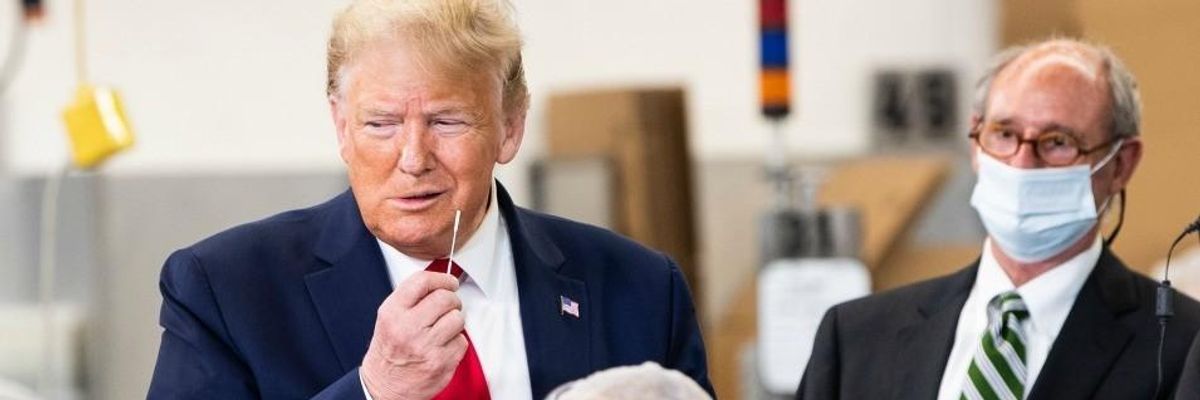
President Donald Trump pretends to take a Covid-19 test while holding a swab during his visit of the Puritan Medical Products facility in Guilford, Maine on June 5, 2020. The facility said after Trump's visit it would have to discard tests that were made during the president's visit because he did not wear a face mask. (Photo: Nicholas Kamm/AFP via Getty Images)
As the vast majority of companies rush to reopen and people rush back to public life, they're falling into the trap of "getting back to normal." They're not realizing we're heading into a period of waves of restrictions once again, due to many states reopening too soon.
Indeed, some of the states to open early onward have already reimposed some restrictions. This shows that as I predicted in a newspaper editorial way back at the start of the pandemic on March 10, 2020, we will greatly underestimate the pandemic and need to prepare to face rolling waves of restrictions and shutdowns until a vaccine. To avoid the trap of normalcy, we need to understand the parallels between what's going on now, and what happened at the start of the pandemic.
Very many prominent business and political leaders downplayed the pandemic in its early stages. As a result, most business owners and plenty of ordinary citizens initially perceived the pandemic as little worse than the common cold.
This initial impression anchored their opinions toward minimizing the threat posed by COVID-19. In neuroscience and behavioral economics research, we call such initial impressions an "anchor." Our minds tend to fall into a dangerous judgment error called the anchoring bias or focalism, where we give too much credit to the initial piece of information we received on a topic and perceive the rest of the information through the filter of that initial impression.
Yes, first impressions really matter, too much for our own good! That means as new information became available about the danger of COVID-19, people stuck to their initial impressions. They feel very reluctant to change their minds based on new evidence. Nowhere is this more evidence than in guidance on wearing masks.
Initially, the CDC indicated that there's no need to wear masks to protect yourself or others from COVID-19. Over time, as research evidence accumulated on the benefits of wearing masks, the CDC changed its guidelines, highlighting the importance of masking in public.
That's how science works: changing evidence results in changing guidelines. But that's not how our brains work, at least for those without training in critical evaluation of evidence.
The result? Many disregarded the new guidance, especially if those they consider authority figures did not reinforce it. Due to a mental blindspot called emotional contagion, we tend to adopt the perspectives of those we see as authority figures. With their guidance, we can overcome initial anchoring; without it, we will stick to our initial perspective.
Just as dangerous is another dangerous judgment error that cognitive neuroscientists call the normalcy bias. This mental blindspot refers to the fact that our gut reactions drive us to feel that the future, at least in the short and medium term of the next couple of years, will function in roughly the same way as the past: normally. As a result, we tend to vastly underestimate both the possibility and impact of a disaster striking us. Moreover, we will rush to get back to normal even when we should be preparing for the aftershocks or continuation of the disaster.
The normalcy bias, anchoring bias, and emotional contagion are three of over one hundred mental blindspots that cognitive neuroscientists and behavioral economists like myself call cognitive biases. Fortunately, recent research by myself and other scholars has shown us how we can effectively defeat such dangerous judgment errors.
First you need to understand and evaluate where you yourself and your organization have fallen into each of these biases, and evaluate the damage caused by doing so. Then, you need to consider realistically the long-term outcomes and plan for a realistic scenario that addresses the likelihood of major disruptions.
Prepare to deal with waves of restrictions and loosenings for the long haul, especially as it's likely that the coronavirus will get worse in the Fall, as weather gets colder. Remember, even if you made some bad decisions in the past, you always have the opportunity to make better decisions going forward to survive and thrive through the pandemic.
Dear Common Dreams reader, It’s been nearly 30 years since I co-founded Common Dreams with my late wife, Lina Newhouser. We had the radical notion that journalism should serve the public good, not corporate profits. It was clear to us from the outset what it would take to build such a project. No paid advertisements. No corporate sponsors. No millionaire publisher telling us what to think or do. Many people said we wouldn't last a year, but we proved those doubters wrong. Together with a tremendous team of journalists and dedicated staff, we built an independent media outlet free from the constraints of profits and corporate control. Our mission has always been simple: To inform. To inspire. To ignite change for the common good. Building Common Dreams was not easy. Our survival was never guaranteed. When you take on the most powerful forces—Wall Street greed, fossil fuel industry destruction, Big Tech lobbyists, and uber-rich oligarchs who have spent billions upon billions rigging the economy and democracy in their favor—the only bulwark you have is supporters who believe in your work. But here’s the urgent message from me today. It's never been this bad out there. And it's never been this hard to keep us going. At the very moment Common Dreams is most needed, the threats we face are intensifying. We need your support now more than ever. We don't accept corporate advertising and never will. We don't have a paywall because we don't think people should be blocked from critical news based on their ability to pay. Everything we do is funded by the donations of readers like you. When everyone does the little they can afford, we are strong. But if that support retreats or dries up, so do we. Will you donate now to make sure Common Dreams not only survives but thrives? —Craig Brown, Co-founder |
Gleb Tsipursky, PhD, serves as the Chair of the Board of Directors of the Pro-Truth Pledge project and authored Pro Truth: A Practical Plan for Putting Truth Back Into Politics.
As the vast majority of companies rush to reopen and people rush back to public life, they're falling into the trap of "getting back to normal." They're not realizing we're heading into a period of waves of restrictions once again, due to many states reopening too soon.
Indeed, some of the states to open early onward have already reimposed some restrictions. This shows that as I predicted in a newspaper editorial way back at the start of the pandemic on March 10, 2020, we will greatly underestimate the pandemic and need to prepare to face rolling waves of restrictions and shutdowns until a vaccine. To avoid the trap of normalcy, we need to understand the parallels between what's going on now, and what happened at the start of the pandemic.
Very many prominent business and political leaders downplayed the pandemic in its early stages. As a result, most business owners and plenty of ordinary citizens initially perceived the pandemic as little worse than the common cold.
This initial impression anchored their opinions toward minimizing the threat posed by COVID-19. In neuroscience and behavioral economics research, we call such initial impressions an "anchor." Our minds tend to fall into a dangerous judgment error called the anchoring bias or focalism, where we give too much credit to the initial piece of information we received on a topic and perceive the rest of the information through the filter of that initial impression.
Yes, first impressions really matter, too much for our own good! That means as new information became available about the danger of COVID-19, people stuck to their initial impressions. They feel very reluctant to change their minds based on new evidence. Nowhere is this more evidence than in guidance on wearing masks.
Initially, the CDC indicated that there's no need to wear masks to protect yourself or others from COVID-19. Over time, as research evidence accumulated on the benefits of wearing masks, the CDC changed its guidelines, highlighting the importance of masking in public.
That's how science works: changing evidence results in changing guidelines. But that's not how our brains work, at least for those without training in critical evaluation of evidence.
The result? Many disregarded the new guidance, especially if those they consider authority figures did not reinforce it. Due to a mental blindspot called emotional contagion, we tend to adopt the perspectives of those we see as authority figures. With their guidance, we can overcome initial anchoring; without it, we will stick to our initial perspective.
Just as dangerous is another dangerous judgment error that cognitive neuroscientists call the normalcy bias. This mental blindspot refers to the fact that our gut reactions drive us to feel that the future, at least in the short and medium term of the next couple of years, will function in roughly the same way as the past: normally. As a result, we tend to vastly underestimate both the possibility and impact of a disaster striking us. Moreover, we will rush to get back to normal even when we should be preparing for the aftershocks or continuation of the disaster.
The normalcy bias, anchoring bias, and emotional contagion are three of over one hundred mental blindspots that cognitive neuroscientists and behavioral economists like myself call cognitive biases. Fortunately, recent research by myself and other scholars has shown us how we can effectively defeat such dangerous judgment errors.
First you need to understand and evaluate where you yourself and your organization have fallen into each of these biases, and evaluate the damage caused by doing so. Then, you need to consider realistically the long-term outcomes and plan for a realistic scenario that addresses the likelihood of major disruptions.
Prepare to deal with waves of restrictions and loosenings for the long haul, especially as it's likely that the coronavirus will get worse in the Fall, as weather gets colder. Remember, even if you made some bad decisions in the past, you always have the opportunity to make better decisions going forward to survive and thrive through the pandemic.

Gleb Tsipursky, PhD, serves as the Chair of the Board of Directors of the Pro-Truth Pledge project and authored Pro Truth: A Practical Plan for Putting Truth Back Into Politics.
As the vast majority of companies rush to reopen and people rush back to public life, they're falling into the trap of "getting back to normal." They're not realizing we're heading into a period of waves of restrictions once again, due to many states reopening too soon.
Indeed, some of the states to open early onward have already reimposed some restrictions. This shows that as I predicted in a newspaper editorial way back at the start of the pandemic on March 10, 2020, we will greatly underestimate the pandemic and need to prepare to face rolling waves of restrictions and shutdowns until a vaccine. To avoid the trap of normalcy, we need to understand the parallels between what's going on now, and what happened at the start of the pandemic.
Very many prominent business and political leaders downplayed the pandemic in its early stages. As a result, most business owners and plenty of ordinary citizens initially perceived the pandemic as little worse than the common cold.
This initial impression anchored their opinions toward minimizing the threat posed by COVID-19. In neuroscience and behavioral economics research, we call such initial impressions an "anchor." Our minds tend to fall into a dangerous judgment error called the anchoring bias or focalism, where we give too much credit to the initial piece of information we received on a topic and perceive the rest of the information through the filter of that initial impression.
Yes, first impressions really matter, too much for our own good! That means as new information became available about the danger of COVID-19, people stuck to their initial impressions. They feel very reluctant to change their minds based on new evidence. Nowhere is this more evidence than in guidance on wearing masks.
Initially, the CDC indicated that there's no need to wear masks to protect yourself or others from COVID-19. Over time, as research evidence accumulated on the benefits of wearing masks, the CDC changed its guidelines, highlighting the importance of masking in public.
That's how science works: changing evidence results in changing guidelines. But that's not how our brains work, at least for those without training in critical evaluation of evidence.
The result? Many disregarded the new guidance, especially if those they consider authority figures did not reinforce it. Due to a mental blindspot called emotional contagion, we tend to adopt the perspectives of those we see as authority figures. With their guidance, we can overcome initial anchoring; without it, we will stick to our initial perspective.
Just as dangerous is another dangerous judgment error that cognitive neuroscientists call the normalcy bias. This mental blindspot refers to the fact that our gut reactions drive us to feel that the future, at least in the short and medium term of the next couple of years, will function in roughly the same way as the past: normally. As a result, we tend to vastly underestimate both the possibility and impact of a disaster striking us. Moreover, we will rush to get back to normal even when we should be preparing for the aftershocks or continuation of the disaster.
The normalcy bias, anchoring bias, and emotional contagion are three of over one hundred mental blindspots that cognitive neuroscientists and behavioral economists like myself call cognitive biases. Fortunately, recent research by myself and other scholars has shown us how we can effectively defeat such dangerous judgment errors.
First you need to understand and evaluate where you yourself and your organization have fallen into each of these biases, and evaluate the damage caused by doing so. Then, you need to consider realistically the long-term outcomes and plan for a realistic scenario that addresses the likelihood of major disruptions.
Prepare to deal with waves of restrictions and loosenings for the long haul, especially as it's likely that the coronavirus will get worse in the Fall, as weather gets colder. Remember, even if you made some bad decisions in the past, you always have the opportunity to make better decisions going forward to survive and thrive through the pandemic.