SUBSCRIBE TO OUR FREE NEWSLETTER
Daily news & progressive opinion—funded by the people, not the corporations—delivered straight to your inbox.
5
#000000
#FFFFFF
To donate by check, phone, or other method, see our More Ways to Give page.
Daily news & progressive opinion—funded by the people, not the corporations—delivered straight to your inbox.
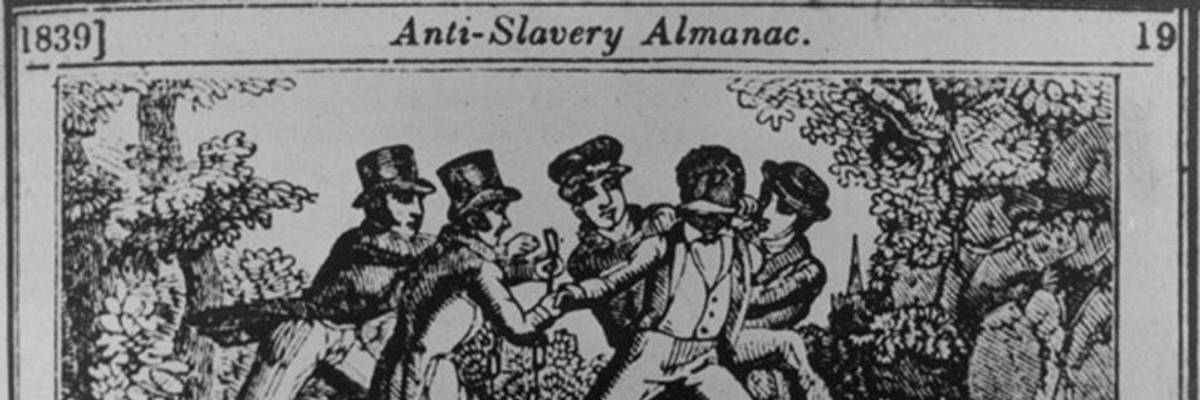
An 1839 woodcut depicts a slave patrol capturing a fugitive. (Anti-Slavery Almanac/Public domain)
For decades, we've been told that policing is a public good: available to all, for the benefit of all. But in practice, that's never been true.
One of the basic measures of a "public good" is that it's accessible to all people in a society, regardless of ability to pay. But from the beginning, policing in this country was designed to protect the assets of the most privileged.
Boston merchants were the first to persuade lawmakers in 1838 that a full-time, publicly funded police force would serve the "collective good." In reality, they wanted to get the public to pay for protecting their shipped goods and routes.
In the South, where the economy depended on enslaved labor, publicly funded slave patrols were created in 1704 to surveil, track, and punish Black people who attempted to escape. As historian Sally Hadden notes, "Most law enforcement was, by definition, white patrolmen watching, catching, or beating Black slaves" -- who were legally considered the property of wealthy white men.
Today, all across the United States, landlords and property managers enlist law enforcement to forcibly evict low-income tenants. Police regularly remove homeless individuals from parks and public spaces. And cops routinely stop, search, and threaten Black and brown people when they drive or walk through white neighborhoods.
We've seen these disparities in policing increase since the outbreak of COVID-19. And soon, with eviction moratoriums lifting across the country, tens of thousands of struggling tenants will be sent eviction notices. When families have no place else to go and landlords call in law enforcement, who do you think the police will serve and protect?
For centuries, police have taken the side of power, at the expense of those most marginalized.
Police have never protected Black lives as much as they protect white property. And when people protest having their safety threatened -- as in the nationwide protests after the murder of George Floyd -- they're met with further violence from police.
Safety is born out of investment in true public goods. Policing in America reveals a lack of it.
If people had guaranteed housing, there would be no one sleeping in subway cars, in parks, or on sidewalks for the police to round up. If people had universal health care, mental health problems might be treated instead of criminalized. And if we had a federal jobs guarantee, people would not be forced into an underground economy that fuels a cruel and punishing prison system.
But instead of addressing root causes of insecurity, leaders of both parties have often chosen to defund education and hospitals while resisting significant reductions to policing.
What if public safety were a public good? What would that look like?
It would mean funding nonviolent tools to de-escalate and respond to safety concerns. It would mean engaging community members in collective decision-making, since each community has unique needs. And, most importantly, it means using an anti-racist framework to create new approaches to public safety.
We're in a transformative moment in history where structural change is within our grasp. Reform has failed time and time again to address the problem of police violence. It's more clear than ever that we need to divest from policing and invest in universal public goods that create true public safety, not just the illusion of it.
Dear Common Dreams reader, It’s been nearly 30 years since I co-founded Common Dreams with my late wife, Lina Newhouser. We had the radical notion that journalism should serve the public good, not corporate profits. It was clear to us from the outset what it would take to build such a project. No paid advertisements. No corporate sponsors. No millionaire publisher telling us what to think or do. Many people said we wouldn't last a year, but we proved those doubters wrong. Together with a tremendous team of journalists and dedicated staff, we built an independent media outlet free from the constraints of profits and corporate control. Our mission has always been simple: To inform. To inspire. To ignite change for the common good. Building Common Dreams was not easy. Our survival was never guaranteed. When you take on the most powerful forces—Wall Street greed, fossil fuel industry destruction, Big Tech lobbyists, and uber-rich oligarchs who have spent billions upon billions rigging the economy and democracy in their favor—the only bulwark you have is supporters who believe in your work. But here’s the urgent message from me today. It's never been this bad out there. And it's never been this hard to keep us going. At the very moment Common Dreams is most needed, the threats we face are intensifying. We need your support now more than ever. We don't accept corporate advertising and never will. We don't have a paywall because we don't think people should be blocked from critical news based on their ability to pay. Everything we do is funded by the donations of readers like you. When everyone does the little they can afford, we are strong. But if that support retreats or dries up, so do we. Will you donate now to make sure Common Dreams not only survives but thrives? —Craig Brown, Co-founder |
For decades, we've been told that policing is a public good: available to all, for the benefit of all. But in practice, that's never been true.
One of the basic measures of a "public good" is that it's accessible to all people in a society, regardless of ability to pay. But from the beginning, policing in this country was designed to protect the assets of the most privileged.
Boston merchants were the first to persuade lawmakers in 1838 that a full-time, publicly funded police force would serve the "collective good." In reality, they wanted to get the public to pay for protecting their shipped goods and routes.
In the South, where the economy depended on enslaved labor, publicly funded slave patrols were created in 1704 to surveil, track, and punish Black people who attempted to escape. As historian Sally Hadden notes, "Most law enforcement was, by definition, white patrolmen watching, catching, or beating Black slaves" -- who were legally considered the property of wealthy white men.
Today, all across the United States, landlords and property managers enlist law enforcement to forcibly evict low-income tenants. Police regularly remove homeless individuals from parks and public spaces. And cops routinely stop, search, and threaten Black and brown people when they drive or walk through white neighborhoods.
We've seen these disparities in policing increase since the outbreak of COVID-19. And soon, with eviction moratoriums lifting across the country, tens of thousands of struggling tenants will be sent eviction notices. When families have no place else to go and landlords call in law enforcement, who do you think the police will serve and protect?
For centuries, police have taken the side of power, at the expense of those most marginalized.
Police have never protected Black lives as much as they protect white property. And when people protest having their safety threatened -- as in the nationwide protests after the murder of George Floyd -- they're met with further violence from police.
Safety is born out of investment in true public goods. Policing in America reveals a lack of it.
If people had guaranteed housing, there would be no one sleeping in subway cars, in parks, or on sidewalks for the police to round up. If people had universal health care, mental health problems might be treated instead of criminalized. And if we had a federal jobs guarantee, people would not be forced into an underground economy that fuels a cruel and punishing prison system.
But instead of addressing root causes of insecurity, leaders of both parties have often chosen to defund education and hospitals while resisting significant reductions to policing.
What if public safety were a public good? What would that look like?
It would mean funding nonviolent tools to de-escalate and respond to safety concerns. It would mean engaging community members in collective decision-making, since each community has unique needs. And, most importantly, it means using an anti-racist framework to create new approaches to public safety.
We're in a transformative moment in history where structural change is within our grasp. Reform has failed time and time again to address the problem of police violence. It's more clear than ever that we need to divest from policing and invest in universal public goods that create true public safety, not just the illusion of it.
For decades, we've been told that policing is a public good: available to all, for the benefit of all. But in practice, that's never been true.
One of the basic measures of a "public good" is that it's accessible to all people in a society, regardless of ability to pay. But from the beginning, policing in this country was designed to protect the assets of the most privileged.
Boston merchants were the first to persuade lawmakers in 1838 that a full-time, publicly funded police force would serve the "collective good." In reality, they wanted to get the public to pay for protecting their shipped goods and routes.
In the South, where the economy depended on enslaved labor, publicly funded slave patrols were created in 1704 to surveil, track, and punish Black people who attempted to escape. As historian Sally Hadden notes, "Most law enforcement was, by definition, white patrolmen watching, catching, or beating Black slaves" -- who were legally considered the property of wealthy white men.
Today, all across the United States, landlords and property managers enlist law enforcement to forcibly evict low-income tenants. Police regularly remove homeless individuals from parks and public spaces. And cops routinely stop, search, and threaten Black and brown people when they drive or walk through white neighborhoods.
We've seen these disparities in policing increase since the outbreak of COVID-19. And soon, with eviction moratoriums lifting across the country, tens of thousands of struggling tenants will be sent eviction notices. When families have no place else to go and landlords call in law enforcement, who do you think the police will serve and protect?
For centuries, police have taken the side of power, at the expense of those most marginalized.
Police have never protected Black lives as much as they protect white property. And when people protest having their safety threatened -- as in the nationwide protests after the murder of George Floyd -- they're met with further violence from police.
Safety is born out of investment in true public goods. Policing in America reveals a lack of it.
If people had guaranteed housing, there would be no one sleeping in subway cars, in parks, or on sidewalks for the police to round up. If people had universal health care, mental health problems might be treated instead of criminalized. And if we had a federal jobs guarantee, people would not be forced into an underground economy that fuels a cruel and punishing prison system.
But instead of addressing root causes of insecurity, leaders of both parties have often chosen to defund education and hospitals while resisting significant reductions to policing.
What if public safety were a public good? What would that look like?
It would mean funding nonviolent tools to de-escalate and respond to safety concerns. It would mean engaging community members in collective decision-making, since each community has unique needs. And, most importantly, it means using an anti-racist framework to create new approaches to public safety.
We're in a transformative moment in history where structural change is within our grasp. Reform has failed time and time again to address the problem of police violence. It's more clear than ever that we need to divest from policing and invest in universal public goods that create true public safety, not just the illusion of it.