SUBSCRIBE TO OUR FREE NEWSLETTER
Daily news & progressive opinion—funded by the people, not the corporations—delivered straight to your inbox.
5
#000000
#FFFFFF
To donate by check, phone, or other method, see our More Ways to Give page.
Daily news & progressive opinion—funded by the people, not the corporations—delivered straight to your inbox.
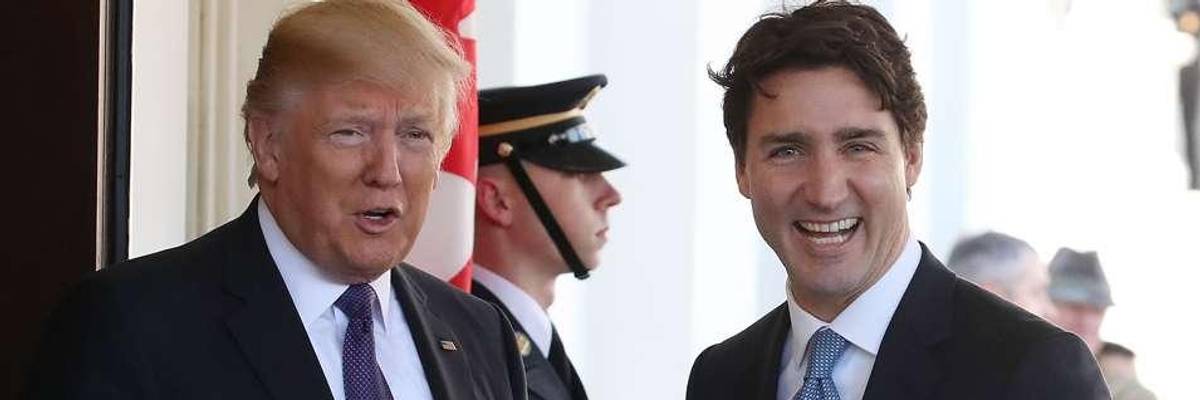
U.S. President Donald Trump greets Canadian Prime Minister Justin Trudeau at the White House February 13, 2017 in Washington, DC. (Photo by Mark Wilson/Getty Images)
The International community's rejection of Canada's Security Council bid should be a catalyst for a fundamental reassessment of foreign policy and spur a corresponding drive to democratize Canada's International affairs.
On the heels of Canada's second consecutive defeat for a seat on the United Nations Security Council, numerous commentators representing different political tendencies have called for a review or reset of Canadian foreign policy. As part of this push, the Canadian Foreign Policy Institute released an open letter signed by more than 500 politicians, artists, academics and activists calling for a "fundamental reassessment of Canadian foreign policy."
Addressed to Prime Minister Justin Trudeau, the open letter is signed by Canadian luminaries including Naomi Klein, David Suzuki, Stephen Lewis and Linda McQuaig as well as sitting MPs Leah Gazan, Paul Manly, Alexandre Boulerice and Niki Ashton. Former MPs Romeo Saganash, Libby Davies, Jim Manly and Svend Robinson have also signed the open letter. Other signatories include Ottawa MPP Joel Harden, Vancouver City Councillor Jean Swanson, Victoria City Councillor Jeremy Loveday, former Plateau-Mont-Royal mayor Luc Ferrandez, Black Lives Matter-Toronto founder Sandy Hudson and Richard Parry of Arcade Fire.
The letter offers 10 questions as a basis of a wide-ranging discussion of Canada's place in the world. This includes whether Canada should continue in NATO, back mining firms abroad, or maintain its close alignment with Washington, DC.
Beyond these and other important policy questions, the reassessment needs to grapple with two broader and interrelated questions: Why are Canadians so confused about their country's place in the world and how do we overcome the stark democratic deficit in international affairs?
Notwithstanding abundant evidence to the contrary, Canadians overwhelmingly believe their country is a benevolent international actor and well-liked around the world. But, two consecutive failures to win international support for a Security Council seat beg the question.
The gap between public perception of Canada's role in the world and Ottawa's actions abroad partially reflect the narrowness of the official debate. After the Security Council defeat the dominant media overwhelmingly turned to current and former Canadian diplomats to explain what transpired. Imagine the Conservative Party losing an election and the media only asking current and former leaders of the organization for their assessment.
Outside of diplomats and politicians, the media mostly sought commentary from corporate and Department of National Defence (DND) financed and aligned think tanks and academic departments. The No to Canada on Security Council campaign, which likely impacted the vote and sent out multiple press releases, was mostly ignored. So were the dozens of grassroots international solidarity, mining injustice and peace groups across the country.
A fundamental reassessment of foreign policy requires an airing of all points of view, especially those of people living in Canada who feel passionately about various subjects. What is Solidarite Quebec-Haiti saying about Canada's support for a repressive Haitian president? Does Rights Action's criticism of Canadian mining practices in Central America have merit? How about the Hamilton Coalition to Stop the War's challenge to Canadian sanctions policy? Or Independent Jewish Voices position on Canadian charities in Israel? Or the Coalition to Oppose the Arms Trade complaints about Canadian firms producing components for US weapon systems? Or the Louis Riel Bolivarian Circle's criticism of Canada's intervention in Venezuela?
Media outlets must be pressed to expand the discussion beyond groups funded by corporations and DND/Global Affairs. The same goes for Parliament's Standing Committee on Foreign Affairs and International Development.
When the dominant media and politicians ignore credible grassroots voices, they are stunting democracy. Exclusion from prominent platforms makes it more difficult to fundraise, attract members and maintain one's campaigning spirit. Any fundamental reassessment of Canadian foreign policy must include a discussion of the structures that preclude popular engagement on International issues.
The Canadian Foreign Policy Institute (CFPI) hopes to counter this exclusion. Hosted on its website here, CFPI is an effort to institutionalize critical foreign policy activism. It seeks to amplify the work of antiwar, mining justice, and international solidarity organizations.
It is important to see ourselves as part of a collective humanity. As anthropogenic global warming and the Covid-19 pandemic highlight, we are one world now more than ever before. A fundamental reassessment of Canadian foreign policy is one step towards making that a reality.
Dear Common Dreams reader, It’s been nearly 30 years since I co-founded Common Dreams with my late wife, Lina Newhouser. We had the radical notion that journalism should serve the public good, not corporate profits. It was clear to us from the outset what it would take to build such a project. No paid advertisements. No corporate sponsors. No millionaire publisher telling us what to think or do. Many people said we wouldn't last a year, but we proved those doubters wrong. Together with a tremendous team of journalists and dedicated staff, we built an independent media outlet free from the constraints of profits and corporate control. Our mission has always been simple: To inform. To inspire. To ignite change for the common good. Building Common Dreams was not easy. Our survival was never guaranteed. When you take on the most powerful forces—Wall Street greed, fossil fuel industry destruction, Big Tech lobbyists, and uber-rich oligarchs who have spent billions upon billions rigging the economy and democracy in their favor—the only bulwark you have is supporters who believe in your work. But here’s the urgent message from me today. It's never been this bad out there. And it's never been this hard to keep us going. At the very moment Common Dreams is most needed, the threats we face are intensifying. We need your support now more than ever. We don't accept corporate advertising and never will. We don't have a paywall because we don't think people should be blocked from critical news based on their ability to pay. Everything we do is funded by the donations of readers like you. When everyone does the little they can afford, we are strong. But if that support retreats or dries up, so do we. Will you donate now to make sure Common Dreams not only survives but thrives? —Craig Brown, Co-founder |
The International community's rejection of Canada's Security Council bid should be a catalyst for a fundamental reassessment of foreign policy and spur a corresponding drive to democratize Canada's International affairs.
On the heels of Canada's second consecutive defeat for a seat on the United Nations Security Council, numerous commentators representing different political tendencies have called for a review or reset of Canadian foreign policy. As part of this push, the Canadian Foreign Policy Institute released an open letter signed by more than 500 politicians, artists, academics and activists calling for a "fundamental reassessment of Canadian foreign policy."
Addressed to Prime Minister Justin Trudeau, the open letter is signed by Canadian luminaries including Naomi Klein, David Suzuki, Stephen Lewis and Linda McQuaig as well as sitting MPs Leah Gazan, Paul Manly, Alexandre Boulerice and Niki Ashton. Former MPs Romeo Saganash, Libby Davies, Jim Manly and Svend Robinson have also signed the open letter. Other signatories include Ottawa MPP Joel Harden, Vancouver City Councillor Jean Swanson, Victoria City Councillor Jeremy Loveday, former Plateau-Mont-Royal mayor Luc Ferrandez, Black Lives Matter-Toronto founder Sandy Hudson and Richard Parry of Arcade Fire.
The letter offers 10 questions as a basis of a wide-ranging discussion of Canada's place in the world. This includes whether Canada should continue in NATO, back mining firms abroad, or maintain its close alignment with Washington, DC.
Beyond these and other important policy questions, the reassessment needs to grapple with two broader and interrelated questions: Why are Canadians so confused about their country's place in the world and how do we overcome the stark democratic deficit in international affairs?
Notwithstanding abundant evidence to the contrary, Canadians overwhelmingly believe their country is a benevolent international actor and well-liked around the world. But, two consecutive failures to win international support for a Security Council seat beg the question.
The gap between public perception of Canada's role in the world and Ottawa's actions abroad partially reflect the narrowness of the official debate. After the Security Council defeat the dominant media overwhelmingly turned to current and former Canadian diplomats to explain what transpired. Imagine the Conservative Party losing an election and the media only asking current and former leaders of the organization for their assessment.
Outside of diplomats and politicians, the media mostly sought commentary from corporate and Department of National Defence (DND) financed and aligned think tanks and academic departments. The No to Canada on Security Council campaign, which likely impacted the vote and sent out multiple press releases, was mostly ignored. So were the dozens of grassroots international solidarity, mining injustice and peace groups across the country.
A fundamental reassessment of foreign policy requires an airing of all points of view, especially those of people living in Canada who feel passionately about various subjects. What is Solidarite Quebec-Haiti saying about Canada's support for a repressive Haitian president? Does Rights Action's criticism of Canadian mining practices in Central America have merit? How about the Hamilton Coalition to Stop the War's challenge to Canadian sanctions policy? Or Independent Jewish Voices position on Canadian charities in Israel? Or the Coalition to Oppose the Arms Trade complaints about Canadian firms producing components for US weapon systems? Or the Louis Riel Bolivarian Circle's criticism of Canada's intervention in Venezuela?
Media outlets must be pressed to expand the discussion beyond groups funded by corporations and DND/Global Affairs. The same goes for Parliament's Standing Committee on Foreign Affairs and International Development.
When the dominant media and politicians ignore credible grassroots voices, they are stunting democracy. Exclusion from prominent platforms makes it more difficult to fundraise, attract members and maintain one's campaigning spirit. Any fundamental reassessment of Canadian foreign policy must include a discussion of the structures that preclude popular engagement on International issues.
The Canadian Foreign Policy Institute (CFPI) hopes to counter this exclusion. Hosted on its website here, CFPI is an effort to institutionalize critical foreign policy activism. It seeks to amplify the work of antiwar, mining justice, and international solidarity organizations.
It is important to see ourselves as part of a collective humanity. As anthropogenic global warming and the Covid-19 pandemic highlight, we are one world now more than ever before. A fundamental reassessment of Canadian foreign policy is one step towards making that a reality.
The International community's rejection of Canada's Security Council bid should be a catalyst for a fundamental reassessment of foreign policy and spur a corresponding drive to democratize Canada's International affairs.
On the heels of Canada's second consecutive defeat for a seat on the United Nations Security Council, numerous commentators representing different political tendencies have called for a review or reset of Canadian foreign policy. As part of this push, the Canadian Foreign Policy Institute released an open letter signed by more than 500 politicians, artists, academics and activists calling for a "fundamental reassessment of Canadian foreign policy."
Addressed to Prime Minister Justin Trudeau, the open letter is signed by Canadian luminaries including Naomi Klein, David Suzuki, Stephen Lewis and Linda McQuaig as well as sitting MPs Leah Gazan, Paul Manly, Alexandre Boulerice and Niki Ashton. Former MPs Romeo Saganash, Libby Davies, Jim Manly and Svend Robinson have also signed the open letter. Other signatories include Ottawa MPP Joel Harden, Vancouver City Councillor Jean Swanson, Victoria City Councillor Jeremy Loveday, former Plateau-Mont-Royal mayor Luc Ferrandez, Black Lives Matter-Toronto founder Sandy Hudson and Richard Parry of Arcade Fire.
The letter offers 10 questions as a basis of a wide-ranging discussion of Canada's place in the world. This includes whether Canada should continue in NATO, back mining firms abroad, or maintain its close alignment with Washington, DC.
Beyond these and other important policy questions, the reassessment needs to grapple with two broader and interrelated questions: Why are Canadians so confused about their country's place in the world and how do we overcome the stark democratic deficit in international affairs?
Notwithstanding abundant evidence to the contrary, Canadians overwhelmingly believe their country is a benevolent international actor and well-liked around the world. But, two consecutive failures to win international support for a Security Council seat beg the question.
The gap between public perception of Canada's role in the world and Ottawa's actions abroad partially reflect the narrowness of the official debate. After the Security Council defeat the dominant media overwhelmingly turned to current and former Canadian diplomats to explain what transpired. Imagine the Conservative Party losing an election and the media only asking current and former leaders of the organization for their assessment.
Outside of diplomats and politicians, the media mostly sought commentary from corporate and Department of National Defence (DND) financed and aligned think tanks and academic departments. The No to Canada on Security Council campaign, which likely impacted the vote and sent out multiple press releases, was mostly ignored. So were the dozens of grassroots international solidarity, mining injustice and peace groups across the country.
A fundamental reassessment of foreign policy requires an airing of all points of view, especially those of people living in Canada who feel passionately about various subjects. What is Solidarite Quebec-Haiti saying about Canada's support for a repressive Haitian president? Does Rights Action's criticism of Canadian mining practices in Central America have merit? How about the Hamilton Coalition to Stop the War's challenge to Canadian sanctions policy? Or Independent Jewish Voices position on Canadian charities in Israel? Or the Coalition to Oppose the Arms Trade complaints about Canadian firms producing components for US weapon systems? Or the Louis Riel Bolivarian Circle's criticism of Canada's intervention in Venezuela?
Media outlets must be pressed to expand the discussion beyond groups funded by corporations and DND/Global Affairs. The same goes for Parliament's Standing Committee on Foreign Affairs and International Development.
When the dominant media and politicians ignore credible grassroots voices, they are stunting democracy. Exclusion from prominent platforms makes it more difficult to fundraise, attract members and maintain one's campaigning spirit. Any fundamental reassessment of Canadian foreign policy must include a discussion of the structures that preclude popular engagement on International issues.
The Canadian Foreign Policy Institute (CFPI) hopes to counter this exclusion. Hosted on its website here, CFPI is an effort to institutionalize critical foreign policy activism. It seeks to amplify the work of antiwar, mining justice, and international solidarity organizations.
It is important to see ourselves as part of a collective humanity. As anthropogenic global warming and the Covid-19 pandemic highlight, we are one world now more than ever before. A fundamental reassessment of Canadian foreign policy is one step towards making that a reality.