SUBSCRIBE TO OUR FREE NEWSLETTER
Daily news & progressive opinion—funded by the people, not the corporations—delivered straight to your inbox.
5
#000000
#FFFFFF
To donate by check, phone, or other method, see our More Ways to Give page.
Daily news & progressive opinion—funded by the people, not the corporations—delivered straight to your inbox.
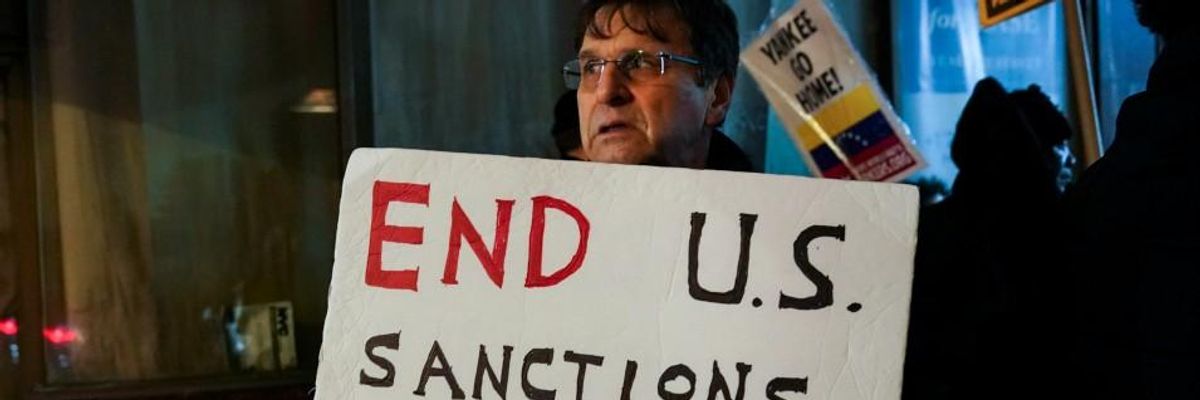
We must ask ourselves whether we will continue to accept our government's participation in a Trump administration regime change effort that effectively undermines the ability of ordinary Venezuelans to feed themselves. (Photo: Drew Angerer/Getty Images)
This is what empowering a bully looks like. The Canadian government is supporting Donald Trump's efforts to starve Venezuelans.
Before dismissing what may sound like over-the-top rhetoric, hear me out.
The US government has imposed a remarkable series of unilateral coercive economic measures on Venezuela - or as Trump boasted last week, "historic sanctions". In a bid to oust the Venezuelan government, Washington has seized billions of dollars in Venezuelan assets effectively driving the country out of International financial markets. This has thwarted Venezuela's ability to buy goods, including food, from abroad.
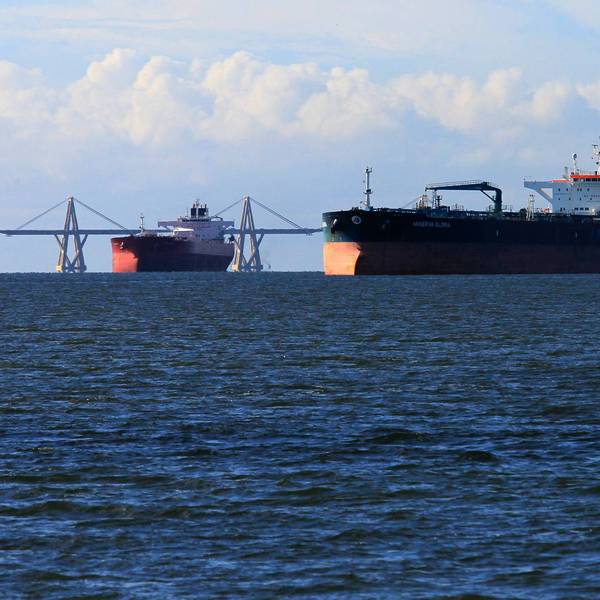
Sanctions imposed 18 months ago targeting Venezuela's oil industry have choked its ability to refine its gigantic oil reserves. More recently, the US launched a successful campaign to deter oil and gas shipping companies from working with Venezuela. Their strategy has been to pressure companies that insure and certify vessels to stop international shipping firms from delivering oil and gasoline to and from Venezuela.
Before the strongest measures were introduced, a study by economists Jeffrey Sachs and Mark Weisbrot found US sanctions responsible for 40,000 deaths between August 2017 and the end of 2018.
Describing this aggressive strategy, Trump's special envoy on Venezuela, Elliott Abrams, told Reuters, "there are people who don't cooperate...We'll go after the ship, the ship owner, the ship captain."
While less gasoline consumption is certainly desirable when it comes to the private automobile, oil does have other important uses. It's needed for tractors on farms. It's required to ship food into urban centres. A Bloomberg story last month titled "Venezuela on Brink of Famine With Fuel Too Scarce to Sow Crops" reported, "oil fields across Venezuela have shut amid the U.S.'s relentless campaign to cut the nation off from global markets. Evidence of fuel scarcity is everywhere. Ambulances can't run, telecommunications networks are faltering and some farmers have given up altogether on machinery -- using oxen instead."
The damage caused by US sanctions to Venezuela's economy and health are immense. Before the strongest measures were introduced, a study by economists Jeffrey Sachs and Mark Weisbrot found US sanctions responsible for 40,000 deaths between August 2017 and the end of 2018.
Yet Ottawa has not criticized the devastating US sanctions. Quite the opposite. It has egged the bully on. Canada has imposed four rounds of its own unilateral sanctions on Venezuela. Canada has also offered important support to US efforts to oust Nicolas Maduro through its role in establishing the Lima Group of countries opposed to Venezuela's government in August 2017. At that time the government contracted staunch pro-Washington and pro-corporate former diplomat,Allan Culham, to act as a Special Advisor on Venezuela. A year later Ottawa decided a marginal opposition politician was the legitimate president of Venezuela. Even after Juan Guaido was embroiled in a failed paramilitary incursion in May -- dubbed the "Bay of Piglets" by a former US diplomat -- and a series of corruption scandals, Ottawa has continued supporting him as "president". Foreign affairs minister Francois-Philippe Champagne directed his July 5 Venezuela Independence Day commemoration to Guaido and three days later tweeted, "Canada stands in support of Juan Guaido."
Canadian officials claim to be promoting democracy and human rights in Venezuela, but they've partnered in their campaign with a Honduran president, Juan Orlando Hernandez, with far weaker constitutional legitimacy than Maduro. Other members of the Lima Group include Haitian president Jovenel Moise, who has faced unprecedented protests over corruption and repression, and Colombian president Ivan Duque, who oversees much greater human rights violations.
Questioning our policy towards Venezuela is part of an open letter calling for a "fundamental reassessment of Canadian foreign policy" released following Canada's recent United Nations Security Council defeat. Signed by David Suzuki, Naomi Klein, Stephen Lewis as well as four sitting MPs and numerous former MPs, one of its 10 questions asks: "Why is Canada involved in efforts to overthrow Venezuela's UN-recognized government, a clear violation of the principle of non-intervention in other country's internal affairs?"
Canadians should debate this question. We must ask ourselves whether we will continue to accept our government's participation in a Trump administration regime change effort that effectively undermines the ability of ordinary Venezuelans to feed themselves.
Dear Common Dreams reader, It’s been nearly 30 years since I co-founded Common Dreams with my late wife, Lina Newhouser. We had the radical notion that journalism should serve the public good, not corporate profits. It was clear to us from the outset what it would take to build such a project. No paid advertisements. No corporate sponsors. No millionaire publisher telling us what to think or do. Many people said we wouldn't last a year, but we proved those doubters wrong. Together with a tremendous team of journalists and dedicated staff, we built an independent media outlet free from the constraints of profits and corporate control. Our mission has always been simple: To inform. To inspire. To ignite change for the common good. Building Common Dreams was not easy. Our survival was never guaranteed. When you take on the most powerful forces—Wall Street greed, fossil fuel industry destruction, Big Tech lobbyists, and uber-rich oligarchs who have spent billions upon billions rigging the economy and democracy in their favor—the only bulwark you have is supporters who believe in your work. But here’s the urgent message from me today. It's never been this bad out there. And it's never been this hard to keep us going. At the very moment Common Dreams is most needed, the threats we face are intensifying. We need your support now more than ever. We don't accept corporate advertising and never will. We don't have a paywall because we don't think people should be blocked from critical news based on their ability to pay. Everything we do is funded by the donations of readers like you. When everyone does the little they can afford, we are strong. But if that support retreats or dries up, so do we. Will you donate now to make sure Common Dreams not only survives but thrives? —Craig Brown, Co-founder |
This is what empowering a bully looks like. The Canadian government is supporting Donald Trump's efforts to starve Venezuelans.
Before dismissing what may sound like over-the-top rhetoric, hear me out.
The US government has imposed a remarkable series of unilateral coercive economic measures on Venezuela - or as Trump boasted last week, "historic sanctions". In a bid to oust the Venezuelan government, Washington has seized billions of dollars in Venezuelan assets effectively driving the country out of International financial markets. This has thwarted Venezuela's ability to buy goods, including food, from abroad.
Sanctions imposed 18 months ago targeting Venezuela's oil industry have choked its ability to refine its gigantic oil reserves. More recently, the US launched a successful campaign to deter oil and gas shipping companies from working with Venezuela. Their strategy has been to pressure companies that insure and certify vessels to stop international shipping firms from delivering oil and gasoline to and from Venezuela.
Before the strongest measures were introduced, a study by economists Jeffrey Sachs and Mark Weisbrot found US sanctions responsible for 40,000 deaths between August 2017 and the end of 2018.
Describing this aggressive strategy, Trump's special envoy on Venezuela, Elliott Abrams, told Reuters, "there are people who don't cooperate...We'll go after the ship, the ship owner, the ship captain."
While less gasoline consumption is certainly desirable when it comes to the private automobile, oil does have other important uses. It's needed for tractors on farms. It's required to ship food into urban centres. A Bloomberg story last month titled "Venezuela on Brink of Famine With Fuel Too Scarce to Sow Crops" reported, "oil fields across Venezuela have shut amid the U.S.'s relentless campaign to cut the nation off from global markets. Evidence of fuel scarcity is everywhere. Ambulances can't run, telecommunications networks are faltering and some farmers have given up altogether on machinery -- using oxen instead."
The damage caused by US sanctions to Venezuela's economy and health are immense. Before the strongest measures were introduced, a study by economists Jeffrey Sachs and Mark Weisbrot found US sanctions responsible for 40,000 deaths between August 2017 and the end of 2018.
Yet Ottawa has not criticized the devastating US sanctions. Quite the opposite. It has egged the bully on. Canada has imposed four rounds of its own unilateral sanctions on Venezuela. Canada has also offered important support to US efforts to oust Nicolas Maduro through its role in establishing the Lima Group of countries opposed to Venezuela's government in August 2017. At that time the government contracted staunch pro-Washington and pro-corporate former diplomat,Allan Culham, to act as a Special Advisor on Venezuela. A year later Ottawa decided a marginal opposition politician was the legitimate president of Venezuela. Even after Juan Guaido was embroiled in a failed paramilitary incursion in May -- dubbed the "Bay of Piglets" by a former US diplomat -- and a series of corruption scandals, Ottawa has continued supporting him as "president". Foreign affairs minister Francois-Philippe Champagne directed his July 5 Venezuela Independence Day commemoration to Guaido and three days later tweeted, "Canada stands in support of Juan Guaido."
Canadian officials claim to be promoting democracy and human rights in Venezuela, but they've partnered in their campaign with a Honduran president, Juan Orlando Hernandez, with far weaker constitutional legitimacy than Maduro. Other members of the Lima Group include Haitian president Jovenel Moise, who has faced unprecedented protests over corruption and repression, and Colombian president Ivan Duque, who oversees much greater human rights violations.
Questioning our policy towards Venezuela is part of an open letter calling for a "fundamental reassessment of Canadian foreign policy" released following Canada's recent United Nations Security Council defeat. Signed by David Suzuki, Naomi Klein, Stephen Lewis as well as four sitting MPs and numerous former MPs, one of its 10 questions asks: "Why is Canada involved in efforts to overthrow Venezuela's UN-recognized government, a clear violation of the principle of non-intervention in other country's internal affairs?"
Canadians should debate this question. We must ask ourselves whether we will continue to accept our government's participation in a Trump administration regime change effort that effectively undermines the ability of ordinary Venezuelans to feed themselves.
This is what empowering a bully looks like. The Canadian government is supporting Donald Trump's efforts to starve Venezuelans.
Before dismissing what may sound like over-the-top rhetoric, hear me out.
The US government has imposed a remarkable series of unilateral coercive economic measures on Venezuela - or as Trump boasted last week, "historic sanctions". In a bid to oust the Venezuelan government, Washington has seized billions of dollars in Venezuelan assets effectively driving the country out of International financial markets. This has thwarted Venezuela's ability to buy goods, including food, from abroad.
Sanctions imposed 18 months ago targeting Venezuela's oil industry have choked its ability to refine its gigantic oil reserves. More recently, the US launched a successful campaign to deter oil and gas shipping companies from working with Venezuela. Their strategy has been to pressure companies that insure and certify vessels to stop international shipping firms from delivering oil and gasoline to and from Venezuela.
Before the strongest measures were introduced, a study by economists Jeffrey Sachs and Mark Weisbrot found US sanctions responsible for 40,000 deaths between August 2017 and the end of 2018.
Describing this aggressive strategy, Trump's special envoy on Venezuela, Elliott Abrams, told Reuters, "there are people who don't cooperate...We'll go after the ship, the ship owner, the ship captain."
While less gasoline consumption is certainly desirable when it comes to the private automobile, oil does have other important uses. It's needed for tractors on farms. It's required to ship food into urban centres. A Bloomberg story last month titled "Venezuela on Brink of Famine With Fuel Too Scarce to Sow Crops" reported, "oil fields across Venezuela have shut amid the U.S.'s relentless campaign to cut the nation off from global markets. Evidence of fuel scarcity is everywhere. Ambulances can't run, telecommunications networks are faltering and some farmers have given up altogether on machinery -- using oxen instead."
The damage caused by US sanctions to Venezuela's economy and health are immense. Before the strongest measures were introduced, a study by economists Jeffrey Sachs and Mark Weisbrot found US sanctions responsible for 40,000 deaths between August 2017 and the end of 2018.
Yet Ottawa has not criticized the devastating US sanctions. Quite the opposite. It has egged the bully on. Canada has imposed four rounds of its own unilateral sanctions on Venezuela. Canada has also offered important support to US efforts to oust Nicolas Maduro through its role in establishing the Lima Group of countries opposed to Venezuela's government in August 2017. At that time the government contracted staunch pro-Washington and pro-corporate former diplomat,Allan Culham, to act as a Special Advisor on Venezuela. A year later Ottawa decided a marginal opposition politician was the legitimate president of Venezuela. Even after Juan Guaido was embroiled in a failed paramilitary incursion in May -- dubbed the "Bay of Piglets" by a former US diplomat -- and a series of corruption scandals, Ottawa has continued supporting him as "president". Foreign affairs minister Francois-Philippe Champagne directed his July 5 Venezuela Independence Day commemoration to Guaido and three days later tweeted, "Canada stands in support of Juan Guaido."
Canadian officials claim to be promoting democracy and human rights in Venezuela, but they've partnered in their campaign with a Honduran president, Juan Orlando Hernandez, with far weaker constitutional legitimacy than Maduro. Other members of the Lima Group include Haitian president Jovenel Moise, who has faced unprecedented protests over corruption and repression, and Colombian president Ivan Duque, who oversees much greater human rights violations.
Questioning our policy towards Venezuela is part of an open letter calling for a "fundamental reassessment of Canadian foreign policy" released following Canada's recent United Nations Security Council defeat. Signed by David Suzuki, Naomi Klein, Stephen Lewis as well as four sitting MPs and numerous former MPs, one of its 10 questions asks: "Why is Canada involved in efforts to overthrow Venezuela's UN-recognized government, a clear violation of the principle of non-intervention in other country's internal affairs?"
Canadians should debate this question. We must ask ourselves whether we will continue to accept our government's participation in a Trump administration regime change effort that effectively undermines the ability of ordinary Venezuelans to feed themselves.