
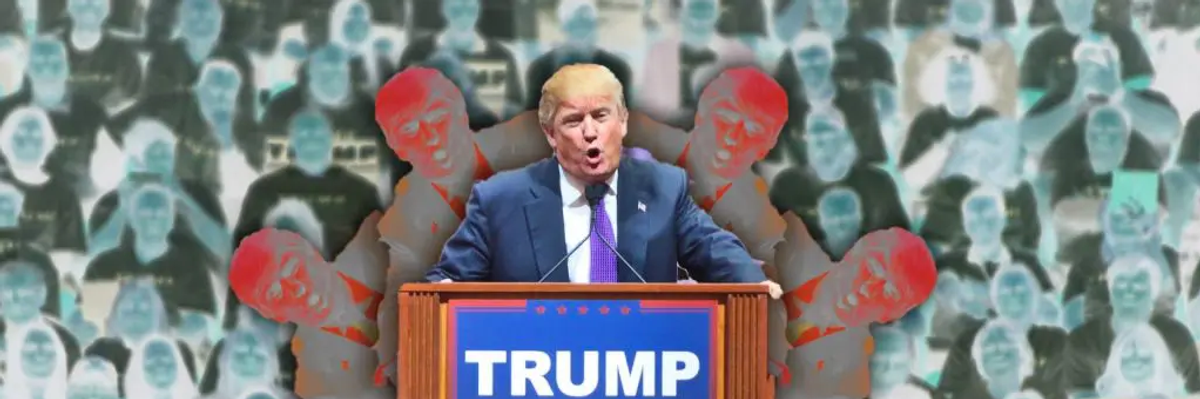
Illustration by Thomas Gaulkin (Photo: Gage Skidmore via Creative Commons)
Cornell Study Reveals Trump Is Covid-19 Misinformation 'Superspreader'
Coverage of the president’s illness, and the fog of misinformation surrounding it, is once again crowding out other important news.
Contact tracers are trying to determine whether President Trump may have spread the coronavirus to staff members, donors, rallygoers, and others he spent time with this week--before he tested positive for COVID-19.
Another set of researchers released a different kind of determination about Trump on the same day he tested positive: The president is a superspreader of what the World Health Organization has termed an "infodemic" of misinformation.
The information ecosphere is sick. And the president's diagnosis has unleashed a new wave of misinformation.
The infodemic's largest driver. On Thursday, researchers at Cornell University released a study of 38 million articles published in English-language media between January 1 and May 26, 2020. Mentions of Trump made up nearly 38 percent of the "misinformation conversation" in these articles. The study's conclusion: "The President of the United States was likely the largest driver of the COVID-19 misinformation 'infodemic.'"
The Cornell researchers also reported that the majority of COVID misinformation in the articles they analyzed was "conveyed by the media without question or correction." Only 16.4 percent was factchecking.
Shortly after the study was made public, and mere hours after the president claimed "the end of the pandemic is in sight," he announced on Twitter that he had tested positive. Many of the responses to his announcement have further undermined the public's trust in information coming from both the White House and its critics.
QAnon craziness. Anyone who hoped that the president's contraction of the virus would be a reality check for coronavirus deniers was immediately disappointed.
For example, people who believe in QAnon, a conspiracy theory that views COVID-19 as a hoax made up to distract the American public from a satanic pedophile ring operated by Democrats and Hollywood elites, have come up with multiple theories about why the president is pretending to have an illness they are convinced is fake.
Other QAnon adherents who support the president have speculated that he got the illness intentionally, so that he could demonstrate the effectiveness of hydroxychloroquine--an antimalarial drug Trump has touted--against the disease. In May, Trump said he had taken a two-week course of the drug to protect himself from the virus.
Today, the House voted 371 to 18 in favor of a resolution condemning the QAnon movement, which the FBI has identified as a domestic terrorist threat.
Disbelief on the left. The president's QAnon supporters aren't the only ones who have questioned the legitimacy of the news about the president's positive test. Some progressives have claimed the announcement is an "October surprise" intended to disrupt Biden's lead, delay the debates, or demonstrate an easy cure for COVID-19.
The president's reputation as a serial liar has made it difficult for his critics to believe anything he says, argued screenwriter David Simon, who suggested that the president might "present as asymptomatic, or claim himself cured with bleach, then dismiss COVID again as a Democratic hoax."
Aides to the president have since reported that he and the first lady have "mild symptoms." But it's unclear what that means, since the White House has not said what their symptoms are.
The "doomsday plane" rumor. One incident perfectly illustrates how quickly misinformation can emerge and spread on social media. It started with a tweet speculating that an E-6B Mercury aircraft spotted near Washington, just before the president announced that he had the coronavirus, had been launched to warn "adversaries" possessing nuclear weapons. A second E-6B Mercury was spotted along the West Coast.
The E-6B has been dubbed the "doomsday plane" because it serves as an airborne command and communications platform for relaying instructions to the US nuclear ballistic missile force.
A military spokesman explained that the flights were part of planned missions that happen about every other day, and that "any timing to the president's announcement was purely coincidental," but by then the misinformation had already circulated at the speed of Twitter and spread to news items published by major media outlets. These outlets ran corrections, but not before tens of thousands of people had tweeted the scare story.
Transparency: a stabilizing force. Trump's illness comes at a time of political panic and low public trust in the media and federal government. National security officials and experts say they are keeping a close eye on the potential for adversaries such as China and Russia to try to inject additional falsehoods into the US election process.
The current situation calls for full transparency. It doesn't inspire confidence that the White House waited a full day to make its announcement about Hope Hicks, a close adviser to the president whose test result was revealed only two hours before the president's (and only after Bloomberg News reported the story). And it doesn't help that Trump attended a fundraiser with about 100 people yesterday even after he knew Hicks had tested positive and was experiencing COVID-19 symptoms, according to the New York Times.
Coverage of the president's illness, and the fog of misinformation surrounding it, is once again crowding out other important news. Wildfires fueled by climate change are still raging in California. More than a million plant and animal species are facing extinction. President Trump still has his finger on the nuclear button. And more than 200,000 Americans who are not the president have died from COVID-19, with no end in sight.
An Urgent Message From Our Co-Founder
Dear Common Dreams reader, It’s been nearly 30 years since I co-founded Common Dreams with my late wife, Lina Newhouser. We had the radical notion that journalism should serve the public good, not corporate profits. It was clear to us from the outset what it would take to build such a project. No paid advertisements. No corporate sponsors. No millionaire publisher telling us what to think or do. Many people said we wouldn't last a year, but we proved those doubters wrong. Together with a tremendous team of journalists and dedicated staff, we built an independent media outlet free from the constraints of profits and corporate control. Our mission has always been simple: To inform. To inspire. To ignite change for the common good. Building Common Dreams was not easy. Our survival was never guaranteed. When you take on the most powerful forces—Wall Street greed, fossil fuel industry destruction, Big Tech lobbyists, and uber-rich oligarchs who have spent billions upon billions rigging the economy and democracy in their favor—the only bulwark you have is supporters who believe in your work. But here’s the urgent message from me today. It's never been this bad out there. And it's never been this hard to keep us going. At the very moment Common Dreams is most needed, the threats we face are intensifying. We need your support now more than ever. We don't accept corporate advertising and never will. We don't have a paywall because we don't think people should be blocked from critical news based on their ability to pay. Everything we do is funded by the donations of readers like you. When everyone does the little they can afford, we are strong. But if that support retreats or dries up, so do we. Will you donate now to make sure Common Dreams not only survives but thrives? —Craig Brown, Co-founder |
Contact tracers are trying to determine whether President Trump may have spread the coronavirus to staff members, donors, rallygoers, and others he spent time with this week--before he tested positive for COVID-19.
Another set of researchers released a different kind of determination about Trump on the same day he tested positive: The president is a superspreader of what the World Health Organization has termed an "infodemic" of misinformation.
The information ecosphere is sick. And the president's diagnosis has unleashed a new wave of misinformation.
The infodemic's largest driver. On Thursday, researchers at Cornell University released a study of 38 million articles published in English-language media between January 1 and May 26, 2020. Mentions of Trump made up nearly 38 percent of the "misinformation conversation" in these articles. The study's conclusion: "The President of the United States was likely the largest driver of the COVID-19 misinformation 'infodemic.'"
The Cornell researchers also reported that the majority of COVID misinformation in the articles they analyzed was "conveyed by the media without question or correction." Only 16.4 percent was factchecking.
Shortly after the study was made public, and mere hours after the president claimed "the end of the pandemic is in sight," he announced on Twitter that he had tested positive. Many of the responses to his announcement have further undermined the public's trust in information coming from both the White House and its critics.
QAnon craziness. Anyone who hoped that the president's contraction of the virus would be a reality check for coronavirus deniers was immediately disappointed.
For example, people who believe in QAnon, a conspiracy theory that views COVID-19 as a hoax made up to distract the American public from a satanic pedophile ring operated by Democrats and Hollywood elites, have come up with multiple theories about why the president is pretending to have an illness they are convinced is fake.
Other QAnon adherents who support the president have speculated that he got the illness intentionally, so that he could demonstrate the effectiveness of hydroxychloroquine--an antimalarial drug Trump has touted--against the disease. In May, Trump said he had taken a two-week course of the drug to protect himself from the virus.
Today, the House voted 371 to 18 in favor of a resolution condemning the QAnon movement, which the FBI has identified as a domestic terrorist threat.
Disbelief on the left. The president's QAnon supporters aren't the only ones who have questioned the legitimacy of the news about the president's positive test. Some progressives have claimed the announcement is an "October surprise" intended to disrupt Biden's lead, delay the debates, or demonstrate an easy cure for COVID-19.
The president's reputation as a serial liar has made it difficult for his critics to believe anything he says, argued screenwriter David Simon, who suggested that the president might "present as asymptomatic, or claim himself cured with bleach, then dismiss COVID again as a Democratic hoax."
Aides to the president have since reported that he and the first lady have "mild symptoms." But it's unclear what that means, since the White House has not said what their symptoms are.
The "doomsday plane" rumor. One incident perfectly illustrates how quickly misinformation can emerge and spread on social media. It started with a tweet speculating that an E-6B Mercury aircraft spotted near Washington, just before the president announced that he had the coronavirus, had been launched to warn "adversaries" possessing nuclear weapons. A second E-6B Mercury was spotted along the West Coast.
The E-6B has been dubbed the "doomsday plane" because it serves as an airborne command and communications platform for relaying instructions to the US nuclear ballistic missile force.
A military spokesman explained that the flights were part of planned missions that happen about every other day, and that "any timing to the president's announcement was purely coincidental," but by then the misinformation had already circulated at the speed of Twitter and spread to news items published by major media outlets. These outlets ran corrections, but not before tens of thousands of people had tweeted the scare story.
Transparency: a stabilizing force. Trump's illness comes at a time of political panic and low public trust in the media and federal government. National security officials and experts say they are keeping a close eye on the potential for adversaries such as China and Russia to try to inject additional falsehoods into the US election process.
The current situation calls for full transparency. It doesn't inspire confidence that the White House waited a full day to make its announcement about Hope Hicks, a close adviser to the president whose test result was revealed only two hours before the president's (and only after Bloomberg News reported the story). And it doesn't help that Trump attended a fundraiser with about 100 people yesterday even after he knew Hicks had tested positive and was experiencing COVID-19 symptoms, according to the New York Times.
Coverage of the president's illness, and the fog of misinformation surrounding it, is once again crowding out other important news. Wildfires fueled by climate change are still raging in California. More than a million plant and animal species are facing extinction. President Trump still has his finger on the nuclear button. And more than 200,000 Americans who are not the president have died from COVID-19, with no end in sight.
Contact tracers are trying to determine whether President Trump may have spread the coronavirus to staff members, donors, rallygoers, and others he spent time with this week--before he tested positive for COVID-19.
Another set of researchers released a different kind of determination about Trump on the same day he tested positive: The president is a superspreader of what the World Health Organization has termed an "infodemic" of misinformation.
The information ecosphere is sick. And the president's diagnosis has unleashed a new wave of misinformation.
The infodemic's largest driver. On Thursday, researchers at Cornell University released a study of 38 million articles published in English-language media between January 1 and May 26, 2020. Mentions of Trump made up nearly 38 percent of the "misinformation conversation" in these articles. The study's conclusion: "The President of the United States was likely the largest driver of the COVID-19 misinformation 'infodemic.'"
The Cornell researchers also reported that the majority of COVID misinformation in the articles they analyzed was "conveyed by the media without question or correction." Only 16.4 percent was factchecking.
Shortly after the study was made public, and mere hours after the president claimed "the end of the pandemic is in sight," he announced on Twitter that he had tested positive. Many of the responses to his announcement have further undermined the public's trust in information coming from both the White House and its critics.
QAnon craziness. Anyone who hoped that the president's contraction of the virus would be a reality check for coronavirus deniers was immediately disappointed.
For example, people who believe in QAnon, a conspiracy theory that views COVID-19 as a hoax made up to distract the American public from a satanic pedophile ring operated by Democrats and Hollywood elites, have come up with multiple theories about why the president is pretending to have an illness they are convinced is fake.
Other QAnon adherents who support the president have speculated that he got the illness intentionally, so that he could demonstrate the effectiveness of hydroxychloroquine--an antimalarial drug Trump has touted--against the disease. In May, Trump said he had taken a two-week course of the drug to protect himself from the virus.
Today, the House voted 371 to 18 in favor of a resolution condemning the QAnon movement, which the FBI has identified as a domestic terrorist threat.
Disbelief on the left. The president's QAnon supporters aren't the only ones who have questioned the legitimacy of the news about the president's positive test. Some progressives have claimed the announcement is an "October surprise" intended to disrupt Biden's lead, delay the debates, or demonstrate an easy cure for COVID-19.
The president's reputation as a serial liar has made it difficult for his critics to believe anything he says, argued screenwriter David Simon, who suggested that the president might "present as asymptomatic, or claim himself cured with bleach, then dismiss COVID again as a Democratic hoax."
Aides to the president have since reported that he and the first lady have "mild symptoms." But it's unclear what that means, since the White House has not said what their symptoms are.
The "doomsday plane" rumor. One incident perfectly illustrates how quickly misinformation can emerge and spread on social media. It started with a tweet speculating that an E-6B Mercury aircraft spotted near Washington, just before the president announced that he had the coronavirus, had been launched to warn "adversaries" possessing nuclear weapons. A second E-6B Mercury was spotted along the West Coast.
The E-6B has been dubbed the "doomsday plane" because it serves as an airborne command and communications platform for relaying instructions to the US nuclear ballistic missile force.
A military spokesman explained that the flights were part of planned missions that happen about every other day, and that "any timing to the president's announcement was purely coincidental," but by then the misinformation had already circulated at the speed of Twitter and spread to news items published by major media outlets. These outlets ran corrections, but not before tens of thousands of people had tweeted the scare story.
Transparency: a stabilizing force. Trump's illness comes at a time of political panic and low public trust in the media and federal government. National security officials and experts say they are keeping a close eye on the potential for adversaries such as China and Russia to try to inject additional falsehoods into the US election process.
The current situation calls for full transparency. It doesn't inspire confidence that the White House waited a full day to make its announcement about Hope Hicks, a close adviser to the president whose test result was revealed only two hours before the president's (and only after Bloomberg News reported the story). And it doesn't help that Trump attended a fundraiser with about 100 people yesterday even after he knew Hicks had tested positive and was experiencing COVID-19 symptoms, according to the New York Times.
Coverage of the president's illness, and the fog of misinformation surrounding it, is once again crowding out other important news. Wildfires fueled by climate change are still raging in California. More than a million plant and animal species are facing extinction. President Trump still has his finger on the nuclear button. And more than 200,000 Americans who are not the president have died from COVID-19, with no end in sight.