SUBSCRIBE TO OUR FREE NEWSLETTER
Daily news & progressive opinion—funded by the people, not the corporations—delivered straight to your inbox.
5
#000000
#FFFFFF
To donate by check, phone, or other method, see our More Ways to Give page.
Daily news & progressive opinion—funded by the people, not the corporations—delivered straight to your inbox.
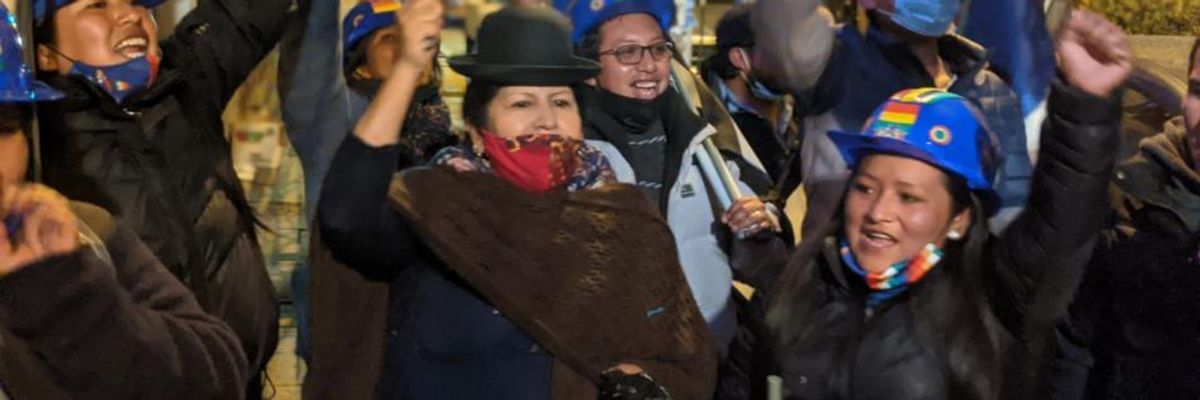
MAS supporters celebrate in La Paz following electoral victory. (Photo: Thomas Becker)
Against all odds, the Movement Toward Socialism (MAS) party won the October 18th elections in Bolivia with 55.1% of the vote. This is better than even Evo Morales did in 2005 with 53.75% support. It gives MAS President-elect Lucho Arce one of the biggest mandates in Bolivian history, and is in part a major endorsement of MAS policies and its 14 years in power.
The election took place a year after a coup overthrew former MAS President Evo Morales and installed right wing Senator Jeanine Anez in power. Under Anez and her notorious Government Minister Arturo Murillo, the government repressed dissidents and anti-coup activists, killing dozens and wounding hundreds of people in massacres in Sacaba and Senkata, Bolivia last November. They politically persecuted MAS figures, allies, and leftist activists over a tumultuous year leading up to the recent election.
The MAS victory is a rejection of the racist coup government. Anez pushed the MAS down, but the party and its diverse base of supporters rose up and won.
The movements that defended democracy over this past year brought Bolivia to this historic moment. For weeks in August, massive road blockade protests organized by MAS-allied campesino, indigenous, and labor groups successfully pressured authorities to hold elections after months of delays.
Following its resounding victory at the polls, the MAS will enter government next month, raising many crucial questions.
How much will the party leadership change? The crisis of the past year has resulted in a diversity of new leadership rising up through the party ranks. For example, young MAS cocalero leaders Andronico Rodriguez and Leonardo Loza were just elected as Senators in Cochabamba.
How will the MAS address critiques from the left? Vice President-elect David Choquehuanca is largely considered a representative of the more critical left-wing of the MAS party, which is oriented more directly by the grassroots base of labor, campesino, and indigenous organizations. This is a sign that the MAS leadership may strengthen its relationship with its bases, and further democratize the party's ties to social movements.
What will Evo Morales' role be? Following the electoral victory, President-elect Arce said Morales will not have a role in the new government, but is welcome to return to Bolivia from Argentina, where he took refuge following last year's coup.
Will the right accept political defeat in the government and streets? Presidential candidate Carlos Mesa, Anez, and the Organization of American States all notably accepted the MAS victory. However, the right-wing Comite Civico pro Santa Cruz, coup leader Fernando Camacho, and other anti-MAS groups have rejected the MAS victory. Considering the actions of racist, paramilitary groups in the country over the past year, it is likely they will continue to foment unrest in Bolivia.
These are major questions guiding the coming months. The fact that they will be addressed with the MAS in power makes all the difference.
The MAS has adapted to and overcome incredible challenges this year. Now they will have to navigate the disastrous pandemic, rising fascism in the country, and an economic downtown. They have a historic mandate to carry out this work on behalf of all Bolivians, not just the oligarchy and racists who were just defeated at the ballot box.
Dear Common Dreams reader, It’s been nearly 30 years since I co-founded Common Dreams with my late wife, Lina Newhouser. We had the radical notion that journalism should serve the public good, not corporate profits. It was clear to us from the outset what it would take to build such a project. No paid advertisements. No corporate sponsors. No millionaire publisher telling us what to think or do. Many people said we wouldn't last a year, but we proved those doubters wrong. Together with a tremendous team of journalists and dedicated staff, we built an independent media outlet free from the constraints of profits and corporate control. Our mission has always been simple: To inform. To inspire. To ignite change for the common good. Building Common Dreams was not easy. Our survival was never guaranteed. When you take on the most powerful forces—Wall Street greed, fossil fuel industry destruction, Big Tech lobbyists, and uber-rich oligarchs who have spent billions upon billions rigging the economy and democracy in their favor—the only bulwark you have is supporters who believe in your work. But here’s the urgent message from me today. It's never been this bad out there. And it's never been this hard to keep us going. At the very moment Common Dreams is most needed, the threats we face are intensifying. We need your support now more than ever. We don't accept corporate advertising and never will. We don't have a paywall because we don't think people should be blocked from critical news based on their ability to pay. Everything we do is funded by the donations of readers like you. When everyone does the little they can afford, we are strong. But if that support retreats or dries up, so do we. Will you donate now to make sure Common Dreams not only survives but thrives? —Craig Brown, Co-founder |
Against all odds, the Movement Toward Socialism (MAS) party won the October 18th elections in Bolivia with 55.1% of the vote. This is better than even Evo Morales did in 2005 with 53.75% support. It gives MAS President-elect Lucho Arce one of the biggest mandates in Bolivian history, and is in part a major endorsement of MAS policies and its 14 years in power.
The election took place a year after a coup overthrew former MAS President Evo Morales and installed right wing Senator Jeanine Anez in power. Under Anez and her notorious Government Minister Arturo Murillo, the government repressed dissidents and anti-coup activists, killing dozens and wounding hundreds of people in massacres in Sacaba and Senkata, Bolivia last November. They politically persecuted MAS figures, allies, and leftist activists over a tumultuous year leading up to the recent election.
The MAS victory is a rejection of the racist coup government. Anez pushed the MAS down, but the party and its diverse base of supporters rose up and won.
The movements that defended democracy over this past year brought Bolivia to this historic moment. For weeks in August, massive road blockade protests organized by MAS-allied campesino, indigenous, and labor groups successfully pressured authorities to hold elections after months of delays.
Following its resounding victory at the polls, the MAS will enter government next month, raising many crucial questions.
How much will the party leadership change? The crisis of the past year has resulted in a diversity of new leadership rising up through the party ranks. For example, young MAS cocalero leaders Andronico Rodriguez and Leonardo Loza were just elected as Senators in Cochabamba.
How will the MAS address critiques from the left? Vice President-elect David Choquehuanca is largely considered a representative of the more critical left-wing of the MAS party, which is oriented more directly by the grassroots base of labor, campesino, and indigenous organizations. This is a sign that the MAS leadership may strengthen its relationship with its bases, and further democratize the party's ties to social movements.
What will Evo Morales' role be? Following the electoral victory, President-elect Arce said Morales will not have a role in the new government, but is welcome to return to Bolivia from Argentina, where he took refuge following last year's coup.
Will the right accept political defeat in the government and streets? Presidential candidate Carlos Mesa, Anez, and the Organization of American States all notably accepted the MAS victory. However, the right-wing Comite Civico pro Santa Cruz, coup leader Fernando Camacho, and other anti-MAS groups have rejected the MAS victory. Considering the actions of racist, paramilitary groups in the country over the past year, it is likely they will continue to foment unrest in Bolivia.
These are major questions guiding the coming months. The fact that they will be addressed with the MAS in power makes all the difference.
The MAS has adapted to and overcome incredible challenges this year. Now they will have to navigate the disastrous pandemic, rising fascism in the country, and an economic downtown. They have a historic mandate to carry out this work on behalf of all Bolivians, not just the oligarchy and racists who were just defeated at the ballot box.
Against all odds, the Movement Toward Socialism (MAS) party won the October 18th elections in Bolivia with 55.1% of the vote. This is better than even Evo Morales did in 2005 with 53.75% support. It gives MAS President-elect Lucho Arce one of the biggest mandates in Bolivian history, and is in part a major endorsement of MAS policies and its 14 years in power.
The election took place a year after a coup overthrew former MAS President Evo Morales and installed right wing Senator Jeanine Anez in power. Under Anez and her notorious Government Minister Arturo Murillo, the government repressed dissidents and anti-coup activists, killing dozens and wounding hundreds of people in massacres in Sacaba and Senkata, Bolivia last November. They politically persecuted MAS figures, allies, and leftist activists over a tumultuous year leading up to the recent election.
The MAS victory is a rejection of the racist coup government. Anez pushed the MAS down, but the party and its diverse base of supporters rose up and won.
The movements that defended democracy over this past year brought Bolivia to this historic moment. For weeks in August, massive road blockade protests organized by MAS-allied campesino, indigenous, and labor groups successfully pressured authorities to hold elections after months of delays.
Following its resounding victory at the polls, the MAS will enter government next month, raising many crucial questions.
How much will the party leadership change? The crisis of the past year has resulted in a diversity of new leadership rising up through the party ranks. For example, young MAS cocalero leaders Andronico Rodriguez and Leonardo Loza were just elected as Senators in Cochabamba.
How will the MAS address critiques from the left? Vice President-elect David Choquehuanca is largely considered a representative of the more critical left-wing of the MAS party, which is oriented more directly by the grassroots base of labor, campesino, and indigenous organizations. This is a sign that the MAS leadership may strengthen its relationship with its bases, and further democratize the party's ties to social movements.
What will Evo Morales' role be? Following the electoral victory, President-elect Arce said Morales will not have a role in the new government, but is welcome to return to Bolivia from Argentina, where he took refuge following last year's coup.
Will the right accept political defeat in the government and streets? Presidential candidate Carlos Mesa, Anez, and the Organization of American States all notably accepted the MAS victory. However, the right-wing Comite Civico pro Santa Cruz, coup leader Fernando Camacho, and other anti-MAS groups have rejected the MAS victory. Considering the actions of racist, paramilitary groups in the country over the past year, it is likely they will continue to foment unrest in Bolivia.
These are major questions guiding the coming months. The fact that they will be addressed with the MAS in power makes all the difference.
The MAS has adapted to and overcome incredible challenges this year. Now they will have to navigate the disastrous pandemic, rising fascism in the country, and an economic downtown. They have a historic mandate to carry out this work on behalf of all Bolivians, not just the oligarchy and racists who were just defeated at the ballot box.