SUBSCRIBE TO OUR FREE NEWSLETTER
Daily news & progressive opinion—funded by the people, not the corporations—delivered straight to your inbox.
5
#000000
#FFFFFF
To donate by check, phone, or other method, see our More Ways to Give page.
Daily news & progressive opinion—funded by the people, not the corporations—delivered straight to your inbox.
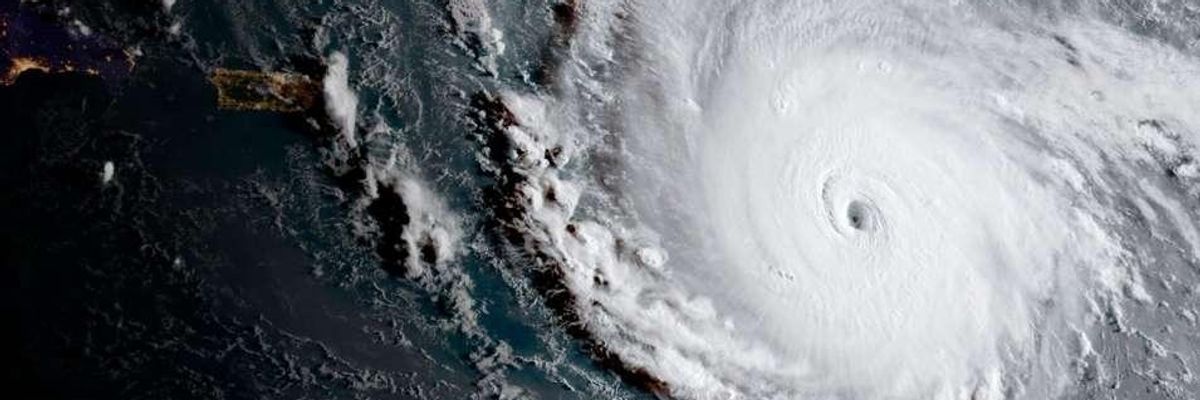
These are lives lost, lives turned upside down, forever changed by storms made much worse by climate change. But these storms are not alone this year. (Photo: NOAA)
I cannot help but wonder as I look at the images of the devastation caused by Hurricanes Iota and Eta across Central America, and if Big Oil had acted decades earlier to address climate change, whether these hurricanes would have happened at all.
We will never know the answer, of course. But as the skies clear and the weather calms, the death and devastation left behind by the hurricanes is all too heartbreakingly evident. Large parts of Nicaragua and Honduras remain under water.
The most recent hurricane Iota has left massive flooding in its wake, affecting some 400,000 people, with at least 20 deaths, and is being described as the most powerful hurricane in Nicaragua's history. The death-toll is likely to rise though as the flood waters recede.
Hurricane Eta, which struck two weeks earlier, also left hundreds of thousands homeless, but killed an estimated 150 people. Nearly 3 million people in Honduras were affected by Eta.
These are lives lost, lives turned upside down, forever changed by storms made much worse by climate change. But these storms are not alone this year.
As the Washington Post noted yesterday: "Ten storms rapidly intensified this Atlantic season, some to a record degree...The 2020 season will go down in history for the dominance of the fast-blooming storms that prowled the Atlantic, raising the question of whether this is the new normal."
It never had to be this way. It should not have been this way. If Shell or Exxon had acted 35 years ago our present would be very different and our future much brighter.
Meteorologist Jim Kossin, of the National Oceanic and Atmospheric Administration, told the paper that that hurricanes had become much more intense over the last 35 years. Kossin concluded, "the warmer than normal waters have certainly contributed to the rapid and explosive intensification events this year, and it's very likely that part of that warming is due to human activities."
It never had to be this way. It should not have been this way. If Shell or Exxon had acted 35 years ago our present would be very different and our future much brighter.
The blinkered addition of the companies to their fossil fuel addiction has not only cost lives and misery across the globe, most recently in Central America, but it is also causing the companies and their investors to lose money. Loads of it.
As I have written many times before, OCI and others have warned that due to climate change many reserves the companies hold will end up being "stranded" due to climate change and the ever cheaper cost of renewables.
For example, in 2013, I wrote: "For over a decade now a growing band of activists and enlightened financiers have argued that if we are going to tackle climate change then a proportion of fossil fuels have to stay in the ground."
I added: "The vast reserves of oil and gas held by major international companies such as BP and Shell are not assets - they are, in fact, liabilities. Their reserves are in effect unburnable carbon."
The warning signs have been there for years, but COVID-19 has accelerated the transition away from oil, as demand has plummeted.
This has led to the largest oil companies - and their investors - being ever more exposed than they were before.
As an article in Platts S&P Global outlined today, quoting work from our colleagues at Carbon Tracker: "low prices in 2020 have already side-lined about a third of global oil and gas investments, raising concerns on the potential for future 'stranded assets'."
Despite the warnings for years that we cannot burn new reserves of oil if we want a livable climate, Platts pointed out that the West's top nine oil majors alone are sitting on more than 28 billion barrels of oil equivalent of undeveloped resources. Much of this could end up going from being an asset to a liability, just as many predicted.
The bottom line is that if these companies drill that oil, our climate crisis will get worse. And if they abandon their projects, their investors will lose billions. It is an existential avoidable crisis of their own making. Exxon knew about the risks of climate change decades ago; so too did Shell.
Their decades' long addiction to oil rather than transformation has cost the companies hundreds of billions, with the European oil and gas companies alone having lost over $400 billion in market value this year alone.
In the meantime, blinkered and belligerent, the companies drill on. Last year alone, 15 projects sanctioned by the international oil companies, with a combined $60 billion in investment, risk becoming stranded assets, including ExxonMobil's $10 billion Golden Pass US LNG project, Chevron's $6.3 billion deepwater Anchor US oil project, and Shell's $3.9 billion deepwater Mero Sepetiba project in Brazil.
If these are developed we will face more hurricanes ripping communities and lives apart as our climate emergency intensifies. It did not have to be this way. It should never had to be that way.
I cannot but help wonder what life would be like if these companies had acted responsibly decades ago.
Dear Common Dreams reader, It’s been nearly 30 years since I co-founded Common Dreams with my late wife, Lina Newhouser. We had the radical notion that journalism should serve the public good, not corporate profits. It was clear to us from the outset what it would take to build such a project. No paid advertisements. No corporate sponsors. No millionaire publisher telling us what to think or do. Many people said we wouldn't last a year, but we proved those doubters wrong. Together with a tremendous team of journalists and dedicated staff, we built an independent media outlet free from the constraints of profits and corporate control. Our mission has always been simple: To inform. To inspire. To ignite change for the common good. Building Common Dreams was not easy. Our survival was never guaranteed. When you take on the most powerful forces—Wall Street greed, fossil fuel industry destruction, Big Tech lobbyists, and uber-rich oligarchs who have spent billions upon billions rigging the economy and democracy in their favor—the only bulwark you have is supporters who believe in your work. But here’s the urgent message from me today. It's never been this bad out there. And it's never been this hard to keep us going. At the very moment Common Dreams is most needed, the threats we face are intensifying. We need your support now more than ever. We don't accept corporate advertising and never will. We don't have a paywall because we don't think people should be blocked from critical news based on their ability to pay. Everything we do is funded by the donations of readers like you. When everyone does the little they can afford, we are strong. But if that support retreats or dries up, so do we. Will you donate now to make sure Common Dreams not only survives but thrives? —Craig Brown, Co-founder |
I cannot help but wonder as I look at the images of the devastation caused by Hurricanes Iota and Eta across Central America, and if Big Oil had acted decades earlier to address climate change, whether these hurricanes would have happened at all.
We will never know the answer, of course. But as the skies clear and the weather calms, the death and devastation left behind by the hurricanes is all too heartbreakingly evident. Large parts of Nicaragua and Honduras remain under water.
The most recent hurricane Iota has left massive flooding in its wake, affecting some 400,000 people, with at least 20 deaths, and is being described as the most powerful hurricane in Nicaragua's history. The death-toll is likely to rise though as the flood waters recede.
Hurricane Eta, which struck two weeks earlier, also left hundreds of thousands homeless, but killed an estimated 150 people. Nearly 3 million people in Honduras were affected by Eta.
These are lives lost, lives turned upside down, forever changed by storms made much worse by climate change. But these storms are not alone this year.
As the Washington Post noted yesterday: "Ten storms rapidly intensified this Atlantic season, some to a record degree...The 2020 season will go down in history for the dominance of the fast-blooming storms that prowled the Atlantic, raising the question of whether this is the new normal."
It never had to be this way. It should not have been this way. If Shell or Exxon had acted 35 years ago our present would be very different and our future much brighter.
Meteorologist Jim Kossin, of the National Oceanic and Atmospheric Administration, told the paper that that hurricanes had become much more intense over the last 35 years. Kossin concluded, "the warmer than normal waters have certainly contributed to the rapid and explosive intensification events this year, and it's very likely that part of that warming is due to human activities."
It never had to be this way. It should not have been this way. If Shell or Exxon had acted 35 years ago our present would be very different and our future much brighter.
The blinkered addition of the companies to their fossil fuel addiction has not only cost lives and misery across the globe, most recently in Central America, but it is also causing the companies and their investors to lose money. Loads of it.
As I have written many times before, OCI and others have warned that due to climate change many reserves the companies hold will end up being "stranded" due to climate change and the ever cheaper cost of renewables.
For example, in 2013, I wrote: "For over a decade now a growing band of activists and enlightened financiers have argued that if we are going to tackle climate change then a proportion of fossil fuels have to stay in the ground."
I added: "The vast reserves of oil and gas held by major international companies such as BP and Shell are not assets - they are, in fact, liabilities. Their reserves are in effect unburnable carbon."
The warning signs have been there for years, but COVID-19 has accelerated the transition away from oil, as demand has plummeted.
This has led to the largest oil companies - and their investors - being ever more exposed than they were before.
As an article in Platts S&P Global outlined today, quoting work from our colleagues at Carbon Tracker: "low prices in 2020 have already side-lined about a third of global oil and gas investments, raising concerns on the potential for future 'stranded assets'."
Despite the warnings for years that we cannot burn new reserves of oil if we want a livable climate, Platts pointed out that the West's top nine oil majors alone are sitting on more than 28 billion barrels of oil equivalent of undeveloped resources. Much of this could end up going from being an asset to a liability, just as many predicted.
The bottom line is that if these companies drill that oil, our climate crisis will get worse. And if they abandon their projects, their investors will lose billions. It is an existential avoidable crisis of their own making. Exxon knew about the risks of climate change decades ago; so too did Shell.
Their decades' long addiction to oil rather than transformation has cost the companies hundreds of billions, with the European oil and gas companies alone having lost over $400 billion in market value this year alone.
In the meantime, blinkered and belligerent, the companies drill on. Last year alone, 15 projects sanctioned by the international oil companies, with a combined $60 billion in investment, risk becoming stranded assets, including ExxonMobil's $10 billion Golden Pass US LNG project, Chevron's $6.3 billion deepwater Anchor US oil project, and Shell's $3.9 billion deepwater Mero Sepetiba project in Brazil.
If these are developed we will face more hurricanes ripping communities and lives apart as our climate emergency intensifies. It did not have to be this way. It should never had to be that way.
I cannot but help wonder what life would be like if these companies had acted responsibly decades ago.
I cannot help but wonder as I look at the images of the devastation caused by Hurricanes Iota and Eta across Central America, and if Big Oil had acted decades earlier to address climate change, whether these hurricanes would have happened at all.
We will never know the answer, of course. But as the skies clear and the weather calms, the death and devastation left behind by the hurricanes is all too heartbreakingly evident. Large parts of Nicaragua and Honduras remain under water.
The most recent hurricane Iota has left massive flooding in its wake, affecting some 400,000 people, with at least 20 deaths, and is being described as the most powerful hurricane in Nicaragua's history. The death-toll is likely to rise though as the flood waters recede.
Hurricane Eta, which struck two weeks earlier, also left hundreds of thousands homeless, but killed an estimated 150 people. Nearly 3 million people in Honduras were affected by Eta.
These are lives lost, lives turned upside down, forever changed by storms made much worse by climate change. But these storms are not alone this year.
As the Washington Post noted yesterday: "Ten storms rapidly intensified this Atlantic season, some to a record degree...The 2020 season will go down in history for the dominance of the fast-blooming storms that prowled the Atlantic, raising the question of whether this is the new normal."
It never had to be this way. It should not have been this way. If Shell or Exxon had acted 35 years ago our present would be very different and our future much brighter.
Meteorologist Jim Kossin, of the National Oceanic and Atmospheric Administration, told the paper that that hurricanes had become much more intense over the last 35 years. Kossin concluded, "the warmer than normal waters have certainly contributed to the rapid and explosive intensification events this year, and it's very likely that part of that warming is due to human activities."
It never had to be this way. It should not have been this way. If Shell or Exxon had acted 35 years ago our present would be very different and our future much brighter.
The blinkered addition of the companies to their fossil fuel addiction has not only cost lives and misery across the globe, most recently in Central America, but it is also causing the companies and their investors to lose money. Loads of it.
As I have written many times before, OCI and others have warned that due to climate change many reserves the companies hold will end up being "stranded" due to climate change and the ever cheaper cost of renewables.
For example, in 2013, I wrote: "For over a decade now a growing band of activists and enlightened financiers have argued that if we are going to tackle climate change then a proportion of fossil fuels have to stay in the ground."
I added: "The vast reserves of oil and gas held by major international companies such as BP and Shell are not assets - they are, in fact, liabilities. Their reserves are in effect unburnable carbon."
The warning signs have been there for years, but COVID-19 has accelerated the transition away from oil, as demand has plummeted.
This has led to the largest oil companies - and their investors - being ever more exposed than they were before.
As an article in Platts S&P Global outlined today, quoting work from our colleagues at Carbon Tracker: "low prices in 2020 have already side-lined about a third of global oil and gas investments, raising concerns on the potential for future 'stranded assets'."
Despite the warnings for years that we cannot burn new reserves of oil if we want a livable climate, Platts pointed out that the West's top nine oil majors alone are sitting on more than 28 billion barrels of oil equivalent of undeveloped resources. Much of this could end up going from being an asset to a liability, just as many predicted.
The bottom line is that if these companies drill that oil, our climate crisis will get worse. And if they abandon their projects, their investors will lose billions. It is an existential avoidable crisis of their own making. Exxon knew about the risks of climate change decades ago; so too did Shell.
Their decades' long addiction to oil rather than transformation has cost the companies hundreds of billions, with the European oil and gas companies alone having lost over $400 billion in market value this year alone.
In the meantime, blinkered and belligerent, the companies drill on. Last year alone, 15 projects sanctioned by the international oil companies, with a combined $60 billion in investment, risk becoming stranded assets, including ExxonMobil's $10 billion Golden Pass US LNG project, Chevron's $6.3 billion deepwater Anchor US oil project, and Shell's $3.9 billion deepwater Mero Sepetiba project in Brazil.
If these are developed we will face more hurricanes ripping communities and lives apart as our climate emergency intensifies. It did not have to be this way. It should never had to be that way.
I cannot but help wonder what life would be like if these companies had acted responsibly decades ago.