SUBSCRIBE TO OUR FREE NEWSLETTER
Daily news & progressive opinion—funded by the people, not the corporations—delivered straight to your inbox.
5
#000000
#FFFFFF
To donate by check, phone, or other method, see our More Ways to Give page.
Daily news & progressive opinion—funded by the people, not the corporations—delivered straight to your inbox.
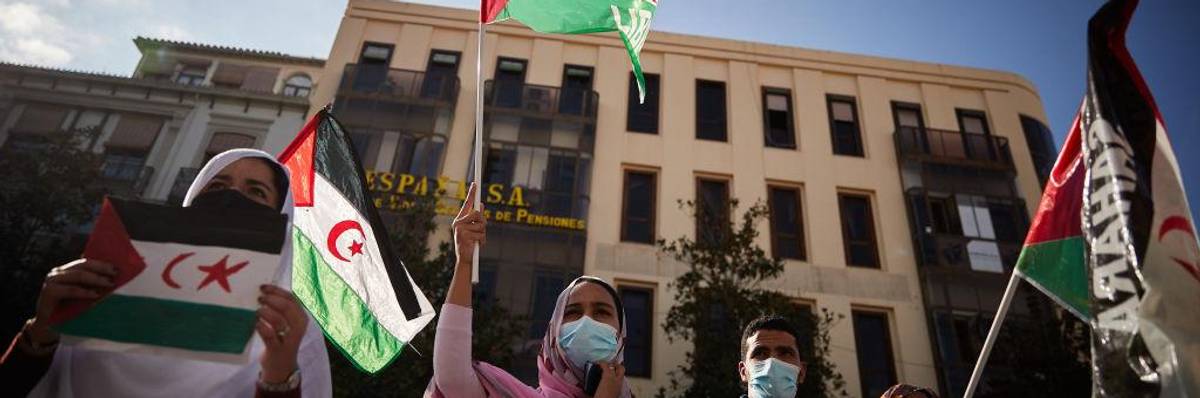
A woman waves a Saharan flag with text Free Sahara during a demonstration to demand the end of Morocco's occupation in Western Sahara, in support of the Polisario Front in Granada on November 21, 2020. Cities throughout Spain have demonstrated in favor to self-determination in Western Sahara and to denounce the violation of the 1991 ceasefire agreements last week. This has triggered the resumption of the armed conflict between the Moroccan army and the Polisario Front. (Photo by Fermin Rodriguez/NurPhoto via Getty Images)
The United States needs to end its support for Moroccan human rights abuses and its occupation of Western Sahara. Last month, Sahrawis who were wearied with the Moroccan occupation, nonviolently blocked traffic in a narrow 5 km demilitarized area (buffer zone) between Moroccan-occupied Western Sahara and Mauritania. The Sahrawis rightly claimed that the demilitarized area was being exploited to the benefit of Morocco and not to the Sahrawis. Morocco broke the cease-fire by entering the buffer zone, attacking the nonviolent protesters, and re-opened the illegal border trade route. In response, the Polisario Front of Western Sahara ended the cease-fire and declared renewed war on Morocco. War is not the answer...and yet un-ending occupation is not the answer either. We do not want to see a single Moroccan or Sahrawi killed when the entire world agrees on how to resolve this issue nonviolently.
Sadly, the U.S. government has provided vast economic and military support to the Moroccan government. Last year Morocco purchased $10.3 billion in weapons from the US, totalling more than Egypt, Israel, Saudi Arabia and UAE combined.
The Moroccan government invaded and has occupied the Western Sahara since Spain withdrew in 1975. From then until 1991, there was a war between the Moroccan Government and the Polisario Front, which fought and campaigned for independence. In 1991, under the auspices of the UN, a cease-fire agreement was announced with Morocco controlling about 80% of the country. The cease-fire and occupation have continued for 29 years causing more damage to the land and suffering to the people of Western Sahara.
There is widespread nonviolent resistance to Moroccan rule, led in large part by women such as RFK Human Rights Laureate Aminatou Haidar. Sahrawis have protested, boycotted and at one point in 2010 even deserted the capitol to create a tent-city in the desert. Many have been tortured, imprisoned and killed. Sahrawi allies in Africa and Europe have launched solidarity boycotts and seized Moroccan contraband. Since 2012, international funds, including the National Employment Savings Trust in the UK, the Netherlands' APG, the Norwegian Government Pension Fund, AP Funds in Sweden, and FDC (Luxembourg) have divested from companies that extract resources from Western Sahara for ethical reasons.
Tensions have risen since the nonviolent road block and Morocco's attack. Many young urban Sahrarwis were abducted this week by the police, tortured and then dumped in the outskirts of cities. Some other Saharawi activists have been jailed and await trial for crimes they did not commit.
The plunder of natural resources continues despite all UN resolutions, European court rulings, and its special UN status as a non-self governing territory. The people of Western Sahara living under occupation are impoverished and marginalized while more numerous settlers are benefitting from the resources of Western Sahara with the blessing of the Moroccan government.
Sadly, the U.S. government has provided vast economic and military support to the Moroccan government. Last year Morocco purchased $10.3 billion in weapons from the US, totalling more than Egypt, Israel, Saudi Arabia and UAE combined.
There is much a Biden/Harris administration can do to help Morocco end its occupation of Western Sahara. The US government, corporations and civil society should:
The world has known how to nonviolently resolve this issue since 1963, when the United Nations called for a referendum on its future status. Morocco has refused to cooperate. We must act swiftly to prevent war and further conflict, end the occupation, and allow Sahrawis to make their decision on union with Morocco or independence.
There is potentially bi-partisan support for this approach. Senator Inhofe (R-OK) and Senator Leahy have spoken out strongly for the rights of the Sahrawi for self-determination. However, we also need Democrats and other Republicans to stand up and speak up for international law and to condemn attacks on nonviolent protesters and the occupation. Their silence is deafening.
Dear Common Dreams reader, It’s been nearly 30 years since I co-founded Common Dreams with my late wife, Lina Newhouser. We had the radical notion that journalism should serve the public good, not corporate profits. It was clear to us from the outset what it would take to build such a project. No paid advertisements. No corporate sponsors. No millionaire publisher telling us what to think or do. Many people said we wouldn't last a year, but we proved those doubters wrong. Together with a tremendous team of journalists and dedicated staff, we built an independent media outlet free from the constraints of profits and corporate control. Our mission has always been simple: To inform. To inspire. To ignite change for the common good. Building Common Dreams was not easy. Our survival was never guaranteed. When you take on the most powerful forces—Wall Street greed, fossil fuel industry destruction, Big Tech lobbyists, and uber-rich oligarchs who have spent billions upon billions rigging the economy and democracy in their favor—the only bulwark you have is supporters who believe in your work. But here’s the urgent message from me today. It's never been this bad out there. And it's never been this hard to keep us going. At the very moment Common Dreams is most needed, the threats we face are intensifying. We need your support now more than ever. We don't accept corporate advertising and never will. We don't have a paywall because we don't think people should be blocked from critical news based on their ability to pay. Everything we do is funded by the donations of readers like you. When everyone does the little they can afford, we are strong. But if that support retreats or dries up, so do we. Will you donate now to make sure Common Dreams not only survives but thrives? —Craig Brown, Co-founder |
The United States needs to end its support for Moroccan human rights abuses and its occupation of Western Sahara. Last month, Sahrawis who were wearied with the Moroccan occupation, nonviolently blocked traffic in a narrow 5 km demilitarized area (buffer zone) between Moroccan-occupied Western Sahara and Mauritania. The Sahrawis rightly claimed that the demilitarized area was being exploited to the benefit of Morocco and not to the Sahrawis. Morocco broke the cease-fire by entering the buffer zone, attacking the nonviolent protesters, and re-opened the illegal border trade route. In response, the Polisario Front of Western Sahara ended the cease-fire and declared renewed war on Morocco. War is not the answer...and yet un-ending occupation is not the answer either. We do not want to see a single Moroccan or Sahrawi killed when the entire world agrees on how to resolve this issue nonviolently.
Sadly, the U.S. government has provided vast economic and military support to the Moroccan government. Last year Morocco purchased $10.3 billion in weapons from the US, totalling more than Egypt, Israel, Saudi Arabia and UAE combined.
The Moroccan government invaded and has occupied the Western Sahara since Spain withdrew in 1975. From then until 1991, there was a war between the Moroccan Government and the Polisario Front, which fought and campaigned for independence. In 1991, under the auspices of the UN, a cease-fire agreement was announced with Morocco controlling about 80% of the country. The cease-fire and occupation have continued for 29 years causing more damage to the land and suffering to the people of Western Sahara.
There is widespread nonviolent resistance to Moroccan rule, led in large part by women such as RFK Human Rights Laureate Aminatou Haidar. Sahrawis have protested, boycotted and at one point in 2010 even deserted the capitol to create a tent-city in the desert. Many have been tortured, imprisoned and killed. Sahrawi allies in Africa and Europe have launched solidarity boycotts and seized Moroccan contraband. Since 2012, international funds, including the National Employment Savings Trust in the UK, the Netherlands' APG, the Norwegian Government Pension Fund, AP Funds in Sweden, and FDC (Luxembourg) have divested from companies that extract resources from Western Sahara for ethical reasons.
Tensions have risen since the nonviolent road block and Morocco's attack. Many young urban Sahrarwis were abducted this week by the police, tortured and then dumped in the outskirts of cities. Some other Saharawi activists have been jailed and await trial for crimes they did not commit.
The plunder of natural resources continues despite all UN resolutions, European court rulings, and its special UN status as a non-self governing territory. The people of Western Sahara living under occupation are impoverished and marginalized while more numerous settlers are benefitting from the resources of Western Sahara with the blessing of the Moroccan government.
Sadly, the U.S. government has provided vast economic and military support to the Moroccan government. Last year Morocco purchased $10.3 billion in weapons from the US, totalling more than Egypt, Israel, Saudi Arabia and UAE combined.
There is much a Biden/Harris administration can do to help Morocco end its occupation of Western Sahara. The US government, corporations and civil society should:
The world has known how to nonviolently resolve this issue since 1963, when the United Nations called for a referendum on its future status. Morocco has refused to cooperate. We must act swiftly to prevent war and further conflict, end the occupation, and allow Sahrawis to make their decision on union with Morocco or independence.
There is potentially bi-partisan support for this approach. Senator Inhofe (R-OK) and Senator Leahy have spoken out strongly for the rights of the Sahrawi for self-determination. However, we also need Democrats and other Republicans to stand up and speak up for international law and to condemn attacks on nonviolent protesters and the occupation. Their silence is deafening.
The United States needs to end its support for Moroccan human rights abuses and its occupation of Western Sahara. Last month, Sahrawis who were wearied with the Moroccan occupation, nonviolently blocked traffic in a narrow 5 km demilitarized area (buffer zone) between Moroccan-occupied Western Sahara and Mauritania. The Sahrawis rightly claimed that the demilitarized area was being exploited to the benefit of Morocco and not to the Sahrawis. Morocco broke the cease-fire by entering the buffer zone, attacking the nonviolent protesters, and re-opened the illegal border trade route. In response, the Polisario Front of Western Sahara ended the cease-fire and declared renewed war on Morocco. War is not the answer...and yet un-ending occupation is not the answer either. We do not want to see a single Moroccan or Sahrawi killed when the entire world agrees on how to resolve this issue nonviolently.
Sadly, the U.S. government has provided vast economic and military support to the Moroccan government. Last year Morocco purchased $10.3 billion in weapons from the US, totalling more than Egypt, Israel, Saudi Arabia and UAE combined.
The Moroccan government invaded and has occupied the Western Sahara since Spain withdrew in 1975. From then until 1991, there was a war between the Moroccan Government and the Polisario Front, which fought and campaigned for independence. In 1991, under the auspices of the UN, a cease-fire agreement was announced with Morocco controlling about 80% of the country. The cease-fire and occupation have continued for 29 years causing more damage to the land and suffering to the people of Western Sahara.
There is widespread nonviolent resistance to Moroccan rule, led in large part by women such as RFK Human Rights Laureate Aminatou Haidar. Sahrawis have protested, boycotted and at one point in 2010 even deserted the capitol to create a tent-city in the desert. Many have been tortured, imprisoned and killed. Sahrawi allies in Africa and Europe have launched solidarity boycotts and seized Moroccan contraband. Since 2012, international funds, including the National Employment Savings Trust in the UK, the Netherlands' APG, the Norwegian Government Pension Fund, AP Funds in Sweden, and FDC (Luxembourg) have divested from companies that extract resources from Western Sahara for ethical reasons.
Tensions have risen since the nonviolent road block and Morocco's attack. Many young urban Sahrarwis were abducted this week by the police, tortured and then dumped in the outskirts of cities. Some other Saharawi activists have been jailed and await trial for crimes they did not commit.
The plunder of natural resources continues despite all UN resolutions, European court rulings, and its special UN status as a non-self governing territory. The people of Western Sahara living under occupation are impoverished and marginalized while more numerous settlers are benefitting from the resources of Western Sahara with the blessing of the Moroccan government.
Sadly, the U.S. government has provided vast economic and military support to the Moroccan government. Last year Morocco purchased $10.3 billion in weapons from the US, totalling more than Egypt, Israel, Saudi Arabia and UAE combined.
There is much a Biden/Harris administration can do to help Morocco end its occupation of Western Sahara. The US government, corporations and civil society should:
The world has known how to nonviolently resolve this issue since 1963, when the United Nations called for a referendum on its future status. Morocco has refused to cooperate. We must act swiftly to prevent war and further conflict, end the occupation, and allow Sahrawis to make their decision on union with Morocco or independence.
There is potentially bi-partisan support for this approach. Senator Inhofe (R-OK) and Senator Leahy have spoken out strongly for the rights of the Sahrawi for self-determination. However, we also need Democrats and other Republicans to stand up and speak up for international law and to condemn attacks on nonviolent protesters and the occupation. Their silence is deafening.