SUBSCRIBE TO OUR FREE NEWSLETTER
Daily news & progressive opinion—funded by the people, not the corporations—delivered straight to your inbox.
5
#000000
#FFFFFF
To donate by check, phone, or other method, see our More Ways to Give page.
Daily news & progressive opinion—funded by the people, not the corporations—delivered straight to your inbox.
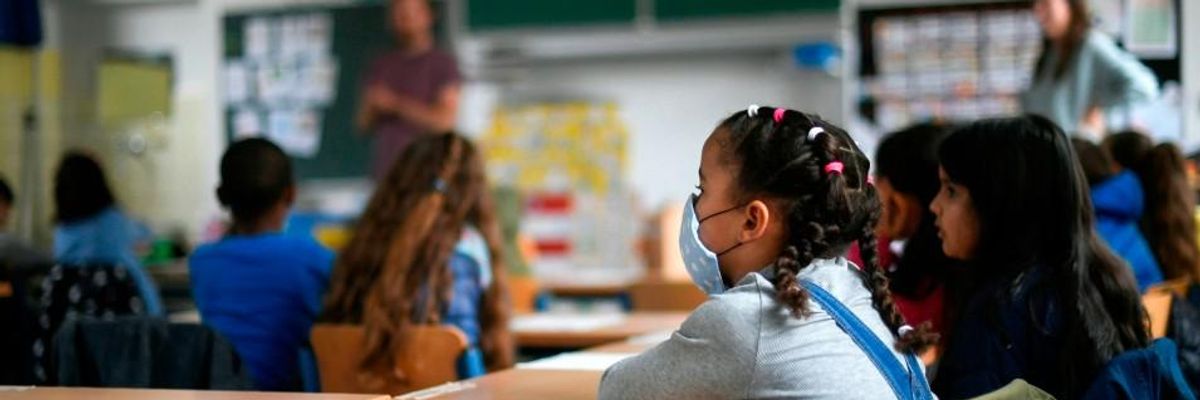
A girl wears a face mask as students sit in a classroom of the Petri primary school in Dortmund, western Germany on June 15, 2020. (Photo: Ina Fassbender/AFP via Getty Images)
As the semester ends, I fear many of my students will fail my class. Most will pass, thanks to their hard work and a generous grade curve, but I've never had this many students failing or dropping the course before.
In my experience, low grades mean something is wrong. Often the problem is mental health. Sometimes the problem is something temporary but difficult in the student's life, like a death in the family.
The Washington Post reports that an unprecedented number of students are failing classes, but asks whether standard A-F grading, as opposed to a simple Pass/Fail, is fair during a pandemic. I think the question is bigger than that.
My questions are: What should our role be as teachers? And what prepares students best for future success in life?
As a student myself, I mostly accepted the system as it was. I accepted that my grades were a legitimate assessment of my work.
That changed as soon as I began teaching. I could see that my students' grades depended on the capability of my teaching and how high I set the bar, as well as on their own work.
I see teaching and learning as an interaction between teacher and student. I get written feedback from every student after every class because I want the class to work for them, and I check in on students immediately when they start to fall behind. I don't scold them. I ask, "How are you doing? What can I do to help?"
Low grades are not a sign of lazy students. Low grades are not a sign of unintelligent students. In my experience, low grades mean something is wrong. Often the problem is mental health. Sometimes the problem is something temporary but difficult in the student's life, like a death in the family.
If the entire class does poorly together, on the other hand, it means I messed up as the teacher.
I view part of my job as helping students learn how to learn. I help them navigate the university to get the resources they need and reflect on what works best for them and what doesn't. I normalize struggling and making mistakes, because it's part of learning--something that's even more true now.
When I ask my students this semester about how they're doing, they describe working harder while comprehending and retaining less. They describe a lack of motivation. These are signs of mental health problems--no doubt a normal response to an abnormal situation. This can't be fixed by asking students to work harder.
How is it ethical to give students a "normal" amount of work and grade them the same as usual on it? We are not in normal times, and we shouldn't pretend like we are.
Debating the merits of A-F grades compared to Pass/Fail misses that the problem isn't giving students grades. The problem is holding them to unrealistic standards during a pandemic.
The message teachers got when we went online last semester was: "Your class is NOT the highest priority of students' OR your life right now. Release yourself from high expectations right now, because that's the best way to help your students learn."
That's still true--and it will remain true until the pandemic ends. The best we can do, for now, is to meet the students where they are and help them learn what they are capable of learning under these conditions, without penalizing them for being unable to do more.
Long term, we should take lessons from this time. Students don't fail because they are lazy. They fail because something is wrong in their lives. We should stop punishing and blaming them and adopt a more supportive approach instead.
Dear Common Dreams reader, It’s been nearly 30 years since I co-founded Common Dreams with my late wife, Lina Newhouser. We had the radical notion that journalism should serve the public good, not corporate profits. It was clear to us from the outset what it would take to build such a project. No paid advertisements. No corporate sponsors. No millionaire publisher telling us what to think or do. Many people said we wouldn't last a year, but we proved those doubters wrong. Together with a tremendous team of journalists and dedicated staff, we built an independent media outlet free from the constraints of profits and corporate control. Our mission has always been simple: To inform. To inspire. To ignite change for the common good. Building Common Dreams was not easy. Our survival was never guaranteed. When you take on the most powerful forces—Wall Street greed, fossil fuel industry destruction, Big Tech lobbyists, and uber-rich oligarchs who have spent billions upon billions rigging the economy and democracy in their favor—the only bulwark you have is supporters who believe in your work. But here’s the urgent message from me today. It's never been this bad out there. And it's never been this hard to keep us going. At the very moment Common Dreams is most needed, the threats we face are intensifying. We need your support now more than ever. We don't accept corporate advertising and never will. We don't have a paywall because we don't think people should be blocked from critical news based on their ability to pay. Everything we do is funded by the donations of readers like you. When everyone does the little they can afford, we are strong. But if that support retreats or dries up, so do we. Will you donate now to make sure Common Dreams not only survives but thrives? —Craig Brown, Co-founder |
As the semester ends, I fear many of my students will fail my class. Most will pass, thanks to their hard work and a generous grade curve, but I've never had this many students failing or dropping the course before.
In my experience, low grades mean something is wrong. Often the problem is mental health. Sometimes the problem is something temporary but difficult in the student's life, like a death in the family.
The Washington Post reports that an unprecedented number of students are failing classes, but asks whether standard A-F grading, as opposed to a simple Pass/Fail, is fair during a pandemic. I think the question is bigger than that.
My questions are: What should our role be as teachers? And what prepares students best for future success in life?
As a student myself, I mostly accepted the system as it was. I accepted that my grades were a legitimate assessment of my work.
That changed as soon as I began teaching. I could see that my students' grades depended on the capability of my teaching and how high I set the bar, as well as on their own work.
I see teaching and learning as an interaction between teacher and student. I get written feedback from every student after every class because I want the class to work for them, and I check in on students immediately when they start to fall behind. I don't scold them. I ask, "How are you doing? What can I do to help?"
Low grades are not a sign of lazy students. Low grades are not a sign of unintelligent students. In my experience, low grades mean something is wrong. Often the problem is mental health. Sometimes the problem is something temporary but difficult in the student's life, like a death in the family.
If the entire class does poorly together, on the other hand, it means I messed up as the teacher.
I view part of my job as helping students learn how to learn. I help them navigate the university to get the resources they need and reflect on what works best for them and what doesn't. I normalize struggling and making mistakes, because it's part of learning--something that's even more true now.
When I ask my students this semester about how they're doing, they describe working harder while comprehending and retaining less. They describe a lack of motivation. These are signs of mental health problems--no doubt a normal response to an abnormal situation. This can't be fixed by asking students to work harder.
How is it ethical to give students a "normal" amount of work and grade them the same as usual on it? We are not in normal times, and we shouldn't pretend like we are.
Debating the merits of A-F grades compared to Pass/Fail misses that the problem isn't giving students grades. The problem is holding them to unrealistic standards during a pandemic.
The message teachers got when we went online last semester was: "Your class is NOT the highest priority of students' OR your life right now. Release yourself from high expectations right now, because that's the best way to help your students learn."
That's still true--and it will remain true until the pandemic ends. The best we can do, for now, is to meet the students where they are and help them learn what they are capable of learning under these conditions, without penalizing them for being unable to do more.
Long term, we should take lessons from this time. Students don't fail because they are lazy. They fail because something is wrong in their lives. We should stop punishing and blaming them and adopt a more supportive approach instead.
As the semester ends, I fear many of my students will fail my class. Most will pass, thanks to their hard work and a generous grade curve, but I've never had this many students failing or dropping the course before.
In my experience, low grades mean something is wrong. Often the problem is mental health. Sometimes the problem is something temporary but difficult in the student's life, like a death in the family.
The Washington Post reports that an unprecedented number of students are failing classes, but asks whether standard A-F grading, as opposed to a simple Pass/Fail, is fair during a pandemic. I think the question is bigger than that.
My questions are: What should our role be as teachers? And what prepares students best for future success in life?
As a student myself, I mostly accepted the system as it was. I accepted that my grades were a legitimate assessment of my work.
That changed as soon as I began teaching. I could see that my students' grades depended on the capability of my teaching and how high I set the bar, as well as on their own work.
I see teaching and learning as an interaction between teacher and student. I get written feedback from every student after every class because I want the class to work for them, and I check in on students immediately when they start to fall behind. I don't scold them. I ask, "How are you doing? What can I do to help?"
Low grades are not a sign of lazy students. Low grades are not a sign of unintelligent students. In my experience, low grades mean something is wrong. Often the problem is mental health. Sometimes the problem is something temporary but difficult in the student's life, like a death in the family.
If the entire class does poorly together, on the other hand, it means I messed up as the teacher.
I view part of my job as helping students learn how to learn. I help them navigate the university to get the resources they need and reflect on what works best for them and what doesn't. I normalize struggling and making mistakes, because it's part of learning--something that's even more true now.
When I ask my students this semester about how they're doing, they describe working harder while comprehending and retaining less. They describe a lack of motivation. These are signs of mental health problems--no doubt a normal response to an abnormal situation. This can't be fixed by asking students to work harder.
How is it ethical to give students a "normal" amount of work and grade them the same as usual on it? We are not in normal times, and we shouldn't pretend like we are.
Debating the merits of A-F grades compared to Pass/Fail misses that the problem isn't giving students grades. The problem is holding them to unrealistic standards during a pandemic.
The message teachers got when we went online last semester was: "Your class is NOT the highest priority of students' OR your life right now. Release yourself from high expectations right now, because that's the best way to help your students learn."
That's still true--and it will remain true until the pandemic ends. The best we can do, for now, is to meet the students where they are and help them learn what they are capable of learning under these conditions, without penalizing them for being unable to do more.
Long term, we should take lessons from this time. Students don't fail because they are lazy. They fail because something is wrong in their lives. We should stop punishing and blaming them and adopt a more supportive approach instead.