SUBSCRIBE TO OUR FREE NEWSLETTER
Daily news & progressive opinion—funded by the people, not the corporations—delivered straight to your inbox.
5
#000000
#FFFFFF
To donate by check, phone, or other method, see our More Ways to Give page.
Daily news & progressive opinion—funded by the people, not the corporations—delivered straight to your inbox.
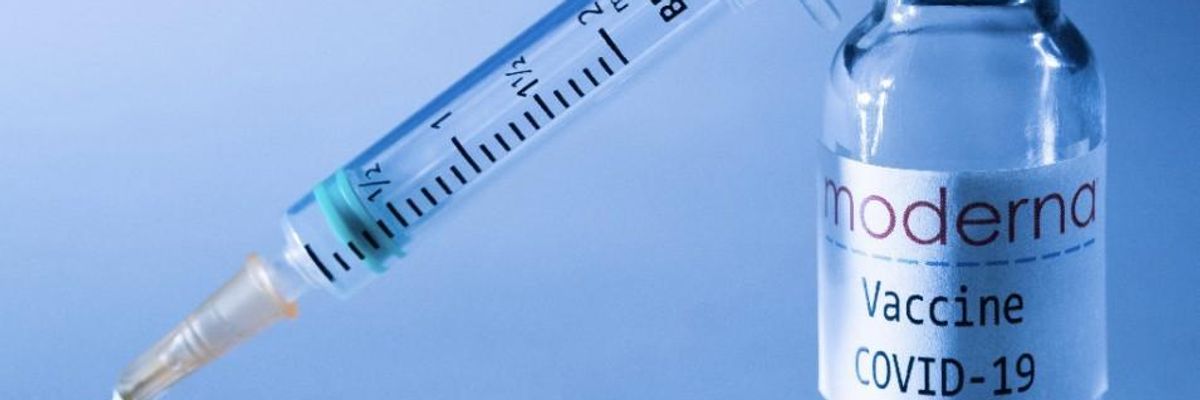
Moderna, a U.S. biotech firm, announced on November 16, 2020 that its experimental vaccine against Covid-19 was almost 95% effective. (Photo illustration: Joel Saget/AFP via Getty Images)
Our commercial media have followed the ups and downs of the vaccine roll out in the United States even as much less attention is devoted to the experience of poor nations. Pundits and TV anchors periodically acknowledge that lethal viruses don't respect borders but seldom discuss the political and economic implications of that truism. The recipes for vaccines also cross boundaries--in the highly privileged form of intellectual property. Too little attention has been paid to the role played by intellectual property in driving domestic and international inequities. The intellectual property regimes that have guided research and development are not only self-defeating in the short term they also slow the long term development of a science that will becomes even more crucial as pandemics becomes more common.
The World Health Organization (WHO) head points to this shocking statistic:
"Between them, G7 nations have secured enough vaccines for every one of their citizens to be vaccinated three times over, while many poor countries are yet to receive a single dose."
These nations are members of the World Trade Organization, which allows them to export to other member states without facing high tariff burdens. This is so called free trade. Nonetheless under most contemporary agreements it has been free trade with an increasingly important exception. Members must accept the patent standards enacted by other member states. A patent on a drug, medical device, or vaccine is a domestic monopoly governing who can produce, market, and distribute that item. Trade agreements extend that monopoly privilege and responsibility to the whole membership. Monopolies and oligopolies are usually very profitable for those who own them. Generally they limit production and increase prices in excess of what a competitive market would do.
The pharmaceutical giants and their lobbies maintain they need monopoly profits in order to fund the cutting edge research that has given us these highly efficacious vaccines.
Recent experience suggests a very different path to the miracle vaccines. Arthur Alan of Kaiser Health News writes:
The Moderna vaccine emerged directly out of a partnership between Moderna and Graham's NIH laboratory.
Those billions in excess profits are one reason the vaccines have yet to gain much of a foothold in poorer nations.
Coronavirus vaccines are likely to be worth billions to the drug industry if they prove safe and effective. As many as 14 billion vaccines would be required to immunize everyone in the world against COVID-19. If, as many scientists anticipate, vaccine-produced immunity wanes, billions more doses could be sold as booster shots in years to come."
Those billions in excess profits are one reason the vaccines have yet to gain much of a foothold in poorer nations. The United States has increased its commitment to the international effort by G-7 states to respond to this severe shortfall. "The USA committed initial $2 billion to Gavi, the Vaccine Alliance for the COVAX Advance Market Commitment and a further $2 billion through 2021 and 2022,..." (WHO Newsletter) Nonetheless COVAX remains almost 23 billion dollars short of its stated goal.
In response both to this inequity and to the continuing carnage inflicted even in advanced states a more grassroots initiative has emerged. "The People's Vaccine Alliance is a coalition of global and national organizations and activists united under a common aim of campaigning for a 'People's Vaccine.' The call for a People's Vaccine is backed by past and present world leaders, health experts, faith leaders and economists." People's vaccines would still receive direct government subsidies and would benefit from continuing R and D by government. They would, however, be required to meet stringent conditions. Their ongoing research must be posted and any discoveries posted in the public domain. And as in the case of a public utility prices would be limited to the standard competitive level. For more information visit: https://peoplesvaccine.org/
That pharmaceutical interests are resisting such efforts is hardly surprising. This initiative is a challenge to their whole business model. Nonetheless COVID-19 and its variants reduce poor nations to producers of pathogens that will continue to disrupt economic and social life in wealthy nations. There are good reasons for many business interests to join the People's Vaccine and/or the effort to suspend these draconian IP rules.
These rules not only exacerbate inequalities within and between nations they also distort and derail scientific progress. Scientists working in the interest of future patents will no longer share information or provide the kind of transparency on which many major discoveries depend. Even wealthy nations need all the popular involvement and creativity they can muster now.
Dear Common Dreams reader, It’s been nearly 30 years since I co-founded Common Dreams with my late wife, Lina Newhouser. We had the radical notion that journalism should serve the public good, not corporate profits. It was clear to us from the outset what it would take to build such a project. No paid advertisements. No corporate sponsors. No millionaire publisher telling us what to think or do. Many people said we wouldn't last a year, but we proved those doubters wrong. Together with a tremendous team of journalists and dedicated staff, we built an independent media outlet free from the constraints of profits and corporate control. Our mission has always been simple: To inform. To inspire. To ignite change for the common good. Building Common Dreams was not easy. Our survival was never guaranteed. When you take on the most powerful forces—Wall Street greed, fossil fuel industry destruction, Big Tech lobbyists, and uber-rich oligarchs who have spent billions upon billions rigging the economy and democracy in their favor—the only bulwark you have is supporters who believe in your work. But here’s the urgent message from me today. It's never been this bad out there. And it's never been this hard to keep us going. At the very moment Common Dreams is most needed, the threats we face are intensifying. We need your support now more than ever. We don't accept corporate advertising and never will. We don't have a paywall because we don't think people should be blocked from critical news based on their ability to pay. Everything we do is funded by the donations of readers like you. When everyone does the little they can afford, we are strong. But if that support retreats or dries up, so do we. Will you donate now to make sure Common Dreams not only survives but thrives? —Craig Brown, Co-founder |
Our commercial media have followed the ups and downs of the vaccine roll out in the United States even as much less attention is devoted to the experience of poor nations. Pundits and TV anchors periodically acknowledge that lethal viruses don't respect borders but seldom discuss the political and economic implications of that truism. The recipes for vaccines also cross boundaries--in the highly privileged form of intellectual property. Too little attention has been paid to the role played by intellectual property in driving domestic and international inequities. The intellectual property regimes that have guided research and development are not only self-defeating in the short term they also slow the long term development of a science that will becomes even more crucial as pandemics becomes more common.
The World Health Organization (WHO) head points to this shocking statistic:
"Between them, G7 nations have secured enough vaccines for every one of their citizens to be vaccinated three times over, while many poor countries are yet to receive a single dose."
These nations are members of the World Trade Organization, which allows them to export to other member states without facing high tariff burdens. This is so called free trade. Nonetheless under most contemporary agreements it has been free trade with an increasingly important exception. Members must accept the patent standards enacted by other member states. A patent on a drug, medical device, or vaccine is a domestic monopoly governing who can produce, market, and distribute that item. Trade agreements extend that monopoly privilege and responsibility to the whole membership. Monopolies and oligopolies are usually very profitable for those who own them. Generally they limit production and increase prices in excess of what a competitive market would do.
The pharmaceutical giants and their lobbies maintain they need monopoly profits in order to fund the cutting edge research that has given us these highly efficacious vaccines.
Recent experience suggests a very different path to the miracle vaccines. Arthur Alan of Kaiser Health News writes:
The Moderna vaccine emerged directly out of a partnership between Moderna and Graham's NIH laboratory.
Those billions in excess profits are one reason the vaccines have yet to gain much of a foothold in poorer nations.
Coronavirus vaccines are likely to be worth billions to the drug industry if they prove safe and effective. As many as 14 billion vaccines would be required to immunize everyone in the world against COVID-19. If, as many scientists anticipate, vaccine-produced immunity wanes, billions more doses could be sold as booster shots in years to come."
Those billions in excess profits are one reason the vaccines have yet to gain much of a foothold in poorer nations. The United States has increased its commitment to the international effort by G-7 states to respond to this severe shortfall. "The USA committed initial $2 billion to Gavi, the Vaccine Alliance for the COVAX Advance Market Commitment and a further $2 billion through 2021 and 2022,..." (WHO Newsletter) Nonetheless COVAX remains almost 23 billion dollars short of its stated goal.
In response both to this inequity and to the continuing carnage inflicted even in advanced states a more grassroots initiative has emerged. "The People's Vaccine Alliance is a coalition of global and national organizations and activists united under a common aim of campaigning for a 'People's Vaccine.' The call for a People's Vaccine is backed by past and present world leaders, health experts, faith leaders and economists." People's vaccines would still receive direct government subsidies and would benefit from continuing R and D by government. They would, however, be required to meet stringent conditions. Their ongoing research must be posted and any discoveries posted in the public domain. And as in the case of a public utility prices would be limited to the standard competitive level. For more information visit: https://peoplesvaccine.org/
That pharmaceutical interests are resisting such efforts is hardly surprising. This initiative is a challenge to their whole business model. Nonetheless COVID-19 and its variants reduce poor nations to producers of pathogens that will continue to disrupt economic and social life in wealthy nations. There are good reasons for many business interests to join the People's Vaccine and/or the effort to suspend these draconian IP rules.
These rules not only exacerbate inequalities within and between nations they also distort and derail scientific progress. Scientists working in the interest of future patents will no longer share information or provide the kind of transparency on which many major discoveries depend. Even wealthy nations need all the popular involvement and creativity they can muster now.
Our commercial media have followed the ups and downs of the vaccine roll out in the United States even as much less attention is devoted to the experience of poor nations. Pundits and TV anchors periodically acknowledge that lethal viruses don't respect borders but seldom discuss the political and economic implications of that truism. The recipes for vaccines also cross boundaries--in the highly privileged form of intellectual property. Too little attention has been paid to the role played by intellectual property in driving domestic and international inequities. The intellectual property regimes that have guided research and development are not only self-defeating in the short term they also slow the long term development of a science that will becomes even more crucial as pandemics becomes more common.
The World Health Organization (WHO) head points to this shocking statistic:
"Between them, G7 nations have secured enough vaccines for every one of their citizens to be vaccinated three times over, while many poor countries are yet to receive a single dose."
These nations are members of the World Trade Organization, which allows them to export to other member states without facing high tariff burdens. This is so called free trade. Nonetheless under most contemporary agreements it has been free trade with an increasingly important exception. Members must accept the patent standards enacted by other member states. A patent on a drug, medical device, or vaccine is a domestic monopoly governing who can produce, market, and distribute that item. Trade agreements extend that monopoly privilege and responsibility to the whole membership. Monopolies and oligopolies are usually very profitable for those who own them. Generally they limit production and increase prices in excess of what a competitive market would do.
The pharmaceutical giants and their lobbies maintain they need monopoly profits in order to fund the cutting edge research that has given us these highly efficacious vaccines.
Recent experience suggests a very different path to the miracle vaccines. Arthur Alan of Kaiser Health News writes:
The Moderna vaccine emerged directly out of a partnership between Moderna and Graham's NIH laboratory.
Those billions in excess profits are one reason the vaccines have yet to gain much of a foothold in poorer nations.
Coronavirus vaccines are likely to be worth billions to the drug industry if they prove safe and effective. As many as 14 billion vaccines would be required to immunize everyone in the world against COVID-19. If, as many scientists anticipate, vaccine-produced immunity wanes, billions more doses could be sold as booster shots in years to come."
Those billions in excess profits are one reason the vaccines have yet to gain much of a foothold in poorer nations. The United States has increased its commitment to the international effort by G-7 states to respond to this severe shortfall. "The USA committed initial $2 billion to Gavi, the Vaccine Alliance for the COVAX Advance Market Commitment and a further $2 billion through 2021 and 2022,..." (WHO Newsletter) Nonetheless COVAX remains almost 23 billion dollars short of its stated goal.
In response both to this inequity and to the continuing carnage inflicted even in advanced states a more grassroots initiative has emerged. "The People's Vaccine Alliance is a coalition of global and national organizations and activists united under a common aim of campaigning for a 'People's Vaccine.' The call for a People's Vaccine is backed by past and present world leaders, health experts, faith leaders and economists." People's vaccines would still receive direct government subsidies and would benefit from continuing R and D by government. They would, however, be required to meet stringent conditions. Their ongoing research must be posted and any discoveries posted in the public domain. And as in the case of a public utility prices would be limited to the standard competitive level. For more information visit: https://peoplesvaccine.org/
That pharmaceutical interests are resisting such efforts is hardly surprising. This initiative is a challenge to their whole business model. Nonetheless COVID-19 and its variants reduce poor nations to producers of pathogens that will continue to disrupt economic and social life in wealthy nations. There are good reasons for many business interests to join the People's Vaccine and/or the effort to suspend these draconian IP rules.
These rules not only exacerbate inequalities within and between nations they also distort and derail scientific progress. Scientists working in the interest of future patents will no longer share information or provide the kind of transparency on which many major discoveries depend. Even wealthy nations need all the popular involvement and creativity they can muster now.