SUBSCRIBE TO OUR FREE NEWSLETTER
Daily news & progressive opinion—funded by the people, not the corporations—delivered straight to your inbox.
5
#000000
#FFFFFF
To donate by check, phone, or other method, see our More Ways to Give page.
Daily news & progressive opinion—funded by the people, not the corporations—delivered straight to your inbox.
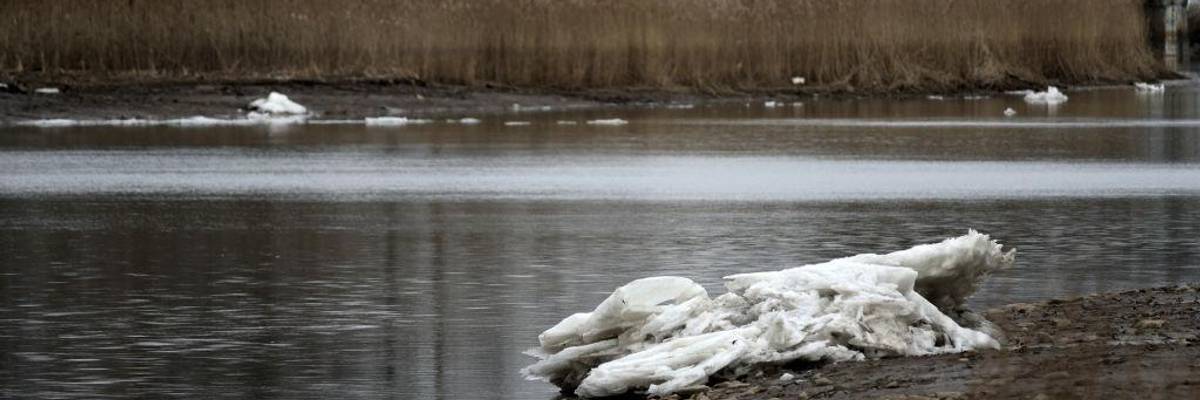
Delaware river and Neshaminy State Park, Tidal Marsh Natural Area, in Bucks County, Pennsylvania. (Photo: Bastiaan Slabbers/NurPhoto via Getty Images)
As the world tries to break free of the shackles of fossil fuel, another link in the chain is trying to be forged with the creation of a liquefied natural gas (LNG) export terminal on the Delaware River in Gibbstown, NJ. The plans were approved by the Delaware River Basin Commission but a number of state and federal permits for the project are being challenged in court. Environmentalists have contested the plans and sent petitions to four governors, citing the impact on climate change and the danger of huge "bomb trains" carrying LNG across Philadelphia and South Jersey.
Promoting fracking in Pennsylvania and exposing NJ residents to the risks of LNG shipping is in direct contradistinction to the espoused environmental protections by Governor Murphy's office.
Natural gas is marketed as clean but only produces 30% less carbon dioxide than oil and 45% less than coal. Promoting fracking in Pennsylvania and exposing NJ residents to the risks of LNG shipping is in direct contradistinction to the espoused environmental protections by Governor Murphy's office. In addition to the environmental dangers of increasing carbon dioxide output, the proposed site for the $450 million port is a former DuPont dynamite manufacturing plant which is already heavily contaminated. The process of dredging and construction will release more toxins like PCB's into the local environment.
Many of the people facing these threats already live in environmental justice communities with multiple and overlapping exposures. Gibbstown which is directly across from the Philadelphia International Airport occupies one of the most industrialized strips of the Delaware River. The gas would be shipped from Pennsylvania's Marcellus Shale to 200 miles south down I-95 by truck and/or rail through some of the most densely populated areas of the East Coast to Gibbstown. The safety of such transport is questionable at best which was opened up by an executive order by the Trump administration last summer though 15 state attorneys general (including PA, NJ, and DE) are currently challenging the move.
Indoor air quality is also impacted by natural gas use which has an additive effect on health. The most vulnerable including children, pregnant women, the elderly, and those with lung or heart problems are at greatest risk but everyone breathes so everyone can be affected. Natural gas, which for now is cheaper, is also being disproportionately used in lower income, less well-ventilated homes, placing the economically disadvantaged in harm's way.
Meanwhile, cities and towns across the US are writing building codes so that new homes and offices would be blocked from using natural gas and would rely on heat pumps and electric kitchen stoves instead. The American Gas Association has been campaigning to prohibit new local ordinances as have numerous other distributors and companies, clawing for self-preservation. While they have been trying to get politicians in their pocket with the promise of more taxes and job openings, there is no attempt to compare outcomes if similar resources were put into the creation of clean energy alternatives. Worse is that, once created, the infrastructure for this dirty energy will be around for decades resulting in even more environmental damage and higher cost.
As renewables become cheaper, more readily available, and more attractive, LNG will become a less and less attractive energy source. Several European companies who had expressed interest in the gas have backed out both because of regulation and public pressure. The gas trafficked through the Gibbstown terminal will not be used in NJ homes but rather will be shipped overseas. Instead, New Jersey will be rely on a large offshore wind farm to reach its goal of complete renewable energy use by 2050.
We need to invest in our energy future by contacting our representatives and expressing our concern, not only over the immediate danger of the project, but also over the long term impact of climate damage. Creation of a gas export terminal is a backward-looking, short-sighted, risky project for NJ and the region.
Dear Common Dreams reader, It’s been nearly 30 years since I co-founded Common Dreams with my late wife, Lina Newhouser. We had the radical notion that journalism should serve the public good, not corporate profits. It was clear to us from the outset what it would take to build such a project. No paid advertisements. No corporate sponsors. No millionaire publisher telling us what to think or do. Many people said we wouldn't last a year, but we proved those doubters wrong. Together with a tremendous team of journalists and dedicated staff, we built an independent media outlet free from the constraints of profits and corporate control. Our mission has always been simple: To inform. To inspire. To ignite change for the common good. Building Common Dreams was not easy. Our survival was never guaranteed. When you take on the most powerful forces—Wall Street greed, fossil fuel industry destruction, Big Tech lobbyists, and uber-rich oligarchs who have spent billions upon billions rigging the economy and democracy in their favor—the only bulwark you have is supporters who believe in your work. But here’s the urgent message from me today. It's never been this bad out there. And it's never been this hard to keep us going. At the very moment Common Dreams is most needed, the threats we face are intensifying. We need your support now more than ever. We don't accept corporate advertising and never will. We don't have a paywall because we don't think people should be blocked from critical news based on their ability to pay. Everything we do is funded by the donations of readers like you. When everyone does the little they can afford, we are strong. But if that support retreats or dries up, so do we. Will you donate now to make sure Common Dreams not only survives but thrives? —Craig Brown, Co-founder |
As the world tries to break free of the shackles of fossil fuel, another link in the chain is trying to be forged with the creation of a liquefied natural gas (LNG) export terminal on the Delaware River in Gibbstown, NJ. The plans were approved by the Delaware River Basin Commission but a number of state and federal permits for the project are being challenged in court. Environmentalists have contested the plans and sent petitions to four governors, citing the impact on climate change and the danger of huge "bomb trains" carrying LNG across Philadelphia and South Jersey.
Promoting fracking in Pennsylvania and exposing NJ residents to the risks of LNG shipping is in direct contradistinction to the espoused environmental protections by Governor Murphy's office.
Natural gas is marketed as clean but only produces 30% less carbon dioxide than oil and 45% less than coal. Promoting fracking in Pennsylvania and exposing NJ residents to the risks of LNG shipping is in direct contradistinction to the espoused environmental protections by Governor Murphy's office. In addition to the environmental dangers of increasing carbon dioxide output, the proposed site for the $450 million port is a former DuPont dynamite manufacturing plant which is already heavily contaminated. The process of dredging and construction will release more toxins like PCB's into the local environment.
Many of the people facing these threats already live in environmental justice communities with multiple and overlapping exposures. Gibbstown which is directly across from the Philadelphia International Airport occupies one of the most industrialized strips of the Delaware River. The gas would be shipped from Pennsylvania's Marcellus Shale to 200 miles south down I-95 by truck and/or rail through some of the most densely populated areas of the East Coast to Gibbstown. The safety of such transport is questionable at best which was opened up by an executive order by the Trump administration last summer though 15 state attorneys general (including PA, NJ, and DE) are currently challenging the move.
Indoor air quality is also impacted by natural gas use which has an additive effect on health. The most vulnerable including children, pregnant women, the elderly, and those with lung or heart problems are at greatest risk but everyone breathes so everyone can be affected. Natural gas, which for now is cheaper, is also being disproportionately used in lower income, less well-ventilated homes, placing the economically disadvantaged in harm's way.
Meanwhile, cities and towns across the US are writing building codes so that new homes and offices would be blocked from using natural gas and would rely on heat pumps and electric kitchen stoves instead. The American Gas Association has been campaigning to prohibit new local ordinances as have numerous other distributors and companies, clawing for self-preservation. While they have been trying to get politicians in their pocket with the promise of more taxes and job openings, there is no attempt to compare outcomes if similar resources were put into the creation of clean energy alternatives. Worse is that, once created, the infrastructure for this dirty energy will be around for decades resulting in even more environmental damage and higher cost.
As renewables become cheaper, more readily available, and more attractive, LNG will become a less and less attractive energy source. Several European companies who had expressed interest in the gas have backed out both because of regulation and public pressure. The gas trafficked through the Gibbstown terminal will not be used in NJ homes but rather will be shipped overseas. Instead, New Jersey will be rely on a large offshore wind farm to reach its goal of complete renewable energy use by 2050.
We need to invest in our energy future by contacting our representatives and expressing our concern, not only over the immediate danger of the project, but also over the long term impact of climate damage. Creation of a gas export terminal is a backward-looking, short-sighted, risky project for NJ and the region.
As the world tries to break free of the shackles of fossil fuel, another link in the chain is trying to be forged with the creation of a liquefied natural gas (LNG) export terminal on the Delaware River in Gibbstown, NJ. The plans were approved by the Delaware River Basin Commission but a number of state and federal permits for the project are being challenged in court. Environmentalists have contested the plans and sent petitions to four governors, citing the impact on climate change and the danger of huge "bomb trains" carrying LNG across Philadelphia and South Jersey.
Promoting fracking in Pennsylvania and exposing NJ residents to the risks of LNG shipping is in direct contradistinction to the espoused environmental protections by Governor Murphy's office.
Natural gas is marketed as clean but only produces 30% less carbon dioxide than oil and 45% less than coal. Promoting fracking in Pennsylvania and exposing NJ residents to the risks of LNG shipping is in direct contradistinction to the espoused environmental protections by Governor Murphy's office. In addition to the environmental dangers of increasing carbon dioxide output, the proposed site for the $450 million port is a former DuPont dynamite manufacturing plant which is already heavily contaminated. The process of dredging and construction will release more toxins like PCB's into the local environment.
Many of the people facing these threats already live in environmental justice communities with multiple and overlapping exposures. Gibbstown which is directly across from the Philadelphia International Airport occupies one of the most industrialized strips of the Delaware River. The gas would be shipped from Pennsylvania's Marcellus Shale to 200 miles south down I-95 by truck and/or rail through some of the most densely populated areas of the East Coast to Gibbstown. The safety of such transport is questionable at best which was opened up by an executive order by the Trump administration last summer though 15 state attorneys general (including PA, NJ, and DE) are currently challenging the move.
Indoor air quality is also impacted by natural gas use which has an additive effect on health. The most vulnerable including children, pregnant women, the elderly, and those with lung or heart problems are at greatest risk but everyone breathes so everyone can be affected. Natural gas, which for now is cheaper, is also being disproportionately used in lower income, less well-ventilated homes, placing the economically disadvantaged in harm's way.
Meanwhile, cities and towns across the US are writing building codes so that new homes and offices would be blocked from using natural gas and would rely on heat pumps and electric kitchen stoves instead. The American Gas Association has been campaigning to prohibit new local ordinances as have numerous other distributors and companies, clawing for self-preservation. While they have been trying to get politicians in their pocket with the promise of more taxes and job openings, there is no attempt to compare outcomes if similar resources were put into the creation of clean energy alternatives. Worse is that, once created, the infrastructure for this dirty energy will be around for decades resulting in even more environmental damage and higher cost.
As renewables become cheaper, more readily available, and more attractive, LNG will become a less and less attractive energy source. Several European companies who had expressed interest in the gas have backed out both because of regulation and public pressure. The gas trafficked through the Gibbstown terminal will not be used in NJ homes but rather will be shipped overseas. Instead, New Jersey will be rely on a large offshore wind farm to reach its goal of complete renewable energy use by 2050.
We need to invest in our energy future by contacting our representatives and expressing our concern, not only over the immediate danger of the project, but also over the long term impact of climate damage. Creation of a gas export terminal is a backward-looking, short-sighted, risky project for NJ and the region.