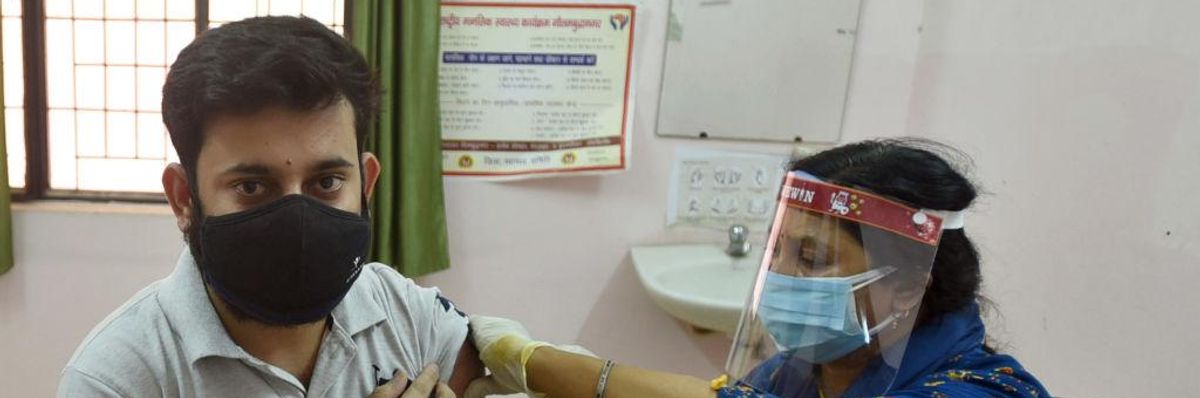
A health worker inoculates a dose of Covid-19 vaccine to a beneficiary, at Primary Health Center (PHC) Govt. Hospital, on May 17, 2021 in Greater Noida, India. (Photo: Sunil Ghosh/Hindustan Times via Getty Images)
Covid-19 Is a Global Threat to Humanity--and Requires an International Response
We cannot end the threat in the United States without ending it everywhere.
COVID-19 knows no national boundaries. It does not discriminate by race or religion or ideology. The pandemic poses a threat to humanity, not to any one country. Our response must be as encompassing as the threat: we cannot end the threat here without ending it everywhere.
Today, India is suffering a brutal second wave of the disease. A staggering 400,000 new cases are counted a day; the actual number is surely higher. Medical facilities run out of oxygen, ventilators, and beds. Thousands die a day, increasing numbers from oxygen shortages. The crematoriums are overwhelmed. In some cities, the dead are burned overnight in parking lots; the sun dawns on the ashes left behind.
Across the global South, the pandemic rages. South Africa is the epicenter in Africa, with 1.6 million infected and only 500,000 fully vaccinated. Brazil is second only to the U.S. in diseases, but unlike the U.S. where 70% will have at least one shot of vaccine by July 4, in Brazil less than 8% have been fully vaccinated.
It is long past time for the U.S. to help mobilize a far bolder global initiative to ensure the rapid vaccination--and the adequate supplies for treatment--across the world.
With the U.S. well on the way to beating the pandemic at home, we must lift our sights to join in combating it across the world. Public Citizen estimates that for $25 billion, we could buy 8 billion doses of vaccine, enough to vaccinate one-half of the planet. For far less, we could help countries build manufacturing facilities and enable them to manufacture the vaccine themselves.
Is our vision expansive enough to meet the challenge posed by COVID-19? Our vision was big enough to help save Europe after World War II with the Marshall Plan. Is it big enough to help save the global South--and ourselves today?
On the evening of April 15 in Indianapolis, a gunman opened fire in a FedEx facility where he had worked. He knew it was overwhelmingly staffed by Sikhs, Indian-Americans. Four of the eight people killed were Sikhs. He specifically targeted Sikh employees, with one employee reporting that the gunman "told a white woman running toward him to get out of the way, after having just shot a Sikh man in the face."
The massacre took place just a month after the targeting of Asian American spas in Atlanta which left eight people dead, including six Asian women. Violence against Sikhs and against Asian Americans spiked after 9/11, and now it is spiking again in the wake of the pandemic, which originated in China. Today, a generation after 9/11, Sikhs are five times more likely to be targets of hate than they were before 9/11.
With COVID-19 we do not have the luxury of hate. We need to rise above our divisions to join to defeat the pandemic. It is long past time for the U.S. to help mobilize a far bolder global initiative to ensure the rapid vaccination--and the adequate supplies for treatment--across the world. We need to help save Indians and South Africans and Brazilians to help save ourselves. We need to join with China and Russia and our allies to address the needs, not compete with them as if this were a fight over markets or influence.
Dr. Martin Luther King taught that all of us are "caught in an inescapable network of mutuality, tied in a single garment of destiny. Whatever affects one directly, affects all indirectly." The pandemic--and future pandemics--demonstrate the truth of his words.
We need a bigger vision. We can find it in many faith traditions. In the wake of the massacre in Indianapolis, Valarie Kaur, a Sikh-American civil rights leader, hailed the multiracial vigil that took place to mourn those who were lost, noting, "We need a shift in consciousness and culture. Sound government is necessary but not sufficient to create an America where you see my children as your own. We need educators, community leaders, faith leaders, parents and students everywhere to rebuild and re-imagine our nation where they are. We can find inspiration in the vision of Guru Nanak, the first teacher in the Sikh faith: See no stranger. Anti-racism is the bridge: love is the destination."
We need this consciousness to bring Americans together across boundaries of race and religion. And now we need this heartfelt vision for our own security in dealing with a pandemic that threatens all.
We are at a crossroads
This country and this world are at a monumental crossroads. In a few short weeks, US voters will have an opportunity to beat back the forces of fascism and confront the billionaires who are rigging the economy, our media system, and our democracy, making it increasingly impossible for ordinary people to get by. We’re not just talking about the election. We’re talking about what must be done once these fascist elements are vanquished from power. We need a bolder set of solutions than what either major party has so far been willing to offer and a working-class movement ready to fight like hell for it. Trump didn't emerge from nowhere. The conditions that fueled MAGA authoritarianism were created by decades of radical neoliberal economic policies and a corrupt political system dominated by corporate interests. They slashed taxes on the super-rich, promising that the benefits would trickle down. They said giveaways to the corporate titans would make life more affordable for the rest of us. It was all bullshit. And when a bitter, betrayed populace searches for someone to blame, right-wing demagogues have little trouble finding scapegoats. People know when they're being lied to, but you won't hear any of this from the corporate media. Only independent journalism—powered and funded by people who believe in building a better world—can deliver truly trustworthy daily news. Our Fall Campaign is underway, and we need your help. To power our newsroom through the rest of the year, we need to raise $125,000 by midnight on October 31. So if you share our vision, please contribute whatever you can to sustain our work. |
COVID-19 knows no national boundaries. It does not discriminate by race or religion or ideology. The pandemic poses a threat to humanity, not to any one country. Our response must be as encompassing as the threat: we cannot end the threat here without ending it everywhere.
Today, India is suffering a brutal second wave of the disease. A staggering 400,000 new cases are counted a day; the actual number is surely higher. Medical facilities run out of oxygen, ventilators, and beds. Thousands die a day, increasing numbers from oxygen shortages. The crematoriums are overwhelmed. In some cities, the dead are burned overnight in parking lots; the sun dawns on the ashes left behind.
Across the global South, the pandemic rages. South Africa is the epicenter in Africa, with 1.6 million infected and only 500,000 fully vaccinated. Brazil is second only to the U.S. in diseases, but unlike the U.S. where 70% will have at least one shot of vaccine by July 4, in Brazil less than 8% have been fully vaccinated.
It is long past time for the U.S. to help mobilize a far bolder global initiative to ensure the rapid vaccination--and the adequate supplies for treatment--across the world.
With the U.S. well on the way to beating the pandemic at home, we must lift our sights to join in combating it across the world. Public Citizen estimates that for $25 billion, we could buy 8 billion doses of vaccine, enough to vaccinate one-half of the planet. For far less, we could help countries build manufacturing facilities and enable them to manufacture the vaccine themselves.
Is our vision expansive enough to meet the challenge posed by COVID-19? Our vision was big enough to help save Europe after World War II with the Marshall Plan. Is it big enough to help save the global South--and ourselves today?
On the evening of April 15 in Indianapolis, a gunman opened fire in a FedEx facility where he had worked. He knew it was overwhelmingly staffed by Sikhs, Indian-Americans. Four of the eight people killed were Sikhs. He specifically targeted Sikh employees, with one employee reporting that the gunman "told a white woman running toward him to get out of the way, after having just shot a Sikh man in the face."
The massacre took place just a month after the targeting of Asian American spas in Atlanta which left eight people dead, including six Asian women. Violence against Sikhs and against Asian Americans spiked after 9/11, and now it is spiking again in the wake of the pandemic, which originated in China. Today, a generation after 9/11, Sikhs are five times more likely to be targets of hate than they were before 9/11.
With COVID-19 we do not have the luxury of hate. We need to rise above our divisions to join to defeat the pandemic. It is long past time for the U.S. to help mobilize a far bolder global initiative to ensure the rapid vaccination--and the adequate supplies for treatment--across the world. We need to help save Indians and South Africans and Brazilians to help save ourselves. We need to join with China and Russia and our allies to address the needs, not compete with them as if this were a fight over markets or influence.
Dr. Martin Luther King taught that all of us are "caught in an inescapable network of mutuality, tied in a single garment of destiny. Whatever affects one directly, affects all indirectly." The pandemic--and future pandemics--demonstrate the truth of his words.
We need a bigger vision. We can find it in many faith traditions. In the wake of the massacre in Indianapolis, Valarie Kaur, a Sikh-American civil rights leader, hailed the multiracial vigil that took place to mourn those who were lost, noting, "We need a shift in consciousness and culture. Sound government is necessary but not sufficient to create an America where you see my children as your own. We need educators, community leaders, faith leaders, parents and students everywhere to rebuild and re-imagine our nation where they are. We can find inspiration in the vision of Guru Nanak, the first teacher in the Sikh faith: See no stranger. Anti-racism is the bridge: love is the destination."
We need this consciousness to bring Americans together across boundaries of race and religion. And now we need this heartfelt vision for our own security in dealing with a pandemic that threatens all.
COVID-19 knows no national boundaries. It does not discriminate by race or religion or ideology. The pandemic poses a threat to humanity, not to any one country. Our response must be as encompassing as the threat: we cannot end the threat here without ending it everywhere.
Today, India is suffering a brutal second wave of the disease. A staggering 400,000 new cases are counted a day; the actual number is surely higher. Medical facilities run out of oxygen, ventilators, and beds. Thousands die a day, increasing numbers from oxygen shortages. The crematoriums are overwhelmed. In some cities, the dead are burned overnight in parking lots; the sun dawns on the ashes left behind.
Across the global South, the pandemic rages. South Africa is the epicenter in Africa, with 1.6 million infected and only 500,000 fully vaccinated. Brazil is second only to the U.S. in diseases, but unlike the U.S. where 70% will have at least one shot of vaccine by July 4, in Brazil less than 8% have been fully vaccinated.
It is long past time for the U.S. to help mobilize a far bolder global initiative to ensure the rapid vaccination--and the adequate supplies for treatment--across the world.
With the U.S. well on the way to beating the pandemic at home, we must lift our sights to join in combating it across the world. Public Citizen estimates that for $25 billion, we could buy 8 billion doses of vaccine, enough to vaccinate one-half of the planet. For far less, we could help countries build manufacturing facilities and enable them to manufacture the vaccine themselves.
Is our vision expansive enough to meet the challenge posed by COVID-19? Our vision was big enough to help save Europe after World War II with the Marshall Plan. Is it big enough to help save the global South--and ourselves today?
On the evening of April 15 in Indianapolis, a gunman opened fire in a FedEx facility where he had worked. He knew it was overwhelmingly staffed by Sikhs, Indian-Americans. Four of the eight people killed were Sikhs. He specifically targeted Sikh employees, with one employee reporting that the gunman "told a white woman running toward him to get out of the way, after having just shot a Sikh man in the face."
The massacre took place just a month after the targeting of Asian American spas in Atlanta which left eight people dead, including six Asian women. Violence against Sikhs and against Asian Americans spiked after 9/11, and now it is spiking again in the wake of the pandemic, which originated in China. Today, a generation after 9/11, Sikhs are five times more likely to be targets of hate than they were before 9/11.
With COVID-19 we do not have the luxury of hate. We need to rise above our divisions to join to defeat the pandemic. It is long past time for the U.S. to help mobilize a far bolder global initiative to ensure the rapid vaccination--and the adequate supplies for treatment--across the world. We need to help save Indians and South Africans and Brazilians to help save ourselves. We need to join with China and Russia and our allies to address the needs, not compete with them as if this were a fight over markets or influence.
Dr. Martin Luther King taught that all of us are "caught in an inescapable network of mutuality, tied in a single garment of destiny. Whatever affects one directly, affects all indirectly." The pandemic--and future pandemics--demonstrate the truth of his words.
We need a bigger vision. We can find it in many faith traditions. In the wake of the massacre in Indianapolis, Valarie Kaur, a Sikh-American civil rights leader, hailed the multiracial vigil that took place to mourn those who were lost, noting, "We need a shift in consciousness and culture. Sound government is necessary but not sufficient to create an America where you see my children as your own. We need educators, community leaders, faith leaders, parents and students everywhere to rebuild and re-imagine our nation where they are. We can find inspiration in the vision of Guru Nanak, the first teacher in the Sikh faith: See no stranger. Anti-racism is the bridge: love is the destination."
We need this consciousness to bring Americans together across boundaries of race and religion. And now we need this heartfelt vision for our own security in dealing with a pandemic that threatens all.