SUBSCRIBE TO OUR FREE NEWSLETTER
Daily news & progressive opinion—funded by the people, not the corporations—delivered straight to your inbox.
5
#000000
#FFFFFF
To donate by check, phone, or other method, see our More Ways to Give page.
Daily news & progressive opinion—funded by the people, not the corporations—delivered straight to your inbox.
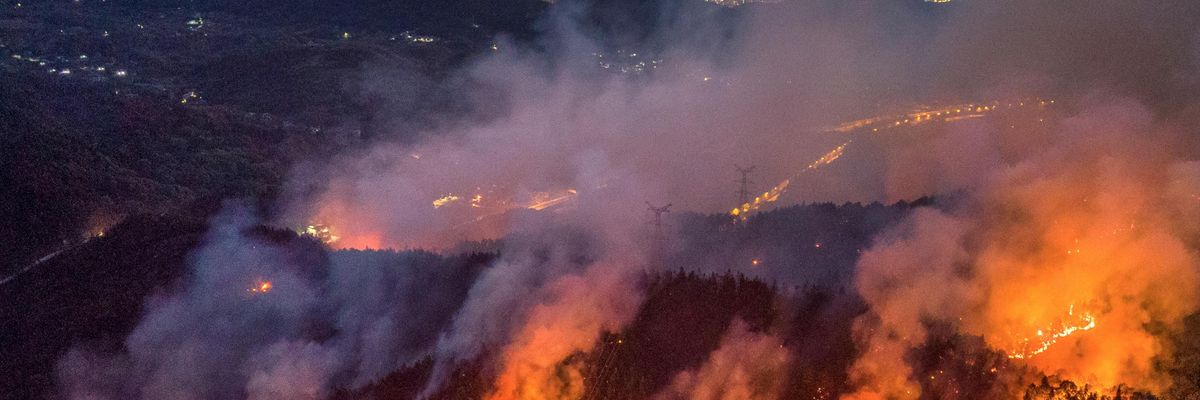
Smoke and flames rise from a mountain during a wildfire in Banan district on August 23, 2022 in Chongqing, China. The wildfire that broke out last Sunday afternoon has been brought under control by firefighters in Chongqing. (Photo: VCG/VCG via Getty Images)
In a year when climate records--from floods, fire, and drought--are being shattered daily like shards of glass, there is one country that bests them all: China. The country is experiencing a heatwave like no other.
It has lasted over seventy days, with record breaking temperatures at day and at night.
Over 100 million people are affected in an area covering 500,000 square miles of the country, experiencing record temperatures exceeding 104degF (40degC). To put this into perspective, this is equivalent to the size of Texas, Colorado and California combined.
Experts are calling it the "worst heatwave ever recorded in global history," or "Worst heat wave known in world climatic history."
They are not alone in outlining the enormity of what is happening in China right now. According to Axios, this extreme event which is baking southern China "has no parallel in modern record-keeping in China, or elsewhere around the world for that matter."
Meteorologist Bob Henson, a contributor to Yale Climate Connections, told Axios: "I can't think of anything comparable to China's heat wave of summer 2022 in its blend of intensity, duration, geographic extent and number of people affected."
Yesterday the World Meteorological Office tweeted:
Some parts of the country have been experiencing temperatures of 110.3degF (43.5degC), shattering previous temperature records. Last weekend, Chongqing, a city of 9 million, recorded an overnight low temperature of 94.8degF (34.9degF), another record.
Once great mighty rivers, such as the Yangtze--the world's third largest river which provides drinking water to 400 million people--they are reduced to shadows of their former selves. Shipping routes on some parts of the river are closed, with levels over fifty percent lower than average over the last five years. Others rivers are reduced to trickles and pools.
Analysts like Jefferies say that with a backdrop of COVID-19 still affecting the country, the record two-month-long heatwave amounted to a "black swan event" for China. "The drought has created a vicious spiral as hydroelectric power becomes scarce which in turn cuts electricity production for industry," says Jefferies.
And the drought has forced the country to cut back on hydropower, leading to blackouts and power shortages. In Sichuan, which gets more than eighty percent of its power from hydro, the region is said to be in a "grave situation," where the authorities have now issued a severe "level 1" emergency incident.
As the country's leaders stepped up efforts to respond to the heat, China issued a formal nationwide drought alert last Friday. Many areas are now without drinking water, with the authorities increasingly having to truck in water or generators to people without water or power.
The drought, which is expected to last well into next month, could affect the country's rice harvest, which is due to happen in the next ten days. The authorities are busy digging new irrigation channels as lake levels are so low, old ones do not work.
And now the authorities in China are so desperate they are trying to induce rainfall in parts of central and southwest of the country, by "cloud seeding", which is a form of weather modification that involves spraying chemicals on to clouds in the hope that will induce rain.
One way to stop the drought is to stop drilling for oil and gas. Because the experts are in no doubt that this is climate change in action:
Dear Common Dreams reader, It’s been nearly 30 years since I co-founded Common Dreams with my late wife, Lina Newhouser. We had the radical notion that journalism should serve the public good, not corporate profits. It was clear to us from the outset what it would take to build such a project. No paid advertisements. No corporate sponsors. No millionaire publisher telling us what to think or do. Many people said we wouldn't last a year, but we proved those doubters wrong. Together with a tremendous team of journalists and dedicated staff, we built an independent media outlet free from the constraints of profits and corporate control. Our mission has always been simple: To inform. To inspire. To ignite change for the common good. Building Common Dreams was not easy. Our survival was never guaranteed. When you take on the most powerful forces—Wall Street greed, fossil fuel industry destruction, Big Tech lobbyists, and uber-rich oligarchs who have spent billions upon billions rigging the economy and democracy in their favor—the only bulwark you have is supporters who believe in your work. But here’s the urgent message from me today. It's never been this bad out there. And it's never been this hard to keep us going. At the very moment Common Dreams is most needed, the threats we face are intensifying. We need your support now more than ever. We don't accept corporate advertising and never will. We don't have a paywall because we don't think people should be blocked from critical news based on their ability to pay. Everything we do is funded by the donations of readers like you. When everyone does the little they can afford, we are strong. But if that support retreats or dries up, so do we. Will you donate now to make sure Common Dreams not only survives but thrives? —Craig Brown, Co-founder |
In a year when climate records--from floods, fire, and drought--are being shattered daily like shards of glass, there is one country that bests them all: China. The country is experiencing a heatwave like no other.
It has lasted over seventy days, with record breaking temperatures at day and at night.
Over 100 million people are affected in an area covering 500,000 square miles of the country, experiencing record temperatures exceeding 104degF (40degC). To put this into perspective, this is equivalent to the size of Texas, Colorado and California combined.
Experts are calling it the "worst heatwave ever recorded in global history," or "Worst heat wave known in world climatic history."
They are not alone in outlining the enormity of what is happening in China right now. According to Axios, this extreme event which is baking southern China "has no parallel in modern record-keeping in China, or elsewhere around the world for that matter."
Meteorologist Bob Henson, a contributor to Yale Climate Connections, told Axios: "I can't think of anything comparable to China's heat wave of summer 2022 in its blend of intensity, duration, geographic extent and number of people affected."
Yesterday the World Meteorological Office tweeted:
Some parts of the country have been experiencing temperatures of 110.3degF (43.5degC), shattering previous temperature records. Last weekend, Chongqing, a city of 9 million, recorded an overnight low temperature of 94.8degF (34.9degF), another record.
Once great mighty rivers, such as the Yangtze--the world's third largest river which provides drinking water to 400 million people--they are reduced to shadows of their former selves. Shipping routes on some parts of the river are closed, with levels over fifty percent lower than average over the last five years. Others rivers are reduced to trickles and pools.
Analysts like Jefferies say that with a backdrop of COVID-19 still affecting the country, the record two-month-long heatwave amounted to a "black swan event" for China. "The drought has created a vicious spiral as hydroelectric power becomes scarce which in turn cuts electricity production for industry," says Jefferies.
And the drought has forced the country to cut back on hydropower, leading to blackouts and power shortages. In Sichuan, which gets more than eighty percent of its power from hydro, the region is said to be in a "grave situation," where the authorities have now issued a severe "level 1" emergency incident.
As the country's leaders stepped up efforts to respond to the heat, China issued a formal nationwide drought alert last Friday. Many areas are now without drinking water, with the authorities increasingly having to truck in water or generators to people without water or power.
The drought, which is expected to last well into next month, could affect the country's rice harvest, which is due to happen in the next ten days. The authorities are busy digging new irrigation channels as lake levels are so low, old ones do not work.
And now the authorities in China are so desperate they are trying to induce rainfall in parts of central and southwest of the country, by "cloud seeding", which is a form of weather modification that involves spraying chemicals on to clouds in the hope that will induce rain.
One way to stop the drought is to stop drilling for oil and gas. Because the experts are in no doubt that this is climate change in action:
In a year when climate records--from floods, fire, and drought--are being shattered daily like shards of glass, there is one country that bests them all: China. The country is experiencing a heatwave like no other.
It has lasted over seventy days, with record breaking temperatures at day and at night.
Over 100 million people are affected in an area covering 500,000 square miles of the country, experiencing record temperatures exceeding 104degF (40degC). To put this into perspective, this is equivalent to the size of Texas, Colorado and California combined.
Experts are calling it the "worst heatwave ever recorded in global history," or "Worst heat wave known in world climatic history."
They are not alone in outlining the enormity of what is happening in China right now. According to Axios, this extreme event which is baking southern China "has no parallel in modern record-keeping in China, or elsewhere around the world for that matter."
Meteorologist Bob Henson, a contributor to Yale Climate Connections, told Axios: "I can't think of anything comparable to China's heat wave of summer 2022 in its blend of intensity, duration, geographic extent and number of people affected."
Yesterday the World Meteorological Office tweeted:
Some parts of the country have been experiencing temperatures of 110.3degF (43.5degC), shattering previous temperature records. Last weekend, Chongqing, a city of 9 million, recorded an overnight low temperature of 94.8degF (34.9degF), another record.
Once great mighty rivers, such as the Yangtze--the world's third largest river which provides drinking water to 400 million people--they are reduced to shadows of their former selves. Shipping routes on some parts of the river are closed, with levels over fifty percent lower than average over the last five years. Others rivers are reduced to trickles and pools.
Analysts like Jefferies say that with a backdrop of COVID-19 still affecting the country, the record two-month-long heatwave amounted to a "black swan event" for China. "The drought has created a vicious spiral as hydroelectric power becomes scarce which in turn cuts electricity production for industry," says Jefferies.
And the drought has forced the country to cut back on hydropower, leading to blackouts and power shortages. In Sichuan, which gets more than eighty percent of its power from hydro, the region is said to be in a "grave situation," where the authorities have now issued a severe "level 1" emergency incident.
As the country's leaders stepped up efforts to respond to the heat, China issued a formal nationwide drought alert last Friday. Many areas are now without drinking water, with the authorities increasingly having to truck in water or generators to people without water or power.
The drought, which is expected to last well into next month, could affect the country's rice harvest, which is due to happen in the next ten days. The authorities are busy digging new irrigation channels as lake levels are so low, old ones do not work.
And now the authorities in China are so desperate they are trying to induce rainfall in parts of central and southwest of the country, by "cloud seeding", which is a form of weather modification that involves spraying chemicals on to clouds in the hope that will induce rain.
One way to stop the drought is to stop drilling for oil and gas. Because the experts are in no doubt that this is climate change in action: