SUBSCRIBE TO OUR FREE NEWSLETTER
Daily news & progressive opinion—funded by the people, not the corporations—delivered straight to your inbox.
5
#000000
#FFFFFF
To donate by check, phone, or other method, see our More Ways to Give page.


Daily news & progressive opinion—funded by the people, not the corporations—delivered straight to your inbox.

Seth Gladstone, sgladstone@fwwatch.org
Groups say congressional Leaders must go back to drawing board, develop a bill with true safety provisions and protections for local control
As Congressional leaders prepare to negotiate a final pipeline safety reauthorization package, more than 75 national, state and local organizations urged Congressional leaders to reject any legislation that fails to meaningfully protect communities from the rapid expansion of carbon dioxide pipelines. The groups warn that the current proposal leaves in place significant safety gaps unaddressed despite years of warnings following a 2020 pipeline rupture in Satartia, Mississippi. The pipeline buildout is backed by what the U.S. Treasury estimates will be nearly $70 billion in industry tax credits authorized in the “One Big Beautiful Bill” that passed last year.
While Congress is considering legislation in the name of pipeline safety, the coalition points out the current legislation fails to establish minimum protections for communities and first responders that are necessary before the industry is allowed to build tens of thousands of miles of new carbon dioxide pipelines. The letter also points out that the administration is actively weakening existing pipeline safety oversight and enforcement, making all pipelines less safe.
The letter comes as Congressional leaders must reconcile differing pipeline safety bills that passed through House and Senate Committees, and the White House is cutting oversight and enforcement for pipeline safety across the board.
“Congress is telling communities to shoulder all the health and safety risks while pipeline companies are making off with billions in taxpayer dollars. Communities deserve more than empty promises about stronger rules at some point in the future. If lawmakers are serious about pipeline safety, they should stop drafting bills to benefit the pipeline companies and start drafting them for people who have to live with the consequences of these dangerous projects,” said Jim Walsh, Policy Director, Food & Water Watch.
"There’s no pipeline safety when the regulations are drafted by the oil and gas industry. For decades, fossil-fuel infrastructure including pipelines have dictated lifespans across Black, Brown, Indigenous, and low-income neighborhoods, exposing these communities to higher rates of disease and early mortality. As the Trump Administration dismantles more and more safeguards, we will see even more chronic illnesses and dangerous pipeline disasters that harm our neighbors and families. Congress must pass comprehensive pipeline safety standards that actually safeguard people’s lives and livelihoods — not cut corners for industry profit," said Mar Zepeda, Legislative Director at Climate Justice Alliance.
“Landowners should not be criminalized for protecting their private property rights,” said Emma Schmit, Bold's Pipeline Fighters Organizing Director. “Farmers who have been waiting on federal regulations for years now should not be forced to accept potentially deadly CO2 pipelines on their farms through eminent domain. Without any adequate federal rules, the industry is plowing forward seeking state authorizations for dangerously unregulated projects while keeping the public in the dark with regard to the full scope of potential risks.”
Food & Water Watch mobilizes regular people to build political power to move bold and uncompromised solutions to the most pressing food, water, and climate problems of our time. We work to protect people's health, communities, and democracy from the growing destructive power of the most powerful economic interests.
(202) 683-2500Researchers found prior authorization—which allows insurers to overrule physicians and deny coverage—acts as a “corporate care veto” that drains tens of billions of dollars each year that could go toward patients.
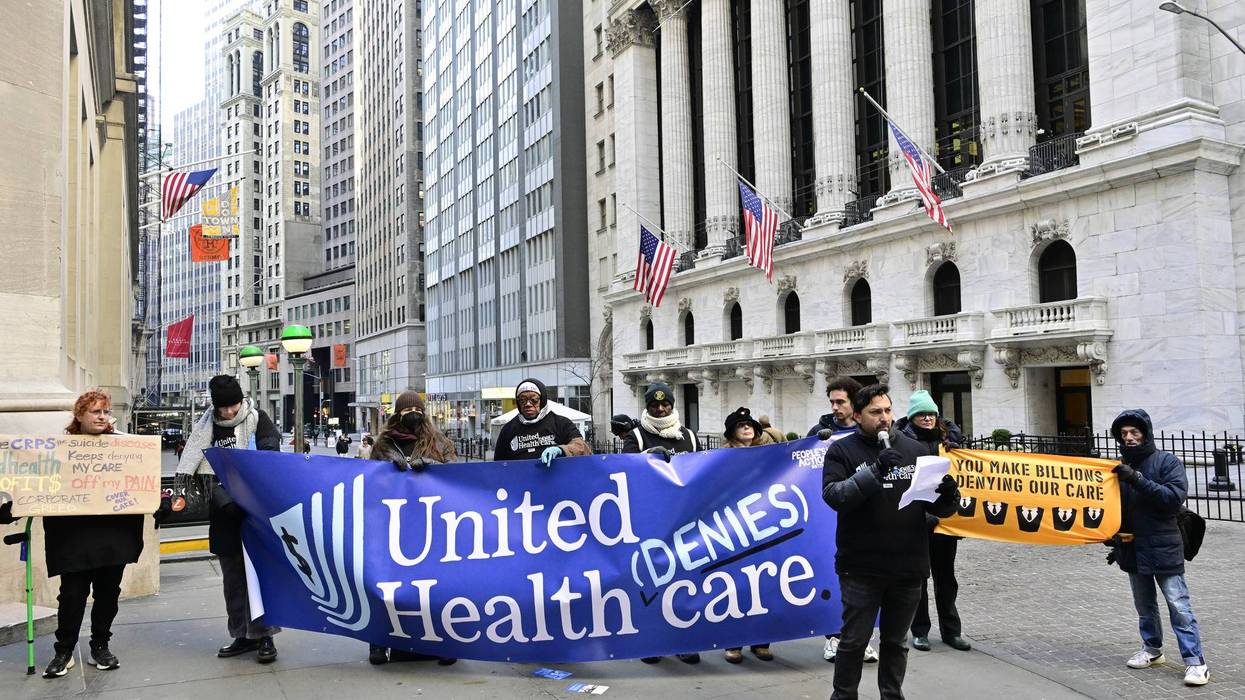
A new report is making the case for ending a widely-hated and sometimes deadly tactic used by for-profit health insurers to deny needed care.
It's called "prior authorization," and it allows health insurance companies to override physicians and decide whether certain care is medically necessary before it is covered.
The policy brief, published Monday by the American Economic Liberties Project (AELP), an anti-monopoly think tank, argues that the system is a massive drag on the US healthcare system, draining doctors of their time, fueling hiring shortages, and—most importantly—worsening treatable health problems for millions of Americans.
"This practice has massive financial and human costs, as I know personally from my family’s own tragic experience,” said the report's author, Hannah Garden-Monheit—a senior fellow at the AELP, whose late father was denied rehab by UnitedHealthcare after cancer forced his leg to be amputated.
"Prior authorization may have started as a narrow cost-control tool," she explained. "But it’s mushroomed into private insurers’ strategy for diverting resources from care toward their own profits. It’s time to ban prior authorization as we know it.”
The report examines how prior authorization went from a tool used sparingly to prevent payment for unnecessary treatments to what Garden-Monheit and co-author, AELP senior healthcare fellow Emma Freer, described as a "corporate care veto."
Around 1 in 5 adults with private insurance report that they or a family member had experienced a coverage denial in the past year, with 28% reporting that it worsened their health problem, according to a June survey from the Commonwealth Fund.
While insurers claim that their decisions to deny care are "evidence-based," the authors say that "in reality, the practice empowers distant corporate entities with a financial conflict of interest to override the professional judgment of physicians with firsthand knowledge of patients’ medical needs."
"There is generally little to no transparency or accountability for these decisions," the authors wrote.
While insurers claim that denials are reviewed by qualified clinicians, one survey from the American Medical Association (AMA) found that only 16% of physicians participating in peer-to-peer reviews reported that the “peer” was often or always qualified.
Garden-Monheit said United denied her father's claim multiple times, first citing his cancer diagnosis—the reason his leg was amputated in the first place—then by claiming that he had made significant enough "progress" that paying for rehab was unnecessary. The "progress" was that he "had figured out how to hop on one leg from his hospital bed to a chair."
Garden-Monheit describes how she, her father, and their care team were forced to navigate a "bureaucratic maze" by United, which ultimately led them to give up.
"At least twice, I learned of a denial only after calling United to check on the status of their request. They hadn’t even bothered with a letter," she said. "While the lines of communication felt frustratingly unpredictable, the answers always led to the same place: 'no.'"
As she explained in a recent op-ed for MS NOW: "My family’s experience wasn’t a one-off glitch. For United, the system was working as designed."
Former United chief medical officer Dr.Archelle Georgiou estimated that across just two Medicare Advantage plans from United and Humana, the companies save an estimated $100 million per year by denying claims that never get appealed. She said that's a "conservative estimate." Across the two plans, 1.75 million people were denied care, even after appeal.
While insurers pad their profits, patients suffer, the researchers found. Among people reporting a prior authorization denial, 41% said it delayed their care and 28% said their health problem worsened, according to the Commonwealth survey.
"My family’s experience wasn’t a one-off glitch. For United, the system was working as designed."
Meanwhile, the AMA survey found that 95% of physicians said that prior authorization delays care, 79% said it causes patients to abandon recommended treatments, and more than 1 in 4 doctors said it has caused a serious adverse event, including hospitalization, permanent impairment, or death.
Denied timely treatments, many patients end up paying for costly and ineffective alternatives that only make their situations worse and cause the costs to increase down the line.
"It was extremely difficult to obtain authorizations for substance abuse treatment when I covered the emergency department as a practicing psychologist," one healthcare professional, identified in the report as Nancy, said. "Other times, in my private practice, I would get authorizations and later experience ‘clawbacks’ where Blue Cross, for example, would decide the treatment was not medically necessary and take back the money already paid."
"It is impossible at times to provide sound ethical treatment and extremely hard to make a living," she said, "when reimbursement rates kept going down, and the insurance companies could take back the money they had already paid for no obvious reason.”
Prior authorization doesn't just deny care to patients. It also creates piles of paperwork for their doctors, taking away precious time that could be dedicated to their care.
The report found that physicians and their teams now spend so much on prior authorization paperwork that it consumes the equivalent of nearly 100,000 full-time physician and advanced practice clinician workloads, plus more than 213,000 clinic staff, costing as much as $32.7 billion each year. If prior authorization were eliminated, they found, it would free up enough capacity to turn a national physician shortage into a surplus.
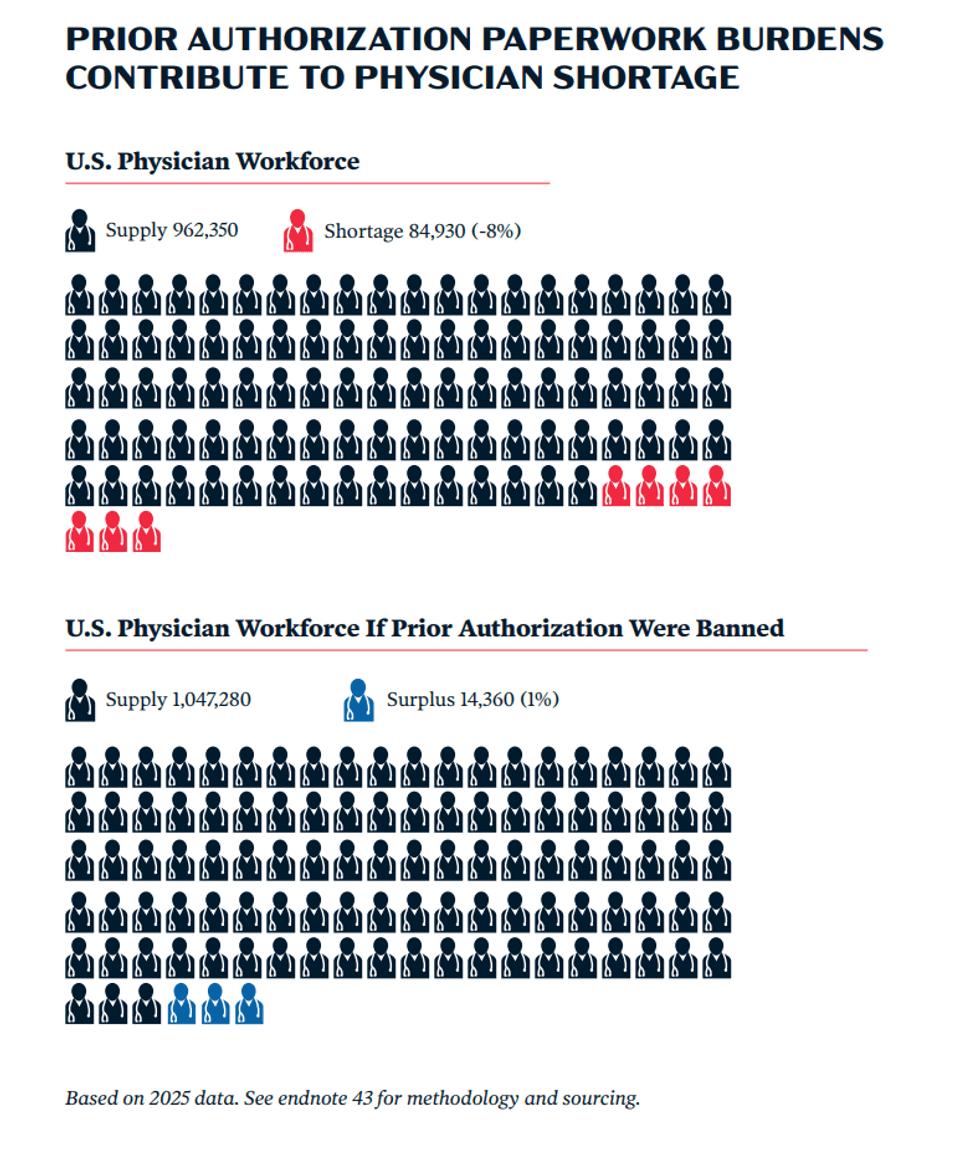
A YouGov poll for AELP found that more than two-thirds of voters in both parties want legislation banning prior authorization outright. But the researchers said both the Trump and Biden administrations have enacted only minor reforms that "fail to address the structural conflict of interest that underpins the corporate care veto strategy."
Meanwhile, the industry is making the denial process even more ruthlessly efficient, increasingly deploying artificial intelligence to deny requests en masse.
According to a 2023 class action lawsuit, United's NaviHealth system used a predictive AI model to determine whether Medicare Advantage patients should receive rehabilitation care despite knowing that the model had a 90% error rate.
President Donald Trump, meanwhile, has expanded prior authorization for traditional Medicare through a pilot program that allows AI models to adjudicate claims in some states. In July, Senate Republicans blocked Democrats' attempt to end the pilot program.
As part of a national pro-AI strategy, Trump has also sought to preempt state laws banning the use of AI to deny care.
The AELP researchers called for a series of reforms to end prior authorization as it currently exists. Among other changes, they said decisions to authorize treatments should be made by independent third parties without the incentive to deny care, that denials must be evidence-based, that the use of AI tools to deny claims should be banned, and that physicians should review patients in person before denying their claims.
“For too long, prior authorization has allowed insurance companies to put profits ahead of patients by overruling doctors and delaying and denying essential care,” Freer said. “This status quo is failing patients, ratcheting up costs, and undermining the basis of effective, expert-informed care. It’s time to end this ‘corporate care veto’ and put medical decisions back where they belong: with patients and their doctors.”

The US Department of Defense had initially denied that any civilians were killed in its operations in Yemen.
An internal review conducted by the US Department of Defense found that US airstrikes in Yemen last year killed and wounded hundreds of civilians.
As reported by The Washington Post on Tuesday, the Pentagon review estimated that US strikes killed more than 150 Yemeni civilians while wounding nearly 250 others.
The strikes were carried out as part of an operation authorized by President Donald Trump targeting Houthi rebels, who were suspected of launching attacks on commercial ships in the Red Sea.
The body count from US strikes in Yemen could be even larger than the Pentagon's current estimates, which only cover three attacks that were determined to have "more likely than not" harmed civilians. An additional 15 incidents are still being reviewed by the DOD.
The deadliest operation carried out by US forces was a strike on Ras Issa Port in the city Hodeidah, which the DOD estimates killed 80 people and wounded 171 others.
As noted by NBC News, the DOD initially said the Yemen strikes did not cause any civilian deaths, and the Pentagon "has yet to publicly acknowledge the casualties or share a full account with Congress."
Stanford University historian Robert Crews remarked that the internal DOD report shows that there is "no end in sight for America’s brutal colonial wars" and "still no substantive domestic anti-colonial movement in the US."
Human rights groups have long been critical of US operations in Yemen, and Human Rights Watch last year described the attack on Ras Issa Port as "an apparent war crime."
“Our generation doesn't have any guarantees about whether we'll have jobs after college, or whether there will be clean drinking water for all of us."
With the pro-artificial intelligence super political action committee Leading the Future projected to spend $200 million on the midterm elections as the industry fights regulations and accountability for the harm its technology can cause, dozens of students rallied Monday at the new Washington, DC lobbying headquarters of OpenAI—with several placed under arrest for the peaceful protest.
More than 30 student activists gathered at the lobbying office—nicknamed "The Workshop"—just blocks from the White House on Monday after the Sunrise Movement, QuitGPT, and the Young Democratic Socialists of America held a training on how young people on college campuses can organize their communities to fight "tech companies propping up authoritarianism."
Sunrise reported that 13 people were arrested at 2:30 pm ET, two hours after the group had begun occupying the front lobby of the office.

The students unfurled a banner reading, "Stop Stealing Our Future," and others displayed signs that said, "OpenAI Bought My Senator."
Both Democrats and Republicans have pushed legislation aimed at expanding AI, even as the massive data centers the technology requires have proven deeply unpopular across the political spectrum, and scientists and advocacy groups alike have warned the technology is likely to lead to job loss for the working class as well as harm users of AI chatbots.
Communities have rallied against the construction of data centers in their towns, citing concerns about the facilities' massive water and energy consumption, failure to bring long-term employment to regions where they're located, and carbon pollution.
“My friends chose to risk arrest to bring the fight to OpenAl,” said Raya Gupta, a student organizer who attended the protest. “Our generation doesn't have any guarantees about whether we'll have jobs after college, or whether there will be clean drinking water for all of us or whether people will have any power left in politics since our elections keep getting bought by Big Tech. We all believe that not taking action now, as the scales slide between the people and the billionaires, puts our futures in great jeopardy.”
Since starting its lobbying operation, OpenAI has pushed to ban states from writing their own AI regulations—an effort backed by President Donald Trump; secure legal immunity in cases where AI tech causes mass killing, such as if a bad actor uses the technology to "create a chemical, biological, radiological, or nuclear weapon"; and win lucrative defense contracts that could result in AI surveillance.
The company's ties to the president have already appeared to benefit OpenAI, which received a $200 million Pentagon contract after OpenAI president Greg Brockman donated $25 million to the pro-Trump super PAC MAGA, Inc.
“Tech billionaires are trying to rob us of our future,” said Sunrise executive director Aru Shiney-Ajay. “They’re building unpopular data centers, they’re taking away our jobs, and they’re polluting our planet. And because they know how unpopular they are, they need to spend millions of dollars in legalized bribes to stop any regulations coming their way. They are sending us careening into fascism, just so they can make more money.”
As Congress is in its August recess, organizers are holding actions across more than 20 states as they demand that elected officials "Dump Big Tech."
Rep. Jamie Raskin wants to know if the Trump administration withheld "key evidence to blame the disastrous reflecting pool renovation on an innocent man?"
The top Democrat on the House Judiciary Committee on Tuesday launched an investigation into the Trump administration's attempt to prosecute former Olympic canoeist David Hearn for felony vandalism amid reports that the White House is pushing the Justice Department to reopen the dropped case.
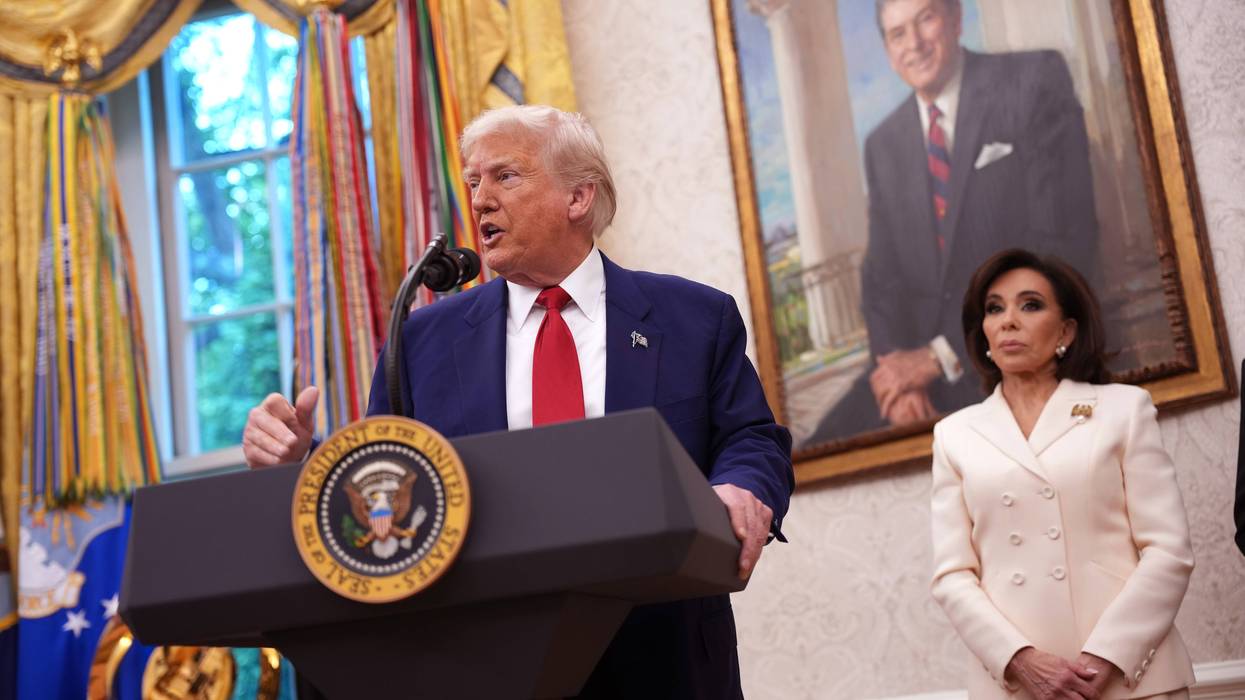
Rep. Jamie Raskin (D-Md.) announced the new probe in a letter to Interior Secretary Doug Burgum and Jeanine Pirro, the US attorney for the District of Columbia. Pirro, a longtime friend and ally of President Donald Trump, dropped the vandalism case against Hearn earlier this month, saying in a filing that the damage he was accused of inflicting on the Lincoln Memorial Reflecting Pool "was the result of a botched installation and not vandalism."
"Did DOJ prosecutors knowingly bring a bogus indictment?" Raskin asked in his letter. "Did [the Department of Interior] withhold key evidence to blame the disastrous reflecting pool renovation on an innocent man? Did President Trump pressure or influence either department to engage in wrongful actions against an American citizen?"
"At a minimum, it appears that members of the Trump administration were ready and willing to imprison an innocent American for a decade in a desperate effort to soothe an ex-landlord’s wounded ego about a terrible paint job and wasteful contract,” Raskin added. "We must get to the bottom of these murky waters to rid our justice system of any and all residual contamination."
"The conclusion seems inescapable that at least one, if not both, of you have misled the American public about the evidence and used it to corrupt and weaponize our justice system."
News of Raskin's investigation came shortly before The Wall Street Journal reported that "White House officials have asked the Justice Department to consider a new prosecution" of Hearn "as President Trump fumes over US Attorney Jeanine Pirro’s decision to drop the case."
"A new prosecution of the defendant... would be highly unusual, especially after Pirro told a judge in surprising detail that the government’s decision to indict him on a felony charge was ill-informed," the Journal noted. "Pirro said a botched renovation, not vandalism, was responsible for the reflecting pool’s problems."
Trump publicly accused Pirro of "folding like a cheap umbrella" after she dropped the effort to prosecute Hearn, whose legal team is seeking documents to show whether Justice Department prosecutors "were candid with the grand jury" when pursuing their indictment against the 67-year-old former Olympian.
Pirro, a former Fox News host who boasted in July that she had "tremendous evidence" of Hearn's guilt, has privately blamed Burgum for the debacle.
In his letter on Tuesday, Raskin demanded that Pirro and Burgum turn over "all documents related to the decision to prosecute" Hearn as well as "all communication between DOJ, DOI, and the White House related to the prosecution." Raskin also demanded "all evidence presented to the grand jury in connection with the indictment" of Hearn, a Maryland resident and one of Raskin's constituents.
"The conclusion seems inescapable that at least one, if not both, of you have misled the American public about the evidence and used it to corrupt and weaponize our justice system against an innocent 67-year-old American citizen," Raskin wrote.
"In a country that has experienced profound loss and suffering, this decision represents a powerful commitment to the right to life," said the UN's human rights chief.
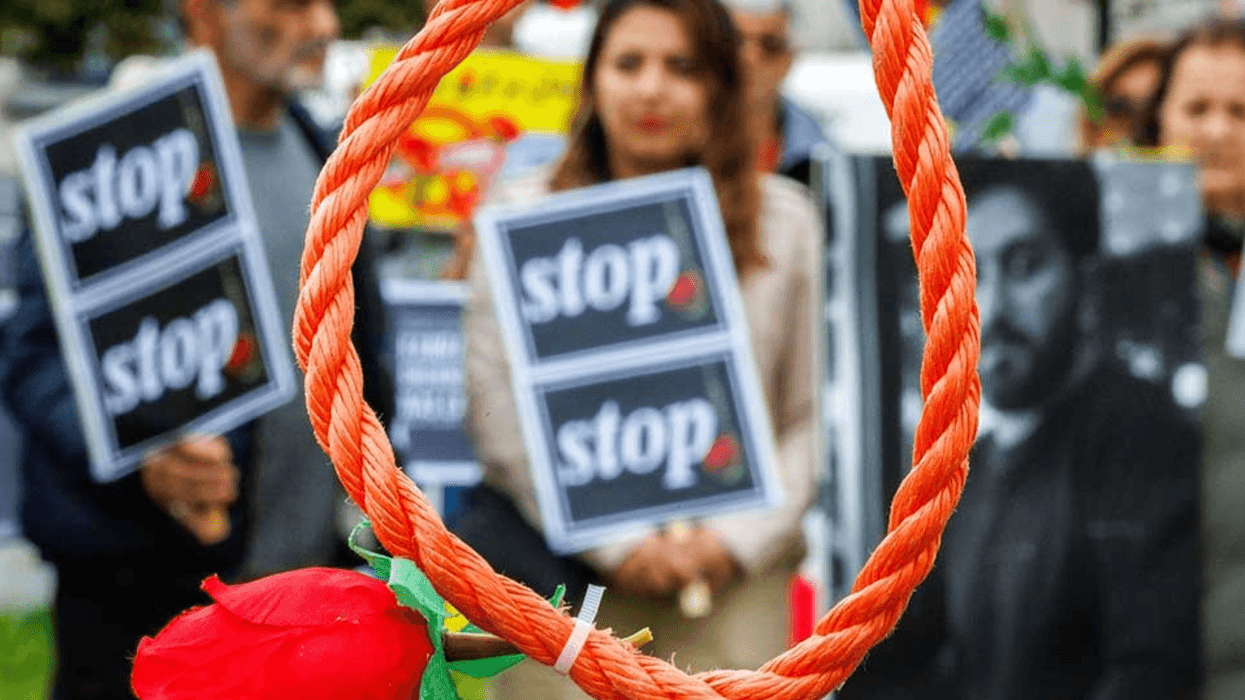
In a move cheered by human rights defenders around the world, Lebanon's Parliament on Tuesday abolished the death penalty for all crimes, making the country the first in the Arab world to do so and standing in stark contrast to neighboring and nearby nations.
Lebanon's abolition—announced on June 30 at the 9th World Congress Against the Death Penalty in Paris—was approved by parliamentary lawmakers and, once signed by President Joseph Aoun as expected, will make the country the 129th worldwide to abolish capital punishment.
Under amendments introduced by Independent MP Abdul Rahman Bizri, execution—formerly carried out by hanging or firing squad—will be replaced as the ultimate punishment by life imprisonment under hard labor for crimes committed after abolition. Those currently condemned to death will have their sentences commuted to hard labor for life.
“Lebanon is regaining its pioneering role in the region as a defender of human rights,” Lebanese Justice Minister Adel Nassar said, adding that his country “has chosen to combat murder rather than resort to capital punishment."
MP Georges Okais of the Christian, right-wing Lebanese Forces party, said that “Abolishing the death penalty is a historic achievement, and we have adopted international standards regarding human rights.”
Hezbollah's parliamentary bloc walked out in protest of abolition, which is also opposed by other lawmakers including Independent MP Jihad al-Samad, who called the move "contrary to Islamic law."
Opponents of abolition argue that it, plus a general amnesty draft law introduced in April, could result in leniency for perpetrators of bombings and other serious crimes.
However, Nassar insisted that abolition “does not mean leniency toward criminals.”
Lebanese law had designated execution as punishment for a wide range of crimes including—but not limited to—murder, aggravated rape, terrorism, treason, spying, military desertion, aggravated theft, and arson. While 84 people were sentenced to death, Lebanon has not executed anyone in 22 years.
“We can see the uncertainty that those who are condemned to death are living under," one psychologist working in Lebanese prisons told the French advocacy group Together Against the Death Penalty in a 2021 study. "We don’t apply the death penalty, but we don’t cancel it either."
"Are we going to wake them up one day and tell them that they will be executed?" the psychologist added, describing the process in Japan and Europe's last executioner, Belarus, without mentioning the countries. "It is the most horrible thing to live through. It leads to anxiety, depression, and stress that is sometimes uncontrollable. They are alive, but without living.”
Lebanon's imminent abolition stands in stark contrast with neighboring and regional countries. Iran, Saudi Arabia, and Yemen rank among the world's most prolific executioners, while Syria's recent history is marred by thousands of extrajudicial executions during the administration of President Ahmed al-Sharaa, and Israel recently legalized the hanging of "terrorists"—a law critics claim will only be applied to Palestinians.
Daniel Cullen, project manager at Oxford University's Death Penalty Research Unit, lauded Lebanon's achievement, which came at "a time of myriad domestic challenges."
"Since October 2023, Israeli forces have conducted intense bombardments in their campaign against the Hezbollah militant group, resulting in thousands of civilian deaths, including during periods of nominal ceasefire," Cullen wrote. "Together with the Israeli military occupation of large areas of the south of the country and issuing of evacuation orders, this has resulted in the displacement of around one million people."
"Even prior to this, the country had already experienced a stark economic collapse since 2019, with a near 40% reduction in GDP, in addition to recovering from the effects of the explosion at Beirut port in August 2020," he continued. "Against this background, Minister of Justice Adel Nassar specifically highlighted the importance of the abolition legislation as a demonstration of Lebanon’s ability to commit to international human rights standards."
"Lebanon’s commitment to achieving abolition during a time of national crisis demonstrates that this is entirely possible," Cullen added.
United Nations High Commissioner for Human Rights Volker Türk said on social media: "I welcome the Lebanese Parliament's decision formally to abolish the death penalty, and call on others to follow its lead. In a country that has experienced profound loss and suffering, this decision represents a powerful commitment to the right to life."
European Union High Representative for Foreign Affairs and Security Policy Kaja Kallas called Lebanon's abolition "a significant step forward for human rights in the country."
"As the first country in the region to abolish the death penalty, Lebanon is setting a powerful example for other countries in the Middle East and beyond, reinforcing the strong global trend towards abolition and the growing international support for ending the death penalty worldwide," she continued.
"The European Union calls on all countries that still apply the death penalty to abolish it and, pending abolition, to maintain or introduce a moratorium on executions as a first step," Kallas added, urging "those considering its reintroduction to refrain from such a regressive step."
The West African nation of Burkina Faso adopted a draft penal code last December that would restore the death penalty for crimes including treason, terrorism, and espionage. An effort to revive capital punishment in the Central Asian country of Kyrgyzstan was blocked by its Constitutional Court. Turkish President Recep Tayyip Erdoğan has repeatedly said he is ready to reintroduce the death penalty during his 23 years in power, while populist Filipino Sen. Ronald dela Rosa—a former police chief closely associated with former President Rodrigo Duterte's mass-murderous drug crackdown—reintroduced death penalty legislation after his reelection last year.
Human Rights Watch Lebanon researcher Ramzi Kaiss hailed Lebanon's "final break from a cruel sentence that should never be imposed.”
“Capital punishment is unique in its cruelty and finality and is plagued with arbitrariness, prejudice, and error,” Kaiss asserted.
Amnesty International called the move "a landmark victory."
“Lebanon’s decision to abolish the death penalty marks a major milestone and a victory for human rights in the country," said Heba Morayef, Amnesty's Middle East and North Africa director.
Morayef continued:
Justice must be rooted in human rights, not in an irreversible and cruel punishment. After more than two decades without executions, today’s step transforms a precarious hiatus in executions into lasting legal protection upholding the right to life and bringing Lebanon in line with the global trend towards abolition.
The passing of this law is testament to the decades of tireless advocacy by Lebanese human rights defenders and organizations, as well as the leadership of key officials who recognized the death penalty as a cruel and inhuman punishment, often imposed after unfair proceedings and the burden of which frequently falls on those at most disadvantage.
“To turn this law from paper to practice, Lebanese authorities must now ensure that all death sentences are commuted and ratify the key international treaty on abolition, while advancing broader reforms to strengthen a justice system based on dignity, fairness, and respect for human rights," Morayef added. "Authorities must accompany this law with broader legislative reform, including to ensure that any criminal justice punishments are consistent with human rights principles.”
"There is zero reason to not take Trump at his word that he and his team are planning something alarming to disrupt the midterms," said CNN host Jake Tapper.
A right-wing talk show host on Tuesday pushed President Donald Trump to declare a "national security emergency" that would let him meddle in the 2026 midterm elections—and the president did not rule it out.
In an appearance on Real America's Voice, Trump listened as host Wayne Allyn Root rattled off actions he would like to see the president take ahead of the midterms.
"Let me put an idea in your head," Root told Trump. "Because it's so hard to get the Senate to do anything, now they're on recess, they never get anything done. If they never get the SAVE America Act done, you have the right to declare a national security emergency for elections."
🚨🚨🚨
WAYNE ALLYN ROOT: You have the right to declare a national security emergency for elections. If you do this in the next month, we will get photo ID, proof of citizenship, and a limit to mail ballots
TRUMP: Let me just say stranger things have happened. I'll leave it at… pic.twitter.com/SvXYoYI0lQ
— Aaron Rupar (@atrupar) August 11, 2026
Root then told the president that "if you do this in the next month" it would allow for the implementation of photo identification and proof of citizenship requirements, as well as restrictions on mail-in ballots.
"Let me just say that stranger things have happened," Trump said in response. "I'll leave it at that."
The US Constitution does not give the president power to declare a "national emergency" that would allow him to unilaterally rewrite states' election laws.
Regardless, ABC News reported in February that a group of pro-Trump attorneys were circulating a 17-page draft order that would use the purported threat of election interference from the Chinese government to declare a "national emergency" that would outright ban mail-in ballots and mandate that all ballots be hand-counted.
Trump has not yet signed such an order, but he has issued other election-related directives, including one that instructs the United States Postal Service (USPS) to not deliver ballots in any states that have not given the federal government access to their voter lists.
The USPS executive order and an order that required Americans to show proof of citizenship when registering to vote have been blocked by courts.
Regardless, some observers expressed concern that the president wasn't yet finished in his efforts to meddle in the coming elections.
"There is zero reason," wrote CNN host Jake Tapper, "to not take Trump at his word that he and his team are planning something alarming to disrupt the midterms and beyond."
Criminal defense attorney Scott Greenfield observed in response to the president's appearance on Real America's Voice that "Trump has no legal authority to do this," but warned "that doesn't mean he won't try."
Journalist Mike Rothschild questioned what the conversation between Trump and Root said about both men’s mental stability.
"Once again, Donald Trump is not a wizard," wrote Rothschild. "He can't just manifest things into existence by saying them or with a tweet. There is no 'right' to do this in US law, nor is there any mechanism that would enable any of this to happen. Both people in this conversation are deranged."
After losing the 2020 presidential election to former President Joe Biden, Trump refused to concede the race, lied about the election being "stolen" by nefarious actors, pressured Georgia Secretary of State Brad Raffensperger to "find" enough votes to overtake Biden in the Peach State, and pushed then-Vice President Mike Pence to reject certifying the election despite lacking constitutional authority to do so.
When these efforts to overturn the election failed, Trump encouraged his followers to march to the US Capitol, where they broke into the building, assaulted law enforcement officers, and sent members of Congress running for their lives.
The Minnesota official took aim at the "special interests" funding her opponent's campaign ahead of the election, while Francesca Hong rejected claims that her priorities are too "extreme" for Wisconsin.
As the Democratic establishment and the corporate media continue to grapple with the results of last week's Senate primary in Michigan, which Abdul El-Sayed won after campaigning on Medicare for All, ending corporations' grip on elections, and investing in the social safety net instead of foreign wars, two more high-profile Midwestern races on Tuesday may provide more answers about the direction in which the Democratic base hopes to push the party.
In Minnesota, progressive Lt. Gov. Peggy Flanagan is facing US Rep. Angie Craig in the Democratic Senate primary, while in neighboring Wisconsin, democratic socialist state Rep. Francesca Hong's (D-76) closest opponent is Milwaukee County Executive David Crowley.
As in Michigan, where Democratic operatives have insisted that Rep. Haley Stevens would have been a better bet to win against Republican candidate Mike Rogers, supporters of Craig claim the congresswoman is more "electable" than Flanagan, who supports Medicare for All, an end to "offensive weapons sales to Israel," and publicly financed universal pre-kindergarten.
“Electability is probably the No. 1 factor,” Joe Radinovich, a Democratic strategist who views Craig as the better candidate to face a Republican in the November midterms, told The New York Times.
But a number of Craig's positions and ties suggest her backers may be working with a flawed understanding of what makes a candidate appealing to voters in 2026, with nearly half of Democratic voters in swing districts last year telling Upswing Strategies that they would avoid supporting a candidate who was funded by the pro-Israel lobby, 78% of Democrats saying in a poll in December that they supported Medicare for All, and half of Americans telling YouGov last month that they believed US Immigration and Customs Enforcement (ICE) should be abolished.
Craig has received major support from the American Israel Public Affairs Committee (AIPAC) in the past, but says she asked the powerful pro-Israel group not to donate to her this year as Americans sour on US military support for Israel, which, with the backing of the Biden and Trump administrations, has slaughtered more than 73,000 Palestinians in Gaza since October 2023. AIPAC has continued hosting fundraisers to boost Craig's campaign indirectly.
Craig has refused to call Israel's attacks on Gaza a genocide, while Flanagan has joined top human rights organizations and Holocaust experts in doing so, saying that “American taxpayer dollars should not be used to fuel the horrific violence and suffering that’s being experienced there."
The congresswoman is also out of step with the majority of Democrats on healthcare, pushing for legislation that would "build on" the Affordable Care Act instead of establishing a national healthcare plan, and on immigration policy. She was the only Democrat in Minnesota to support the Laken Riley Act, which gave ICE broader power to detain immigrants. Although Craig initially defended her vote, she expressed regret in March, after two Minnesota residents were killed by federal immigration agents who were part of President Donald Trump's crackdown in the state.
Flanagan has not joined the specific call to abolish ICE, but told The New York Times: “Whatever word you want to use, it can’t exist like this anymore. We have to rip ICE apart and start over.”
Outside groups, including super political action committees (PACs) representing cryptocurrency interests, have poured roughly $20 million into the effort to elect Craig, a co-sponsor of the CLARITY Act. The bill would split regulation of digital assets between the Securities and Exchange Commission and the industry-friendly Commodity Futures Trading Commission.
Flanagan on Monday said she was not intimidated by the special interests that, as she said "think they can buy this Senate seat."
The lieutenant governor has been endorsed by Sens. Bernie Sanders (I-Vt.), Elizabeth Warren (D-Mass.), and Tina Smith (D-Minn.), among others, as well as a number of labor unions, the anti-corruption group End Citizens United, and the advocacy group Indivisible.
Some recent polls have shown Craig with a small lead, while some internal surveys by Flanagan's campaign have shown the lieutenant governor several points ahead of her opponent.
Sanders predicted "a tight race" on Sunday in an interview with Margaret Brennan of CBS News' "Face the Nation."
"I hope very much that Peggy wins," said the senator. "I think what we’re seeing in Minnesota, Margaret, in Michigan, and all across this country, is that people understand that we’re living with an economy that is rigged. You have working families, 60% of our people, living paycheck to paycheck. People can’t afford groceries, housing, healthcare, basic necessities of life."
In Wisconsin, Sanders, Warren, and Rep. Alexandria Ocasio-Cortez (D-NY) are among the high-profile progressives who have declined to wade into the race and endorse Hong, who has consistently led by double digits in polls since February.
The gubernatorial candidate has distanced herself recently from what she called "bad takes"—a call in 2020 to "cancel Thanksgiving" and support for abolishing law enforcement.
“I will not abolish the police," said Hong in a debate in July. “I want to focus on stopping violent crime and giving law enforcement the resources and the training that they need but ensure that we are also holding accountable law enforcement that does not follow the law."
But Hong has won the support of Reps. Ilhan Omar (D-Minn.) and Ro Khanna (D-Calif.), with Omar calling her a "true champion for working families" and highlighting her support for broadly popular proposals like universal childcare, Medicare for All, and guaranteed paid leave.
Opponents of Hong are striving to attach the word "communism" to her political priorities—a clear sign, said Gustavo Gordillo of the Democratic Socialists of America (DSA) chapter in New York City recently, that "democratic socialism is not the scary word it used to be" for voters.
When asked by Fox News on Tuesday about alleged "fears that democratic socialism could turn into communism," Hong dismissed the idea, echoing Ocasio-Cortez's recent comment that "we can't even raise the minimum wage" in Congress.
"This is a state where we still have a $2.33 tipped minimum wage and $7.25 minimum wage," said Hong. "I think it's gonna be hard to turn that into socialism soon, but what we can do with this campaign is make sure we fight for policies that put working-class people first."
She added that she rejects claims that she is too "extreme" to win the general election in November due to her support for policies like taxing the rich and abolishing ICE, countering that Republican primary front-runner Rep. Tom Tiffany has displayed extremism by denying the 2020 election results and voting to keep files regarding convicted sex offender Jeffrey Epstein, a former associate of Trump, hidden from the public.
"What's extreme is that Congressman Tiffany, a longtime DC congressman, has voted against the interests of Wisconsinites over and over again," said Hong.
Q: Were you prepared for the pushback you received, especially from Republicans, framing you as far too extreme for Wisconsin?
FRANCESCA HONG: What's extreme is Rep. Tiffany has voted against the interests of Wisconsinites over and over again. What's extreme is that he's an… pic.twitter.com/QW0M5AVIVc
— Aaron Rupar (@atrupar) August 11, 2026
The Intercept noted that despite the recent hand-wringing in the corporate media over Hong's past comments on Thanksgiving—complete with a Times article that asked whether voters can forgive her—"the Times’ on-the-ground reporting managed to dig up precisely one Wisconsinite who would not."
"Even allowing for the fact that the attacks on Hong follow a well-established right-wing tradition—let us never forget those who laid down their lives in the War on Christmas—why has such a ridiculous controversy come to dominate efforts to quash her campaign?" asked Intercept reporter Sean Bell.
"The answer is simple: Nothing else has worked, and that failure indicates a worrying pattern for the Democratic establishment terrified of an insurgent left," Bell continued. "As the numerous recent victories for DSA-backed or progressive Democratic candidates have demonstrated, attacking the left on policy is not the winning strategy it once was. Many voters no longer recoil at the mere mention of universal healthcare, rent controls, or the dreaded 'socialism.'"
Joseph Geevarghese, executive director of Our Revolution, which has endorsed both Hong and Flanagan, issued a reminder on Tuesday: "Here’s how electability actually works: The most electable candidate is the one who gets the most votes. This narrative was always manufactured by people afraid of Francesca—and afraid of what happens when working people actually win. Her supposedly ‘radical’ agenda is healthcare, affordable childcare, and making billionaires pay their fair share."
"That’s not unelectable," he said. "That’s what working people are asking for.”
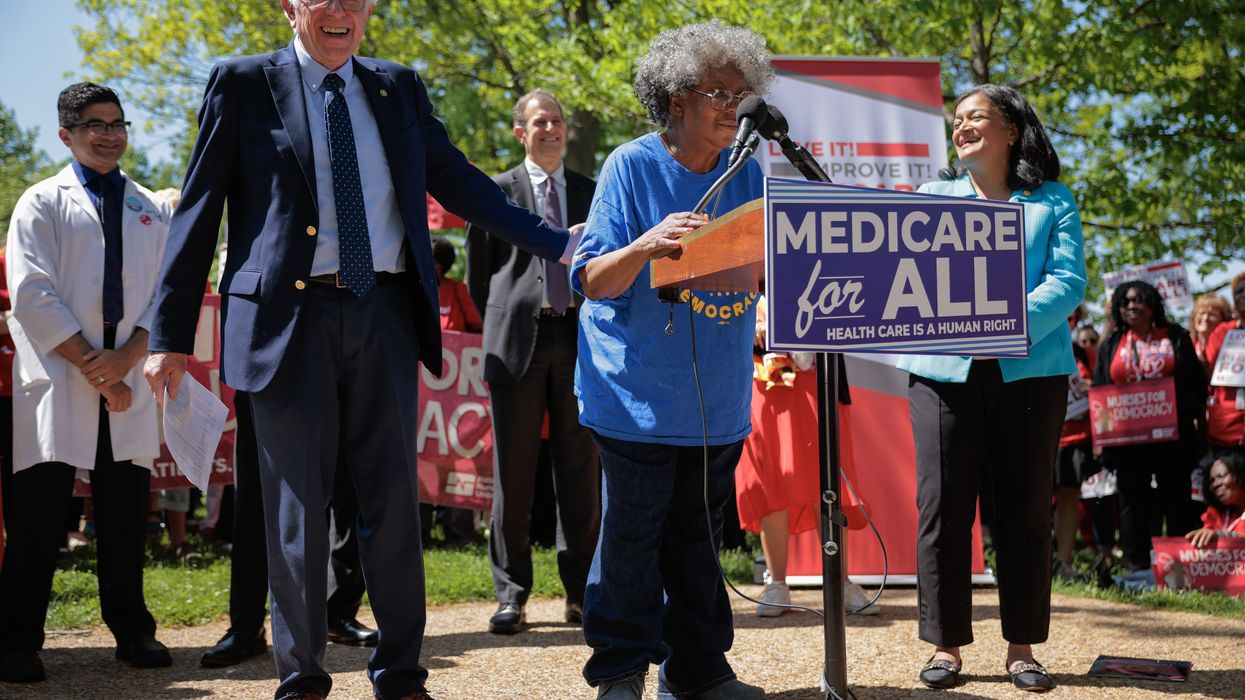
"Do not tell me we cannot afford Medicare for All," said Sen. Bernie Sanders. "What we cannot afford is a broken healthcare system based on greed."
Previous research has shown that shifting the United States to a Medicare for All system could save roughly 68,000 lives and $650 billion per year, but a new study by experts at Yale University suggests the savings would likely be even greater on both fronts.
In a Tuesday statement, Sen. Bernie Sanders (I-Vt.), lead sponsor of the Medicare for All Act in the Senate, highlighted the findings, published recently on medRxiv, a server for preprints, or research that hasn't yet been peer reviewed.
"The US spends more on healthcare than any other nation, yet tens of millions of Americans are uninsured or underinsured, and coverage retractions enacted in 2025 are widening these gaps," the five experts wrote.
Upward of 15 million Americans could lose health insurance coverage over the next decade because of Medicaid cuts in President Donald Trump's so-called One Big Beautiful Bill Act and the Republican-led Congress' failure to extend Affordable Care Act subsidies that expired at the end of last year.
"The misalignment between the for-profit insurance architecture and optimal patient care, together with the inefficiencies of a fragmented system, contributes to both unnecessary costs and preventable mortality," according to the Yale researchers. "We update our previous analyses with the most recent data to project the economic benefits and the number of lives saved that would be achieved by single-payer universal coverage, as proposed in the Medicare for All Act."
"We estimate that such a system would reduce national health expenditure by $1,041 billion annually," they explained. "Sources of savings include reductions in administrative overhead, pharmaceutical prices, fraudulent billing, and avoidable emergency care. Combined with the reversal of recent retractions, universal coverage would save over 114,000 lives annually."
Specifically, as Sanders' office detailed in a statement, Americans would save:
Welcoming the findings, the senator declared that "this study confirms what we have known for years: Medicare for All saves lives and saves money. In fact, guaranteeing healthcare as a human right through a Medicare for All, single-payer system would cost $1 trillion less than our current dysfunctional system."
"It would save working families thousands of dollars a year. And it would prevent over 100,000 Americans from dying unnecessarily each and every year because they cannot make it to a doctor in time," he stressed. "At a time when 15 million Americans are being thrown off the healthcare they have and 20 million Americans have already seen their premiums double, on average, as a result of Trump's so-called 'Big Beautiful Bill,' we need Medicare for All now more than ever."
"The time is now to end the greed of the big insurance and drug companies and pass Medicare for All," he added.
The research comes as Americans face high prices for not only healthcare but also food, gasoline, housing, and more under President Donald Trump and the GOP-led Congress. It also comes amid a renewed push by hundreds of advocacy groups that support Medicare for All and a wave of victories by progressive candidates who support the policy.
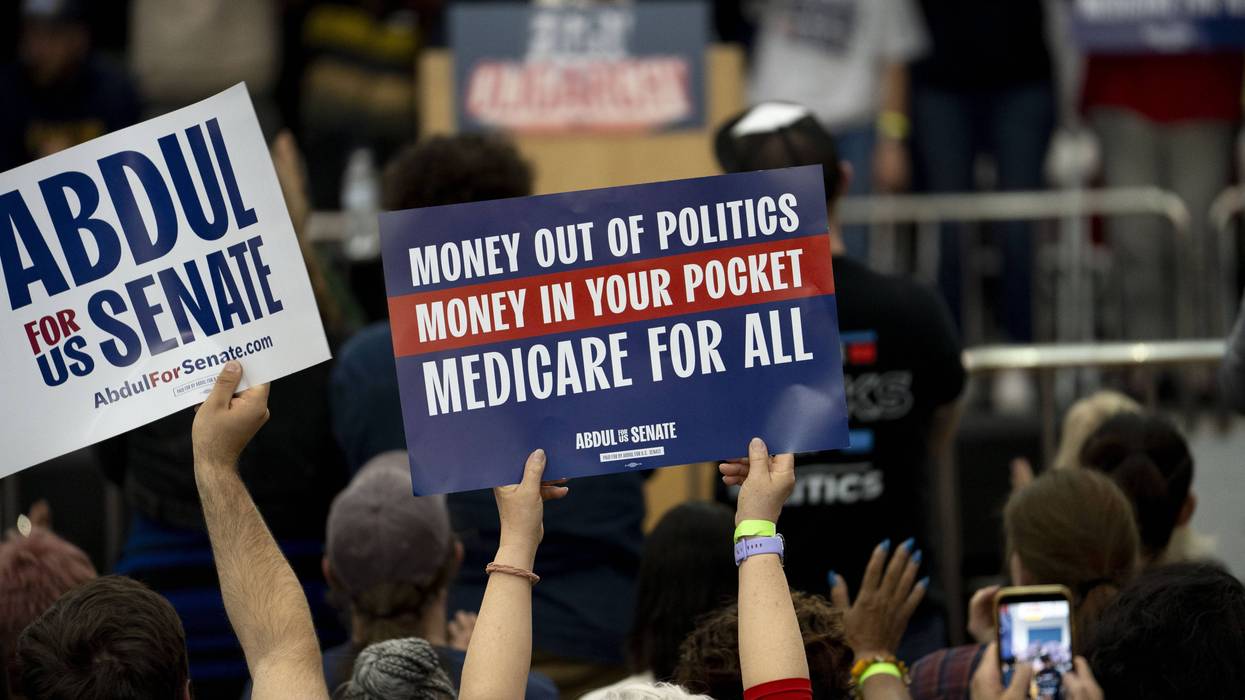
Among them is former Detroit health official Abdul El-Sayed, who won the Democratic primary for US Senate in Michigan last week having campaigned on a promise to prioritize "money out of politics, money in your pocket, and Medicare for All." His victory followed those of various other candidates, from Colorado to New York and Pennsylvania.
However, it's not just elected Republicans standing the way of a transition to universal healthcare in the United States. As a Monday analysis from the investigative outlet Sludge shows, the health insurance industry is pouring money into Third Way, a think tank reportedly preparing to spend $15 million combating the rise of candidates who support progressive policies including Medicare for All.
"You can't have your privacy violated if you don't know your privacy is violated," Rogers said in an infamous clip from 2013 as he defended the NSA's mass spying programs.
Amid an expanding assault on privacy by the federal government, Democratic nominee Dr. Abdul El-Sayed has brought the issue of mass surveillance to the forefront of Michigan's Senate race, attacking his Republican opponent, former Rep. Mike Rogers, for his longtime defense of the PATRIOT Act.
"Mike Rogers out here fighting for the Peeping Tom vote," wrote El-Sayed, a former public health official, in a social media post on Monday. "Creepy stuff, Mike."
El-Sayed was responding to an unearthed comment from Rogers, then the chair of the House Intelligence Committee, made during a 2013 committee hearing in Congress just months after whistleblower Edward Snowden's explosive revelations about the extent of the National Security Agency's (NSA) warrantless surveillance of Americans.
At the time, Congress was debating whether to enact legislation reining in a provision in the PATRIOT Act, Section 215, which the government had used to secretly collect phone records and other information in bulk from Americans not accused of wrongdoing.
Rogers was pushing American University law professor Stephen Vladeck to agree that the government should be allowed to examine Americans' business records to determine if they were connected to a foreign terrorist organization. Vladeck said he believed it should, but that protecting Americans' privacy needed to be taken into account. "The way we do it matters," he said.
The chair responded that in the decade since the policy had been enacted, nobody had ever complained about it. Vladeck, noting that the program was a secret, responded: "But who would be complaining?”
"Somebody whose privacy was violated," Rogers retorted. "You can't have your privacy violated if you don't know your privacy is violated."
The quote is highly representative of Rogers' record of support for extensive government surveillance over his decade-and-a-half in Congress. He was one of the PATRIOT Act's leading champions since its introduction in 2001 and led the charge to stop mass collection powers from being curtailed after the Snowden revelations.
“The charge that the program tramples on the privacy of citizens is simply wrong,” he said in a statement with Rep. Dutch Ruppersberger (D-Md.), then the ranking member of the Intelligence Committee.
Rogers and Ruppersberger also coauthored the Cyber Intelligence Sharing and Protection Act (CISPA) in 2012, which would have allowed companies to share cybersecurity-related information with the government, including the NSA, with protections from existing privacy restrictions. The American Civil Liberties Union argued that the bill, which failed in the Senate, would have allowed the government to obtain large amounts of sensitive personal data with few restrictions.
"You can't have your privacy violated if you don't know your privacy is violated."
In 2026, as artificial intelligence becomes a new tool for even more powerful and pervasive spying, El-Sayed has said the government must be banned from using it to "conduct warrantless surveillance."
As part of an AI policy platform rolled out in June, he said rules should be put in place to prevent its use for "domestic authoritarianism," including "mass political surveillance, protected-characteristic predictive policing, or AI targeting of dissent."
During President Donald Trump's second term, as he's used anti-"terrorism" rhetoric to justify a legal crackdown on domestic opposition, the government's expanding spy powers have become an increasing concern.
With the aid of private surveillance companies like Palantir, the administration has created an unprecedented surveillance dragnet that connects AI-powered facial recognition technology, license plate readers, and phone location tools to piles of data on Americans that have been used to supercharge its mass deportation campaign and aggressively monitor protesters and dissenters.
It has been met with some pushback in the Senate, where Republicans earlier this year narrowly failed to extend Trump's powers to surveil noncitizens under Section 702 of the Foreign Intelligence Surveillance Act (FISA) without warrants. Though US citizens are not supposed to be targeted, civil liberties advocates argue that their information is often collected easily and the government has used it to prosecute them.
Rogers has attempted to back off some of his earlier defense of mass surveillance, though he has not meaningfully pushed to reduce the government's spying powers. During a losing Senate bid against Sen. Elissa Slotkin (D-Mich.) in 2024, he said that it's "wrong" for the FBI to conduct warrantless searches against US citizens, but did not call for actually repealing or blocking Section 702.
Since serving in Congress, Rogers parlayed his time overseeing the intelligence community into a lucrative career advising and governing cybersecurity, intelligence, and government-contracting firms.
He served as a senior security adviser to AT&T while the company operated a little-known program that gave law enforcement access to searches of trillions of domestic phone records, though there is no record that he personally worked on the program.
Michigan Advance reported earlier this year that he also made almost $100,000 advising a company that helped the government of former Venezuelan President Nicolás Maduro spy on dissidents.
Noting the Republican nominee's recent pivot to Trumpian election denialism, journalist Spencer Ackerman—who has extensively covered the expansion of government surveillance during the War on Terror—suggested in a post on social media that there is little reason to believe Rogers has changed much after over a decade out of Congress.
"I saw up close his efforts, post-Snowden, to protect the NSA and ensure it continues to nullify your constitutionally-protected privacy," Ackerman said. "He was for impunity then and wants the same thing for himself."
Third Way has received donations from CVS Health, Johnson & Johnson, and an organization that counts the Blue Cross Blue Shield Association as one of its members, tax filings reveal.
The investigative outlet Sludge published an analysis on Monday showing that the health insurance industry is among the corporate donors to Third Way, a think tank that is reportedly preparing to pour $15 million into an effort to combat the rise of candidates who support Medicare for All and other progressive policies.
Third Way, which has long been hostile to the progressive wing of the Democratic Party and Medicare for All in particular, does not publicly disclose its donors. But Sludge's David Moore uncovered some of the group's benefactors by examining corporate tax filings, which revealed that the private insurance industry group Better Solutions for Healthcare (BSFH) donated $50,000 to Third Way's advocacy arm in 2024.
Among BSFH's members are the Blue Cross Blue Shield Association and the health insurance industry trade group AHIP. Moore noted that BSFH is "run out of the offices of leading Republican digital and strategy firm Targeted Victory in Arlington" and was founded by GOP operative Alexander Schriver.
Sludge's review of corporate tax filings showed other healthcare industry donors to Third Way, including CVS Health and Johnson & Johnson.
"Another corporate lobbying heavyweight, the Business Roundtable (BRT), gave $50,000 to Third Way in 2024, up from the $25,000 it gave in 2023 and down from the $75,000 it gave in 2022," Moore reported. "Each year in 2019, 2020, and 2021, BRT gave $50,000 to Third Way. The CEO group’s health insurance members include the heads of UnitedHealth, Cigna, Elevance (formerly Anthem), CVS Health—all members of AHIP (formerly America's Health Insurance Plans), save for UnitedHealth—as well as healthcare company Centene and many Big Pharma firms like Johnson & Johnson."
NEW: Who's funding the dark money Third Way, dug up in most recent tax filings:
- Republican-run insurance industry front group
- Health insurance giant
- Big Pharma
- More insurance lobbyists
...as it fights the Democratic left and Medicare for All:https://t.co/w787PVhxsH
— David Moore (@ppolitics) August 11, 2026
Moore's reporting came days Third Way president Jonathan Cowan told The New York Times that his organization is "preparing for the next war that is coming."
Cowan said that "it is deeply troubling to see radical, far-left candidates winning in places that are potentially presidential swing states"—a comment published two days after progressive epidemiologist Abdul El-Sayed, a vocal supporter of Medicare for All, won the Democratic primary for a critical US Senate seat in Michigan.
The Times story characterized Third Way as "a leading centrist Democratic group," without mentioning the organization's corporate ties.
"Post El-Sayed’s win, Third Way has done media hits in NYT, CNN, WaPo, Vox, and not one of these outlets has mentioned who funds Third Way historically or bothered to ask who their current donors are," journalist Adam Johnson wrote in a social media post on Tuesday, praising Sludge's review of tax records.
"Journalists are, in principle, supposed to do what David did here: investigate ulterior motives, follow the money, dig deeper," Johnson wrote. "Alas what mainstream outlets have done for Third Way this past week is credulously take them at their word they are merely 'concerned about electability.'"
Earlier this year, Third Way published a memo attacking Medicare for All and its purportedly "astronomical cost." (The memo does not mention research showing that a Medicare for All system would cost less than the status quo, while providing comprehensive universal health coverage and saving tens of thousands of lives per year.)
A recent study by Yale University researchers found that a Medicare for All system would reduce US national health expenditures by more than $1 trillion a year and "save over 114,000 lives annually."
Dr. Ed Weisbart, the national board secretary of Physicians for a National Health Program, told Sludge that "anybody who chooses to attack [Medicare for All] is putting themselves out of step with what I think most people in our country see as the solution."
“People want this, even when they understand that of course it's going to mean a change in their taxes—but they also understand that for 95% of people or so, the change in taxes is smaller than the amount that they would save by not having premiums, not having co-pays, not having deductibles,” said Weisbart. “People are getting that. And if you try to market a political view that's opposite, people see right through that."