
SUBSCRIBE TO OUR FREE NEWSLETTER
Daily news & progressive opinion—funded by the people, not the corporations—delivered straight to your inbox.
5
#000000
#FFFFFF
To donate by check, phone, or other method, see our More Ways to Give page.


Daily news & progressive opinion—funded by the people, not the corporations—delivered straight to your inbox.
A slew of White House actions are undermining efforts to address climate change, and under Biden, the country is producing more energy from fossil fuels than it did under former President Donald Trump.
The science is clear: Building any new fossil fuel infrastructure is incompatible with a livable climate. Yet, while President Joe Biden touts the Inflation Reduction Act, or IRA, as the country’s biggest climate law ever, he’s glossing over all the ways his administration has advanced fossil fuels, including in the IRA.
A slew of White House actions are undermining efforts to address climate change. And under Biden, the country is producing more energy from fossil fuels than it did under former President Donald Trump. In 2022, the U.S. broke its record for most fossil fuels produced in a year. Worse, it’s on track to break that record for 2023.
We know that to stem the tide of climate chaos, we need to move off fossil fuels, period. Instead, the Biden administration has approved and supported several projects that will unleash carbon bombs on our climate and lock in decades of drilling, burning, and emitting.
Despite his big talk on climate, when it comes to fossil fuels, President Biden’s policies just build on previous expansion.
Here are five of the Biden administration’s biggest carbon bomb approvals.
On the campaign trail, Biden promised to ban oil and gas leasing on federal lands and waters. But this promise didn’t last long.
In Biden’s first two years in office, his administration approved more than 6,400 permits for drilling on public lands, outpacing the Trump administration. Most recently, the White House auctioned off 100,000 acres in Wyoming to oil and gas companies.
The administration has also let Big Oil loose on our public waters. The Inflation Reduction Act prevented Biden from leasing any federal waters to offshore wind until he made 60 million acres available for oil and gas. So the administration resurrected two huge, previously canceled sales for offshore oil and gas drilling.
This past spring, it put more than 73 million acres of water in the Gulf of Mexico up for auction to fossil companies. If all the oil and gas there gets used, it would add the equivalent of 941 million metric tons of CO2 to the atmosphere. That’s the same emissions as an additional 209.4 million cars on the road for a year.
The Biden administration’s approval of Willow flew in the face of intense nationwide opposition. The project could last 30 years and pump up to 600 million barrels of oil out of the Northern Slopes of Alaska.
That means an extra 258 million metric tons of CO2 in the atmosphere—what 57.4 million cars would emit in a year.
For more perspective, the Center for American Progress compared Willow to the goals Biden set for building renewables on public lands and waters. If those clean energy goals were met, Willow would cancel out all of their climate gains—twice over. Literally one step forward, two steps back.
The Mountain Valley Pipeline (MVP) should have been dead ages ago. Federal courts have blocked it several times. But Biden didn’t just make way for Senator Joe Manchin to resurrect MVP—his administration has been greasing the wheels as it moves forward.
In May, Biden’s debt ceiling deal included orders for the MVP’s approval, ASAP. And most recently, Biden’s Department of Justice asked the Supreme Court to intervene after a lower court blocked construction on part of the pipeline.
MVP would carry up to 2 billion cubic feet of natural gas a day. The production and use of this gas would create the equivalent of 84 million metric tons of CO2 emissions each year. That’s like adding about 19 million gas-powered cars to our roads.
These 84 million metric tons of climate pollution aren’t inevitable. They’re a choice the Biden administration has made.
White House officials have framed MVP as “inevitable”—completely ignoring the role the administration played in pushing it forward. These 84 million metric tons of climate pollution aren’t inevitable. They’re a choice the Biden administration has made.
In 2019, Alaska LNG was all but over. The project proposed to extract and liquefy natural gas, then export it abroad. Though the Trump administration approved the project, its owner couldn’t make it make economic sense and stalled it.
But that changed as oil and gas companies capitalized on global crises to push liquefied natural gas (LNG). Moreover, subsidies in the Inflation Reduction Act made the project more viable. Then, the Biden administration pushed it even closer to the finish line with a key approval in April.
Alaska LNG’s climate impact would be monumental, as it’s authorized to export 929 billion cubic feet of gas per year. In addition to emissions throughout the supply chain, just producing and burning this LNG would release the equivalent of 108 million metric tons of CO2 every year for 30 years. That’s about the same as putting 24 million more cars on the road.
The project claims its planned use of carbon capture and storage will make the gas “green.” But we know carbon capture is nothing but an expensive failure. Yet, IRA subsidies for carbon capture could allow the company to snatch up to $600 million in public funds each year.
Speaking of …
Carbon capture and storage is one of Big Oil’s new favorite scams. Boosters call carbon capture climate-friendly, claiming it takes emissions and stores them permanently underground.
But in reality, this technology will lock us into a future with more fossil fuels. That includes the industry’s dirty pipelines, power plants, and refineries. Moreover, carbon capture has so far led to more U.S. emissions, not less.
Nevertheless, the Biden administration is promoting the technology through new policy, in addition to billions of dollars worth of subsidies.
Carbon capture won’t stop climate change, but it will boost Big Oil’s profits with public dollars via the IRA and other subsidies.
This April, the Environmental Protection Agency proposed new rules for power plants that rely on carbon capture—even though there are no power plants currently using carbon capture technology. Attaching it to power plants will just allow the same old pollution, only with a smokescreen of “captured emissions.”
Carbon capture won’t stop climate change, but it will boost Big Oil’s profits with public dollars via the IRA and other subsidies. And since 95% of carbon captured in the U.S. is currently used to pull more oil out of the ground, the administration is literally flushing money down oil wells.
Despite his big talk on climate, when it comes to fossil fuels, President Biden’s policies just build on previous expansion. His administration’s actions risk decades more climate pollution during this tipping point for the fate of our planet. The science has been unequivocal: we need to move off fossil fuels and rapidly transition to renewable energy.
This September, we have a huge opportunity to shout this loud and clear, as a major United Nations climate summit convenes in New York City. While the eyes of the world fall on New York, thousands will gather for the March to End Fossil Fuels before the summit.
This is our chance to communicate clearly to President Biden: The era of fossil fuels must end, and he must use every tool at his disposal to make that happen.
On September 17, we’re gathering with allies to demand that President Biden take the climate crisis seriously. Our planet depends on it.
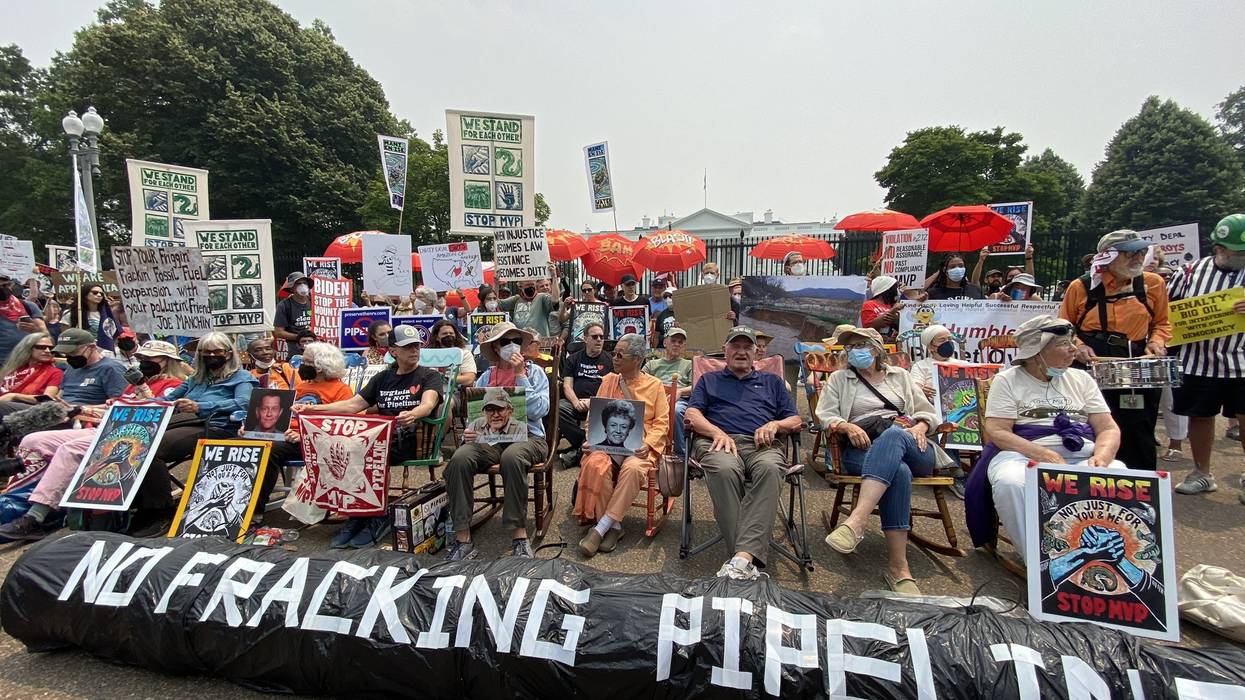
The president "can stop MVP just like he stopped Keystone XL" and "can reclaim his climate legacy by stopping all new fossil fuel projects."
Progressives descended upon the White House on Thursday to demand that U.S. President Joe Biden use his executive authority to cancel the Mountain Valley Pipeline and declare a climate emergency to expedite the end of the fossil fuel era.
Approval of the Mountain Valley Pipeline (MVP) was fast-tracked last week via the debt ceiling agreement that Biden, eschewing his options for unilateral action, forged with House Republicans who took the global economy hostage. The fracked gas development in Appalachia—pushed hard by the GOP and Sen. Joe Manchin (D-W.Va.), a coal profiteer and Congress' top recipient of Big Oil money—is one of several fossil fuel projects that Biden has the power to stop.
While Biden was inside the White House talking with right-wing United Kingdom Prime Minister Rishi Sunak, hundreds of people gathered outside to remind the president that "he can stop MVP just like he stopped Keystone XL." The rally was organized by People vs. Fossil Fuels, a coalition of more than 1,200 organizations. It marks the start of multiple days of action nationwide.
Many people wore masks due to the hazardous air quality in Washington, D.C. The East Coast's smoke-filled skies are a direct result of climate change-intensified wildfires now spiraling out of control in Canada—a fact that observers were keen to point to as evidence for why Biden should revoke the permits needed to complete MVP and other planet-heating fossil fuel projects.
When asked by a reporter Wednesday if the coalition planned to cancel Thursday's protest as a public health precaution, Fossil Free Media director Jamie Henn said, "No, this is exactly why we have to take these sorts of actions." On Thursday, he added that "we're not going to sit idle as the world burns."
A separate rally scheduled for Thursday in New York City had to be canceled, however, because the record-setting air pollution blanketing the country's most populous metropolitan area in an apocalyptic orange haze poses too great a risk.
"We're fighting for a future," West Virginia resident Maury Johnson said during the demonstration in the nation's capital. "Not one that's filled with smoke."
Climate justice advocates were joined outside the White House by Rep. Rashida Tlaib (D-Mich.). Noting that MVP has nothing to do with raising the nation's debt limit—an arbitrary and arguably unconstitutional cap on federal borrowing the GOP has weaponized to impose its agenda on multiple occasions—the progressive lawmaker denounced the inclusion of the project's approval in the debt ceiling deal.
As The Guardian reported Thursday, "The Mountain Valley Pipeline project has been enmeshed in legal challenges for years due to opposition from grassroots groups and landowners but the deal passed by Congress to raise the U.S. debt ceiling, signed by Biden over the weekend, singles out the pipeline as being 'required in the national interest' and therefore should be allowed to proceed, shielded from any future judicial review."
The approval of MVP comes just months after Biden greenlighted ConocoPhillips' massive Willow oil drilling project in the Alaskan Arctic. Additionally, despite possessing the executive authority to cancel nearly two dozen proposed fracked gas export projects that threaten to generate heat-trapping emissions equivalent to roughly 400 new coal-fired power plants, the Biden administration has moved to increase fracked gas export capacity, especially in the U.S. Gulf Coast, since Russia invaded Ukraine last February. The president has also rubber-stamped more permits for fossil fuel extraction on public lands and waters than his White House predecessor.
The Biden administration has done all of those things despite mounting evidence of the climate emergency's worsening toll and ample warnings from scientists about the incompatibility of expanding fossil fuels and preserving a livable planet. United Nations Secretary-General António Guterres recently told Biden and other wealthy country officials in no uncertain terms that their current climate policies amount to a civilizational "death sentence."
People vs. Fossil Fuels has argued that the president "can reclaim his climate legacy by stopping all new fossil fuel projects."
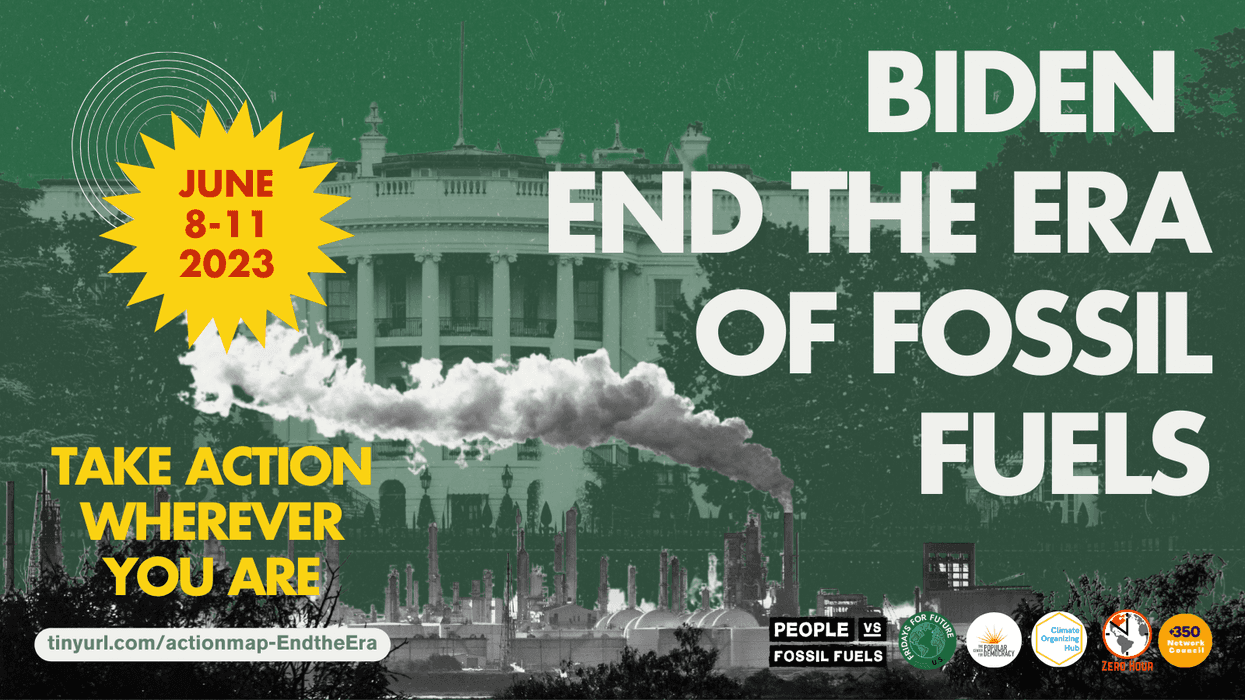
Thursday's rally outside the White House marks the beginning of what the coalition called "a stampede of distributed actions across the country" from June 8-11.
Participants have four main demands for Biden:
As another alliance of progressive advocacy groups has explained: "The president has a long list of actions that he could take or instruct his agencies to take, ranging from stopping fossil fuel infrastructure approvals to instructing the [U.S. Environmental Protection Agency] to issue a stringent pollution prevention rule for the oil and gas sector. Declaring a climate emergency under the National Emergencies Act would unlock additional statutory powers, including the ability to halt crude oil exports and directing funds to build resilient, distributed renewable energy."
In a statement this week, Zero Hour organizing director Magnolia Mead said that "young people are angry and fed up with watching President Biden cave to the fossil fuel industry time and time again."
"We need an immediate transition to renewable energy to slow the climate crisis, and that's impossible while our president is still approving massive fossil fuel expansion," said Mead. "If President Biden cares at all for future generations and frontline communities, he must choose to end the era of fossil fuels."
"Young people are angry and fed up with watching President Biden cave to the fossil fuel industry time and time again," one activist said.
In the wake of Biden administration decisions like approving ConocoPhillips' Willow project and agreeing to fast-track the Mountain Valley Pipeline (MVP), climate organizations and frontline communities across the country are launching a week of action from June 8 to 11 to demand President Joe Biden honor his promise to be the climate president and end the era of fossil fuels for good.
The action week will include a Thursday rally and sit-in at the White House along with demonstrations at 65 other locations across the nation backed by 64 different Indigenous, climate, labor, and environmental justice groups.
"Young people are angry and fed up with watching President Biden cave to the fossil fuel industry time and time again," Zero Hour organizing director Magnolia Mead said in a statement. "We need an immediate transition to renewable energy to slow the climate crisis, and that's impossible while our president is still approving massive fossil fuel expansion. If President Biden cares at all for future generations and frontline communities, he must choose to end the era of fossil fuels."
Our public officials clearly lack the political will or backbone to protect our people and the planet. So we must take action."
The action week—whose organizers include Zero Hour, Sunrise, 350.org, the Indigenous Environmental Network, Fridays for Future, and the People vs. Fossil Fuels coalition—grew out of disappointment with Biden's Willow approval along with the desire to channel young people's online opposition to that project into direct action.
The sense of urgency only mounted when the debt-ceiling agreement, signed into law by Biden Saturday, included approving the MVP and weakening the National Environmental Policy Act (NEPA), which gives frontline communities a say in infrastructure projects.
The protest outside the White House, which begins at 2:00 pm ET, will specifically demand that Biden cancel the 300-mile fracked gas MVP through Virginia and West Virginia.
"We are still not deterred in our fight against the MVP and other such harmful projects," Maury Johnson, a landowner in the MVP's path and a member of Preserve Monroe and the POWHR (Protect Our Water, Heritage, & Rights) Coalition—who is helping to arrange transport for the rally—told Common Dreams. "Hope to see hundreds if not thousands join us in front of the White House on Thursday, June 8."
The new direct action group Climate Defiance has promised to risk arrest at the protest and called on everyone of conscience to join them.
"Now is the time for climate action," Jay Waxse of Climate Defiance told Common Dreams. "Joe Biden and Joe Manchin think it's time for massive fossil fuel expansion, while our forests burn and skies fill with smoke. Our public officials clearly lack the political will or backbone to protect our people and the planet. So we must take action."
Waxse added that the group had chosen nonviolent direct action "to express to our branches of government that we won't be satisfied until we put an end to the expansion of new fossil fuels. And that means stopping the MVP now!"
As Washington D.C., along with most of the eastern U.S., chokes on unhealthy air from Canadian wildfires, Jamie Henn of Fossil Free Media said the White House protest would go ahead, though the organizers were taking health precautions including distributing N95 masks.
"This is 'exactly' why we have to take these sorts of actions," Henn tweeted.
For those who can't travel to D.C., organizers have provided a nationwide action map for the week as well as a toolkit explaining how to register an action.
Overall, the week has four main demands for Biden:
Local actions will also target specific fossil fuel projects, such as the Canadian-owned aging Line 5 pipeline that Indigenous advocates worry will spill oil into the Great Lakes.
"As a Bad River Band of Lake Superior Ojibwe member, I am calling on the Biden administration to shut down Line 5 immediately," Bad River Ojibwe activist Aurora Conley of the Anishinaabe Environmental Protection Alliance said in a statement.
"Our territories and water are in imminent danger, and we do not want to see irreversible damage to our land, water, and wild rice. We do not want our lifeways destroyed," Conley added.
In Seattle, meanwhile, protesters with XR Seattle, 350 Seattle, and other groups are meeting outside the Henry M. Jackson Federal Building at 12:00 pm PT Thursday with both national and local demands. In addition to calling on Biden to halt the MVP and restore NEPA, they also want Sens. Maria Cantwell (D-Wash.) and Patty Murray (D-Wash.) to publicly oppose the expansion of the GTN pipeline, a plan from TC Energy to pump an additional 150 million cubic feet of methane per day through the 1,354 mile long pipeline that runs through British Columbia, Idaho, Washington, and Oregon. The additional methane would add 3.47 million metric tons of greenhouse gasses into the atmosphere each year.
The Federal Energy Regulatory Commission could decide on the expansion as soon as July 27.
350 Seattle communications director Ben Jones told Common Dreams that the action was motivated by "the combination of looming expansion of natural gas" along the West Coast "and approval of a deeply unpopular and strongly resisted pipeline out East."
Jones was also concerned about the gutting of NEPA, which has helped communities in the Pacific Northwest to fight off more than 20 proposals for oil and gas expansion in the region in the last 15 years.
"With gutting NEPA, that's some of the main avenues that community groups have for public comment or for advocacy," Jones said.
Nationwide, organizers hope that the coming week of action will be the first in a summer-long escalation leading up to U.N. Secretary General António Guterres' hosting of a global Climate Ambition Summit in New York City in September.
"Starting this June and leading up to September, we will be taking action with national and international partners to make it clear that siding with Big Oil is a political liability for Biden—and we, the people who got him elected, demand better," the coalition said in their toolkit.
Correction: This piece has been updated to reflect a change in the expected FERC agenda with regards to the GTN pipeline expansion.
This geopolitical security plea for the Alaska LNG project ignores the Biden administration’s commitment to a 1.5°C aligned pathway to limit climate change and global warming.
Notwithstanding its climate-wrecking impacts, Biden administration officials are pushing a proposed 807-mile gas pipeline across Alaska and a liquefied natural gas (LNG) export facility they say would enhance U.S. national security and economic interests in the Indo-Pacific by assisting allies Japan and South Korea.
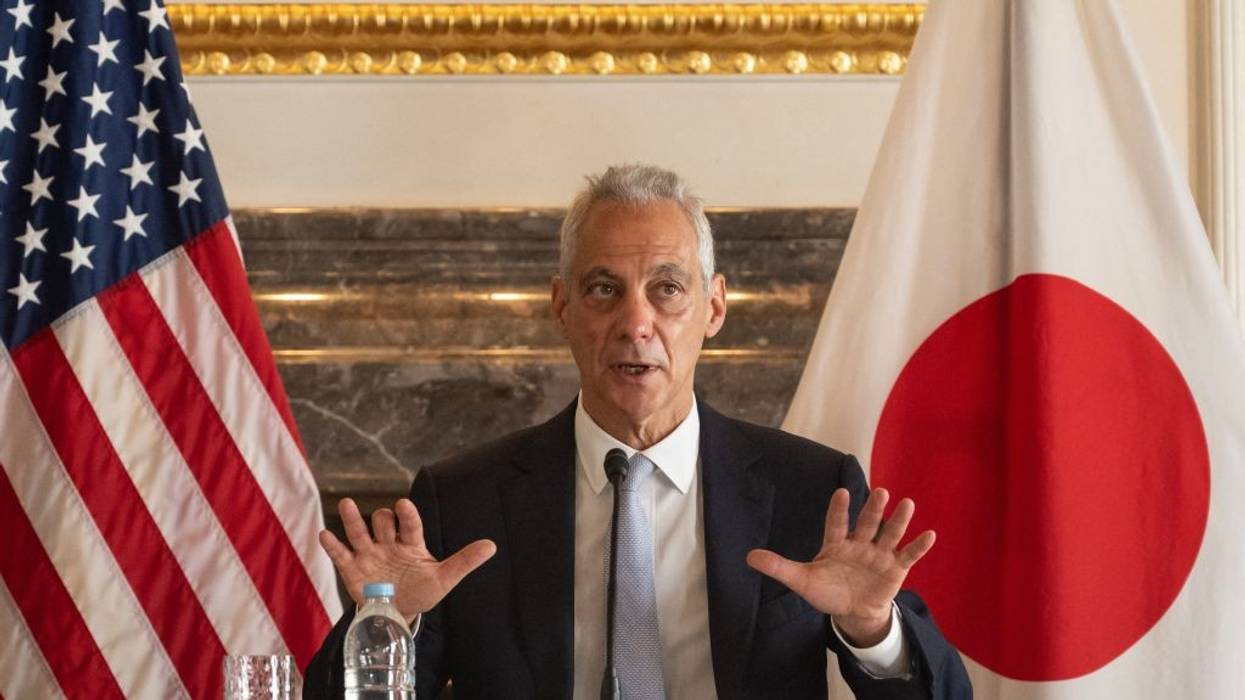
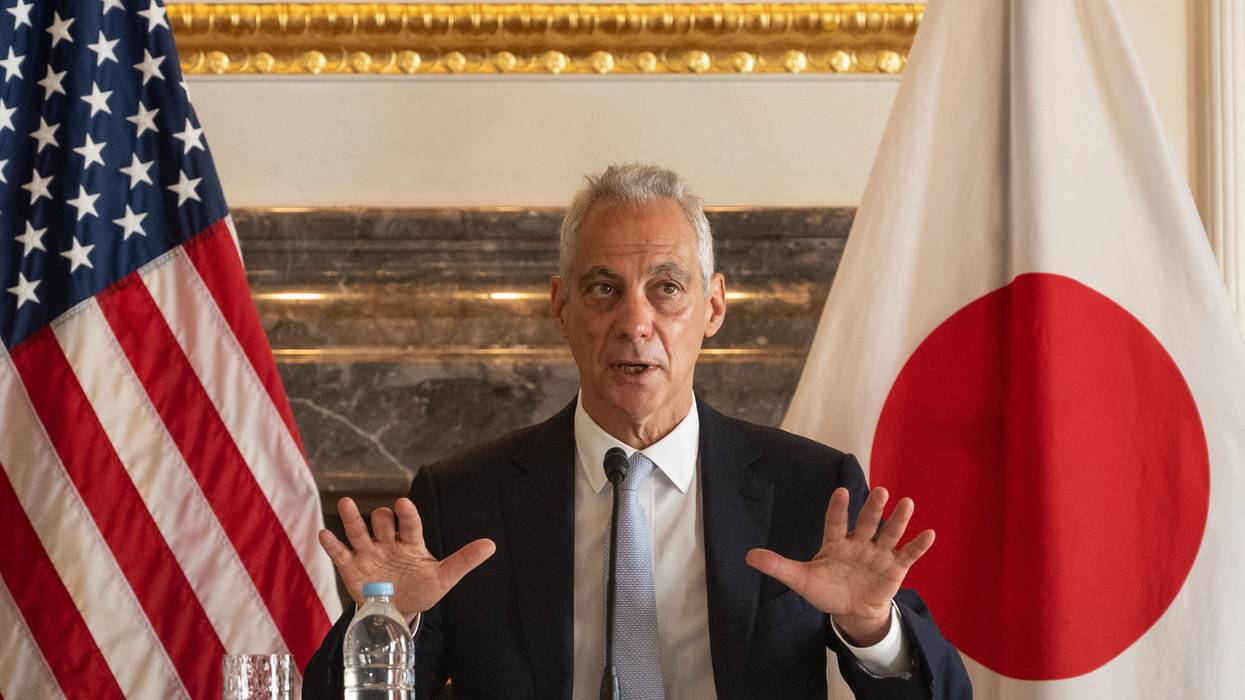
At a recent “Alaska Sustainable Energy Conference” organized by Governor Mike Dunleavy, U.S. Ambassador to Japan and former Chicago Mayor Rahm Emanuel and other officials promoted Alaska LNG as a “strategic asset” that could draw Asian allies closer to the U.S. and secure Asian markets for U.S. LNG into the future over competitors Russia and China.
Alaska LNG fills an important safety and security niche for Japan and Korea because it’s a straight shot to transport there from Alaska, and this route avoids “strategic choke points” in Chinese waters, Emanuel said.
While presented as a “temporary” solution, Alaska LNG would lock in an enormous amount of fossil fuel use and production beyond 2050, deepening the climate crisis.
“Every country wants more of America—not just militarily, but the economic statecraft it brings. Because they know firsthand what an unmoored, untied China can do,” Emanuel said.
This geopolitical security plea for the Alaska LNG project ignores the Biden administration’s commitment to a 1.5°C aligned pathway to limit climate change and global warming, as well as the scientific consensus that the climate can’t tolerate existing fossil fuel infrastructure and certainly no more new fossil fuel developments. This project could release up to 2.7 billion metric tons of greenhouse gas emissions over its lifetime, and 20 million metric tons of gas per year that could result in more than 50 million metric tons of carbon dioxide equivalent emissions annually.
While presented as a “temporary” solution, Alaska LNG would lock in an enormous amount of fossil fuel use and production beyond 2050, deepening the climate crisis. Although U.S. LNG exports to Europe were essential to meet the needs of our allies and provided the means to push back against Russia’s aggression in Ukraine, shutting down its major markets, the Alaska LNG project wouldn’t come online for at least 10 years so would have no effect on alleviating current shortages.
Although Emanuel asserted that Alaska LNG would help the climate, he and other officials made only a passing mention of the risks, harms, and threats of failing to reverse the trajectory of increasing fossil fuel production.
The Alaska project was described as being “clean” and climate-friendly because its LNG would displace coal use in Asia and has a shorter transportation route compared to LNG from the U.S. Gulf. However, coal is already being phased out, and LNG is a fossil fuel which is not clean energy.
LNG is a false solution that will intensify the climate crisis and increase the world’s dependence on fossil fuels. LNG is methane compressed and chilled to make it easier to transport. Methane emissions are 80 times more damaging to the climate than carbon dioxide, in the short term. Methane is notorious for fugitive emissions which are difficult to account for and occur frequently from production to end use.
The project’s economics are shaky, at best. The project’s current configuration, from the North Slope to tidewater with an export facility on the Kenai Peninsula, is optimistically estimated to cost $44 billion. Various configurations of a North Slope gas line have been unable to secure purchase agreements or financing for more than four decades despite massive but apparently insufficient federal loan guarantees that have exacerbated the U.S. debt crisis; the project has long been deemed uneconomic by independent analysts. The major gas producers abandoned the project years ago. All of the major oil companies associated with Alaska North Slope (ANS) gas have written down the value of their ANS natural gas pipeline development costs to zero.
Asian utilities are not waiting on the long-shot Alaska LNG to become even marginally credible as a commercial prospect; Houston-based Cheniere Energy and Korea Southern Power (KOSPO) recently announced a new long-term sale and purchase agreement.
The world already has more than enough methane in production or under development to meet global demand for decades, as well as many more proposed LNG export projects seeking approval that are less costly to develop than Alaska’s North Slope gas.
Other federal officials speaking in favor of the Alaska LNG project included Geoffrey Pyatt, assistant secretary for energy resources at the State Department, and Dave Turk, deputy secretary at the U.S. Department of Energy. Republican officials, U.S. Sen. Dan Sullivan, Gov. Dunleavy, and others on his team echoed similar points in their presentations.
From a climate, as well as an economic, perspective, Alaska LNG exports and the associated gas line are a No-Go. Instead of trying to prop up a dirty, dying industry, the federal and state governments should pursue opportunities to develop renewable energy and stop new fossil fuel developments like Alaska LNG.
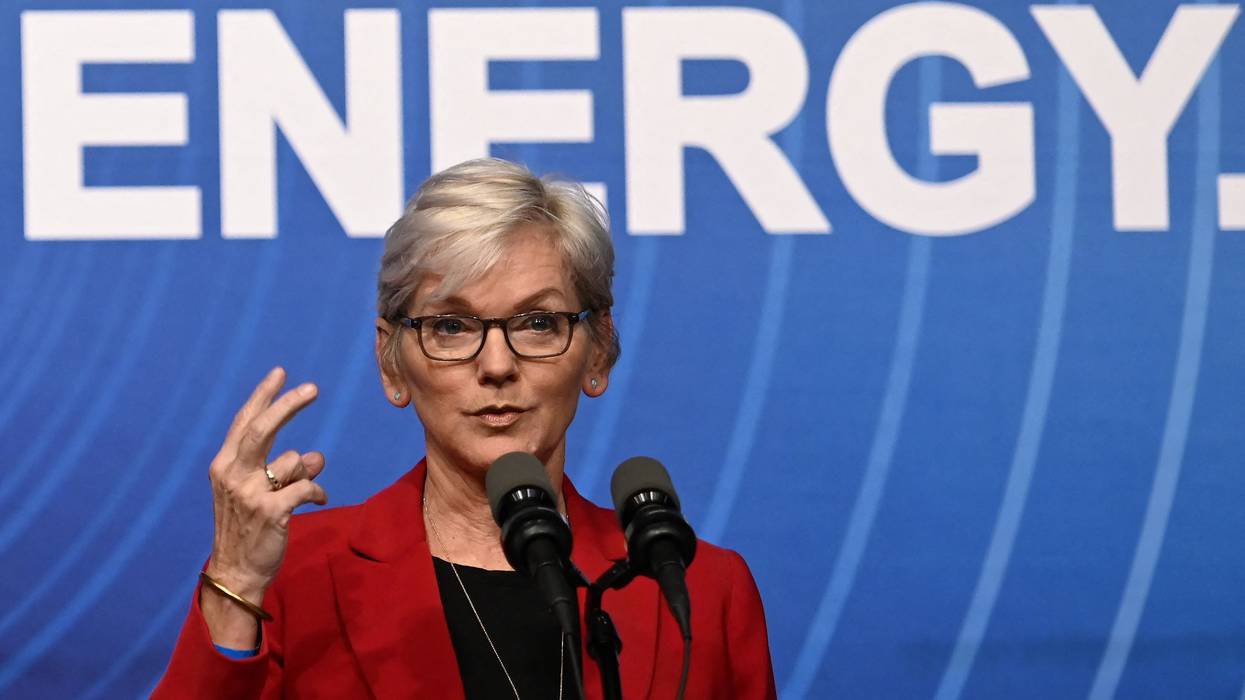
At a talk by Energy Secretary Jennifer Granholm, activists said that private security guards and Politico staff "brutalized" the demonstrators in their efforts to remove them.
A coalition of climate activists from CodePink, Climate Defiance, Climate First!, and Stop the Money Pipeline disrupted two talks at the Politico Energy Summit at Washington D.C.'s Schuyler event space Thursday, calling out corporate greenwashing and the Biden administration's approval of destructive fossil fuel projects.
At a talk by Energy Secretary Jennifer Granholm, protesters rushed the stage chanting, "No MVP, no LNG, Granholm you are killing me." Private security guards and Politico staff "brutalized" the demonstrators, the activists said, choking some, body slamming others, and dragging one woman out by her hair.
"We heard the first eight minutes of the conversation with Granholm," Jay Waxse of Climate Defiance told Common Dreams. "From the beginning she was justifying the need for new pipelines, like the Mountain Valley Pipeline (MVP). Especially with her background in clean energy policy, these fossil fuel projects she and the Biden administration are greenlighting are especially horrible."
President Joe Biden and his administration have disappointed climate campaigners for failing to uphold a campaign promise not to approve any more oil and gas drilling on federal lands. Despite this pledge, Biden actually approved more drilling during his first two years in office than did former President Donald Trump.
In particular, the activists targeted Granholm over two projects: the Alaska LNG Project and the MVP.
The Department of Energy signed off on the Alaska LNG Project in April, despite the fact that its own environmental impact statement found that the project—which would export as many as 20 million metric tons of fracked gas overseas starting in 2030—would spew 2.7 billion metric tons of greenhouse gas emissions over its lifetime—10 times more than the Biden-approved Willow project.
"This carbon bomb would lock in billions of tons of pollution and cause severe harm to Alaska's arctic wilderness," Waxse said in a statement. "It's completely unacceptable."
Also in April, Granholm sent a letter to the Federal Energy Regulatory Commission (FERC) affirming the Biden administration's support for the MVP that would carry fossil gas through Virginia and West Virginia.
"We've been treated as a sacrifice zone for so long that I'm absolutely fed up."
"Right now she is giving the thumbs up to the Mountain Valley Pipeline, which is a 300-mile long pipeline that would go through my home state, and we've been treated as a sacrifice zone for so long that I'm absolutely fed up and not willing to just sit by and let things like this slide," Climate Defiance organizer Rylee Haught said in a video interview after the action.
Granholm's talk began at around 4:25 pm ET, Waxse told Common Dreams. The first question Politico asked Granhom was about how she justified her approval of the MVP, but Waxse and Haught said in the video interview that her answer was not satisfying and that Politico did not challenge it.
In general, Haught criticized the way the media has framed the response to the Biden administration's sign off on fossil fuel projects.
Reports will say, "'Biden's ticked off some environmentalists,'" she explained, "when really they should be saying that Biden is currently harming the futures of all of us, not just the environmentalists."
The activists disrupted the talk at 4:34 pm, Waxse told Common Dreams. There were 15 activists in the room, including those filming, before security acted quickly to remove them.
"They ripped us out super quick," Haught said in the video interview, adding that she was so agitated by the response that she threw up in the parking lot afterward.
Climate Defiance documented security's aggression in a Twitter thread.
"The militarized response was unlike anything we've ever seen. A Black man was told 'we can shoot you, like you do each other,' the group wrote. "A woman had her neck mashed to the ground."
Climate Defiance said protesters were carted out by their feet, "one misstep away from a catastrophic injury."
The aggression toward the protesters carried over into racial profiling against other summit attendees.
"Black people who didn't even come as part of our group were summarily turned away. One was assaulted by a private security force—told the event was 'full' as white people in suits were allowed to stream in, unquestioned. Three unaffiliated Black women were kicked out," Climate Defiance tweeted.
The group criticized Politico for the violence of its response, as well as for taking money from utilities TC Energy—the company behind the Keystone XL pipeline—and Southern Company to fund the summit.
German media company Axel Springer—which has been known to compromise journalistic ethics to support right-wing talking points—purchased Politico in 2021, as Foreign Policy reported.
"Cancel you[r] subscription to politico. They hosted the event. They militarized it. They took money from utilities to pay for it," Climate Defiance tweeted.
In addition to the Granholm event, three demonstrators also interrupted a panel at around 1:50 pm ET that included Citibank chief sustainability officer Val Smith, presenting her with a "Greenwashing Award."
"It's hard to find a bank more committed to greenwashing than Citi," Arielle Swernoff, U.S. Banks Campaign Manager at Stop the Money Pipeline, said in a statement. "It has worked so hard to appear to be a climate leader yet is the most egregious example of a climate laggard. By almost every metric, Citi appears at the top of the league when it comes to funding fossil fuels and enabling environmental racism. As a global bank, Citi's greenwashing is playing a major role in stopping action on climate change."
Citi is the second-greatest funder of fossil fuels in the world, according to Banking on Climate Chaos. While the bank has set emissions reductions targets for 2030 and 2050, it has not detailed how it will work with high-emitting clients to meet them, the Sierra Club noted in March.
Emanuel is using his role as U.S. ambassador to Japan to boost a major gas export project in Alaska, The American Prospect reported.
A figure widely reviled in progressive circles for his past efforts to drag the Democratic Party to the right on climate and other issues is using his current position as the U.S. ambassador to Japan—and his extensive ties to the corporate world—to help secure funding for a major gas export project in Alaska that the Biden administration is supporting despite its pledge to rein in planet-warming emissions.
The American Prospect's Lee Harris reported Wednesday that Rahm Emanuel, who previously served as White House chief of staff in the Obama administration and was the mayor of Chicago for eight years, "hosted a summit last October" on the Alaska gas project "with investors including Goldman Sachs and BlackRock, and is expected to continue his promo tour with next week’s keynote address at the Alaska Sustainable Energy Conference."
"The Alaska LNG Project, which would help the U.S. sell more gas to Asia, has struggled for years to raise capital, despite billions of dollars in federal loan guarantees," Harris noted. "Oil companies ExxonMobil, ConocoPhillips, and BP pulled out of the project in 2014, after a natural gas supply glut caused prices to collapse."
Climate advocates voiced outrage—but not surprise—over Emanuel's role in boosting the project, which got a crucial green light from the Biden Energy Department last month.
"Rahm Emanuel did more than any single individual to sabotage Barack Obama's climate agenda at a time when there were congressional majorities," Lukas Ross, senior program manager at Friends of the Earth, told the Prospect. "It comes as no surprise to find him 13 years later trying to light the fuse of a massive carbon bomb."
Harris noted that the $40 billion project would "include multiple interlocking pieces of infrastructure: a gas processing facility with carbon capture and an export terminal, connected by 800 miles of pipeline across melting permafrost."
Proposed by the state-owned Alaska Gasline Development Corporation (AGDC), the project could result in more than 50 million metric tons of new planet-warming emissions each year if it's completed.
Politico reported earlier this month that Emanuel's "continued promotion of the project [has] helped ease foreign buyers' fears that the Biden administration would abruptly kill the project."
Earlier this week, Sierra Club and Earthjustice formally requested a rehearing of the Department of Energy's decision to approve methane gas exports from the Alaska project, which the groups said would "exacerbate the climate crisis by locking in decades of increased gas extraction."
"Claiming that a project like this could possibly be in the public interest isn't just out of step with the Biden administration's stated commitment to climate action—it's out of step with reality," said Andrea Feniger, chapter director of Sierra Club Alaska.
But as Harris detailed, the Biden administration has "expanded existing guarantees to move risks associated with Alaska LNG onto the public balance sheet."
"In 2004, the Natural Gas Pipeline Act authorized up to $18 billion in loan guarantees for the Alaska project, meaning the government would act as a backstop to assure lenders that they would be repaid. That commitment, which was indexed to inflation, is worth nearly $30 billion in guaranteed debt today," Harris explained. "The bipartisan Infrastructure Investment and Jobs Act passed in 2021 sweetened the deal. The 2004 law would have required that the Alaska project send gas to the continental United States to be eligible for subsidies. But an IIJA amendment allowed any project that exports natural gas from Alaska’s North Slope, including outside the U.S., to qualify."
Harris added that the project could also benefit—to the tune of billions of dollars—from the Inflation Reduction Act (IRA), which "dialed up federal subsidies for carbon capture in the Section 45Q tax credit."
The IRA was heavily influenced by Sen. Joe Manchin (D-W.Va.), one of the fossil fuel industry's top allies in Congress.
Harris reported that Emanuel is "selling the Alaska gas complex as a blunt political instrument," citing a recent Wall Street Journal op-ed in which he wrote that "if America, Australia, and other friends can supply the majority of Japan's LNG needs, why would Japan need to rely on its adversaries?"—pointing specifically to Russia.
"The U.S. already supplies Japan with 10% of its LNG, and we are ready to do more," Emanuel declared.
By working to boost U.S. gas exports, Harris wrote, Emanuel is "working on behalf of senators from fossil fuel states, including Joe Manchin (D-W.Va.), Ted Cruz (R-Texas), and Dan Sullivan (R-Alaska), who in March wrote a letter complaining of 'excessive restrictions on public financing of gas projects and unnecessary delays in approving privately-financed projects.'"
"In the face of current uncertainty, to protect migratory birds, the U.S. government should ensure the most important bird areas continue to be set aside," the co-author of a new study asserted.
Migratory bird nest survival "decreased significantly" near fossil fuel extraction sites in Alaska's Prudhoe Bay, a study led by the Wildlife Conservation Society revealed Tuesday.
WCS analyzed 17 years of migratory bird nesting data in Prudhoe Bay and found that "nest survival decreased significantly near high-use oil and gas infrastructure and its related noise, dust, traffic, air pollution, and other disturbances."
"Prudhoe Bay is the site of intensive energy development and is located on the Arctic Coastal Plain, one of the most important avian breeding grounds in the world," WCS noted. "Millions of birds nest here, with some then migrating through every state in the nation to wintering grounds in Central and South America, even Africa, with others crossing the Pacific Ocean to Russia, China, Japan, Australia, New Zealand, and Antarctica."
According to the study, which was published in the Journal of Avian Biology:
The Arctic Coastal Plain is one of the most important avian breeding grounds in the world; however, many species are in decline. Arctic-breeding birds contend with short breeding seasons, harsh climatic conditions, and now, rapidly changing, variable, and unpredictable environmental conditions caused by climate change. Additionally, those breeding in industrial areas may be impacted by human activities. It is difficult to separate the impacts of industrial development and climate change; however, long-term datasets can help show patterns over time.
We evaluated factors influencing reproductive parameters of breeding birds at Prudhoe Bay, Alaska, 2003–2019, by monitoring 1,265 shorebird nests, 378 passerine nests, and 231 waterfowl nests. We found that nest survival decreased significantly nearer high-use infrastructure for all guilds. Temporally, passerine nest survival declined across the 17 years of the study, while there was no significant evidence of change in their nest density. Shorebird nest survival did not vary significantly across years, nor did nest density. Waterfowl nest density increased over the course of the study, but we could not estimate nest survival in all years.
"Tundra-breeding birds contend with short breeding seasons, harsh climatic conditions, and now, rapidly changing, variable, and unpredictable environmental conditions caused by climate change," Martin Robards, regional director of WCS' Arctic Beringia Program and an author of the study, said in a statement.
"Additionally, as we demonstrate here, those breeding in industrial areas are impacted by human activities too," Robards added. "The urgency to better understand these relationships and mitigate impacts cannot be expressed strongly enough, given widely acknowledged declines in these species [and] our national and global obligations to protect migratory birds."
WCS said that "factors associated with industrial development that may directly or indirectly affect nesting include: habitat degradation via hydrology alteration and road dust, vehicle and aircraft traffic, noise, air pollution, and increased nest predator populations associated with development, including glaucous gulls, ravens, Arctic fox, and other species."
The study comes two weeks after the Biden administration approved the Willow Project, an $8 billion oil drilling project on federal lands in Alaska's largest remaining unspoiled wilderness, as well as the Alaska LNG Project, which the Department of Energy admits will unleash 10 times the greenhouse emissions of Willow.
"Claiming that a project like this could possibly be in the public interest isn't just out of step with the Biden administration's stated commitment to climate action—it's out of step with reality," one campaigner said of the fracked gas export initiative.
Climate justice advocates on Thursday vowed to fight the U.S. Department of Energy's approval of exports from a proposed liquified natural gas project in Alaska, condemning the initiative as "another carbon bomb" that puts a livable future in jeopardy.
The Alaska LNG Project plans to export up to 20 million metric tons of fracked gas per year starting in 2030. According to the DOE's own environmental impact statement, the project could unleash up to 2.7 billion metric tons of greenhouse gas emissions over the course of its lifetime.
That's ten times as much cumulative planet-heating pollution as the Willow oil project rubber-stamped one month ago by the U.S. Interior Department, which has been sued for refusing to use its authority to prevent ConocoPhillips from drilling on federal land.
"Right after the horrific Willow decision, it's painful to see Biden officials greenlight an even bigger fossil fuel project that will destroy Arctic habitat and feed the climate crisis," Liz Jones, an attorney at the Center for Biological Diversity, said in a statement.
Moneen Nasmith, a senior attorney at Earthjustice, added that "this administration cannot continue to approve these fossil fuel projects and say that it is taking the climate crisis seriously."
According to Reuters, "Backers of the roughly $39 billion project hope it will be operational by 2030 if it gets investments and all required permits."
The Alaska LNG Project, proposed by the state-owned Alaska Gasline Development Corporation (AGDC), constitutes one of the largest infrastructure endeavors in U.S. history. As Earthjustice explained:
The project involves constructing an 807-mile pipeline that would bisect the state from north to south, spanning a distance roughly the width of Texas. Construction would affect 35,474 acres of land, 45% of which would be permanently affected. "Stranded" gas deposits discovered decades ago in Alaska's Arctic, which would remain in the ground without causing any climate harm if it weren't for this project, would first be extracted and sent to gas treatment facilities operated by AGDC in the Arctic. The gas would then be transported 807 miles south to the Kenai Peninsula via the new pipeline, which would require 489 new roads to construct and maintain. AGDC would also build a liquefaction plant and marine terminal on the eastern shore of the Cook Inlet in Nikiski. The LNG would be transported to Asian markets via Cook Inlet, a sensitive water body that offers critical habitat for endangered beluga whales.
Earthjustice is currently representing a coalition of green groups in challenging the Federal Energy Regulatory Commission's (FERC) 2020 approval of construction on the Alaska LNG Project.
"With DOE and FERC approvals, the Alaska LNG export terminal now has most of the approvals needed for it to move forward. The ultimate fate of the project, however, is far from certain," Earthjustice noted. "The DOE order also grants the Center for Biological Diversity and Cook Inletkeeper leave to intervene, clearing the way for both organizations, along with Sierra Club, to potentially file additional legal challenges to DOE's approval. Earthjustice has represented the Center for Biological Diversity and Cook Inletkeeper to date in Alaska LNG proceedings before DOE."
Erin Colón, an Earthjustice senior attorney who led the FERC litigation, said that "not only is the Alaska LNG Project unnecessary given the widespread transition to clean energy alternatives we expect to see in the years to come, it's also a major threat to ecosystems and climate in Alaska."
"The state's greenhouse gas emissions from fossil fuels would balloon by nearly 30% over today's levels, in an era where all other states will be scrambling to reduce greenhouse gas emissions," said Colón. "This is also happening in a place that is uniquely impacted by climate change—with sea-ice melt, thawing permafrost, and coastal erosion."
Colón called it "frustrating to see the Department of Energy rubber-stamp a massive fossil fuel infrastructure project of this kind when it clearly conflicts with the urgent need to tackle the climate crisis."
The International Energy Agency and the Intergovernmental Panel on Climate Change (IPCC) have made clear that fossil fuel expansion is incompatible with averting the worst consequences of the life-threatening planetary emergency. To have a chance at limiting global warming to 1.5°C above preindustrial levels, peer-reviewed research shows that no new coal, oil, and gas projects should be greenlighted or financed and existing fossil fuel production must wind down.
According to Earthjustice:
Interest in gas will be waning by 2030, the earliest AGDC could expect to begin exporting LNG. The four countries that DOE assumes would receive gas from the project—Japan, South Korea, China, and India—all have announced plans to expand their renewable energy usage. By the year 2030, the IPCC warned in its Sixth Assessment Report, nations must complete the task of slashing greenhouse gas emissions 50% below preindustrial levels. By the time this project would be built, there may no longer be any demand for it, leaving more stranded fossil fuel infrastructure across the state.
Last year, the U.S. became the world's top LNG exporter. Despite mounting evidence of the deadly toll of fossil fuels, the Biden administration has yet to use its executive authority to cancel nearly two dozen proposed fracked gas export projects that threaten to generate pollution equivalent to roughly 400 new coal-fired power plants.
Instead, the White House has helped Big Oil secure dozens of long-term methane gas export contracts amid Russia's war on Ukraine.
"The proposed Alaska LNG export project would threaten Arctic wildlife and exacerbate the climate crisis by locking in decades of increased gas extraction and exports at a time when the science is clear that we must rapidly transition away from fossil fuels," said Andrea Feniger, director of the Sierra Club's Alaska chapter. "Claiming that a project like this could possibly be in the public interest isn't just out of step with the Biden administration's stated commitment to climate action—it's out of step with reality."
"We will pursue every available avenue to ensure that this ill-advised project is never built," Feniger added.