
SUBSCRIBE TO OUR FREE NEWSLETTER
Daily news & progressive opinion—funded by the people, not the corporations—delivered straight to your inbox.
5
#000000
#FFFFFF
To donate by check, phone, or other method, see our More Ways to Give page.


Daily news & progressive opinion—funded by the people, not the corporations—delivered straight to your inbox.
Despite VP Harris’ loss, the results of this election cycle proved that investing in women is not only central to creating a more representative government; it’s also a strong electoral strategy.
It’s crushing to witness the inauguration of U.S. President-elect Donald Trump, a man who built his campaign, and his entire political career at large, on hatred, division, and lies.
Vice President Kamala Harris’ loss was a deeply devastating one for so many of us—and certainly one of the hardest I’ve had to swallow throughout my career in Democratic politics—but skepticism about the viability of a woman becoming president in our lifetimes has added even further insult to injury.
As the president of EMILYs List, one thing I know with certainty is this: Underestimating the strength of women candidates based on the outcome of the presidential race is a grave mistake. The results of this election cycle proved that investing in women is not only central to creating a more representative government; it’s also a strong electoral strategy.
Men lose campaigns all the time, particularly in the last 40 years as EMILYs List has grown, yet we never question whether another man can win in the future.
Across the ballot this year, women candidates were key to winning races under even the most difficult of circumstances and up against tremendous headwinds. Democratic women held onto highly competitive Senate seats in three battleground states that were won by Trump and won in four House districts that Trump carried. They flipped key Republican-held House seats from coast to coast—in Oregon’s 5th and New York’s 4th congressional districts. They broke Republican supermajorities in states across the country, and they protected and flipped vital state Supreme Court seats that are going to be essential to protecting our freedoms in years to come.
It’s clear: Women have what it takes to win. And Americans are ready and fired up to elect them.
That’s because voters know who crafts our policy matters. Women candidates bring personal perspectives and professional experiences that make a difference on the campaign trail and in our government. Whether it’s Lisa Blunt Rochester’s personal connection to IVF, Lucy McBath losing her son to gun violence, or Lauren Underwood’s experience as a public health expert—their deep understanding of these issues and their deep-rooted commitment to enacting change shapes policy in ways that better the lives of their constituents. When these women shared their stories on the campaign trail this year, voters responded by turning out in their favor.
Pundits will try to diminish the practicality of running Democratic women candidates for president in the future, and voters may feel disillusioned as they watch Donald Trump be sworn in. So we must be clear about the truth surrounding the presidential race: Kamala Harris is the reason that the election was as close as it was. At a time when Democrats were poised to lose big, her leadership galvanized millions of previously apathetic voters and evened the playing field for our party amid an immensely challenging environment.
Immediately after announcing her candidacy, Harris shattered fundraising records, hauling in $81 million in her first 24 hours as the nominee. She erased the enthusiasm gap among critical voters—creating a 56-point jump in young women’s motivation to vote and a 68% increase in motivation to vote among women in battleground states. She drove massive spikes across voter registration and volunteer sign-ups. And while it wasn’t enough to overcome the challenges she inherited, her ability to quickly narrow Democrats’ deficits against Donald Trump is a testament to the strength of women candidates and the continued need to invest in their leadership.
Men lose campaigns all the time, particularly in the last 40 years as EMILYs List has grown, yet we never question whether another man can win in the future. We don’t debate their electability or the shortcomings of their gender—and we don’t let those limitations stand between them and the highest levels of our government.
To let gendered biases overshadow women’s extensive qualifications, their ability to best represent our communities, and their demonstrable strength as candidates, is a disservice to the American people and to our future. Misconceptions about women’s electability become a self-fulfilling prophecy only if we let them.
Kamala Harris herself said it best: It hurts to break glass ceilings. But just because we haven’t broken our nation’s highest and hardest glass ceiling yet doesn’t mean we won’t.
The women who won in 2024 reinforced a vital lesson: investing in women candidates is a winning strategy for the Democratic Party. So now is not the time to doubt, question, or give up on them. It’s time to double down on them—because women are our best pathway to taking back power. And with their leadership, we will undoubtedly shatter our nation’s last glass ceiling.
Denouncing "extremist Republicans," EMILY's List says the new state law exemplifies why voters "have to stop them at the ballot box this November."
As Iowa's six-week abortion ban took effect on Monday after a June ruling by the state Supreme Court, reproductive rights advocates pointed to the law as the latest proof of the importance of opposing anti-choice Republicans in the November elections.
"Today, people in Iowa woke up to the unfortunate reality that their reproductive rights have been ripped away," said NextGen America. "They're already fleeing the state for care. In November, abortion is on the ballot. Vote on it."
Also blasting "Iowa's near-total draconian abortion ban," EMILY's List warned: "This is the cruel future that extremist Republicans want for our country. We have to stop them at the ballot box this November."
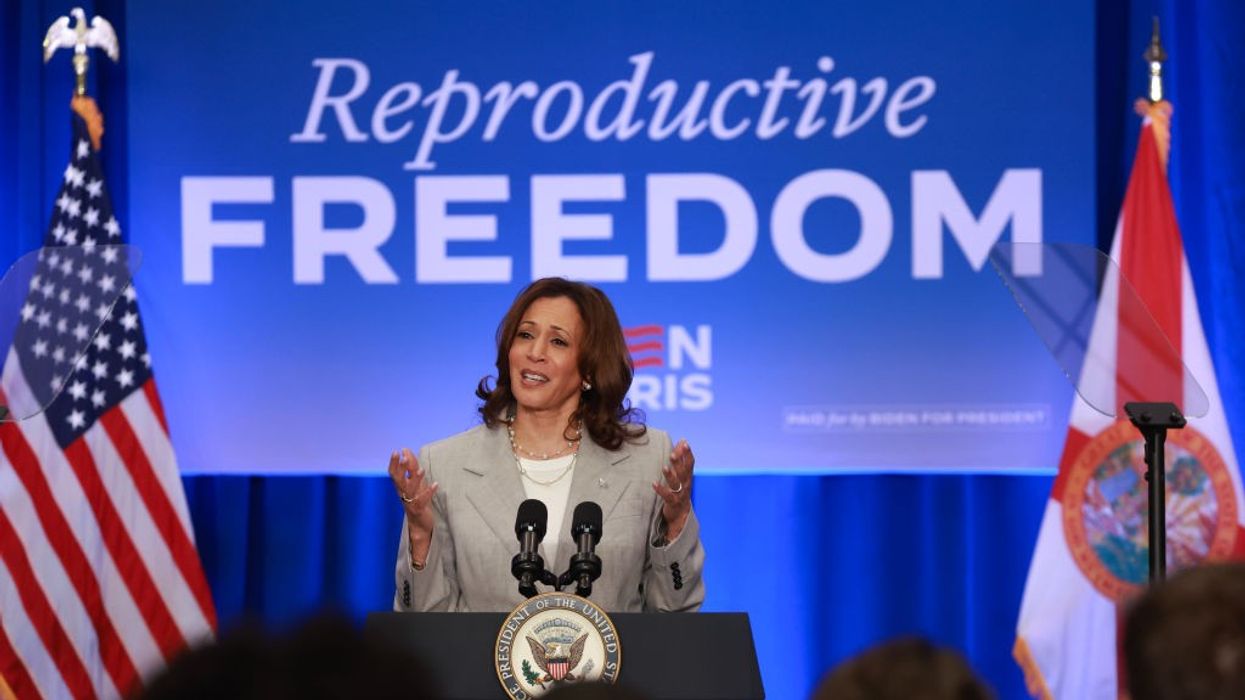
Reproductive freedom has been a key issue at all levels of U.S. politics this election cycle. President Joe Biden made abortion rights a top focus of his 2024 campaign, which Vice President Kamala Harris has continued since he dropped out and she became the presumed Democratic nominee to face former Republican President Donald Trump this fall.
Although Trump has at times tried to distance himself from state legislators' recent attacks on reproductive rights, he has also bragged about appointing half of the U.S. Supreme Court justices who reversed Roe v. Wade—and both his selection of his running mate, Sen. JD Vance (R-Ohio), and the latest Republican Party platform have stoked fresh fears about the GOP's plans for abortion at the national level.
Harris on Monday openly blamed the Republican presidential candidate for the new state ban, saying on social media: "This morning, more than 1.5 million women in Iowa woke up with fewer rights than they had last night because of another Trump abortion ban. In November, we will stop Trump's extreme abortion bans at the ballot box."
The vice president also shared a video message and her campaign on Monday launched a "Fight for Reproductive Freedom" week of action, which features dozens of planned events across battleground states.
More than 1 in 3 women of reproductive age in America now live in a state with a Trump abortion ban.
When I am President of the United States, I will sign a law restoring and protecting reproductive freedom in every state. pic.twitter.com/ka8f8zI145
— Kamala Harris (@KamalaHarris) July 29, 2024
Iowa's new law prohibits most abortion care after cardiac activity can be detected—supporters of such bans use the medically misleading term "fetal heartbeat"—which is usually around six weeks, before many people know they are pregnant. The ban has limited exceptions that critics warn are ineffective.
The state's Republican lawmakers initially passed a similar ban in 2018, though reproductive rights advocates won their legal battle to block it. However, after the U.S. Supreme Court overturned Roe with the Dobbs v. Jackson Women's Health Organization ruling in 2022, Iowa legislators last year tried to revive the old ban before ultimately passing the one that took effect Monday.
Planned Parenthood Federation of America and the ACLU of Iowa challenged the new ban on behalf of a Planned Parenthood North Central States subsidiary, the Emma Goldman Clinic, and Dr. Sarah Traxler, but the Iowa Supreme Court upheld it 4-3.
"To say the last few weeks have been hard is an understatement," Kristina Remus, a Planned Parenthood patient services associate, told The 19th on Friday. "People are confused and seeking clarification. And a lot of patients are unaware that there is a law banning abortion at about six weeks before many people know that they're pregnant set to take effect so soon on Monday. We are having extremely difficult conversations in my department with patients."
Planned Parenthood Action said on social media Monday: "Iowa's six-week ban marks the 22nd state that has banned some or all abortions. We know how dangerous this ban will be for Iowans, but we will not stop fighting for your right to abortion care."
Iowa Abortion Access Fund posted a similar message, saying: "We are heartbroken by this ban. It will affect thousands of Iowans but, as all abortion bans do, it will disproportionately affect those in marginalized communities, including communities of color, those in the LGBTQ community, lower-income individuals, and individuals living in rural areas."
"While this ban is disheartening, please know we are still here for you. We have partnered with the Chicago Abortion Fund (CAF) to provide comprehensive, wraparound support for Iowans in need of abortion care," the group continued, sharing the Illinois helpline. "Despite this gross government overreach, we will continue to fundraise. We will continue to advocate for abortion access and reproductive freedom for all. And we will continue to be here for you."
Illinois has seen a flood of "healthcare refugees" as surrounding states have tightened abortion restrictions in the wake of Dobbs. Democratic Gov. JB Pritzker, who is on the short list of Harris' potential vice presidential candidate picks, declared Monday that "here in Illinois, we will welcome our Iowan neighbors for reproductive freedom and whatever care they need. Please know—as you work to maneuver around this dangerous and unjust law—we are here for you."
In neighboring Wisconsin, there is also an ongoing battle over abortion rights. The state Supreme Court has agreed to take up two related cases, and in the meantime, Planned Parenthood has resumed providing abortion care in its clinics there. Like Harris, Democratic Gov. Tony Evers on Monday also blamed Trump and his "radical agenda" for Iowa's new law, highlighting that the Republican "promised to overturn Roe v. Wade, and called abortion bans like Iowa's 'beautiful.'"
"We will continue fighting to protect reproductive freedom in Wisconsin, but the only way to stop Donald Trump and JD Vance, Project 2025, and their plan to ban abortion in all 50 states is to elect Kamala Harris," Evers argued. "Kamala Harris will sign a federal law to restore reproductive freedom and make sure every woman in America has access to the reproductive healthcare they need and deserve."
While passing federal pro-choice legislation would almost certainly require Democrats to control not only the White House but also both chambers of Congress, the Democratic National Committee also directed attention to the presidential contest, with DNC spokesperson Stephanie Justice saying Monday that "today is a dark day for Iowa, the Midwest, and the country, and if Trump wins election again, this will be a harbinger of what's to come for the entire nation."
"Trump's Project 2025 will ban abortion nationwide and punish women who seek reproductive care," Justice added. "However, this does not have to be our future. Women in Iowa and across the nation are fed up and will rise up and vote against Donald Trump and JD Vance's plan to rip away our reproductive rights."
Meanwhile, Democratic Legislative Campaign Committee (DLCC) interim communications director Sam Paisley on Monday stressed the importance of electing supporters of reproductive freedom to state offices.
"Iowa Republicans have officially made their state one of the most extreme when it comes to restricting reproductive freedom, flying in the face of the majority of Iowans who support abortion access," Paisely said. "Since Roe v. Wade was overturned, GOP state legislatures have made these bans a top priority, and they show no sign of letting up."
"The time is now for Democrats to turn their attention to state legislatures where Republicans are leveraging power to pass an extreme agenda that rips up fundamental freedoms," she added. "The DLCC will continue to hold the GOP in the states accountable as they compromise the healthcare of their constituents."
"Kamala and I will restore Roe v. Wade and make it once again the law of the land. Donald Trump will ban abortion nationwide. That is what is at stake this November," the Democratic president warns.
"Freedom. Personal freedom is fundamental to who we are as Americans. There's nothing more important. Nothing more sacred. That's been the work of my first term."
That's how U.S. President Joe Biden began the video launch of his reelection campaign last year—and now, with the primary season underway, the Democrat continues to emphasize the importance of freedom and the related issue of reproductive healthcare.
The Republican front-runner, former President Donald Trump, and his MAGA movement have made clear that they are foes of abortion rights and other reproductive justice priorities, but Biden has work to do to win over some frustrated voters, including those outraged about the maternal health crisis created by the U.S.-backed Israeli war on the Gaza Strip.
Biden is backed by national groups such as EMILY's List, Planned Parenthood Action Fund, and Reproductive Freedom for All, but the devastation of Gaza has caused a "growing rift in the reproductive rights movement," HuffPost's Alanna Vagianos reported Friday.
Vagianos pointed to the January rally marking what would have been the 51st anniversary of Roe v. Wade—the landmark abortion rights ruling overturned in June 2022 by the right-wing U.S. Supreme Court to which Trump appointed three justices:
The president was interrupted over a dozen times as security struggled to wrangle protesters who were screaming "Genocide Joe!" and demanding a cease-fire. Hundreds of Biden supporters tried to drown out the protesters by clapping and chanting, "Four more years!"
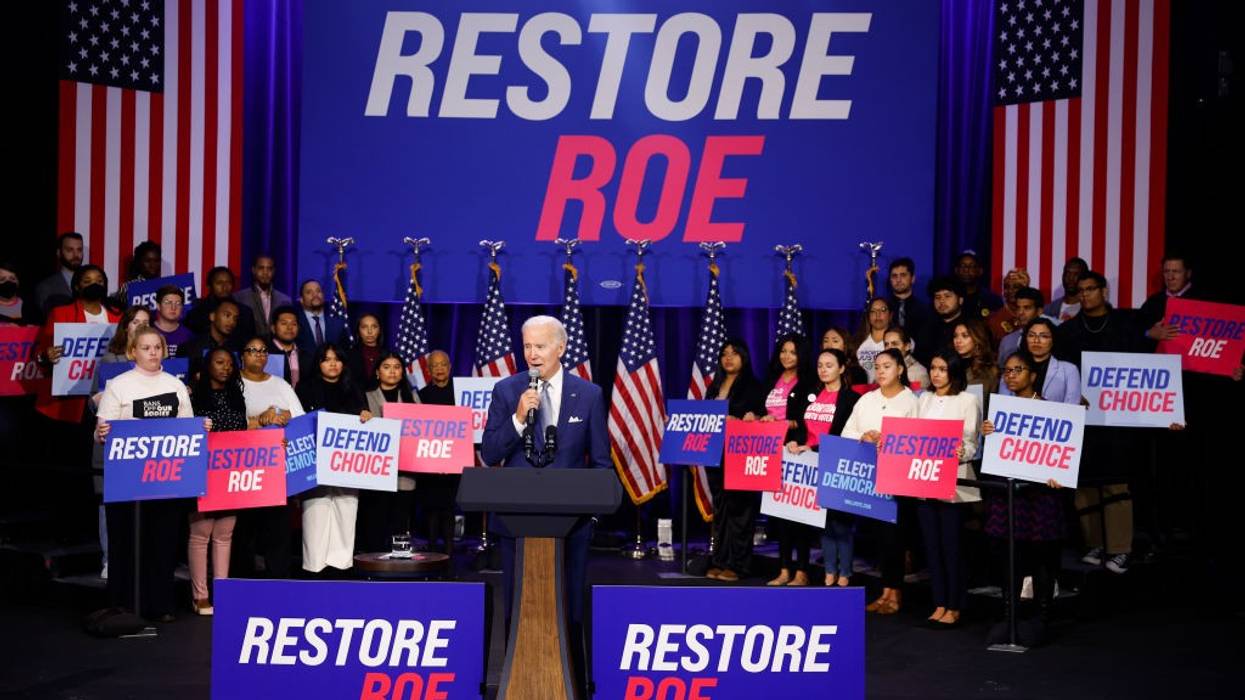
"Israel kills two mothers every hour in Gaza! Cease-fire now! End the genocide!" one protester yelled at Biden, who was standing on stage in front of a massive "Restore Roe" banner and flanked by supporters holding "Defend choice" signs.
A video of the event shows Alexis McGill Johnson, the president of the Planned Parenthood Federation of America, clad in her trademark hot-pink pantsuit, standing up and chanting "Four more years!" as security dragged the shouting protester out.
" HuffPost spoke with over a dozen people who work for reproductive justice causes―including current Planned Parenthood employees, legal experts, nurse midwives, abortion fund workers, and clinic staffers from across the country―who say that Biden's unwavering support for Israel has fractured the movement," Vagianos added. "The rift has left those who support Palestinians to feel ostracized by the larger reproductive rights groups and questioning whether they can vote for Biden in November."
Frustration with Biden's response to what other world leaders and legal scholars are calling Israel's genocidal war on Gaza—which has killed nearly 29,000 Palestinians—is far from limited to those campaigning for or working in reproductive healthcare.
"Right now, we feel completely neglected and just unseen by our government," U.S. Rep. Rashida Tlaib (D-Mich.), the only Palestinian American in Congress, said in a Saturday video supporting the Listen to Michigan campaign, which is urging Democrats to vote uncommitted in the February 27 presidential primary to send Biden a message on Gaza.
Michigan has large numbers of Arab and Muslim Americans. It is also a swing state where residents narrowly supported Biden over Trump in 2020. Two years later, just after the Roe reversal, they voted to enshrine abortion rights in the state's constitution.
After The New York Times reported Friday that "Trump has told advisers and allies that he likes the idea of a 16-week national abortion ban" with exceptions for rape, incest, or saving the pregnant person's life, Democratic Michigan Gov. Gretchen Whitmer joined Biden allies in advocating for reelecting him and Vice President Kamala Harris "to protect reproductive rights."
In a Friday statement about the reporting, Biden said that " Roe v. Wade is no longer the law of the land. And that's because of one person: Donald Trump. In fact, Trump brags about being the one to overturn Roe."
"Kamala and I will restore Roe v. Wade and make it once again the law of the land. Donald Trump will ban abortion nationwide. That is what is at stake this November," he added. "Our democracy. Our fundamental freedoms."
The Times then reported Saturday that Trump allies and former officials "are planning ways to restrict abortion rights if he returns to power that would go far beyond proposals for a national ban or the laws enacted in conservative states across the country."
As the newspaper detailed:
In policy documents, private conversations, and interviews, the plans described by former Trump administration officials, allies, and supporters propose circumventing Congress and leveraging the regulatory powers of federal institutions, including the Department of Health and Human Services, the Food and Drug Administration, the Department of Justice, and the National Institutes of Health.
The effect would be to create a second Trump administration that would attack abortion rights and abortion access from a variety of angles and could be stopped only by courts that the first Trump administration had already stacked with conservative judges.
Biden campaign manager Julie Chávez Rodríguez responded that "it's never been clearer what the American people can expect from Donald Trump: If given power, he will circumvent Congress and further rip away women's healthcare, including attempting to unilaterally institute a national abortion ban. These plans are as terrifying as they are unsurprising."
Leaders of national groups also weighed in with comments circulated by Biden's campaign. McGill Johnson called Trump "a disaster for democracy and a disaster for sexual and reproductive healthcare," while EMILY's List interim president Jessica Mackler declared that "there is a clear choice in November: Joe Biden and Kamala Harris, who have worked consistently to protect our rights, or Donald Trump and his Republican allies, who want to take our decisions and our rights away."
Reproductive Freedom for All president and CEO Mini Timmaraju said: "The most chilling part of the playbook of horrors Trump's advisers have cooked up is how confident they are that he can do untold damage in a second term—with or without Congress. If they have another opportunity, they'll act on it, and the consequences will be unimaginable."
As Common Dreams reported earlier this month, Biden has centered his support for abortion rights on the campaign trail but also come under fire for some recent remarks. While fundraising in New York City—where he faced Gaza-related protests—he said: "I'm a practicing Catholic. I don't want abortion on demand but I thought Roe v. Wade was right."
Renee Bracey Sherman, an organizer and abortion storyteller, said that "if Biden insists on hinging his entire campaign on abortion because it's more popular than he is, it would behoove him to actually use the messaging that we use to talk about abortion, without stigma, rather than throwing all of us who had abortions on demand under the bus."
Butler previously served as the head of a major SEIU local. But she also represented Uber as it fought efforts to classify drivers as employees.
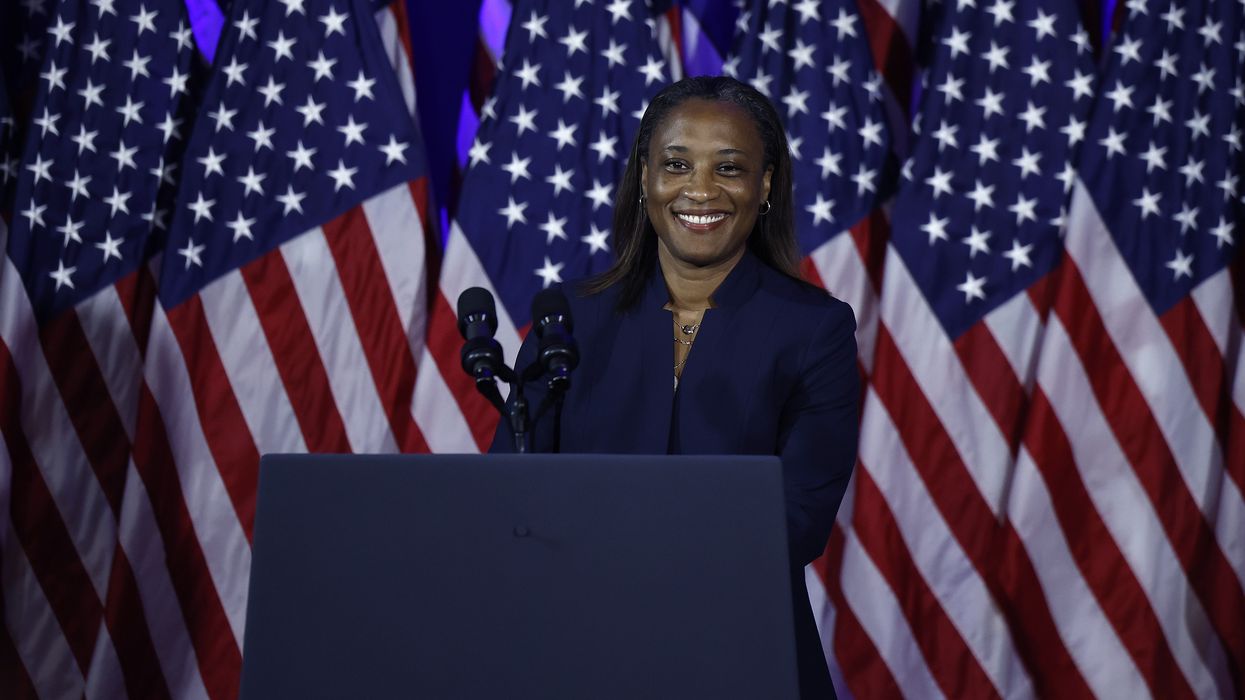
California Gov. Gavin Newsom announced late Sunday that he will appoint Laphonza Butler, president of the Democratic Party-aligned reproductive rights group
EMILY's List, to fill the U.S. Senate seat left vacant by the death of long-serving Sen. Dianne Feinstein last week.
Newsom's selection rebuffs calls from progressives and some Democratic lawmakers—including the head of the Congressional Black Caucus—to nominate Rep. Barbara Lee (D-Calif.) to fill the vacancy. Lee is one of three prominent Democrats running for Feinstein's seat in 2024.
Feinstein had planned to step down at the end of her term in January 2025.
Newsom pledged to fill any early vacancy with a Black woman, but he signaled last month that it would not be Lee, who is running against Reps. Katie Porter (D-Calif.) and Adam Schiff (D-Calif.).
"I don't want to get involved in the primary," Newsom told NBC, stressing that his selection would be an interim pick. "It would be completely unfair to the Democrats that have worked their tail off. That primary is just a matter of months away. I don't want to tip the balance of that."
In a statement late Sunday, Newsom said that "as we mourn the enormous loss of Senator Feinstein, the very freedoms she fought for—reproductive freedom, equal protection, and safety from gun violence—have never been under greater assault. Laphonza will carry the baton left by Senator Feinstein, continue to break glass ceilings, and fight for all Californians in Washington, D.C."
"An advocate for women and girls, a second-generation fighter for working people, and a trusted adviser to Vice President [Kamala] Harris," Newsom added, "Laphonza Butler represents the best of California, and she'll represent us proudly in the United States Senate."
Shortly following news of the governor's decision, journalists
noticed that EMILY's List removed the final line of Butler's bio that said she lives in Maryland with her partner and daughter. Newsom's office confirmed to California reporter Ashley Zavala that Butler moved to the Washington, D.C. area for her role at EMILY's List but owns a home in California, and will reregister to vote in the state before she is sworn in.
Prior to her stint at EMILY's List, which works to elect pro-choice Democrats, Butler served as president of Service Employees International Union (SEIU) Local 2015, the nation's largest home care and nursing home workers union.
But CalMatters noted Sunday that "despite her previous career, organized labor is likely to split on Butler."
"Many felt betrayed when she represented Uber in 2019 as the company tried to broker a deal that would avoid classifying their drivers as employees," the outlet reported.
Butler also worked as director of public policy for Airbnb.
Politico reported that "Newsom is making his appointment without putting limitations or preconditions on his pick running for the seat in 2024. That means Butler could decide to join the sprawling and competitive field of Democratic contenders seeking to succeed Feinstein, with special elections now layered on top of the March primary and November runoff."
In a letter to Newsom earlier Sunday, Congressional Black Caucus Chair Steven Horsford (D-Nev.) urged Newsom to appoint Lee to fill the vacant U.S. Senate seat, arguing that her "unparalleled legislative record, longstanding leadership in the Democratic Party, and deep commitment to justice and equality cannot be equaled."
"Barbara Lee has diagnosed a sickness in this country: greed," Horsford wrote. "And, as a former mental health professional, she has a solution: eradicate poverty, exterminate corporate welfare, and end austerity for working families. She is the only person with the courage, vision, and record to eradicate poverty, face down the fossil fuel industry, defend our democracy, and tirelessly advance the progressive agenda."
Lee, for her part, wrote in a social media post that she looks forward to working with Butler to "deliver for the Golden State."
"I am singularly focused on winning my campaign for Senate," Lee wrote. "CA deserves an experienced senator who will deliver on progressive priorities. That's exactly what I'm running to do."
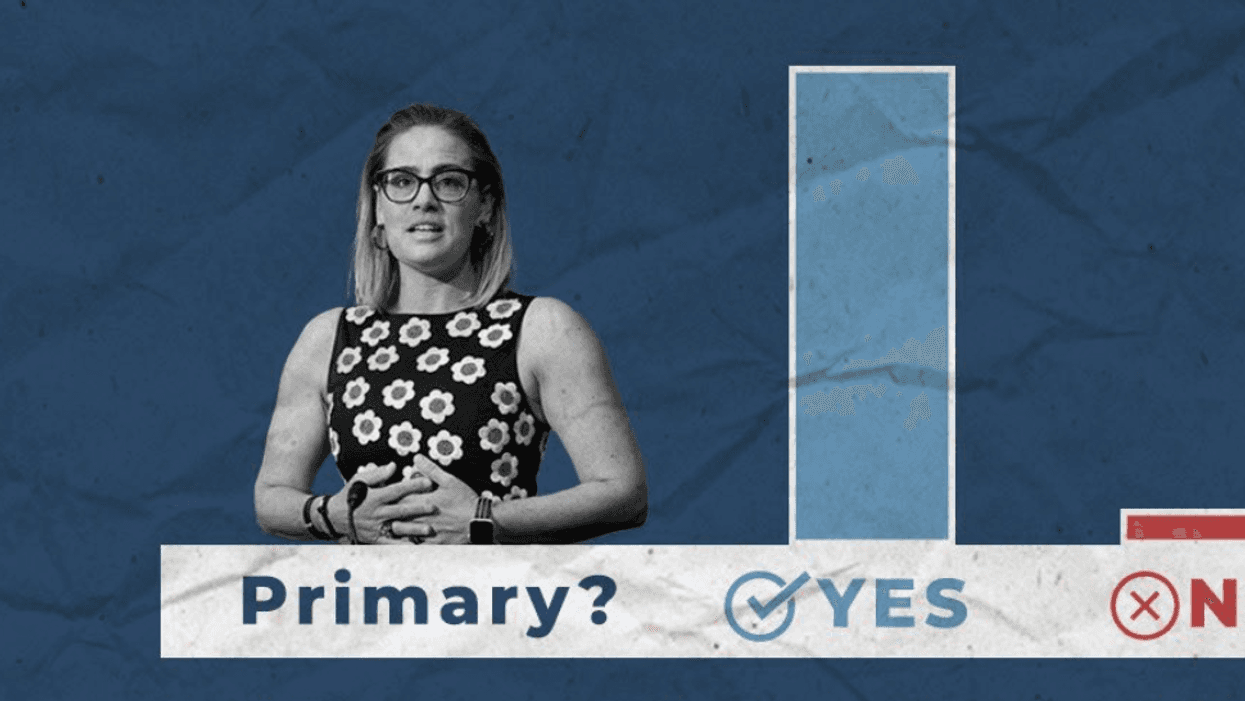
As U.S. Sen. Kyrsten Sinema continues to stymie voting rights legislation by refusing to support filibuster reform, an overwhelming majority of respondents to a Tuesday survey by Indivisible said they would back a 2024 primary challenger to the Arizona Democrat if she does not change course.
"Since 2021, Arizonans have been calling on Sinema to eliminate the filibuster and pass democracy reform."
In a "flash poll," the progressive advocacy group asked over 4,600 Indivisible activists in Arizona via SMS: "If Sen. Sinema votes 'no' on fixing the filibuster and passing voting rights, would you support a Democratic primary challenge to her in 2024?"
Out of the 723 people who texted back, 94% replied affirmatively.
"Since 2021, Arizonans have been calling on Sinema to eliminate the filibuster and pass democracy reform," Indivisible said in a statement Tuesday. "Despite the senator's refusal to host a single town hall or have a meeting with activists, Indivisibles have been trying to get through to her with rallies, light brigades, car caravan protests, letters to the editor, and social media."
"After a year of demonstrations and activist pressure, fed-up constituents and voters who helped elect Sinema are starting conversations around finding a Democratic primary challenger to Sinema after her failure to represent Arizonans and follow through on her campaign promises," the group said.
Indivisible isn't the only progressive organization that would support primarying Sinema. In a statement last week, Adam Jentleson of Battle Born Collective and the Primary Sinema Project asserted that "there is no excuse for Sinema's obstruction" of filibuster reform, which progressives say could be the key to passing the Freedom to Vote: John R. Lewis Act.
Obstruction by Sinema and fellow corporate Democrat Sen. Joe Manchin (W.Va.) has already all but sunk President Joe Biden's flagship Build Back Better Act, as well as other progressive legislation.
Jentleson argues that Sinema is "out of step with Arizonans--and not just Democrats," noting, for example, that 61% of all voters in the state support a $15 minimum wage--which she opposes--according to Data for Progress polling.
"Sinema is not blocking a wave of far-left priorities," he asserts, "rather, she is blocking President Biden's agenda. Biden ran and won on an ambitious agenda that included democracy reforms and aggressive steps to stop climate change, among many other issues. By supporting Republican efforts to gut Biden's Build Back Better agenda, and by defending the filibuster that blocks a wide range of Democratic priorities, Sinema is blocking much of Biden's agenda from passing."
Related Content

Punchbowl News reporter Christian Hall tweeted Tuesday that Sen. Bernie Sanders (I-Vt.) told him that "he'd be open to supporting a primary challenge to senators against suspending the filibuster."
EMILY's List, the national advocacy group that supports pro-choice women running for public office, said Tuesday it would no longer support Sinema if she won't back filibuster reform.
"Right now, Sen. Sinema's decision to reject the voices of allies, partners, and constituents who believe the importance of voting rights outweighs that of an arcane process means she will find herself standing alone in the next election," Emily's List president Laphonza Butler said in a statement Tuesday.
Also on Tuesday, the reproductive freedom advocacy group NARAL Pro-Choice America announced it was changing its endorsement criteria "to reflect our commitment to the freedom to vote."
"Going forward," the group tweeted, "we won't endorse any U.S. senator who doesn't support changing the Senate rules to pass voting rights legislation. Our democracy is on the line."
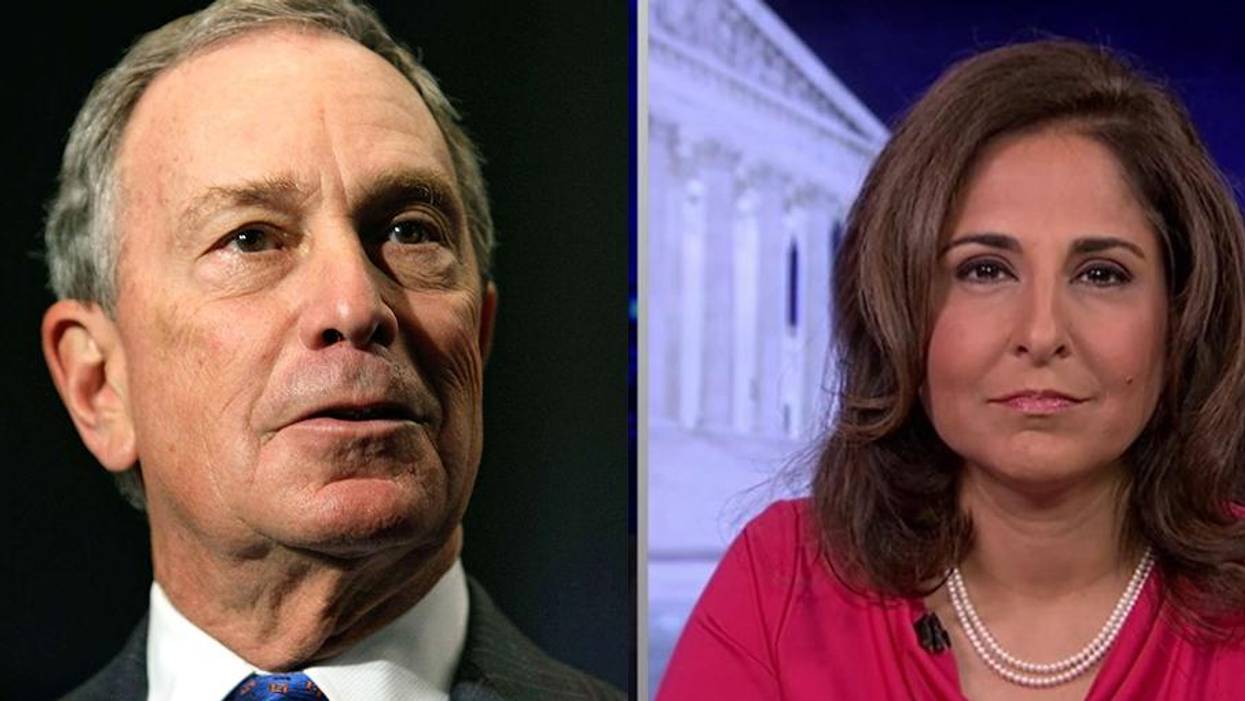
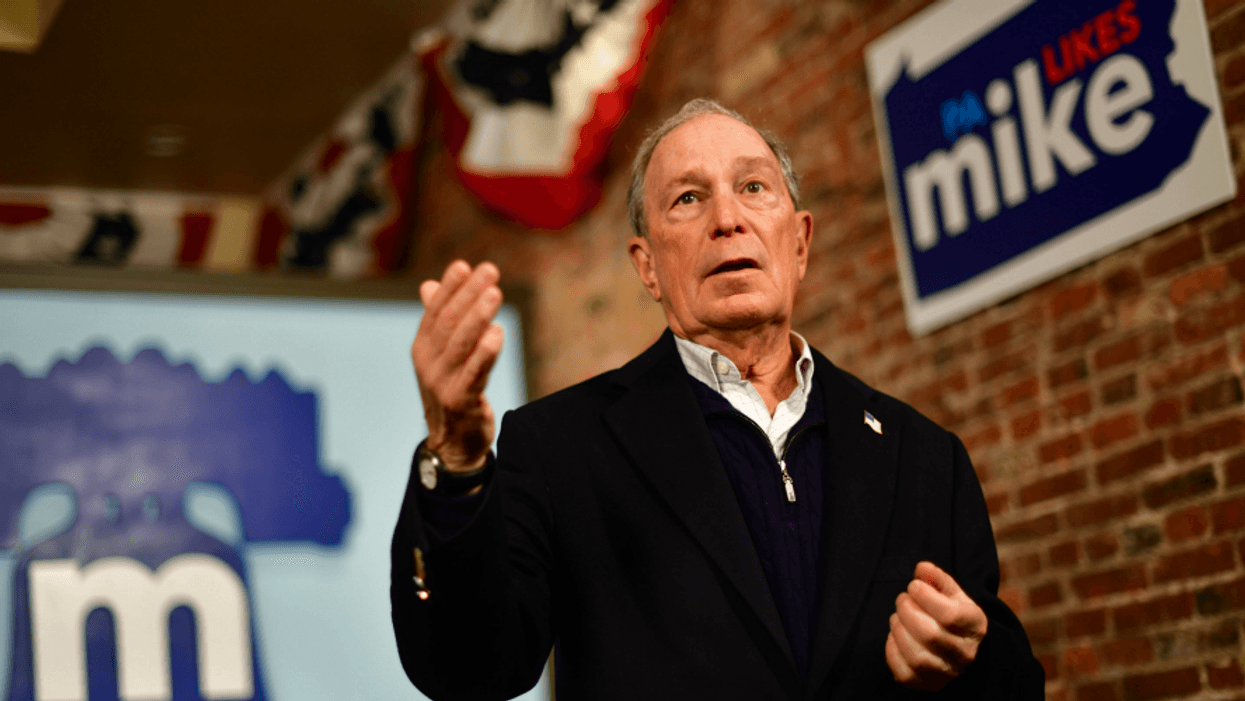
Billionaire Republican-turned-Democrat Presidential Candidate Michael Bloomberg was hit with two damaging front-page headlines Saturday.
The Washington Post reported, "Bloomberg for years has battled women's allegations of profane, sexist comments."
"Now, as Bloomberg is increasingly viewed as a viable Democratic candidate for president and the #MeToo era has raised the profile of workplace harassment, he is finding that his efforts to prevent disclosure are clashing against demands that he release former employees and complainants from their nondisclosure agreements."
"The allegations that he tolerated a hostile office culture could undercut his ability to criticize President Trump's alleged sexual misconduct and efforts to keep such claims private."
And in a headline titled "Bloomberg's Billions: How the Presidential Candidate Built His Influence" the New York Times exposes the corruption of two faux-progressive DNC-affiliated organizations, Emily's List and the Center for American Progress who sold out their organization's missions in return for millions of Bloomberg's influence buying:
"In the fall of 2018, Emily's List had a dilemma. With congressional elections approaching and the Supreme Court confirmation battle over Judge Brett M. Kavanaugh underway, the Democratic women's group was hosting a major fund-raising luncheon in New York. Among the scheduled headline speakers was Michael R. Bloomberg, the former mayor, who had donated nearly $6 million to Emily's List over the years."
"Days before the event, Mr. Bloomberg made blunt comments in an interview with The New York Times, expressing skepticism about the #MeToo movement and questioning sexual misconduct allegations against Charlie Rose, the disgraced news anchor. Senior Emily's List officials seriously debated withdrawing Mr. Bloomberg's invitation, according to three people familiar with the deliberations, who spoke on the condition of anonymity."
"In the end, the group concluded it could not risk alienating Mr. Bloomberg."
And the Times on the Center for American Progress:
"In interviews with The Times, no one described being threatened or coerced by Mr. Bloomberg or his money. But many said his wealth was an inescapable consideration -- a gravitational force powerful enough to make coercion unnecessary."
""They aren't going to criticize him in his 2020 run because they don't want to jeopardize receiving financial support from him in the future," said Paul S. Ryan, vice president of policy and litigation at the good-government group Common Cause."
"That chilling effect was apparent in 2015 to researchers at the Center for American Progress, a liberal policy group, when they turned in a report on anti-Muslim bias in the United States. Their draft included a chapter of more than 4,000 words about New York City police surveillance of Muslim communities; Mr. Bloomberg was mentioned by name eight times in the chapter, which was reviewed by The Times."
"When the report was published a few weeks later, the chapter was gone. So was any mention of Mr. Bloomberg's name."
"Yasmine Taeb, an author of the report, said in an interview that the authors had been instructed to make drastic revisions or remove the chapter, and opted to do the latter rather than "whitewash the N.Y.P.D.'s wrongdoings." She said she found it "disconcerting" to be asked to remove the chapter "because of how it was going to be perceived by Mayor Bloomberg.""
In June 2018, billionaire business executive and former Republican Michael Bloomberg hosted a fundraiser for Long Island GOP Rep. Peter King. At his lavish home in New York City, Bloomberg urged co-hosts to raise at least $10,000 for King, with whom he has "a long-standing relationship," according to his adviser Howard Wolfson.
King was running against Democratic challenger Gretchen Liuba Shirley, who had strong fundraising and the endorsement Emily's List, a liberal political group that helps elect women. But a few months later, Emily's List invited Bloomberg, one of its major donors, to be a featured speaker at its conference. Not only had Bloomberg raised money for the opponent of one of the group's candidates, but he was under fire for dismissive comments about the Me Too movement.
In October 2018, just after his Emily's List speech, and as he mulled a run for president, Bloomberg became a Democrat for the first time since 2000. His partner switched from Republican to Democrat. In 2000, Bloomberg had been a lifelong Democrat but morphed into a Republican to run for New York City mayor after popular GOP Mayor Rudy Giuliani termed out. Bloomberg was a Republican for the first half of his 12 years in office before becoming an independent.
Over the years, Bloomberg's large donations to gun control groups and liberal super PACs have made him many liberal friends. He may no longer be the Republican mayor who endorsed George W. Bush and hosted the Republican National Convention in 2004, but his financial support for the GOP continued through 2018.
Since 1987, according to Federal Election Commission records, Bloomberg donated over $900,000 directly to Republican candidates' campaigns, national GOP party committees, and federal PACs of state Republican Party committees. Recipients include former Rep. Dan Donovan of Staten Island, New York, whom he has given a total of $10,800, including $5,400 in 2018; former Sen. John McCain ($13,700 total); Giuliani, who has become one of Donald Trump's closest devotees ($5,000); and Alabama Sen. Richard Shelby ($4,000).
Bloomberg has given $4.6 million to New York state GOP party committees and roughly $300,000 to Republican state and local candidates.
But the billionaire's donations to outside political spending groups, including one he founded, represent far more money, and some of these groups have helped Republican candidates win elections.
Over the last decade, Bloomberg helped Republicans take and maintain control of the U.S. Senate, which, in the Trump era and under Mitch McConnell's (R-KY) leadership, has confirmed scores of right-wing judges, blocked liberal legislation passed by the House, and shielded the president from any repercussions after seeking foreign election assistance, tampering with witnesses, and defying congressional subpoenas.
Bloomberg's Independence USA super PAC, which he funds exclusively, spent nearly $10.1 million supporting Republican federal candidates from 2012-16. The majority of that, $5.9 million, helped Sen. Pat Toomey (R-PA) win re-election in 2016 against Democrat Katie McGinty, an environmental policy expert and another Emily's List endorsee. In 2014, the super PAC boosted Republican House candidates Bob Dold (IL; $1.9 million) and Michael Fitzpatrick (PA; $174,000). Two years earlier, Independence USA had spent $1.7 million backing Connecticut House candidate Andrew Rorabach, as well as $963,000 supporting Dold.
Americans for Responsible Solutions, a gun control-focused super PAC heavily funded by Bloomberg, also spends the majority of its money in favor of Democrats, but in 2014, when Bloomberg gave it $250,000, it backed Maine Republican Sen. Susan Collins ($486,000) and Fitzpatrick ($374,000). Collins recently voted to acquit Trump of both impeachment charges and said she thought Trump had "a pretty big lesson" from impeachment. In 2007, Bloomberg personally donated $4,600 to Collins's campaign, and in 2014, he gave $5,200.
Also in 2014, Bloomberg helped out two other Republican senators. He donated $250,000 to the West Main Street Values PAC-by far the group's largest contribution-which spent $272,381 to help Sen. Lindsey Graham (SC) win re-election. Graham has become one of Donald Trump's biggest cheerleaders in Congress from his powerful position as Senate Judiciary Committee chairman. The super PAC also spent six figures against Democratic Sen. Tom Udall of New Mexico.
Bloomberg was one of the biggest donors to single-candidate super PAC Mississippi Conservatives, which backed then-Sen. Thad Cochran (MS) in a contested GOP primary in 2014.
And Bloomberg worked to hurt additional Democratic Senate candidates in the 2014 election cycle. He sent a letter in 2013 to hundreds of big Democratic donors, urging them not to donate to four vulnerable Democratic incumbents who voted to block a background check bill. Meanwhile, through the group Mayors Against Illegal Guns, Bloomberg funded ads targeting these and other senators. Mark Begich and Mark Pryor lost their re-election bids in 2014, and Heitkamp lost her seat the next time she was up for re-election, in 2018.
In 2012, Bloomberg endorsed Republican Scott Brown in his Massachusetts Senate race against Sen. Elizabeth Warren, who is now one of Bloomberg's primary opponents.
In 2018, the With Honor Fund, a bipartisan pro-veteran super PAC, spent $4.9 million in support of Republican candidates and $168,000 against Democratic candidates. Billionaire Jeff Bezos provided the majority of its funding, but Bloomberg added $250,000 during that election cycle.
The former mayor has devoted still more money to outside spending groups that have backed GOP state candidates; most notably, Independence USA spent $2.3 million on ads backing then-GOP Gov. Rick Snyder of Michigan in his successful re-election bid-months after the Flint water crisis began. Bloomberg also held a fundraiser for Snyder at his home in New York.
After Snyder's win, Bloomberg said Snyder was "an extremely competent guy who took on the unions to get Detroit and Michigan going in the right direction. And he was re-elected despite being attacked by the unions." Snyder had signed anti-union "Right to Work" legislation in late 2012. The New York City mayor also praised Snyder's expansion of public charter schools.
In the current election cycle, Bloomberg, the eighth-richest person on Earth, has already spent $300 million of his own money on his presidential bid. His colossal ad spending around the country has pushed him up in the polls, even as he skips the first four primary states.
Meanwhile, his giant staffing expenditures are reportedly hurting other Democratic candidates. As The Intercept reports, Bloomberg has hired so many staffers, typically with generous salaries, benefits, and perks, that state and local campaigns are having trouble finding the talent they need.
Despite his Republican past, Bloomberg's previous election spending and funding for gun-control groups appears to be paying off.
Bloomberg is racking up support from Democratic elected officials, including 13 members of the House. On Wednesday he got endorsements from three members of the Congressional Black Caucus, even after audio emerged of his comments in full support of the racist stop-and-frisk policing method. Rep. Gregory Meeks (D-NY), Rep. Lucy McBath (GA), and Virgin Islands House Delegate Stacey Plaskett (D), endorsed the former mayor.
Independence USA spent $130,000 in favor of gun control activist McBath in the 2018 elections, and it spent over $2.2 million that year to help elect Rep. Mikie Sherrill (D-NJ), who has also endorsed Bloomberg. The super PAC arm of House Majority PAC, to which Bloomberg donated nearly $500,000 in 2018, also spent in favor of Sherrill. Bloomberg is by far the biggest donor to House Majority PAC in the 2020 cycle so far, having given $10 million.
Rep. Harley Rouda (D-CA), who endorsed Bloomberg, got a boost from Independence USA in 2018 as the super PAC spent nearly $4.5 million against his Republican opponent, Rep. Dana Rohrabacher. And Rep. Haley Stevens (D-MI), who has endorsed Bloomberg, benefited from over $2.2 million of Independence USA spending.
Bloomberg gave $5 million in 2018 to the League of Conservation Voters' super PAC, which spent $103,000 in support of Stevens. The group spent $83,000 to boost Rep. Ben McAdams (D-UT), who is backing Bloomberg, and $19,000 against his opponent.
In addition to earning him endorsements, Bloomberg's donations have enabled him to boost his image by standing alongside rising Democratic stars such as Georgia's Stacey Abrams. In January of this year, he gave a speech at a voting rights summit that Abrams hosted. He had given $500,000 to the Georgia Democratic Party as Abrams ran for governor in 2018 and $5 million to her voting rights initiative, Fair Fight-the group's largest single donation. After meeting Abrams, Bloomberg announced the start of his presidential campaign's operations in Georgia.
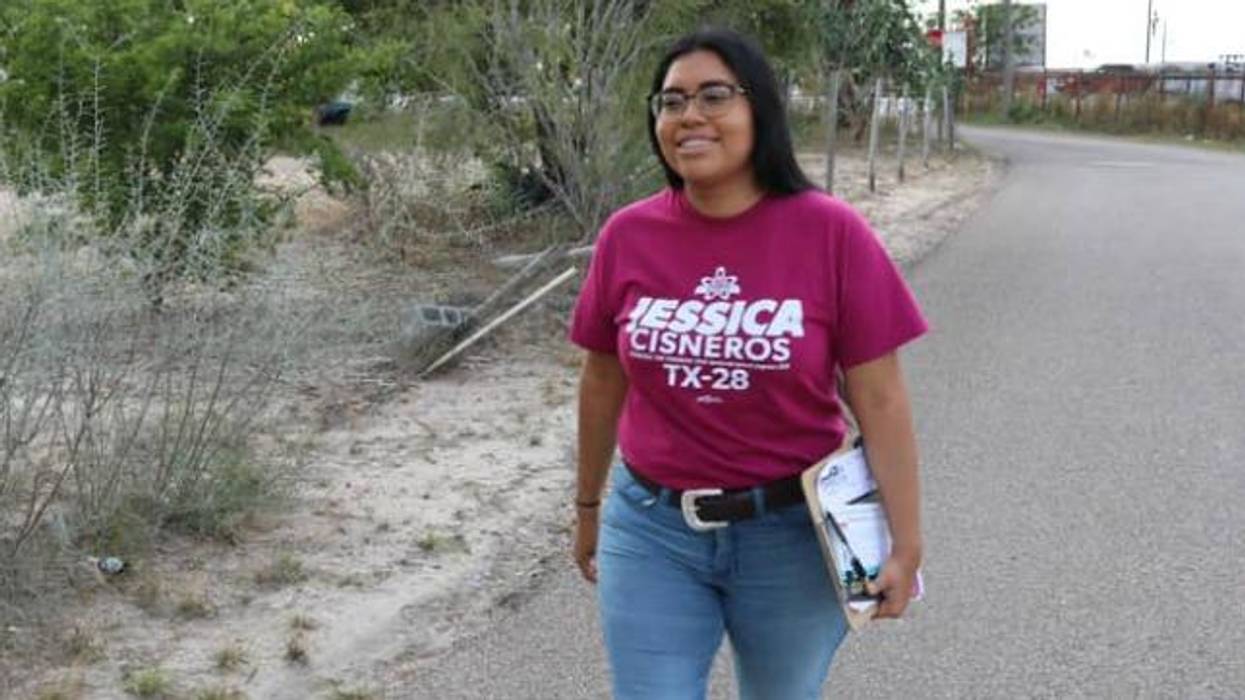
Progressive Democrat Jessica Cisneros of south Texas notched another key endorsement on Wednesday as Sen. Bernie Sanders announced his support for the human rights attorney's primary election bid to unseat Rep. Henry Cuellar.
Laredo-born Cisneros is seeking to defeat Cuellar in Texas's 28th district. Cisneros has dubbed Cuellar, a 15-year incumbent, "Trump's favorite Democrat."
In a statement cheering the new endorsement, Cisneros tied her run to Sanders's 2020 presidential campaign.
"I'm so grateful to receive the endorsement of Senator Bernie Sanders who is running a grassroots campaign to fight for working people, not big corporate donors," said Cisneros. "We're proud that presidential candidates are taking a close look at South Texas as we fight to turn Texas blue in November--and that they know we're the only candidate in this race who will champion Democratic values in Washington."
Sanders, in a statement Wednesday, welcomed the fact that Cisneros was just one of a number of 2020 candidates who could usher in progressive policies.
"This is the most important election in our lifetime and I'm proud there are so many candidates running for Congress who understand that real change comes from the bottom on up, not the top on down," said Sanders, who's also backed Rep. Alexandria Ocasio-Cortez (D-N.Y.) and Marie Newman of Illinois. "They're all strong advocates for real change and together we will build a movement to transform this nation so that it works for all our people."
Cisneros is backed by Justice Democrats, the political action committee that helped Ocasio-Cortez in her successful challenge to 10-term Congressman Joe Crowley. Cisneros getting Sanders's endorsement, said Justice Democrats, is "huge."
"Jessica is building a movement in South Texas that is standing up to the most powerful forces in our country," said Alexandra Rojas, executive director of Justice Democrats. "We're proud she's received this endorsement from Bernie who has dedicated his career to fighting for working families and needs fighters like Jessica in Congress to enact a bold agenda."
The Sanders announcement comes a day after the Cisneros campaign announced endorsements from three progressive groups--Sierra Club, Texas Organizing Project (TOP), and Stonewall Democrats of San Antonio. Those organizations join a growing list of voices supporting her challenge to Cueller, such as the AFL-CIO, EMILY's List, National Nurses United, and NARAL Pro-Choice America, as well as Democratic presidential primary candidate Sen. Elizabeth Warren. Despite the increasing support, Cisnernos says Cuellar continues to refuse to debate her.
"When we are judged in the future, it will be by our actions at this moment," Cisneros said Tuesday, "how we stood up for our working families, how we advocated for our most vulnerable populations, and how we fought for our planet."
Working and low-income progressive women whose congressional runs go overlooked by establishment political action groups have a new resource for funding their campaigns: the newly-launched organization Matriarch.
The group--whose founding members include board director Nomiki Konst, a former candidate for public advocate in New York City; former Nevada assemblywoman Lucy Flores; and former California state assembly candidate Jovanka Beckles--shared its overarching mission on Twitter:
"Working-class women who beat the odds to run for office and win are rare. We won't rest until the exception is the rule," the group tweeted.
The group details its mission statement on its website.
"Now more than ever, we need strong, progressive working women at the helm of government," the statement reads. "Domestic workers. Teachers. Home health aides. Food-service workers. No one knows better what it feels like to work for less than $15 an hour. What it means to have no healthcare. What it tastes like when your tap water runs brown. No one knows better the human cost of gun violence, police brutality, and family separation."
"For working-class candidates, raising huge sums of money in a short amount of time--while also working one or more jobs--is often unthinkable. These are the candidates who need and deserve early assistance and infrastructure support, because they are personally connected to the issues they are fighting for."
--Matriarch"For working-class candidates, raising huge sums of money in a short amount of time--while also working one or more jobs--is often unthinkable," the group continues. "These are the candidates who need and deserve early assistance and infrastructure support, because they are personally connected to the issues they are fighting for."
With more than three dozen progressive women on its founding board--including many former candidates themselves--Matriarch will offer working-class women's campaigns the support and financial backing that larger organizations, like EMILY's List, frequently withhold from candidates who aren't wealthy or backed by rich donors.
Within just days of announcing its launch on social media late last month, Matriarch has already received 1,500 nominations for working-class women's campaigns, according to The Intercept. The group is taking nominations until December 1 and plans to make its first endorsements by January.
It's a model like the one used by progressive group Justice Democrats, who endorsed Rep. Alexandria Ocasio-Cortez (D-N.Y.) after receiving her nomination from her brother, when the congresswoman was taking part in protests at Standing Rock Indian Reservation and working as a bartender.
When Ocasio-Cortez challenged former Rep. Joe Crowley in the 2018 Democratic primary for New York's 14th congressional district, the pro-choice PAC EMILY's list declined to endorse her along with a number of other female progressives during that cycle. The group trains, helps fund, and endorses pro-choice women who are running for office, but progressives are critical of the organization for leaving economic justice and working-class women, who generally can't afford to run a campaign full-time and who aren't independently wealthy, out of their mission.
As Konst explained on the podcast "The Majority Report" last month, Matriarch will prioritize financially backing women who run for office with few resources and who make economic justice a central message of their campaigns.
"The goal of the group is to fill a space because we think that economic justice and intersectional issues are not prioritized when supporting women running for office, but also if you're a working woman running for office you most likely don't have access to wealth," Konst said. "So we want to help, really from the ground level, a lot of these candidates."
Some of the women on Matriarch's founding team have had their own experiences being passed over for support from EMILY's List.
In 2016, the group endorsed Susie Lee, a wealthy philanthropist, over Flores in the campaign for Nevada's 4th congressional district, reasoning that Lee had "over half a million dollars more in her campaign account than Lucy."
"They continue to exist as if they're these big champions of women, but really what they are is a champion of rich white women," Flores told Buzzfeed News in 2018.
A number of progressive observers applauded Matriarch for offering support for women whose own struggles with poverty and inequality could help them to give working families unprecedented representation in Congress.
"Our current electoral system works against working people and is biased towards those who are independently wealthy," Beckles told The Intercept. "We need systemic change that recognizes that--as designed--the status quo automatically significantly eliminates those that are most affected by these policies."
In a clear rebuke of Democratic Party leadership and the mounting threats to abortion rights across the United States, Sen. Bernie Sanders on Tuesday endorsed Marie Newman, who is challenging anti-choice Illinois Congressman Dan Lipinski in the 2020 primary after she narrowly lost to the Blue Dog Democrat in the last cycle.
"At a time when workers are under attack by Wall Street and women's rights are under attack by well-funded extremist groups across the country, I am proud to support Marie Newman's grassroots campaign for Congress," Sanders (I-Vt.) told BuzzFeed News.
"Marie will challenge the establishment by fighting for Medicare for All, a $15 minimum wage, expanding workers' rights," Sanders said, "and she will be a powerful voice for upholding Roe v. Wade at a disturbing moment in our history when a woman's right to control her own body and future is at stake."
Waleed Shahid, the communications director for Justice Democrats, called the endorsement "huge" and tweeted, "I wonder if other 2020 candidates will follow suit." So far, Newman has the support of only three of the 23 Democratic candidates: Sanders, Sen. Kirsten Gillibrand (N.Y.), and Washington Gov. Jay Inslee.
The senator's endorsement of Newman--his first for a congressional candidate in this primary cycle, according to BuzzFeed--comes as states continue to enact restrictions on abortion that are designed to provoke a lawsuit that forces the right-wing U.S. Supreme Court to reconsider Roe v. Wade, the 1973 case that affirmed the constitutional right to terminate a pregnancy up until viability.
Lawmakers in nine states--Alabama, Arkansas, Georgia, Kentucky, Louisiana, Mississippi, Missouri, Ohio, and Utah--have passed legislation restricting abortion rights this year. Though most measures were pushed through by Republican politicans, a Democratic state senator wrote Louisiana's ban and Democratic Gov. John Bel Edwards signed it into law.
At the federal level, BuzzFeed noted, Lipinski is one of the last anti-choice Democrats in Congress. Lipinski's record on reproductive rights was a major focus of the 2018 primary race, but it could take on new weight in this cycle, given the growing threats to Roe.
Newman's support from Sanders also comes as progressives continue to call out party leaders for the Democratic Congressional Campaign Committee's (DCCC) March decison to blacklist firms and strategists who work with anyone who runs against incumbent Democrats, including primary candidates.
As Common Dreams reported in April, Newman said she had several vendors leave her campaign due to the DCCC's policy. At the time, Ilyse Hogue, president of NARAL Pro-Choice America, expressed her frustration with the news on Twitter: "Dan Lipinski votes against women's rights, LGBTQ rights, and the Affordable Care Act, and the the DCCC is punishing his opponent, Marie Newman who stands up for all of those things."
In addition to NARAL, Newman's campaign is backed by Planned Parenthood Action Fund, EMILY's List, Democracy for America, the Progressive Change Campaign Committee, MoveOn, and Rep. Ro Khanna (D-Calif.), a leader in the Congressional Progressive Caucus.
A few weeks after Newman's revelation about departing vendors, the head of the DCCC backed out of a fundraiser for Lipinski. In a statement, Cheri Bustos boasted about her "100 percent pro-choice voting record" and claimed she was "deeply alarmed" by the recent wave of anti-choice state laws--but she also reiterated that "this does not change how I will work as DCCC chair to protect our big tent Democratic caucus."