SUBSCRIBE TO OUR FREE NEWSLETTER
Daily news & progressive opinion—funded by the people, not the corporations—delivered straight to your inbox.
5
#000000
#FFFFFF
To donate by check, phone, or other method, see our More Ways to Give page.




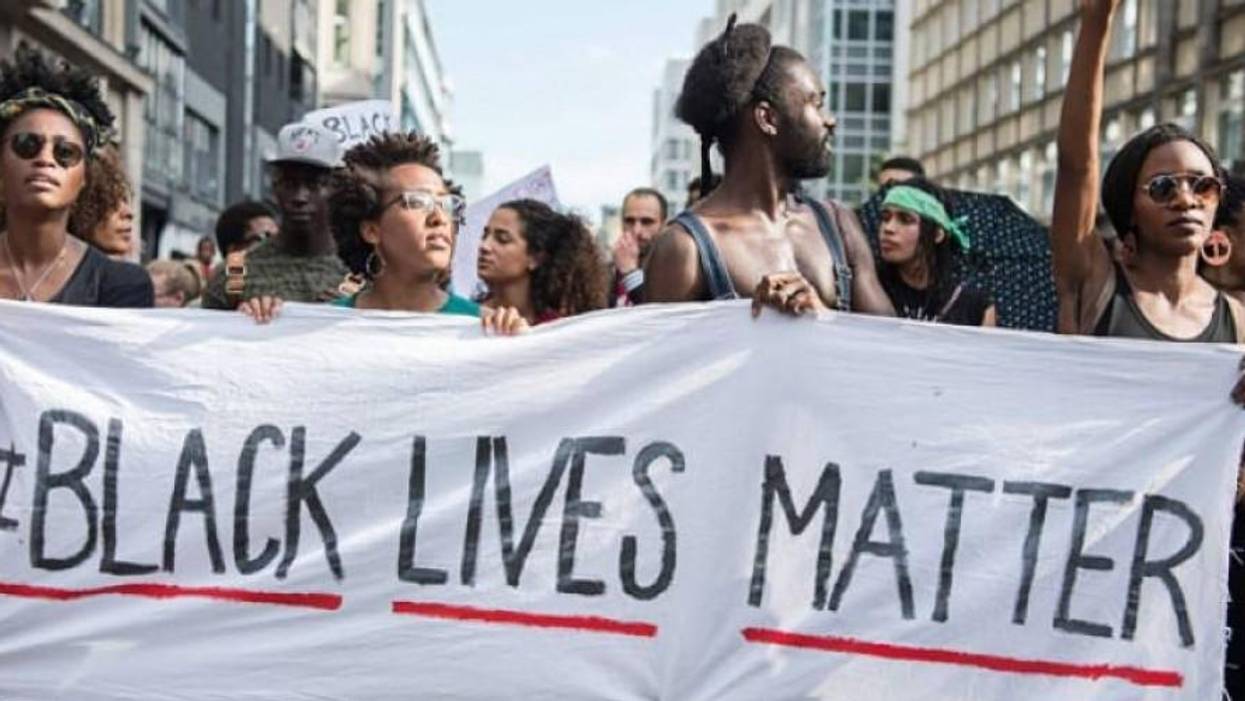
Our nation faces interlocking crises of unprecedented collective scale and urgency, from the pandemic's devastation to extreme economic inequality, entrenched systemic racism, the right's assault on our democracy, and the overarching imperative of climate breakdown. The resurgent progressive left is the only social force committed to fully confronting and resolving them. From last year's historic wave of protest to protect Black lives from state violence to the rise of a new, movement-aligned democratic socialist contingent with real power -- launched by Bernie Sanders's presidential campaigns and growing from Democratic Socialists of America chapters across America to the Alexandria Ocasio-Cortez-led wing of the Congressional Progressive Caucus -- there is undeniable momentum toward transformational change that would have been hard to imagine just a few years ago.
Like most democratic socialist political visions, Kingian democratic socialism demands a radical, structural redistribution of wealth and power.
Yet, along with that momentum, we also confront deep, daunting challenges and limitations. Despite a very open field and an effective sweep of the first three primary states, the progressive left failed to make a candidate of ours the Democratic nominee. And even with a Democratic trifecta, the breakthrough reforms we so urgently need face steep barriers. So as we seek the best path forward in the new terrain of the Biden administration, we encourage our movement to make use of the special opportunity that today provides, not only to remember and honor King, but to reflect on what his full legacy might offer to our generational task in this moment.
In our view, it offers something essential. In fact, we believe that what we might call "Kingian democratic socialism" is perhaps the very best guide for how the progressive left can make America what it ought to be and must finally become: a multi-racial social democracy at peace with itself and the world.
A Kingian democratic socialism
By Kingian democratic socialism we mean the fusion of King's prophetic social vision, fully including his radical critiques not only of racism but also of capitalism and militarism, with his revolutionary methods of social change. "Kingian revolutionary politics" might serve as well, but we choose this frame to highlight one of the most radical, under-appreciated and consequential dimensions of King's politics, one which serves well as an orienting foundation for the rest, and also to explicitly connect to the vibrant democratic socialist current animating today's American progressive left.
As a note to Kingian scholars, trainers and acolytes, please know that we propose this formulation with great appreciation for and the aspiration to contribute to the framework of Kingian Nonviolence, a tradition developed by Dr. Bernard Lafayette, one of King's lieutenants, and David Jehnsen. Both of us have trained in that tradition and advocate what it teaches. While Kingian Nonviolence focuses tightly on the core principles of King's moral vision and conception of nonviolence and has tended somewhat toward producing practitioners of conflict reconciliation and peace-building, we aim here to add an emphasis on King's full political critique and to empower political organizers who undertake the kind of efforts that made up most of King's work: nonviolent direct action campaigns and popular mobilization.
Like most democratic socialist political visions, Kingian democratic socialism demands a radical, structural redistribution of wealth and power. It centers the plight of the economic "least of these," the poor, and the conditions of the working class, bringing a militant challenge to the greed-driven extreme materialism and "thing-oriented" fixation of capitalism. Kingian democratic socialism strives to build a new economy based on the realization of egalitarian, inclusive human well-being. It understands that organizing the poor and the working class and building a radical union movement to confront and overcome capital's power is central. But not exclusively so.
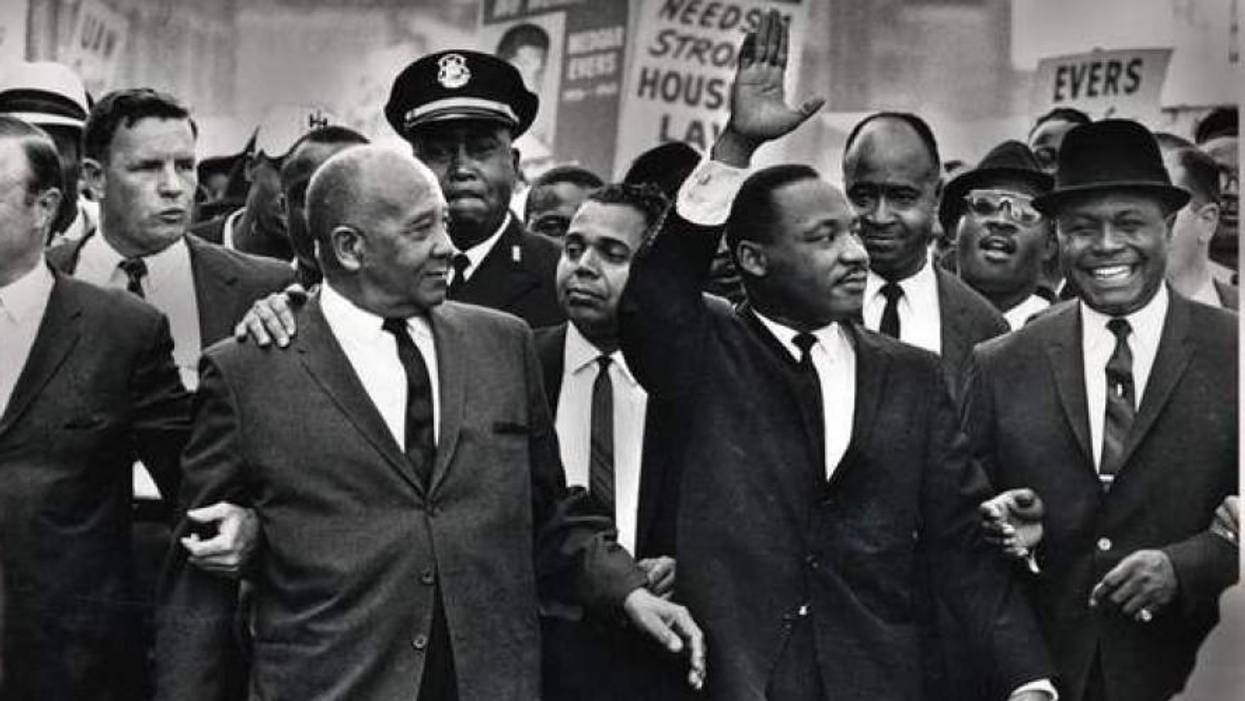
A Kingian democratic socialist approach to class is inherently deeply intersectional, forged in an intimate struggle to dismantle the society-defining, brutally violent racial caste system of the original Jim Crow. Indeed, when King launched his last, uncompleted project, the Poor People's Campaign, he declared its mission to challenge a set of "triple evils," poverty and capitalist inequality, systemic racism and militarist empire, which he saw as fundamentally interlinked.
The revolutionary challenge Kingian democratic socialism makes to the second of those triple evils, systemic racism, is sweeping and visionary. It rejects not only every expression of anti-Black hatred, all forms of racism, personal and institutional, and every expression of white supremacy, but any logic of supremacy itself. It aims to reconstruct American society to reckon with and repair fully the harm of the genocidal colonization and slavery of our founding and, through that deep collective atonement, forge a genuinely multi-racial democracy. A Beloved Community, in which real human fellowship and freedom are enriched by our rainbow of heritage and unshackled from the traumas of the past, is the North Star, never to be abandoned for cynical hate or separatist despair no matter the new pains we experience.
Further, while the anti-racist perspective of many in the United States and even some progressives sometimes seems blind to the impacts of American foreign policy on people of color beyond our borders, the anti-imperialist and anti-militarist orientation of Kingian democratic socialism produces a consistent, global concern for racial justice. The lethal systemic racism evidenced in the suffering of sun-kissed people in Vietnam, El Salvador, Somalia, Yemen or Palestine killed by American soldiers or weapons -- or by governments we support -- is as clear and urgent as that displayed in the pain of Black children poisoned by lead pipes and criminal neglect in Flint, Michigan or brown migrant children ripped from their mother's arms at our southern border. It must be so, because a Kingian democratic socialist view sees human lives as fundamentally equal and precious without exception, possessed of a worth entirely unrelated to national origin or citizenship.
Kingian democratic socialism does call America to be a great nation in the world community. But the greatness to which it calls us, as King explained in his profound "Drum Major Instinct" sermon, is a greatness not of selfish, imperial domination or walled, wealthy isolation but one of loving service. Alongside this redemptive faith in the potential of American power to serve the world as a just, compassionate force for good, Kingian democratic socialism brooks no excuse for the abuse of that power and has zero tolerance for American hypocrisy in world affairs whether on human rights, democracy or any other matter. It insists on integrity as a condition of righteous leadership for people and nations. It rejects empire and the war economy categorically, confronting the military-industrial complex and calling for a radical shift in our national budget and priorities from war and the preparations for it toward ambitious investments in and initiatives toward building a just peace among all nations.
On the question of war, Kingian democratic socialism's opposition to militarism is profound, because it is rooted not only in conditional objections to specific interests or methods but in a principled, universal insistence that humankind can and must find less destructive and devastating ways to settle even our most serious conflicts. Even as we reckon with the tragic constraints and awful choices that the violent world, as it is, presents to leaders and governments, Kingian democratic socialism drives us to never give up on the determined, creative and courageous civilizational march toward the horizon of abolishing forever the human institution of war.
This radical, redemptive critique of American imperialism is part of a deeper understanding of our nation. Kingian democratic socialism is committed to seeing and owning the whole of the American story. It insists that we reckon fully with America's profound original sins and the grave injustices that are part of what we are today. Yet, as is often harder for many of us on the left, Kingian democratic socialism also claims full ownership of the revolutionary, democratic legacy which has also been part of America from the start. It refuses to let false patriots who defile democracy like Donald Trump wrap themselves in our flag. Indeed, Kingian democratic socialism understands that -- from a moral, aspirational perspective concerned foremost with the highest values we proclaim as a nation -- those like Harriet Tubman who are most true to the cause of real democracy are, in fact, more truly American and the most qualified to bear our national symbols and be represented on them.
While prominent currents in leftist history have made the crucial mistake of rejecting religion entirely as a tool of oppression, Kingian democratic socialism chooses a markedly different path. It embraces the liberatory power of religious community and spiritual practice while rejecting Christian supremacy in favor of interfaith fellowship grounded in reason.
The most central, perhaps, among those values which ground Kingian democratic socialism is an uncompromising ethic of universal, unconditional, compassionate love.
For Kingian democratic socialists, an intersectional view expands to an integral one that sees all injustice and suffering as interrelated because it understands all life as interdependent. Kingian democratic socialism perceives the reality and importance of race, class, gender, nation, faith, sexuality, and all the dimensions of our experience and dividing lines of identity by which injustice is often structured, while also taking a holistic view of the full, individual person in their unique story, experience and precious humanity. Thus, its populism is radically inclusive. Kingian democratic socialists strive to build a truly welcoming fusion movement of deep fellowship across every line of difference, bringing all who embrace its values into common struggle to create a society in which they are fully realized.
The most central, perhaps, among those values which ground Kingian democratic socialism is an uncompromising ethic of universal, unconditional, compassionate love. While Kingian democratic socialists acknowledge that holding such a love in our hearts and acting according to it as a rule is extremely difficult, we understand it as inescapably essential and unfailingly liberating. We aren't talking about liking everyone or advocating naive kumbaya choruses. The radical love King taught is not a sentimental, weak or passive feeling. It is an active, determined, transformational force. This transformative love drives those who commit to it to strive toward a revolution whose ultimate aim is not only the utter reconstruction of every institution to align it with love, but the reconciliation and redemption of all people in a Beloved Community.
Owing in part to Gandhi's seminal influence, another core value of Kingian democratic socialism is its commitment to truth. We must speak truth, acknowledge it fully and in all its complexity even when inconvenient or temporarily disadvantageous, and devote ourselves to an ongoing, open pursuit of truth. Thus, a Kingian democratic socialism is fundamentally non-sectarian. It seeks not the maintenance of any sterile dogma or line, but an ongoing dialogue and a continuous evolution guided by enduring principles. In fact, on the question of how to describe the radical orientation to political economy that he advocated, King proposed in his 1961 speech to the Negro American Labor Council a decidedly non-sectarian, ecumenical approach, saying, "Call it democracy, or call it democratic socialism, but there must be a better distribution of wealth within this country for all God's children."
This statement also points to the non-negotiable centrality of democracy within a Kingian democratic socialism. Some say that socialism inherently includes democracy, but the historical actions of many self-described socialists and the realities of some avowedly socialist governments or nations make clear that this simply isn't true. People who are deeply concerned with economic justice can unfortunately still embrace authoritarian approaches to both movements and governing, forgetting that political self-determination is an essential condition of true freedom and justice. Kingian democratic socialism militantly rejects any compromise on political democracy and civil liberty. It understands them as equally essential as economic justice and equality and integral to any progressive project and any liberatory socialism.
Strategically, Kingian democratic socialism pursues its vision of radical social transformation by building a well-organized movement that wields power on two fronts: mass, militantly nonviolent direct action and protest and the electoral task of mobilizing majorities to vote and govern. The nonviolence of Kingian democratic socialism is resolute, grounded in a moral posture that holds sacred the dignity of every human life. But it is also shrewdly strategic, motivated by an analysis of how everyday people can best win contests for the ultimate arbiter of social conflict: the active allegiance of the majority.
To claim King and root one's vision in his dream is to operate from one of the very strongest positions of moral high ground and transpartisan political credibility possible in our country.
As organizers, Kingian democratic socialists are called to servant leadership that renounces greed and careerist ambition in favor of sacrifice for a mission and community with those who suffer most. Kingian democratic socialism calls us to a lifetime of beautiful struggle. It leads us to militantly confront the darkest, deepest injustices while shining the most radiant light, one which affirms our highest aspirations by embodying them in human action, thus illuminating a concrete way to the promised land where they might be fulfilled.
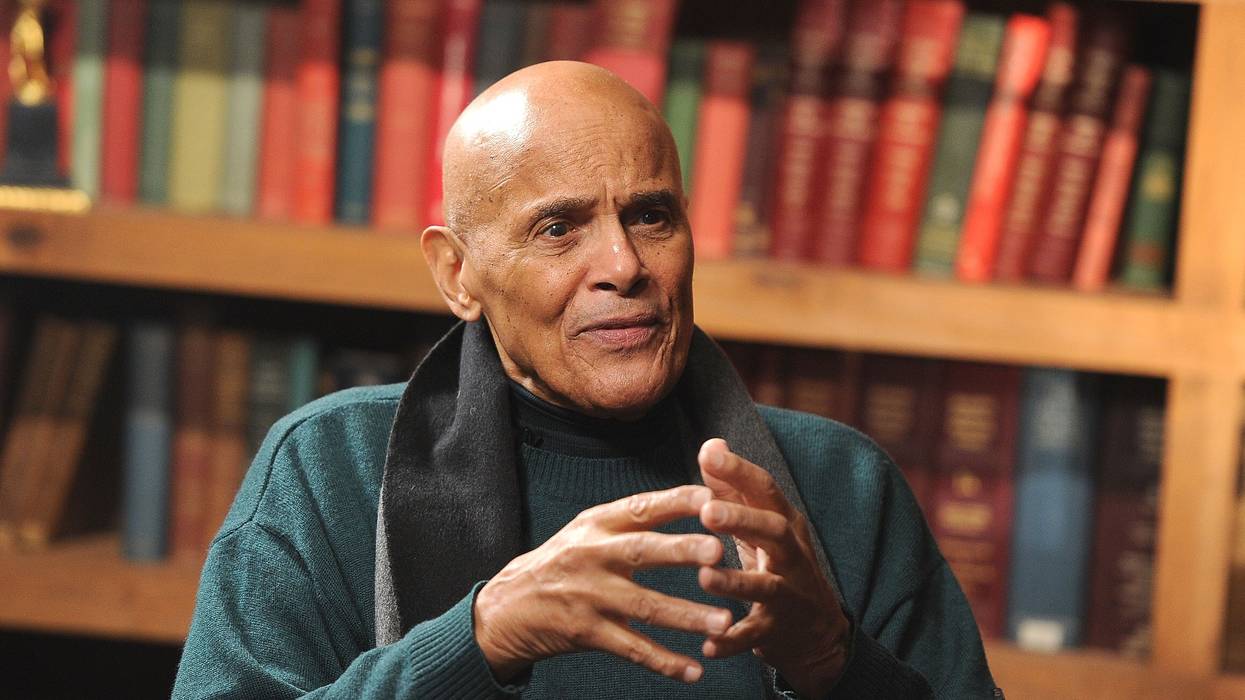
For all these great strengths and its special synthetic brilliance, we acknowledge, of course, that King's revolutionary political praxis was not perfect and must continue to evolve and grow. In King's time, a gay leader like Bayard Rustin could not be active in national politics without staying in the closet. Today there are prominent lesbian, gay, and bisexual elected officials at every level of government. The Kingian democratic socialism of our time, and that which we advocate, is one that has undergone a feminist evolution that fully integrates trans-inclusive gender justice and embraces sexual diversity. This feminist development is powerfully displayed in the history-shaping leadership of the founding national co-chairs of the Women's March, Tamika Mallory, Carmen Perez and Linda Sarsour, who trained extensively in Kingian Nonviolence with King's dear friend and collaborator, Harry Belafonte.
Another area where Kingian democratic socialism has evolved is in the deeper integration of ecological awareness and the recognition that the climate crisis and environmental destruction are a central, overarching, existential concern. We see this development clearly in the decision by Rev. William J. Barber II and the leaders who revived King's Poor People's Campaign to include what they term "ecological devastation" alongside King's original triple evils in an expanded conception of the giant interlocking injustices we must confront.
Why Kingian democratic socialism now for the progressive left?
To prevail in our generational task, the progressive left must win the trust and allegiance of a decisive majority of Americans that empowers us to govern our nation for long enough to lead it through profound changes. To accomplish this -- what some would call a realignment -- we need an orienting basis of unity that provides a radical, transformative vision. It will need to challenge all of the institutional barriers to freedom -- from capital to systemic racism to the military-industrial complex -- and offer a story that is rooted in who we already are and have always been as Americans. It must be an unassailably American story and a genuinely revolutionary one.
King and his revolutionary politics offer an unequaled solution. King's radical vision is one of the most transformative and aspirational ever proclaimed. And there is simply no other comparably radical progressive figure and tradition that is memorialized at the highest level of our political culture. Indeed, Martin Luther King Jr. is one of a handful of Americans honored with a monument on our National Mall. To claim King and root one's vision in his dream is to operate from one of the very strongest positions of moral high ground and transpartisan political credibility possible in our country.
Kingian democratic socialism, mobilized as the vehicle by which we build a movement and a new America that can lead the world to solve the existential climate crisis together, offers an unparalleled framework for the realignment we must achieve. Poetically, such an achievement would finally fulfill the potential for a progressive realignment that was created when King and others forced the Democratic Party to break with the Southern Dixiecrat part of its coalition by enacting the civil and voting rights reforms that ended Jim Crow. Then, for various reasons, including, in our view, the irreplaceable loss of King's leadership, progressive forces couldn't hold the support of enough white people to forge a winning multi-racial coalition. Clearly, that is now possible, even in Georgia. But, as Trump's gains among Latinos and other communities of color show, demographics are neither destiny or safe to take for granted.
So how do we build a durable multi-racial coalition that not only can produce a majority that elects Democrats but creates a progressive left-led version of the Democratic Party? Several elements we see as strategic keys are strongly enabled by Kingian democratic socialism. The powerful race/class narrative called for by Ian Haney Lopez and lifted up brilliantly in Heather McGhee's new book as a path to building a progressive multi-racial coalition comes naturally within the civil rights-forged fusion approach of Kingian democratic socialism. The inclusive populism that Sunrise Movement promotes and the welcoming, "relentlessly positive" politics that Alexandria Ocasio-Cortez implores us to practice are similarly inherent to Kingian democratic socialism, fueled by its unconditional commitment to seek the redemptive potential of others and lovingly welcome every kind of person into a radiantly hopeful coalition of conscience. Embracing a proudly moral language that resonates with the faith traditions and spiritual aspirations of so many Americans, as Kingian democratic socialism does so well, is another key to winning support for our policy vision from a larger base, within and beyond traditional Democratic voters.
Some leftists still contend that we can win major Democratic primary elections primarily by mobilizing a decisive turnout of new, nontraditional or very infrequent working class voters. No modern primary campaign has done close to what the Bernie presidential campaigns did on the mobilization front and still the limitations of what that can achieve in a cycle were confirmed. We have to keep working at improving this capacity, especially through longer-term permanent organizing. But we must understand that to win we must dramatically strengthen our ability to persuade or convert existing Democratic voters who have not yet chosen to back progressive left candidates in primaries but who support or are open to much of our policy agenda.
Some of us lapse easily into cynical dismissal or even disrespectful conflict with Democratic voters who aren't already with us or may challenge our candidate or ideas -- but these are some of the exact people who we need to win over. To do so, we must meet them where they're at with respect. We have to listen, demonstrate the inviting, compassionate character of our movement and build bridges of relationship that offer the easiest possible path to join us. The deep nonviolence and uncompromising love ethic of Kingian democratic socialism are incredibly powerful tools for this essential work.
If the progressive left is going to succeed in becoming the senior rather than junior partner or even the hegemonic force in the Democratic Party coalition in the next decade, we will have to adapt how we communicate and organize to connect with older Black voters. No other constituency votes at higher rates for Democrats. Older Black voters are the core of the party. Though they have many policy affiliations with the progressive left, we have rarely won their votes. There are multiple reasons for this and we don't pretend to have the answer, but we think embracing Kingian democratic socialism can help. A movement that is proudly, explicitly rooted in the legacy of the greatest leader of the civil rights generation begins from a place of deep common ground with older Black voters. That bridge -- one in which our full, radical policy vision is firmly secure -- may provide opportunities to build toward greater cooperation to fulfill King's vision
Finally, if our movement is going to succeed we must be able to exercise power in the streets, in the workplace, at the ballot box and in the halls of power. As we've noted, we need both people power in the form of mass, militant nonviolent direct action from marches, boycotts, protests, sit-ins, blockades and strikes and electoral power to mobilize majorities and govern effectively. This fusion is core to Kingian democratic socialism. We have seen it play out successfully in multiple recent struggles. The Fight for $15 -- though not yet won nationally -- is one. The integration of mass nonviolent protest and mass voter mobilization will be crucial to build the popular support and majorities we need. And we must expect that it will be essential to defend them and counter the serious extra-legal resistance our movement could face from corporations, paramilitary right-wing forces or parts of the military or state security and surveillance institutions if we gain power and severely threaten entrenched interests determined to block major change.
At any stage of this process, this strategic fusion is much less likely to work if our movement enacts or is successfully portrayed as committing significant political violence. As Omar Wasow's research helps show, strategic nonviolent discipline is crucial to ensure that the polarization power of disruptive protest works to build popular support and sustain majority coalitions. Kingian democratic socialism provides the best framework for building a movement that can escalate to high levels of disruption and sacrifice through direct action while still maintaining crucial nonviolent discipline.
It is time to realize the dream
We see hopeful signs of elements of the Kingian democratic socialism we call for here in many places in our movement. They're visible in spaces from the new Poor People's Campaign to the sublime nonviolent resistance at Standing Rock, from calls for a "politics of loving our neighbor," radical love, reparations, a federal jobs guarantee, and cutting the Pentagon budget from the Squad to organizations like Until Freedom and Sunrise Movement, from the Fight for $15 and Amazon workers organizing a union in the Deep South to grassroots struggles across the country for Black lives and justice in all its forms.
Now, more than ever before, we believe it is time for us to take up the collective work of studying, building alignment around, and innovating together to consciously apply King's full, living radical praxis to our movement.
Today, when we mourn King's tragic, brutal murder on this Resurrection Sunday, we hope that his revolutionary love legacy will be powerfully revived in our time. If we make it so, we believe that together we can lead our nation out of its present wilderness to the promised land of a truly multi-racial social democracy secure in the blessing of a peaceful, healthy planet. With the vision and tools he left us, let us finally realize the radical, undying dream to which Martin Luther King Jr. devoted his life.