
SUBSCRIBE TO OUR FREE NEWSLETTER
Daily news & progressive opinion—funded by the people, not the corporations—delivered straight to your inbox.
5
#000000
#FFFFFF
To donate by check, phone, or other method, see our More Ways to Give page.


Daily news & progressive opinion—funded by the people, not the corporations—delivered straight to your inbox.
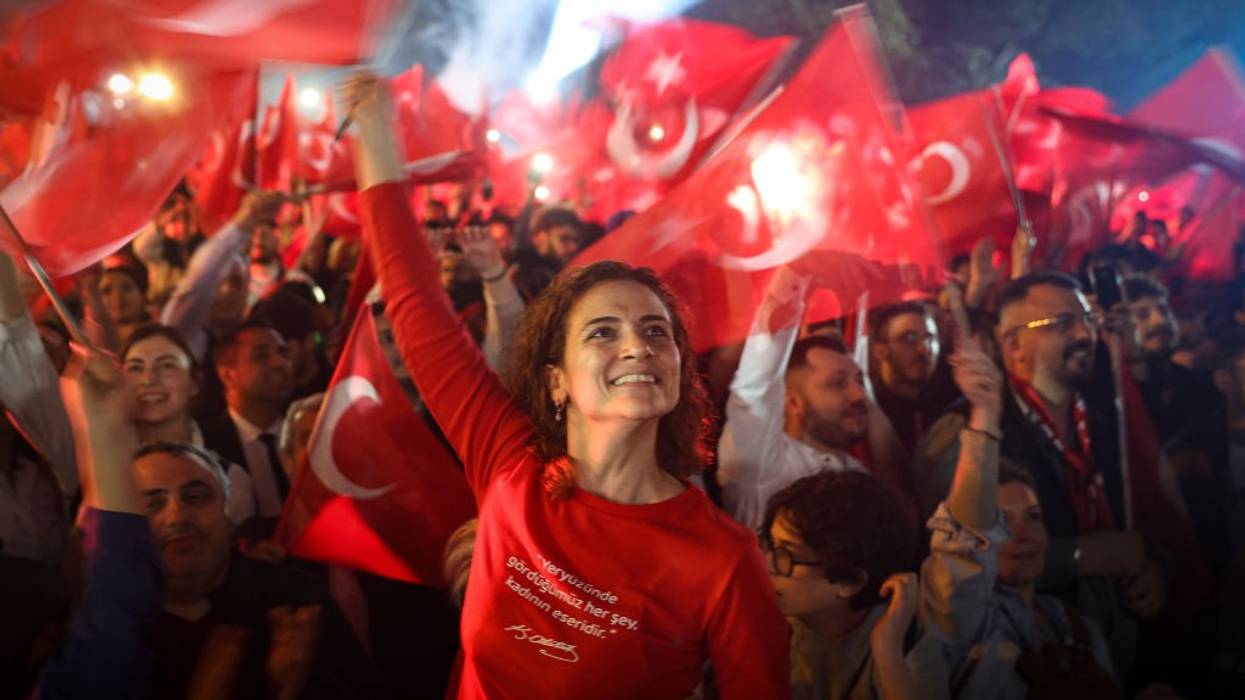
"You opened the door to the rise of democracy, equality, and freedom," Istanbul Mayor Ekrem Imamoğlu said following his re-election. "You ignited hope at the ballot box."
Turkish President Recep Tayyip Erdoğan's Justice and Development Party suffered its worst-ever defeat Sunday when the country's main opposition party scored major wins in municipal elections, including in all five of the nation's largest cities.
With nearly all ballots counted, candidates for the center-left Republican People's Party (CHP) emerged victorious in Istanbul, the capital Ankara, İzmir, Bursa, Adana, and other cities and towns. Turkish media reported CHP victories in 36 of the country's 81 provinces. The right-wing Justice and Development Party (AKP) performed best in the largely rural Anatolian interior.
It was the first time in Erdoğan's 21 years as Turkey's increasingly autocratic president that the AKP suffered such a nationwide electoral defeat.
"My dear Istanbulites, you opened the door to a new future today," incumbent CHP Istanbul Mayor Ekrem Imamoğlu told jubilant supporters during his victory speech following what's likely to be a double-digit win over AKP challenger Murat Kurum. "Starting from tomorrow, Turkey will be a different Turkey. You opened the door to the rise of democracy, equality, and freedom... You ignited hope at the ballot box."
Turkey’s main opposition Republican People’s Party (CHP) has dealt the biggest blow in two decades to President Erdogan’s AK Party by winning control of major cities in local elections. Ekrem Imamoglu secured a second term as Istanbul’s mayor ⤵️ pic.twitter.com/fjgsLzuEYg
— Al Jazeera English (@AJEnglish) April 1, 2024
Imamoğlu said that Sunday "marks the end of democratic erosion in Turkey and the resurgence of democracy."
"People oppressed under authoritarian regimes now turn their gaze to Istanbul," he added.
In Ankara—where an ecstatic crowd chanted "Turkey is secular and will remain secular!" and "Tayyip resign!" outside the city hall—CHP Mayor Mansur Yavaş promised his second term would be one of greater inclusion after beating his AKP rival by a stunning 25-point margin.
"Our political views may be different... But now the election is over," he told supporters. "We will... continue to serve 6 million Ankara residents without discrimination."
Erdoğan, meanwhile, acknowledged that the AKP "lost altitude" with Sunday's sweeping losses, vowing, "We will correct our mistakes and redress our shortcomings."
Imamoğlu's reelection was a personal blow to Erdoğan, an Istanbul native who launched his political career as the megacity's mayor in the 1990s. The AKP had set its sights on retaking control of Istanbul and Ankara but came up empty-handed.
Analysts said skyrocketing inflation, the collapsing value of the lira, disaffected Islamist voters, and Imamoğlu's popularity—which transcends the CHP's traditionally secular base—were major factors in Sunday's results.
So was the Gaza genocide. While Turkey is supporting the South Africa-led genocide case against Israel at the International Court of Justice, Erdoğan and the AKP have been accused—especially by Islamists—of paying little more than lip service to the cause of Palestinian liberation, while Imamoğlu has said that Turkey should immediately sever trade relations with Israel.
Experts said Imamoğlu's victory puts him, and the CHP, at the center of Turkish politics.
"Imamoglu demonstrated he could reach across the deep socio-political divisions that define Turkey's opposition electorate even without their institutional support," Mert Arslanalp, assistant professor of political science at Istanbul's Boğaziçi University, told Reuters. "This makes him the most politically competitive rival to Erdogan's regime."
In the predominantly Kurdish southeast, the progressive People's Equality and Democratic Party (DEM) won 10 provinces. Election-related violence erupted in parts of the region, including in the village of Ağaçlıdere in the Sur district of Diyarbakır, where DEM polling officer Emin Çelik was killed and around a dozen others were wounded. There were multiple reports of Turkish police violently dispersing Kurds celebrating election wins.
International leftists hailed the big wins by CHP and DEM candidates, with Party of European Socialists president Stefan Löfven cheering what he called "a great victory for democracy and a giant step towards a better future of the Turkish people."
"Erdoğan is losing the local elections in the entire country, leaving room for the opposition to breath and to come back victorious at the next national elections," he added. "We are looking forward to that."
Violence rocked Turkey on Monday, as two women reportedly opened fire on the U.S. consulate in Istanbul, and a series of separate attacks throughout the country left at least eight people dead.
The incidents come amid rising tensions over Turkey's involvement in the U.S.-led fight against Islamic State militants.
On Sunday, the U.S. military announced that six F-16 fighter jets and some 300 personnel had been deployed to Turkey's southern Incirlik Air Base to join the fight against ISIS. Last month, Turkey, which is a member of NATO, conducted aerial strikes against ISIS positions in Syria and agreed to let the U.S.-led coalition use its bases in its war against the militants.
As Reuters reports:
The NATO member has been in a heightened state of alert since starting its "synchronized war on terror" last month, including air strikes against Islamic State fighters in Syria and Kurdistan Workers Party (PKK) militants in northern Iraq. It has also rounded up hundreds of suspected militants at home.
One of the assailants in Monday's attack on the U.S. consulate was reportedly wounded and detained. Turkey's Dogan news agency said the injured woman was 51 years old and had served prison time for being a suspected member of the far-leftist Revolutionary People's Liberation Army-Front (DHKP-C), described by Reuters as "virulently anti-American and...listed as a terrorist organization by the United States and Turkey."
Al Jazeera America notes that DHKP-C also claimed responsibility for a 2013 suicide attack on the U.S. embassy in Ankara, which killed a Turkish security guard.
Overnight from Sunday into Monday, a separate attack took place on the other side of the city. According to the BBC:
In the other attack in Istanbul, on a police station in the district of Sultanbeyli, a car bomb was detonated, injuring 10 people, including three police officers.
Two suspected militants were killed in ensuing clashes with police and an injured police officer died later in hospital.
Also Monday, according to the Guardian:
In Turkey's south-eastern Sirnak province, four police officers were killed when their armored vehicle was hit by roadside explosives in the town of Silopi.
A soldier was also killed when Kurdish militants opened fire on a military helicopter in a separate attack in Sirnak, the military said in a statement. Security sources said at least seven other soldiers were wounded in the attack, which came as the helicopter took off.
Turkey's Anadolu Agency adds that a remote-controlled roadside bomb was used in that incident and that the Sirnak Governor's Office has vowed to launch a "large-scale operation... to find the perpetrators of this terrorist attack."
Last week, I spoke at the International Association of Democratic Lawyers congress in Brussels. In the audience there were over 500 hundred progressive lawyers from over 50 countries. Many of these lawyers focus on human rights issues. I called on the lawyers attending the congress to join me in campaigning for environmental protection and protecting environmental human rights defenders. Below is a summary of my remarks.
Work is getting tougher and tougher for lawyers worldwide, especially those working on human rights issues, including the lawyers representing environmentalists. We at Greenpeace can confirm this based on our work around the world and in our collaboration with big and small NGOs and individual activists fighting on the frontlines, and on the coalface, of environment destruction.
According to the Global Witness report released during the Congress, at least 908 people were killed in 35 countries protecting rights to land and the environment between 2002 and 2013. Moreover, 2012 was the worst year so far to be an environmental defender, with 147 killings - nearly three times more than in 2002. Impunity for these crimes is rife: only 10 perpetrators are known to have been convicted between 2002 and 2013 - just over one per cent of the overall incidence of killings. The problem is particularly acute in Latin America and South East Asia. Brazil is the most dangerous place to defend rights to land and the environment, with 448 killings, followed by Honduras (109) and the Philippines (67).
The sad reality is that being an environmental activist is also deadly. Thanks to people like Billy Kyte of Global Witness for exposing the very scary fact 2 activists protecting rights to land and environment are killed per week.
Our own experiences for example in Istanbul's Gezi Park and in the Russian Arctic last year made me realize how difficult it is to be a peaceful protestor in the current political and legal climate. It takes an incredibly committed individual to stand up against the all powerful - whether they are governments or oil companies - when those individuals have their security put on the line in order to protect all of our rights. The 28 Greenpeace activists and two freelance journalists who faced piracy charges following their peaceful protest in the Russian arctic had no chance of receiving a fair trial. Luckily, the Arctic 30, as we call them, had their freedom secured by the millions around the world who stood up and took action to defend them. But most Human Rights defenders are not so lucky.
Environmental campaigners are under attack. Indigenous communities fighting to save their own homes, are too under attack. Governments and corporations are increasingly putting them under immense pressure. Some are being charged with terrorism and piracy, and jailed, silenced and even killed. Their fundamental rights and freedoms are being violated-- freedom of expression, freedom of assembly, freedom of association - even the right to life itself. As we meet today, Greenpeace worldwide is facing about 72 million euros in damages claims and our activists collectively face decades of jail-time as a result of peaceful campaign efforts aimed at exposing environmental problems. Corporations are seeking court orders to permanently stop protests.
We need vigorous action fighting public backlash and regressive laws. We need the support of human rights lawyers in strategically defending environmental activists and NGOs from government and corporate attacks. I urge human rights lawyers to be creative and fearless in defending environmental activists from injustice.
Let's break down the artificial barriers that have so long separated the human rights, environmental, and development communities. We face common threats. But there are common solutions.
Sharon Burrows of the ITUC, in a meeting with the UN Secretary General, Ban Ki Moon, noticed that the he was a bit unsure why she was even there because the topic of the conversation was climate change. She said to him, you might be wondering why as a trade unionist I'm so concerned about the climate. That's because 'there are no jobs, decent or indecent, on a dead planet.' As my good friend, Richard Harvey, one of the organisers of this Congress, rightly points out; there are no human rights on a dead planet. So to bring it home, there are no lawyers or clients on a dead planet either.
SIMFEROPOL, Ukraine - Crimean officials have reported that roughly 97 percent of Crimeans voted for independence from Ukraine on Sunday, with a turnout of about 80 percent. Yet the security situation in Crimea has led many to question how free the vote really was.

"Leaving the question of the referendum's legality aside, the situation on the ground is hardly conducive to free expression of one's will," Dr. Anna Neistat, Human Rights Watch associate director who is now in Crimea, told IPS.
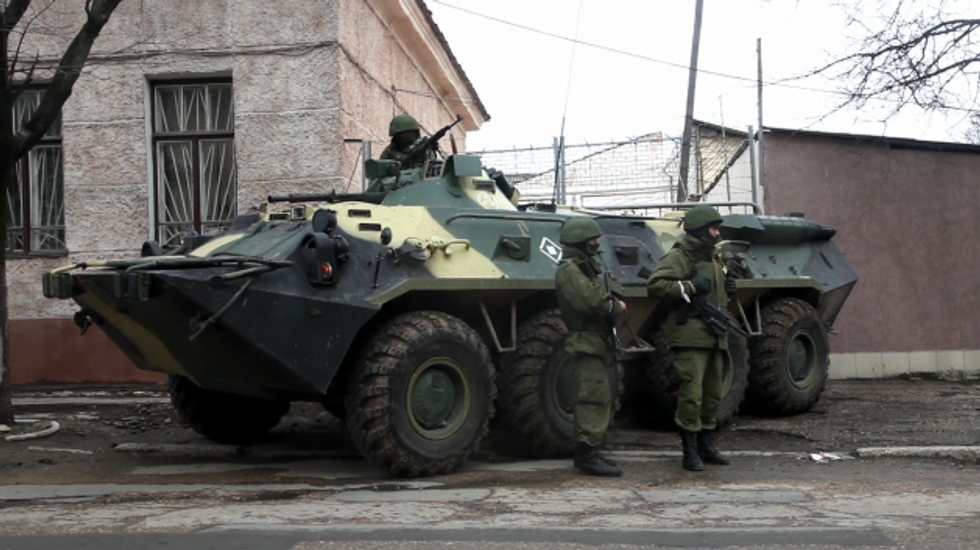
"With unmarked armoured personnel carriers without licence plates in the streets, surrounded by fully armed men, and subjected to incessant pro-Russian propaganda, Crimeans [felt] that the choice has already been made for them," she said.
Russian armed personnel carriers were parked on street corners throughout the Crimean capital Simferopol. The Russians have since surrounded and taken ground inside Ukrainian military bases throughout the peninsula.
Paramilitary groups of Cossacks, a Slavic people, brought from Russia roamed the streets on the day of the vote and leading up to it. Joined by members of local "self-defence" groups wearing distinctive red armbands, they attacked foreign and local journalists.
Slovak photojournalist Jan Husar was the victim of such an attack.
On Mar. 12, just a few days before the vote, Husar was taking photos at Simferopol airport of local militants barring flights coming from Kiev and Istanbul. They only let planes flying in from Moscow land.
Outside the airport terminal, he took a picture of a car passing by. "In the car were some guys," he told IPS. "They jumped out. One had a handgun." Husar speculates they may have been the Russian secret service.
They demanded to see his papers. A group of Cossacks started surrounding Husar. The two unidentified men from the car left after Husar deleted the picture of their vehicle but the Cossacks stayed.
They started to push him towards a nearby forest. Only after the intervention of a local resident did they let Husar go, but they kept his camera memory cards.
"In the lead-up to the referendum the authorities spared no effort to control information and silence critics," Neistat told IPS. The units attacking journalists "acted completely outside of the law, with no clear chain of command and no accountability."
"So imagine if you were a guy who was a [political] leader who wanted to speak out," Husar said. "You could get in a really, really dangerous situation."
Some activists in Crimea experienced just that. Viktor Neganov, leader of the Euromaidan movement in the Crimean city Sevastopol, led about 100 Ukrainians in his hometown to call for an end to corruption. At one protest, a pro-Russian crowd confronted the activists. They attacked Neganov, knocking him down.
"They started to punch me, I tried to protect myself but there were too many people - 10 or 20 from different sides," Neganov told IPS.
Neganov said the protests were infiltrated and orchestrated by Russian spies and military officers pretending to be ordinary citizens. After facing threats later, he slipped away from Crimea.
Despite the crackdown, many voters also told IPS they had little concern about Russian troops occupying their homeland.
"I'm supporting the Russian troops. If there weren't Russian troops, there would be something like what happened at Maidan in Kiev," said Vladimir Ifirich, who said he voted for Crimea to join Russia.
The Maidan in Kiev has been the centre of pro-democracy protests over the past several months. Those protests have come to be known as the Euromaidan movement since the movement was started in opposition to former Ukrainian president Viktor Yanukovych's decision to not sign a European Union trade deal.
Voter Gunadi Blinsky, a 60-year-old emergency service worker in Simferopol, also doesn't mind the Russian military presence.
"Actually we don't experience any inconvenience with Russian troops here," he told IPS. "The other day, we were at the theatre, today we're going to a concert. So no problem at all."
Construction plant worker Natasha Mamayeva echoed an indifference to the Russian occupation. "Everything is calm," she said. "So far the Russian troops have done no harm to local people."
On Tuesday, Russian troops stormed a Ukrainian military base in Crimea, killing a Ukrainian soldier and wounding another in the process of taking control. In the Crimean port city Yalta, Russian troops were reported to have kidnapped a Ukrainian military foreign intelligence service chief.
At a polling station in Simferopol with Soviet-style music being blasted out, local election official Ivana Lubov-Dutrianko told IPS that the vote was free and fair.
"Everything is quiet here," she said. "Please tell the truth: Nobody forced anyone to vote. Everyone is free to vote how they want."
But in Bakhchisarai town, just a half hour's drive south of Simferopol, many boycotted the vote. It's the heartland of the Turkic ethnic group, the Tatars, who make up about 12 percent of the Crimean population. The entire Tatar population was forcibly deported from Crimea in 1944 by Soviet leader Joseph Stalin.
"If the diplomatic efforts fail, obviously some Tatars will join the insurgency and run a guerrilla war," according to Imiril Mirov, the Bakhchisarai district government chief.
But there is no sign of any Tatar resistance movement. "We have no armed units, no self-defence, nothing at all," Mirov told IPS. The primary goal is to avoid bloodshed, he said.

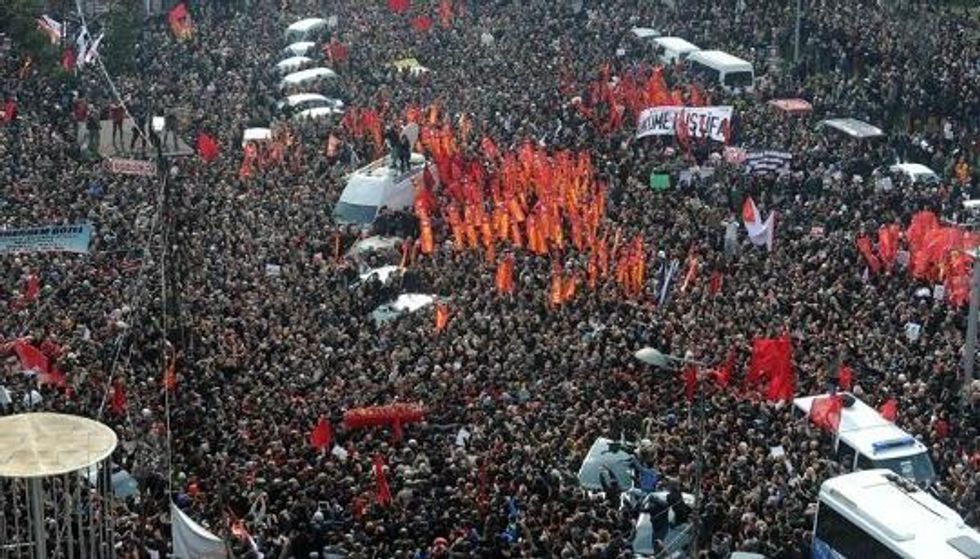
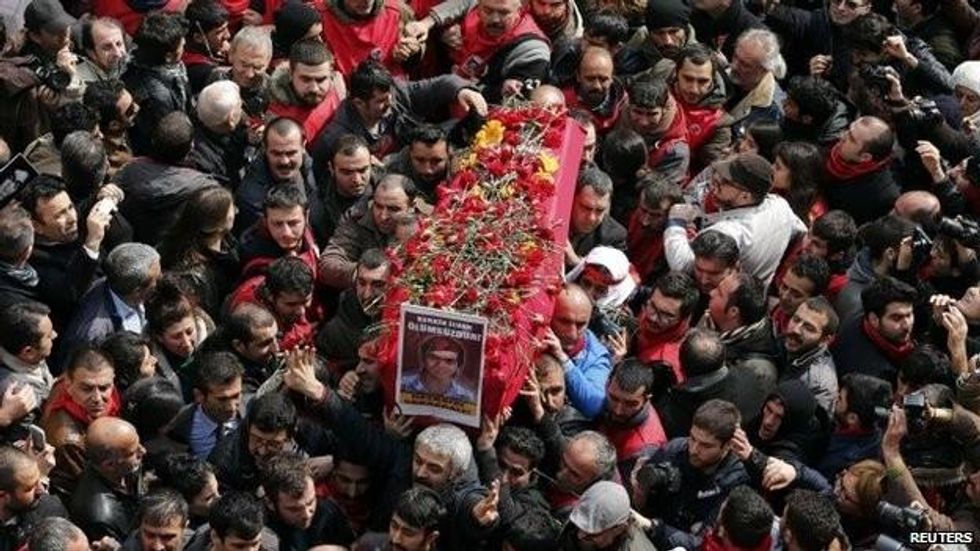
Tens of thousands of protesters filled the streets of Istanbul Wednesday to mourn the death of Berkin Elvan, 15, whose death followed 269 days in a coma after having sustained a blow to the head by a tear gas canister fired by police.
"Berkin's murderers are the AKP police," said the protesters in reference to Prime Minister Recep Tayyip Erdogan's Justice and Development Party (AKP), whose policies have sparked mass unrest in the country.
"The rage of mothers will suffocate the killers," some yelled outside the site of Elvan's funeral. The crowds chanted, "Tayyip! Killer!" and "Everywhere is Berkin, everywhere is resistance" while many held up photos of Elvan.
The funeral followed a night of protests and clashes which spread to 32 towns and cities across the country upon the announcement of Elvan's death. The protests maintained the same anti-AKP sentiment of last year's mass protests, which drew international attention and gained momentum in the face of the police's heavy-handed tactics. Roughly 2.5 million people took part in those protests which were sparked over the course of three weeks in June, demanding Erdogan's resignation. Over 8,000 people were injured, according to medics.
"It's not God who took my son away but Prime Minister Erdogan," Elvan's mother told reporters on Tuesday.
"How many young people have to die for Erdogan to resign? My only wish is for this fascism to end without spilling more blood," said retired worker Atilla Izmirlioglu.
Heavy-handed police tactics showed no sign of easing Wednesday, as police fired tear gas and water cannon at protesters in the capital Ankara and reports of similar clashes in Istanbul and other cities surfaced on social media following the funeral.
Erdogan has vowed to step down if the AKP loses power in upcoming local elections scheduled for March 30th. On the campaign trail Wednesday Erdogan addressed a rally in the city of Siirt but did not mention Elvan's death and referred to last year's protests as a coalition of "anarchists, terrorists and vandals."
However those in the street rejected Erdogan's sentiment. "The lack of compassion, the polarizing attitude of the prime minister and the fact that he behaves like an autocrat is what brought us here," one protester told Reuters at Wednesday's funeral.
Tweets about "#turkey OR #BerkinElvan OR #OccupyGezi OR #DirenGezi lang:en"

______________________

"This report is the beginning of chipping away at U.S. impunity," said Phyllis Bennis, senior fellow at Institute for Policy Studies, in an interview with Common Dreams.
In a damning 21-page report, UN special rapporteur on human rights Ben Emmerson identifies 30 drone strikes in Afghanistan, Pakistan, Yemen, Somalia, and Gaza in which civilians were killed, injured, or threatened by drone strikes.
This includes a December 2013 U.S. drone strike on a recent wedding procession in Yemen near the city of Rad'a that left 12 people dead and at least 15 wounded -- an attack that the U.S. and Yemeni governments initially claimed had killed "militants."
While the U.S. is leading the covert drone wars in all of these countries except for Gaza, and is backing that effort, the Obama administration has refused to acknowledge the full extent of the attacks, refused to publicly identify the people killed in drone attacks, and repeated the unverified claim that civilian deaths have been minimal.
Yet, data for 2013 shows that drone strikes in Afghanistan accounted for 40 percent of civilian deaths by pro-government forces, marking a three-fold increase since 2012, the report notes.
While civilian drone deaths appear to have decreased in Pakistan in 2013, they are increasing in Yemen, the report notes -- echoing what experts have pointed out is an apparent U.S. shift from Pakistan to Yemen. According to the report, Yemeni President Abd Rabbuh Mansur Hadi previously stated that "specific drone strikes are not pre-approved, but instead such strikes are 'generally permitted' pursuant to an unwritten agreement concluded between the United States and former President Abdullah Saleh."
The report outlines numerous civilian drone deaths in Gaza, including a November 2012 strike on farmland near a house north of Gaza City that killed a father, his 12-year-old daughter, and his 19-year-old son as they picked spearmint. The attack was allegedly carried out by Israeli forces, the report notes.
Victims and survivors of drone strikes have long demanded accountability. "Drone strikes in Pakistan have devastated my family and brought only fear and suffering to my community. Yet we still have had no explanation as to why they happened, and who was responsible," said Rafiq Rehman, the son of Mammana Bibian -- who was killed by an October 2012 strike in North Waziristan, Pakistan that was outlined in the report. "I still hope that we might one day see justice and an end to these catastrophic strikes in Pakistan."
Emmerson insists that states must actively investigate these drone deaths, and if they refuse, provide an explanation why. However, he falls short of calling for action by the International Criminal Court.
Yet, Bennis says the report is still a significant step forward. "The importance is this is the first internationally UN sanctioned investigation into the concept and practice of drone warfare as the U.S. has been practicing it for the last ten years or so," she said.
"It is up to civil society to use this report as an instrument and take it further," Bennis added.
_____________________

"I was brutally assaulted by Egyptian police, who never said what I was being accused of," said Benjamin from Istanbul, where she arrived after being deported. "When the authorities came into the cell to deport me, two men threw me to the ground, stomped on my back, pulled my shoulder out of its socket and handcuffed me so that my injured arm was twisted around and my wrists began to bleed. I was then forced to sit between the two men who attacked me on the plane ride from Cairo to Istanbul, and I was (and still am) in terrible pain the whole time."
Benjamin was attempting to enter Egypt to meet up with an international delegation of women who were traveling to Gaza for International Women's Day on March 8. The delegation was traveling there to highlight the plight of women in Gaza. Conditions have worsened since the Rafah border crossing between Egypt and Gaza was indefinitely closed last year, Benjamin said in an interview over the phone with Democracy Now!.
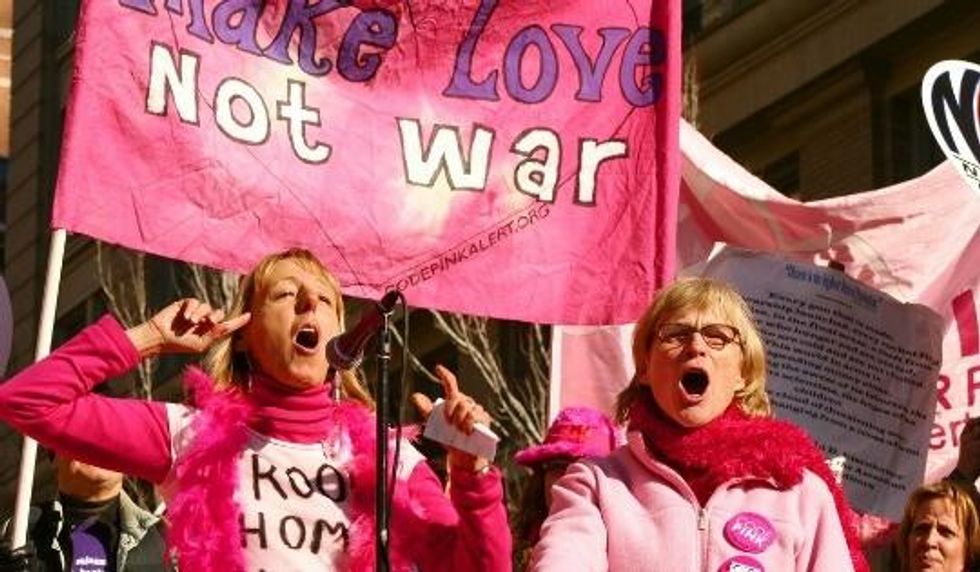
CODEPINK has continuously called for the "lifting of the siege on Gaza," and an end to Israeli settlements in the West Bank.
Benjamin, a U.S. citizen and well known anti-war activist, said the U.S. embassy never arrived to help her out of the situation despite repeated calls by colleagues at CODEPINK.
While being held overnight in the detention cell at the Cairo airport, Benjamin used her cell phone to contact colleagues and live tweet her situation to the world:
Benjamin spoke with Democracy Now! over the phone Tuesday morning after the ordeal:
______________________
In the spring of 2011 I was in Benghazi, standing in a crowd of anti-Gaddafi demonstrators protesting outside the hotel of a visiting delegation.

I was a little uneasy about reporting this because the demonstration gave a misleading idea of the people, in reality Islamic fundamentalists of different types, who were the driving force behind the Libyan uprising. But at the same time I thought it quite right that the revolutionaries should use every PR trick available. There was no doubt the uprising had massive support in Benghazi and who was Gaddafi to complain when he had denied Libyans freedom of expression for 42 years? So what if the protesters had concocted a version of reality shaped for television and western viewers. Didn't the Republican and Democratic Parties in the United States invariably do the same?
At this time, revolutionaries in the Arab world believed they had hit on a winning formula in confronting a repressive state. Peaceful protesters would take over a square or central space in a capital city, such as Tahrir Square in Cairo or the Pearl Roundabout, Bahrain, which became the symbol of resistance and the rallying point for demonstrators. It was also the stage where every charge by the police and counter-charge by protesters would be played out before the cameras. A simple narrative of peaceful people resisting a brutal despotic regime could be established.
It turned out that life was not so simple. Revolutionaries must have some idea of what they are going to do once they have displaced the powers-that-be. It is not enough to say that anything is better than the status quo, particularly, as happened in Egypt and Syria, when people find their lives are getting worse. What happens when foreign powers, once so eager to support the risen people, want a share of the political cake? The success of those first uprisings meant that the revolutionaries, always better on tactics than strategy, had lethally few ideas about what to do next.
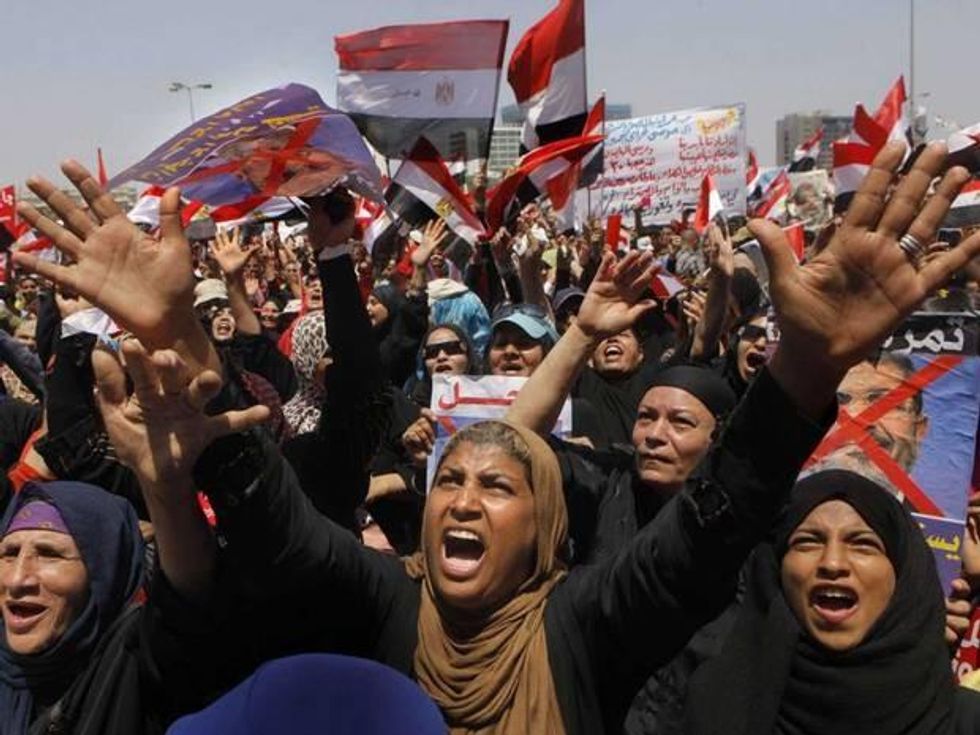
But the formula that brought them to power still works. In the past eight months, governments in Turkey, Thailand and Ukraine have been destabilised by prolonged mass protests. In the case of Egypt a giant demonstration on 30 June led directly to - and was portrayed as giving legitimacy to - a military coup on 3 July. In Istanbul it was Taksim Square and in Kiev it was Independence Square that were the stages on which revolutionary dramas were played.
But what is at issue now is very different from 2011. This is not obvious, because television reporters often produce the same simple-minded story as before. Downplayed and even unstated in reports from Kiev, Cairo, Bangkok and Istanbul was that this time the protesters were confronting democratically elected leaders. Viewers watching demonstrations in Independence Square, Kiev in recent weeks might easily have concluded that President Viktor Yanukovych was a despot installed by Russian tanks or a coup d'etat. Despotic he may be, but in 2010 he won the closely fought presidential election with 12.5 million votes or 48.9 per cent of the poll against 11.6 million votes or 45.5 per cent for Julia Tymoshenko.
The protests which began in Gezi Park, Istanbul in June last year at one level resembled the Arab Spring demonstrations. Outraged, courageous Turks battled the forces of an increasingly authoritarian and hubristic government. But seldom mentioned in foreign television coverage was that the Turkish Prime Minister Recep Tayyip Erdogan won three landslide elections in a row and the Turkish economy has trebled in size since his ruling AKP Party took power in 2002. He ended the long era when Turkey was dominated by a self-serving security and judicial establishment that periodically reinforced its power with military coups of great brutality. Some in the opposition were trying to win on the streets what they had failed to win at the ballot box.
This was certainly so in Thailand where three-month long anti-government protests in their final spasm have been openly anti-democratic, seeking physically to prevent people voting in the general election on 2 February. The protesters' own solution to the crisis is the appointment of an unelected council of "good men" to run the country. The protests are trying to get rid of the government of Yingluck Shinawatra acting on behalf of her exiled elder brother and former prime minister Thaksin Shinawatra, whose party has repeatedly won elections. Backing the protests is a Thai establishment connected to the royal court, judiciary, civil service and the opposition Democratic Party. The opposition's aim has been to destabilise the government by paralysing Bangkok through street protests and provoke a crisis in which the judiciary or other state agencies could get rid of the Shinawatra government.
A difference in the struggle between protesters and government in Ukraine compared to those in Turkey and Thailand is that in Kiev they can expect backing from the United States and European Union as can the government from Russia. The opposition has received an overwhelmingly good press from western television and newspapers portraying the struggle as one between ordinary Ukrainians and a repressive government. The television-friendly version of the protests has little time for complicated stuff about the role of outside powers or the competition between oligarchs and the ruling family. Understandably, it is the phrase "Fuck the EU" in the leaked phone call between Victoria Nuland, the top US diplomat for Europe, and Geoffrey Pyatt, US ambassador to Ukraine, that has attracted the attention. But it is worth listening to the rest of their talk on YouTube to appreciate the extent to which these senior US officials saw themselves as determining who should form a future Ukrainian government.
Is the Tahrir Square model of protests becoming discredited? Probably not entirely, because it bonds so well with the needs of television, but it is now at the service of both people who demand an elected government and those who refuse to accept losing at the polls. Of course those who lose elections in Egypt, Turkey, Thailand and Ukraine have their rights, but so do those who win them.

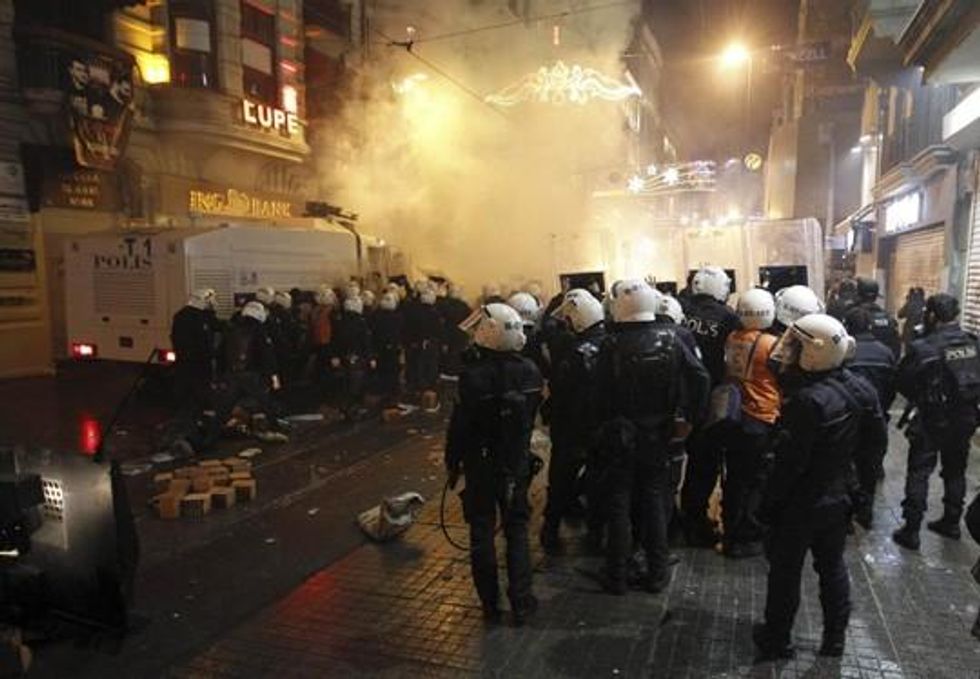
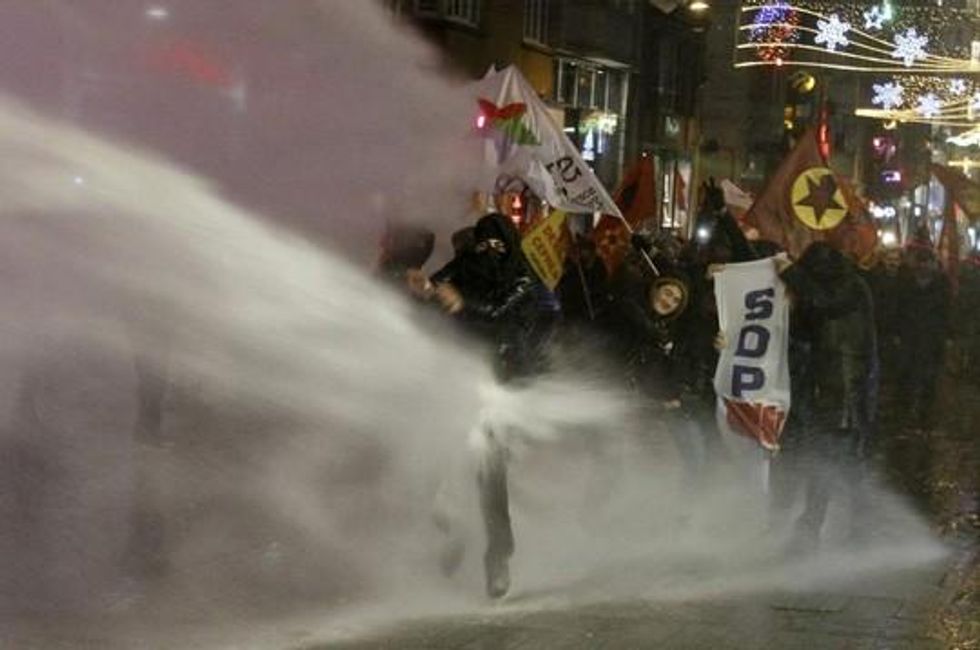
Turkish police fired volleys of tear gas and used water cannons to disperse large crowds of protesters Saturday rallying in central Istanbul against new "draconian" internet laws passed to stifle dissent and stop evidence of high-level corruption being seen online..
The new bill was passed late Wednesday by the Turkish parliament which is dominated by Prime Minister Recep Tayyip Erdogan's AKP party.
"Everywhere is bribery, everywhere is corruption," the crowd chanted, a variation of an anti-government slogan used by demonstrators in protests across the country last summer.
The legislation would give authorities the power to block web pages without a court order within just hours. It would also require internet service providers (ISPs) to store data on their clients' online activities for two years and provide it to the authorities on request.
The government says the internet "reform" is aimed at "protecting individual privacy."

A commercial airliner made an emergency landing in Istanbul on Friday after a passenger said there was bomb on board.

Some early reports said the man demanded the plane be diverted to Sochi, Russia where the Olympic Games are celebrating opening ceremonies today. Other officials speaking to news outlets said that this fact had not been confirmed.
"People are still inside but the pilot called security and gave them a signal that they can enter the plane. There is a translator - a Turkish man near the Ukrainian to calm him down," an airport official told Reuters.
According to CNN:
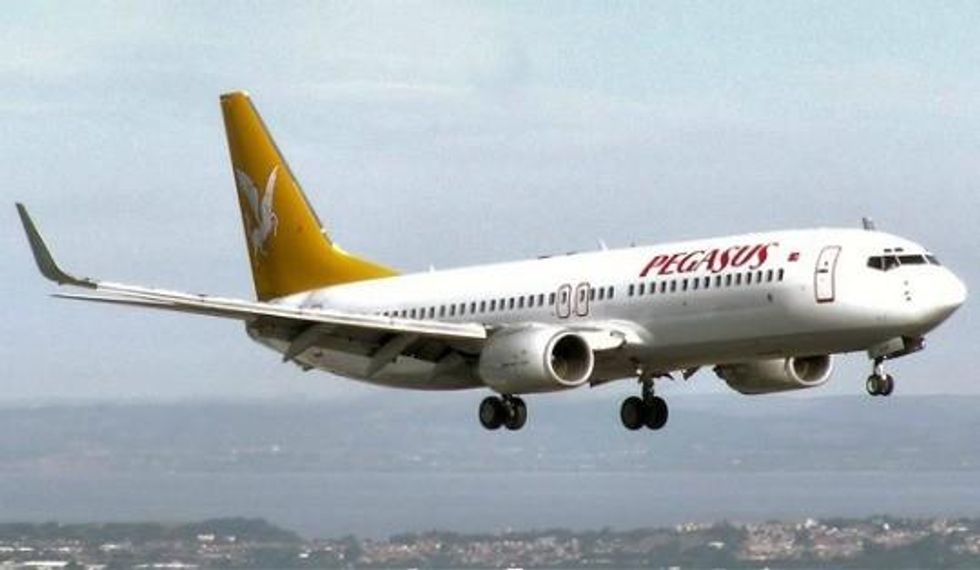
A Pegasus Airlines plane landed at an Istanbul airport Friday after a passenger "said that there was a bomb on board" and wanted the plane to land in Sochi, Russia, the site of the Winter Olympics, said officials with Turkey's Transportation Ministry.
"While the plane was in the air, one of the passengers said that there was a bomb on board and asked the plane to not land in Sabiha Gokcen (in Turkey) but rather to land in Sochi," Transportation Ministry official Habip Soluk said Friday on CNNTurk.
The Olympic Games began Thursday in Sochi amid intense security against potential terror attacks. Official opening ceremonies were being held Friday.
The 110 passengers are still on board the plane, a public diplomacy officer said Friday night in Turkey.
The alleged hijacker is of Ukrainian nationality, Soluk said.
The plane sent a hijacking signal, and after landing it was being held in a safe zone at Istanbul's Sabiha Gokcen Airport, Turkish state media outlet TRT reported.
The plane had been flying a route between Kharkov in Ukraine, and Istanbul, the Transportation Ministry representative
said. It wasn't clear in which city the flight started.
Reuters adds:
The passenger was believed to have drunk alcohol and was calmed down by the crew and persuaded to let the plane, a Boeing 737-800, land in Istanbul at 6:02 pm (1602 GMT), according to Dogan news agency.
An official from Turkey's transport ministry said there were 110 passengers on board and confirmed that a bomb threat had been made but said the plane had landed safely.
Security teams were continuing inspections on the plane, the ministry said in a statement.
Updates on Twitter:
__________________________________