SUBSCRIBE TO OUR FREE NEWSLETTER
Daily news & progressive opinion—funded by the people, not the corporations—delivered straight to your inbox.
5
#000000
#FFFFFF
To donate by check, phone, or other method, see our More Ways to Give page.
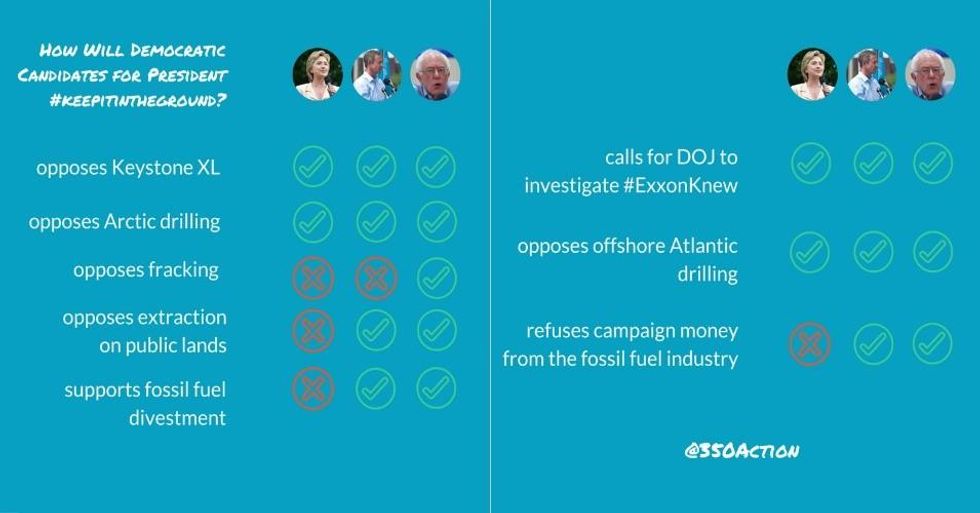
A new political scorecard, from the group that has already dogged White House hopefuls on the campaign trail with more than 70 direct questions related to environmental issues, shows that Bernie Sanders is the only presidential candidate with a spotless record when it comes to the climate movement's top priorities.
On issues ranging from Arctic drilling to fossil fuel divestment to fracking to #ExxonKnew, the senator from Vermont has taken strong stances--going as far as to call for an outright ban on fracking just a few weeks ago, according to 350 Action, the 501(c)(4) political arm of 350.org.
While his rivals for the Democratic nomination, former Secretary of State Hillary Clinton and former Maryland Gov. Martin O'Malley, share many of the same positions, Sanders is the only candidate that checks every box.
Indeed, as Rebecca Leber wrote at The New Republic on Wednesday, "there's one environmental issue where Sanders truly stands apart: He wants to ban hydraulic fracturing outright. Clinton and O'Malley have proposed lesser measures, and show no sign of going further."
See 350 Action's full scorecard below:
Sanders' "early, decisive stances in support of many of the environmental movement's top demands," as Leber puts it, have actually pushed his competitors--namely Clinton--to the left.
According to 350 Action:
Persistent questioning drove one of the most notable political "evolutions" of the campaign thus far: Hillary Clinton's position on the Keystone XL pipeline. 350 Action volunteers first asked the former Secretary of State about her position on the project on July 28th, when she responded that "If it is undecided when I become president, I will answer your question." A 350 Action volunteer pushed Clinton again on September 17th and responded, "I have been waiting for the administration to make a decision. I can't wait much longer." The very next day, September 18th, she got pressured again. Finally on September 22nd, after a question from a 350 Action volunteer in Iowa, Clinton pivoted and said, "I oppose it."
Sanders had long voiced vigorous opposition to the proposed pipeline.
Still, when compared with those of their GOP competitors, the responses from Democrats demonstrate a markedly better understanding of the global climate crisis. Unsurprisingly, on the Republican side, 350 Action and its supporters say they've had "more luck eliciting declarations of climate denial and defenses of the fossil fuel industry than any significant evolution on the issue."
The group plans to continue to pressure all presidential candidates to take stronger stances on these top concerns, with Yong Jung Cho, 350 Action campaign coordinator, declaring: "This year, we set out to make it one of the most talked about issues in the race, and expand the debate to force candidates to address issues of climate justice, and how the environment intersects with other issues like race, class, and immigration."
A new political scorecard, from the group that has already dogged White House hopefuls on the campaign trail with more than 70 direct questions related to environmental issues, shows that Bernie Sanders is the only presidential candidate with a spotless record when it comes to the climate movement's top priorities.
On issues ranging from Arctic drilling to fossil fuel divestment to fracking to #ExxonKnew, the senator from Vermont has taken strong stances--going as far as to call for an outright ban on fracking just a few weeks ago, according to 350 Action, the 501(c)(4) political arm of 350.org.
While his rivals for the Democratic nomination, former Secretary of State Hillary Clinton and former Maryland Gov. Martin O'Malley, share many of the same positions, Sanders is the only candidate that checks every box.
Indeed, as Rebecca Leber wrote at The New Republic on Wednesday, "there's one environmental issue where Sanders truly stands apart: He wants to ban hydraulic fracturing outright. Clinton and O'Malley have proposed lesser measures, and show no sign of going further."
See 350 Action's full scorecard below:
Sanders' "early, decisive stances in support of many of the environmental movement's top demands," as Leber puts it, have actually pushed his competitors--namely Clinton--to the left.
According to 350 Action:
Persistent questioning drove one of the most notable political "evolutions" of the campaign thus far: Hillary Clinton's position on the Keystone XL pipeline. 350 Action volunteers first asked the former Secretary of State about her position on the project on July 28th, when she responded that "If it is undecided when I become president, I will answer your question." A 350 Action volunteer pushed Clinton again on September 17th and responded, "I have been waiting for the administration to make a decision. I can't wait much longer." The very next day, September 18th, she got pressured again. Finally on September 22nd, after a question from a 350 Action volunteer in Iowa, Clinton pivoted and said, "I oppose it."
Sanders had long voiced vigorous opposition to the proposed pipeline.
Still, when compared with those of their GOP competitors, the responses from Democrats demonstrate a markedly better understanding of the global climate crisis. Unsurprisingly, on the Republican side, 350 Action and its supporters say they've had "more luck eliciting declarations of climate denial and defenses of the fossil fuel industry than any significant evolution on the issue."
The group plans to continue to pressure all presidential candidates to take stronger stances on these top concerns, with Yong Jung Cho, 350 Action campaign coordinator, declaring: "This year, we set out to make it one of the most talked about issues in the race, and expand the debate to force candidates to address issues of climate justice, and how the environment intersects with other issues like race, class, and immigration."
A new political scorecard, from the group that has already dogged White House hopefuls on the campaign trail with more than 70 direct questions related to environmental issues, shows that Bernie Sanders is the only presidential candidate with a spotless record when it comes to the climate movement's top priorities.
On issues ranging from Arctic drilling to fossil fuel divestment to fracking to #ExxonKnew, the senator from Vermont has taken strong stances--going as far as to call for an outright ban on fracking just a few weeks ago, according to 350 Action, the 501(c)(4) political arm of 350.org.
While his rivals for the Democratic nomination, former Secretary of State Hillary Clinton and former Maryland Gov. Martin O'Malley, share many of the same positions, Sanders is the only candidate that checks every box.
Indeed, as Rebecca Leber wrote at The New Republic on Wednesday, "there's one environmental issue where Sanders truly stands apart: He wants to ban hydraulic fracturing outright. Clinton and O'Malley have proposed lesser measures, and show no sign of going further."
See 350 Action's full scorecard below:
Sanders' "early, decisive stances in support of many of the environmental movement's top demands," as Leber puts it, have actually pushed his competitors--namely Clinton--to the left.
According to 350 Action:
Persistent questioning drove one of the most notable political "evolutions" of the campaign thus far: Hillary Clinton's position on the Keystone XL pipeline. 350 Action volunteers first asked the former Secretary of State about her position on the project on July 28th, when she responded that "If it is undecided when I become president, I will answer your question." A 350 Action volunteer pushed Clinton again on September 17th and responded, "I have been waiting for the administration to make a decision. I can't wait much longer." The very next day, September 18th, she got pressured again. Finally on September 22nd, after a question from a 350 Action volunteer in Iowa, Clinton pivoted and said, "I oppose it."
Sanders had long voiced vigorous opposition to the proposed pipeline.
Still, when compared with those of their GOP competitors, the responses from Democrats demonstrate a markedly better understanding of the global climate crisis. Unsurprisingly, on the Republican side, 350 Action and its supporters say they've had "more luck eliciting declarations of climate denial and defenses of the fossil fuel industry than any significant evolution on the issue."
The group plans to continue to pressure all presidential candidates to take stronger stances on these top concerns, with Yong Jung Cho, 350 Action campaign coordinator, declaring: "This year, we set out to make it one of the most talked about issues in the race, and expand the debate to force candidates to address issues of climate justice, and how the environment intersects with other issues like race, class, and immigration."