SUBSCRIBE TO OUR FREE NEWSLETTER
Daily news & progressive opinion—funded by the people, not the corporations—delivered straight to your inbox.
5
#000000
#FFFFFF
To donate by check, phone, or other method, see our More Ways to Give page.
Daily news & progressive opinion—funded by the people, not the corporations—delivered straight to your inbox.
Despite limited advances provided by the Affordable Care Act, the U.S. healthcare system remains "uniquely wasteful" and profit-driven, leaving tens of millions without any insurance and even more underinsured.
As a result, say leading physicians, "the right to medical care remains a dream deferred."
In an effort to finally realize that dream, thousands of medical professionals across the country have signed onto the "Physicians' Proposal for Single-Payer Health Care Reform," calling for a publicly financed, single-payer National Health Program (NHP) that would cover all Americans for all medically necessary care.
The plan, unveiled Thursday in the American Journal of Public Health, aims to "remedy the persistent shortcomings of the current health care system," reads an accompanying editorial.
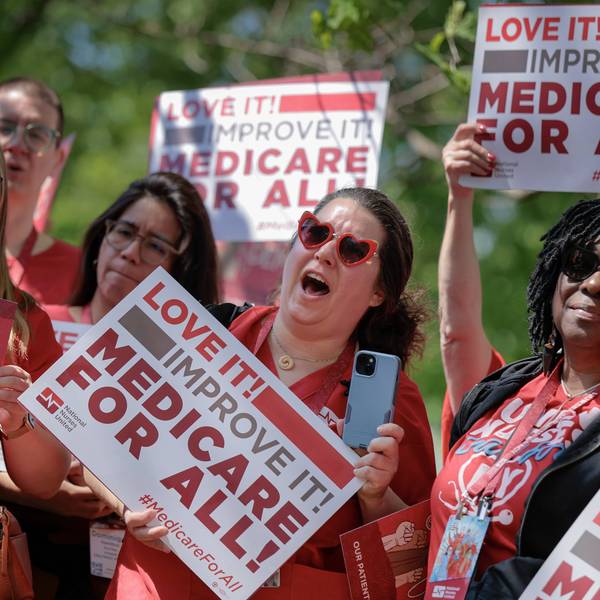
It comes as the 2016 presidential race has thrust the issue of healthcare back into the national spotlight, and while the proposal is non-partisan, it hews closely to Bernie Sanders' call for Medicare-for-All.
Drafted by a working group of 39 physicians and endorsed by more than 2,231 other physicians and 149 medical students, the proposal "would save enough on administrative overhead to provide comprehensive coverage to the uninsured and to upgrade coverage for everyone else, thus requiring no increase in total health spending," according (pdf) to Physicians for a National Health Program (PHNP), which is backing the effort.
Under the proposal, according to PHNP:
"Our nation is at a crossroads," said Dr. Adam Gaffney, a Boston-based pulmonary disease and critical care specialist who co-chaired the working group that produced the proposal. "Despite the passage of the Affordable Care Act six years ago, 30 million Americans remain uninsured, an even greater number are underinsured, financial barriers to care like co-pays and deductibles are rising, bureaucracy is growing, provider networks are narrowing, and medical costs are continuing to climb."
As a result, Gaffney continued, "Caring relationships are increasingly taking a back seat to the financial prerogatives of insurance firms, corporate providers, and Big Pharma."
Supporting Gaffney's claim, a separate study published in the May 2016 issue of Monthly Review finds that the Affordable Care Act's neoliberal approach to expanding health insurance has in fact failed in other countries such as Colombia, Chile, and Mexico, where corporate profits have soared, the safety net of public hospitals and clinics has deteriorated, and health costs have increased.
"We can continue down this harmful path--or even worse, take an alternative, 'free-market' route that would compound our problems--or we can embrace the long-overdue remedy that we know will work: the creation of a publicly financed, nonprofit, single-payer system that covers everybody," said Dr. Steffie Woolhandler, a co-author of the single-payer editorial and proposal who is a professor of public health at the City University of New York's Hunter College and lecturer at Harvard Medical School.
"Today we're saying we must quickly make that shift," Woolhandler said. "Lives are literally at stake."
Dear Common Dreams reader, It’s been nearly 30 years since I co-founded Common Dreams with my late wife, Lina Newhouser. We had the radical notion that journalism should serve the public good, not corporate profits. It was clear to us from the outset what it would take to build such a project. No paid advertisements. No corporate sponsors. No millionaire publisher telling us what to think or do. Many people said we wouldn't last a year, but we proved those doubters wrong. Together with a tremendous team of journalists and dedicated staff, we built an independent media outlet free from the constraints of profits and corporate control. Our mission has always been simple: To inform. To inspire. To ignite change for the common good. Building Common Dreams was not easy. Our survival was never guaranteed. When you take on the most powerful forces—Wall Street greed, fossil fuel industry destruction, Big Tech lobbyists, and uber-rich oligarchs who have spent billions upon billions rigging the economy and democracy in their favor—the only bulwark you have is supporters who believe in your work. But here’s the urgent message from me today. It's never been this bad out there. And it's never been this hard to keep us going. At the very moment Common Dreams is most needed, the threats we face are intensifying. We need your support now more than ever. We don't accept corporate advertising and never will. We don't have a paywall because we don't think people should be blocked from critical news based on their ability to pay. Everything we do is funded by the donations of readers like you. When everyone does the little they can afford, we are strong. But if that support retreats or dries up, so do we. Will you donate now to make sure Common Dreams not only survives but thrives? —Craig Brown, Co-founder |
Despite limited advances provided by the Affordable Care Act, the U.S. healthcare system remains "uniquely wasteful" and profit-driven, leaving tens of millions without any insurance and even more underinsured.
As a result, say leading physicians, "the right to medical care remains a dream deferred."
In an effort to finally realize that dream, thousands of medical professionals across the country have signed onto the "Physicians' Proposal for Single-Payer Health Care Reform," calling for a publicly financed, single-payer National Health Program (NHP) that would cover all Americans for all medically necessary care.
The plan, unveiled Thursday in the American Journal of Public Health, aims to "remedy the persistent shortcomings of the current health care system," reads an accompanying editorial.
It comes as the 2016 presidential race has thrust the issue of healthcare back into the national spotlight, and while the proposal is non-partisan, it hews closely to Bernie Sanders' call for Medicare-for-All.
Drafted by a working group of 39 physicians and endorsed by more than 2,231 other physicians and 149 medical students, the proposal "would save enough on administrative overhead to provide comprehensive coverage to the uninsured and to upgrade coverage for everyone else, thus requiring no increase in total health spending," according (pdf) to Physicians for a National Health Program (PHNP), which is backing the effort.
Under the proposal, according to PHNP:
"Our nation is at a crossroads," said Dr. Adam Gaffney, a Boston-based pulmonary disease and critical care specialist who co-chaired the working group that produced the proposal. "Despite the passage of the Affordable Care Act six years ago, 30 million Americans remain uninsured, an even greater number are underinsured, financial barriers to care like co-pays and deductibles are rising, bureaucracy is growing, provider networks are narrowing, and medical costs are continuing to climb."
As a result, Gaffney continued, "Caring relationships are increasingly taking a back seat to the financial prerogatives of insurance firms, corporate providers, and Big Pharma."
Supporting Gaffney's claim, a separate study published in the May 2016 issue of Monthly Review finds that the Affordable Care Act's neoliberal approach to expanding health insurance has in fact failed in other countries such as Colombia, Chile, and Mexico, where corporate profits have soared, the safety net of public hospitals and clinics has deteriorated, and health costs have increased.
"We can continue down this harmful path--or even worse, take an alternative, 'free-market' route that would compound our problems--or we can embrace the long-overdue remedy that we know will work: the creation of a publicly financed, nonprofit, single-payer system that covers everybody," said Dr. Steffie Woolhandler, a co-author of the single-payer editorial and proposal who is a professor of public health at the City University of New York's Hunter College and lecturer at Harvard Medical School.
"Today we're saying we must quickly make that shift," Woolhandler said. "Lives are literally at stake."
Despite limited advances provided by the Affordable Care Act, the U.S. healthcare system remains "uniquely wasteful" and profit-driven, leaving tens of millions without any insurance and even more underinsured.
As a result, say leading physicians, "the right to medical care remains a dream deferred."
In an effort to finally realize that dream, thousands of medical professionals across the country have signed onto the "Physicians' Proposal for Single-Payer Health Care Reform," calling for a publicly financed, single-payer National Health Program (NHP) that would cover all Americans for all medically necessary care.
The plan, unveiled Thursday in the American Journal of Public Health, aims to "remedy the persistent shortcomings of the current health care system," reads an accompanying editorial.
It comes as the 2016 presidential race has thrust the issue of healthcare back into the national spotlight, and while the proposal is non-partisan, it hews closely to Bernie Sanders' call for Medicare-for-All.
Drafted by a working group of 39 physicians and endorsed by more than 2,231 other physicians and 149 medical students, the proposal "would save enough on administrative overhead to provide comprehensive coverage to the uninsured and to upgrade coverage for everyone else, thus requiring no increase in total health spending," according (pdf) to Physicians for a National Health Program (PHNP), which is backing the effort.
Under the proposal, according to PHNP:
"Our nation is at a crossroads," said Dr. Adam Gaffney, a Boston-based pulmonary disease and critical care specialist who co-chaired the working group that produced the proposal. "Despite the passage of the Affordable Care Act six years ago, 30 million Americans remain uninsured, an even greater number are underinsured, financial barriers to care like co-pays and deductibles are rising, bureaucracy is growing, provider networks are narrowing, and medical costs are continuing to climb."
As a result, Gaffney continued, "Caring relationships are increasingly taking a back seat to the financial prerogatives of insurance firms, corporate providers, and Big Pharma."
Supporting Gaffney's claim, a separate study published in the May 2016 issue of Monthly Review finds that the Affordable Care Act's neoliberal approach to expanding health insurance has in fact failed in other countries such as Colombia, Chile, and Mexico, where corporate profits have soared, the safety net of public hospitals and clinics has deteriorated, and health costs have increased.
"We can continue down this harmful path--or even worse, take an alternative, 'free-market' route that would compound our problems--or we can embrace the long-overdue remedy that we know will work: the creation of a publicly financed, nonprofit, single-payer system that covers everybody," said Dr. Steffie Woolhandler, a co-author of the single-payer editorial and proposal who is a professor of public health at the City University of New York's Hunter College and lecturer at Harvard Medical School.
"Today we're saying we must quickly make that shift," Woolhandler said. "Lives are literally at stake."