SUBSCRIBE TO OUR FREE NEWSLETTER
Daily news & progressive opinion—funded by the people, not the corporations—delivered straight to your inbox.
5
#000000
#FFFFFF
To donate by check, phone, or other method, see our More Ways to Give page.
Daily news & progressive opinion—funded by the people, not the corporations—delivered straight to your inbox.
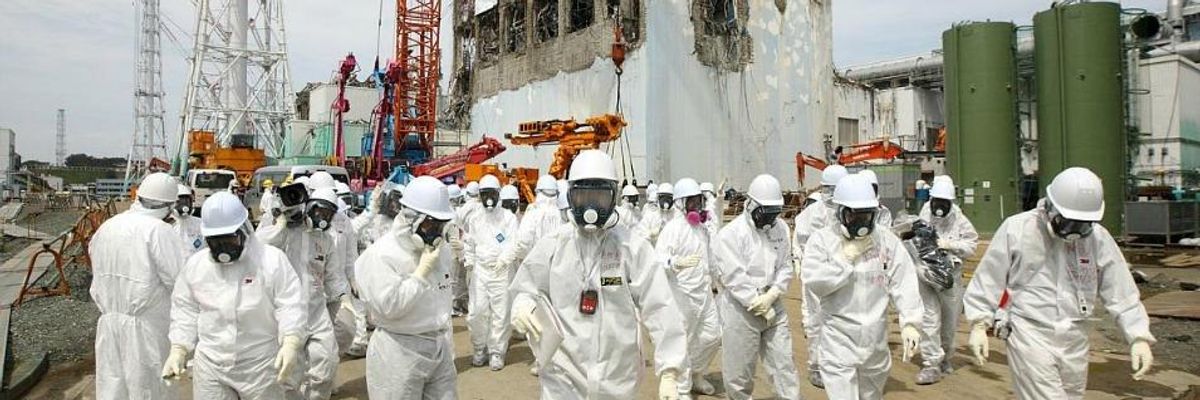
Members of the media and TEPCO employees walk in front of the No. 4 reactor building, crippled by the March 11, 2011 earthquake and tsunami, at the utility company's Fukushima Dai-ichi nuclear power plant in Okuma, Fukushima prefecture, Japan, May 26, 2012. (Photo: Tomohiro Ohsumi, Pool)
More than seven years after the Fukushima nuclear disaster, prosecutors in Japan on Wednesday demanded that three former executives from Tokyo Electric Power Co. (TEPCO) each face five years behind bars for failing to ensure the safety of the power plant.
"It was easy to safeguard the plant against tsunami, but they kept operating the plant heedlessly. That led to the deaths of many people."
--prosecutors
In March of 2011, the most powerful earthquake to ever strike Japan triggered a tsunami that caused three reactors at the Fukushima Dai-ichi nuclear complex to melt down, forcing hundreds of thousands of nearby residents to evacuate. In court on Wednesday, the prosecution accused TEPCO's leadership of "postponing" safety measures designed to protect the plant from powerful tsunamis.
"It was easy to safeguard the plant against tsunami, but they kept operating the plant heedlessly," prosecutors said at the trial at the Tokyo District Court, according to The Asahi Shimbum, a Japanese newspaper. "That led to the deaths of many people."
While the prosecution claims at least 44 people died in connection with the incident, other estimates have put the number around 1,600. Prosecutors called for the five-year sentences, the maximum punishment allowed for the charges, during closing arguments on Wednesday.
The three executives standing trial for negligence resulting in death and injury are former TEPCO chairman Tsunehisa Katsumata, 78, as well as former vice presidents Sakae Muto, 68, and Ichiro Takekuro, 72. They all pleaded not guilty.
"The case has taken a twisting journey to arrive at this point," NPR noted. "In two instances, public prosecutors opted not to seek indictments against the three TEPCO executives."
A panel of randomly selected citizens, however, disagreed, which led to the ongoing trial. As Japan's NHK News reported:
In line with that decision, the men were indicted by court-appointed lawyers in February 2016.
The court-appointed lawyers say the defendants were told two to three years before the accident that a massive tsunami could hit the nuclear plant. They also say the defendants did not try to gather information about the potential danger. The court-appointed lawyers indicate that the former executives later claimed that they had not been informed, and that the executives put all the blame on their subordinates.
The court-appointed lawyers also say the defendants should have suspended the plant's operations when they were told that a massive tsunami could hit the plant.
An attorney for victims' families was slated to speak on Thursday, but defense lawyers aren't scheduled to deliver their closing arguments until March of 2019.
The executives' trial follows a class-action suit decided late last year, when a federal court ordered TEPCO and the Japanese government to pay a total of 500 million yen ($4.4 million USD) to thousands of plaintiffs--who received, at most, a few thousand U.S. dollars each. Meanwhile, in the region around the nuclear facility, public health concerns persist.
This country and this world are at a monumental crossroads. US voters have an opportunity to beat back the forces of fascism and confront the billionaires who are rigging the economy, our media system, and our democracy, making it increasingly impossible for ordinary people to get by. We’re not just talking about the election. We’re talking about what must be done once these fascist elements are vanquished from power. We need a bolder set of solutions than what either major party has so far been willing to offer and a working-class movement ready to fight like hell for it. Trump didn't emerge from nowhere. The conditions that fueled MAGA authoritarianism were created by decades of radical neoliberal economic policies and a corrupt political system dominated by corporate interests. They slashed taxes on the super-rich, promising that the benefits would trickle down. They said giveaways to the corporate titans would make life more affordable for the rest of us. It was all bullshit. And when a bitter, betrayed populace searches for someone to blame, right-wing demagogues have little trouble finding scapegoats. People know when they're being lied to, but you won't hear any of this from the corporate media. Only independent journalism—powered and funded by people who believe in building a better world—can deliver truly trustworthy daily news. If you share our vision, please contribute whatever you can to sustain our work. |
More than seven years after the Fukushima nuclear disaster, prosecutors in Japan on Wednesday demanded that three former executives from Tokyo Electric Power Co. (TEPCO) each face five years behind bars for failing to ensure the safety of the power plant.
"It was easy to safeguard the plant against tsunami, but they kept operating the plant heedlessly. That led to the deaths of many people."
--prosecutors
In March of 2011, the most powerful earthquake to ever strike Japan triggered a tsunami that caused three reactors at the Fukushima Dai-ichi nuclear complex to melt down, forcing hundreds of thousands of nearby residents to evacuate. In court on Wednesday, the prosecution accused TEPCO's leadership of "postponing" safety measures designed to protect the plant from powerful tsunamis.
"It was easy to safeguard the plant against tsunami, but they kept operating the plant heedlessly," prosecutors said at the trial at the Tokyo District Court, according to The Asahi Shimbum, a Japanese newspaper. "That led to the deaths of many people."
While the prosecution claims at least 44 people died in connection with the incident, other estimates have put the number around 1,600. Prosecutors called for the five-year sentences, the maximum punishment allowed for the charges, during closing arguments on Wednesday.
The three executives standing trial for negligence resulting in death and injury are former TEPCO chairman Tsunehisa Katsumata, 78, as well as former vice presidents Sakae Muto, 68, and Ichiro Takekuro, 72. They all pleaded not guilty.
"The case has taken a twisting journey to arrive at this point," NPR noted. "In two instances, public prosecutors opted not to seek indictments against the three TEPCO executives."
A panel of randomly selected citizens, however, disagreed, which led to the ongoing trial. As Japan's NHK News reported:
In line with that decision, the men were indicted by court-appointed lawyers in February 2016.
The court-appointed lawyers say the defendants were told two to three years before the accident that a massive tsunami could hit the nuclear plant. They also say the defendants did not try to gather information about the potential danger. The court-appointed lawyers indicate that the former executives later claimed that they had not been informed, and that the executives put all the blame on their subordinates.
The court-appointed lawyers also say the defendants should have suspended the plant's operations when they were told that a massive tsunami could hit the plant.
An attorney for victims' families was slated to speak on Thursday, but defense lawyers aren't scheduled to deliver their closing arguments until March of 2019.
The executives' trial follows a class-action suit decided late last year, when a federal court ordered TEPCO and the Japanese government to pay a total of 500 million yen ($4.4 million USD) to thousands of plaintiffs--who received, at most, a few thousand U.S. dollars each. Meanwhile, in the region around the nuclear facility, public health concerns persist.