SUBSCRIBE TO OUR FREE NEWSLETTER
Daily news & progressive opinion—funded by the people, not the corporations—delivered straight to your inbox.
5
#000000
#FFFFFF
To donate by check, phone, or other method, see our More Ways to Give page.
Daily news & progressive opinion—funded by the people, not the corporations—delivered straight to your inbox.
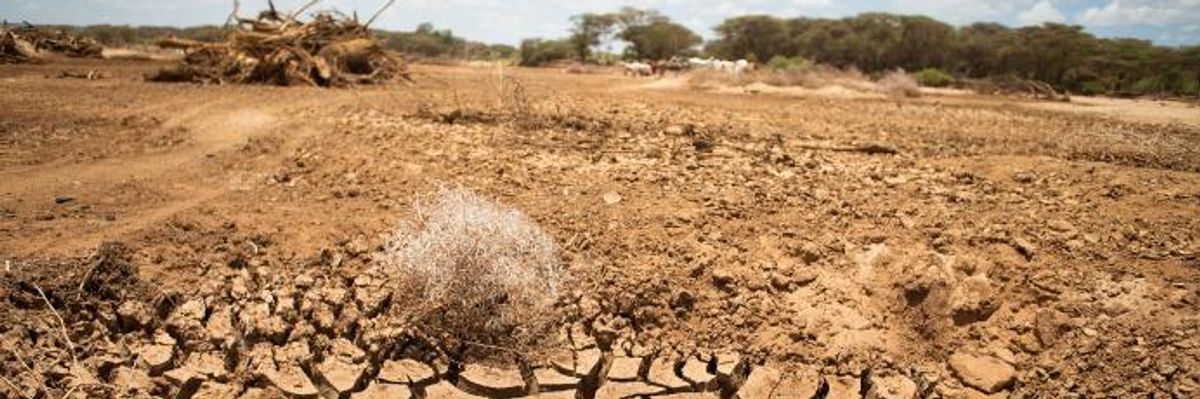
Pastoralists living in the Ewaso Ngiro river basin in central Kenya dig for water on April 4, 2017. (Photo: Climate Centre/flickr/cc)
A new study sheds light on another impact of the climate crisis--a "time bomb" for the world's groundwater reserves.
It's a key issue, as roughly two billion people worldwide rely on groundwater as their main source of freshwater, and many of these reserves are already being overdrawn.
In contrast to surface water, groundwater is stored beneath the ground's surface, held in porous rock, sand, and soil. That water seeps out, or "discharges," into waterways. The groundwater is also replenished in what is called "recharge" when precipitation falls. As such, a balance is created. But events like drought or extreme downpours--features of a warming planet--have an impact on restoring that balance.
Assessing groundwater model results along with hydrologic data sets, the team of researchers behind the new study found very differing timescales for how groundwater is going to respond to climate change, with groundwater in wetter areas expected to experience a far shorter response time than reserves in more arid areas.
"Our research shows that groundwater systems take a lot longer to respond to climate change than surface water, with only half of the world's groundwater flows responding fully within 'human' timescales of 100 years," said lead author Mark Cuthbert of Cardiff University's School of Earth and Ocean Sciences and Water Research Institute in a statement.
While some regions could bounce back in less than 10 years, including parts of central Africa and the U.S. Midwest, other areas--including Australia, the Sahara region, and parts of the central U.S.--were shown to have response times of thousands of years.
"This means that in many parts of the world," Cuthbert continued, "changes in groundwater flows due to climate change could have a very long legacy. This could be described as an environmental time bomb because any climate change impacts on recharge occurring now, will only fully impact the baseflow to rivers and wetlands a long time later."
Speaking to Agence France-Presse, Cuthbert added, "Groundwater is out of sight and out of mind, this massive hidden resource that people don't think about much yet it underpins global food production."
The authors conclude, in part, that it "is critical therefore that climate change adaptation strategies that shift reliance to groundwater in preference to surface water should also take account of lags in groundwater hydrology and include appropriately long timescale planning horizons for water resource decision making."
The study was published Monday in the journal Nature Climate Change.
This country and this world are at a monumental crossroads. US voters have an opportunity to beat back the forces of fascism and confront the billionaires who are rigging the economy, our media system, and our democracy, making it increasingly impossible for ordinary people to get by. We’re not just talking about the election. We’re talking about what must be done once these fascist elements are vanquished from power. We need a bolder set of solutions than what either major party has so far been willing to offer and a working-class movement ready to fight like hell for it. Trump didn't emerge from nowhere. The conditions that fueled MAGA authoritarianism were created by decades of radical neoliberal economic policies and a corrupt political system dominated by corporate interests. They slashed taxes on the super-rich, promising that the benefits would trickle down. They said giveaways to the corporate titans would make life more affordable for the rest of us. It was all bullshit. And when a bitter, betrayed populace searches for someone to blame, right-wing demagogues have little trouble finding scapegoats. People know when they're being lied to, but you won't hear any of this from the corporate media. Only independent journalism—powered and funded by people who believe in building a better world—can deliver truly trustworthy daily news. If you share our vision, please contribute whatever you can to sustain our work. |
A new study sheds light on another impact of the climate crisis--a "time bomb" for the world's groundwater reserves.
It's a key issue, as roughly two billion people worldwide rely on groundwater as their main source of freshwater, and many of these reserves are already being overdrawn.
In contrast to surface water, groundwater is stored beneath the ground's surface, held in porous rock, sand, and soil. That water seeps out, or "discharges," into waterways. The groundwater is also replenished in what is called "recharge" when precipitation falls. As such, a balance is created. But events like drought or extreme downpours--features of a warming planet--have an impact on restoring that balance.
Assessing groundwater model results along with hydrologic data sets, the team of researchers behind the new study found very differing timescales for how groundwater is going to respond to climate change, with groundwater in wetter areas expected to experience a far shorter response time than reserves in more arid areas.
"Our research shows that groundwater systems take a lot longer to respond to climate change than surface water, with only half of the world's groundwater flows responding fully within 'human' timescales of 100 years," said lead author Mark Cuthbert of Cardiff University's School of Earth and Ocean Sciences and Water Research Institute in a statement.
While some regions could bounce back in less than 10 years, including parts of central Africa and the U.S. Midwest, other areas--including Australia, the Sahara region, and parts of the central U.S.--were shown to have response times of thousands of years.
"This means that in many parts of the world," Cuthbert continued, "changes in groundwater flows due to climate change could have a very long legacy. This could be described as an environmental time bomb because any climate change impacts on recharge occurring now, will only fully impact the baseflow to rivers and wetlands a long time later."
Speaking to Agence France-Presse, Cuthbert added, "Groundwater is out of sight and out of mind, this massive hidden resource that people don't think about much yet it underpins global food production."
The authors conclude, in part, that it "is critical therefore that climate change adaptation strategies that shift reliance to groundwater in preference to surface water should also take account of lags in groundwater hydrology and include appropriately long timescale planning horizons for water resource decision making."
The study was published Monday in the journal Nature Climate Change.