SUBSCRIBE TO OUR FREE NEWSLETTER
Daily news & progressive opinion—funded by the people, not the corporations—delivered straight to your inbox.
5
#000000
#FFFFFF
To donate by check, phone, or other method, see our More Ways to Give page.
Daily news & progressive opinion—funded by the people, not the corporations—delivered straight to your inbox.
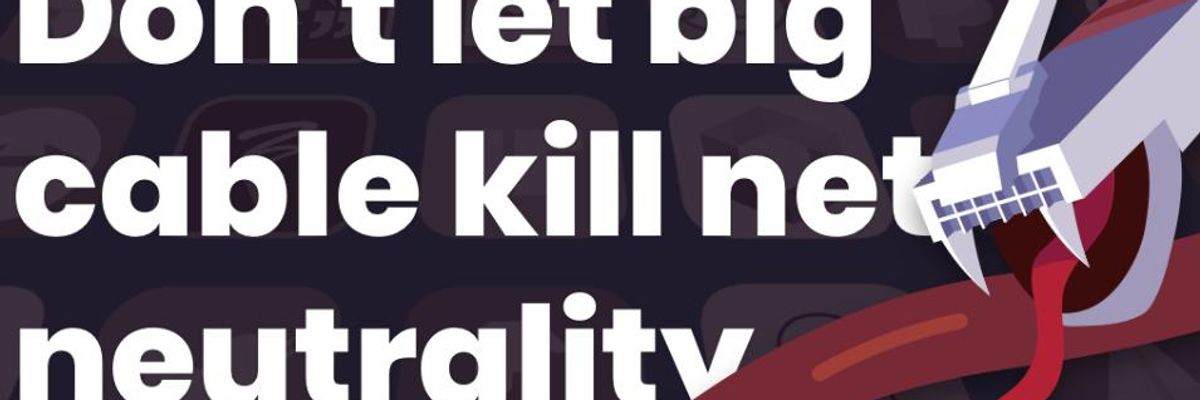
Net neutrality advocates are calling out Republican lawmakers for putting forth "deceptive" legislation that would limit federal regulation of Internet companies. (Graphic: Fight for the Future/Facebook)
Internet defenders are calling "bullshit" on Republican lawmakers pushing "deceptive" legislation that would prevent strong regulation of the very telecom companies that stand to profit most if the Federal Communication Commission's (FCC) gutting of net neutrality protections is allowed to stand.
"All three of the lawmakers behind these bills essentially rubber stamped [FCC Chairman] Ajit Pai's repeal of net neutrality; that should tell you everything you need to know about their true intentions."
--Evan Green, Fight for the Future
Rep. Bob Latta (R-Ohio) has introduced a bill that claims its aim is "to amend Title I of the Communications Act of 1934 to provide for internet openness, and for other purposes," and Reps. Cathy McMorris Rodgers (R-Wash.) and Greg Walden (R-Ore.) have announced plans to put forth similar proposals.
Although the drafts of their bills are not yet available, activists and reporters are taking cues from their voting records and public statements, including what they said during a House Communications and Technology subcommittee hearing on Thursday.
Free Press general counsel Matt Wood told Gizmodo that "despite what the new House minority claims, none of these bills would safeguard net neutrality or internet users' rights." Instead, he warned, they would "undermine the FCC's ability to protect people online by removing broadband and wireless companies from nearly all agency oversight."
"This is just more of the same BS from Big Cable funded politicians," declared Fight for the Future's Evan Greer. "They're intentionally trying to confuse the public and derail real efforts to restore net neutrality by pushing weaksauce legislation that would undermine the open Internet while claiming to save it."
"We've been tracking these bad faith efforts to push legislation backed by telecom lobbyists for years, and there's no way people are going to fall for it," she added. "All three of the lawmakers behind these bills essentially rubber stamped [FCC Chairman] Ajit Pai's repeal of net neutrality; that should tell you everything you need to know about their true intentions."
Members of the Battle for the Net coalition--which includes Free Press Action, Fight for the Future, and Demand Progress--turned to Twitter to encourage the public to pressure elected officials to oppose the measures.
The legislative tricks by Republicans come as net neutrality defenders continue to fight in court to reverse the GOP-controlled FCC's repeal and call on members of Congress to impose nationwide restrictions on Internet service providers (ISPs) to prevent them from prioritizing certain content.
"We need strong legislation that reinstates the FCC rules that never should have been repealed, and doesn't leave loopholes for Comcast, Verizon, and AT&T to scam us and control what we see online," said Greer.
While net neutrality advocates want legislation to safeguard consumer protections, the bills currently being touted by House Republicans likely pose an even greater threat to the rights of Internet users than the FCC's rollback in December of 2017. As Gizmodo's Dell Cameron outlined:
The idea of Congress passing an in-name-only "net neutrality" law worries many of the policy's chief supporters. By the time such a bill navigates its way to a vote, it's unlikely to resemble anything close to the 2015 Open Internet Order, which first established federal net neutrality regulations. To be clear: Republicans are introducing these bills not for the purpose of restoring the protections offered by net neutrality, but to cement under the law the ability of ISPs to violate it. A shoddy law passed by Congress that claims to promote 'Internet openness' would be infinitely more difficult to overturn than rules put forth by the FCC.
Journalist Karl Bode urged others reporting on the GOP net neutrality bills to follow Cameron's lead, emphasizing that "these are not good faith efforts to protect consumers, and should not be described as such."
This country and this world are at a monumental crossroads. US voters have an opportunity to beat back the forces of fascism and confront the billionaires who are rigging the economy, our media system, and our democracy, making it increasingly impossible for ordinary people to get by. We’re not just talking about the election. We’re talking about what must be done once these fascist elements are vanquished from power. We need a bolder set of solutions than what either major party has so far been willing to offer and a working-class movement ready to fight like hell for it. Trump didn't emerge from nowhere. The conditions that fueled MAGA authoritarianism were created by decades of radical neoliberal economic policies and a corrupt political system dominated by corporate interests. They slashed taxes on the super-rich, promising that the benefits would trickle down. They said giveaways to the corporate titans would make life more affordable for the rest of us. It was all bullshit. And when a bitter, betrayed populace searches for someone to blame, right-wing demagogues have little trouble finding scapegoats. People know when they're being lied to, but you won't hear any of this from the corporate media. Only independent journalism—powered and funded by people who believe in building a better world—can deliver truly trustworthy daily news. If you share our vision, please contribute whatever you can to sustain our work. |
Internet defenders are calling "bullshit" on Republican lawmakers pushing "deceptive" legislation that would prevent strong regulation of the very telecom companies that stand to profit most if the Federal Communication Commission's (FCC) gutting of net neutrality protections is allowed to stand.
"All three of the lawmakers behind these bills essentially rubber stamped [FCC Chairman] Ajit Pai's repeal of net neutrality; that should tell you everything you need to know about their true intentions."
--Evan Green, Fight for the Future
Rep. Bob Latta (R-Ohio) has introduced a bill that claims its aim is "to amend Title I of the Communications Act of 1934 to provide for internet openness, and for other purposes," and Reps. Cathy McMorris Rodgers (R-Wash.) and Greg Walden (R-Ore.) have announced plans to put forth similar proposals.
Although the drafts of their bills are not yet available, activists and reporters are taking cues from their voting records and public statements, including what they said during a House Communications and Technology subcommittee hearing on Thursday.
Free Press general counsel Matt Wood told Gizmodo that "despite what the new House minority claims, none of these bills would safeguard net neutrality or internet users' rights." Instead, he warned, they would "undermine the FCC's ability to protect people online by removing broadband and wireless companies from nearly all agency oversight."
"This is just more of the same BS from Big Cable funded politicians," declared Fight for the Future's Evan Greer. "They're intentionally trying to confuse the public and derail real efforts to restore net neutrality by pushing weaksauce legislation that would undermine the open Internet while claiming to save it."
"We've been tracking these bad faith efforts to push legislation backed by telecom lobbyists for years, and there's no way people are going to fall for it," she added. "All three of the lawmakers behind these bills essentially rubber stamped [FCC Chairman] Ajit Pai's repeal of net neutrality; that should tell you everything you need to know about their true intentions."
Members of the Battle for the Net coalition--which includes Free Press Action, Fight for the Future, and Demand Progress--turned to Twitter to encourage the public to pressure elected officials to oppose the measures.
The legislative tricks by Republicans come as net neutrality defenders continue to fight in court to reverse the GOP-controlled FCC's repeal and call on members of Congress to impose nationwide restrictions on Internet service providers (ISPs) to prevent them from prioritizing certain content.
"We need strong legislation that reinstates the FCC rules that never should have been repealed, and doesn't leave loopholes for Comcast, Verizon, and AT&T to scam us and control what we see online," said Greer.
While net neutrality advocates want legislation to safeguard consumer protections, the bills currently being touted by House Republicans likely pose an even greater threat to the rights of Internet users than the FCC's rollback in December of 2017. As Gizmodo's Dell Cameron outlined:
The idea of Congress passing an in-name-only "net neutrality" law worries many of the policy's chief supporters. By the time such a bill navigates its way to a vote, it's unlikely to resemble anything close to the 2015 Open Internet Order, which first established federal net neutrality regulations. To be clear: Republicans are introducing these bills not for the purpose of restoring the protections offered by net neutrality, but to cement under the law the ability of ISPs to violate it. A shoddy law passed by Congress that claims to promote 'Internet openness' would be infinitely more difficult to overturn than rules put forth by the FCC.
Journalist Karl Bode urged others reporting on the GOP net neutrality bills to follow Cameron's lead, emphasizing that "these are not good faith efforts to protect consumers, and should not be described as such."