SUBSCRIBE TO OUR FREE NEWSLETTER
Daily news & progressive opinion—funded by the people, not the corporations—delivered straight to your inbox.
5
#000000
#FFFFFF
To donate by check, phone, or other method, see our More Ways to Give page.
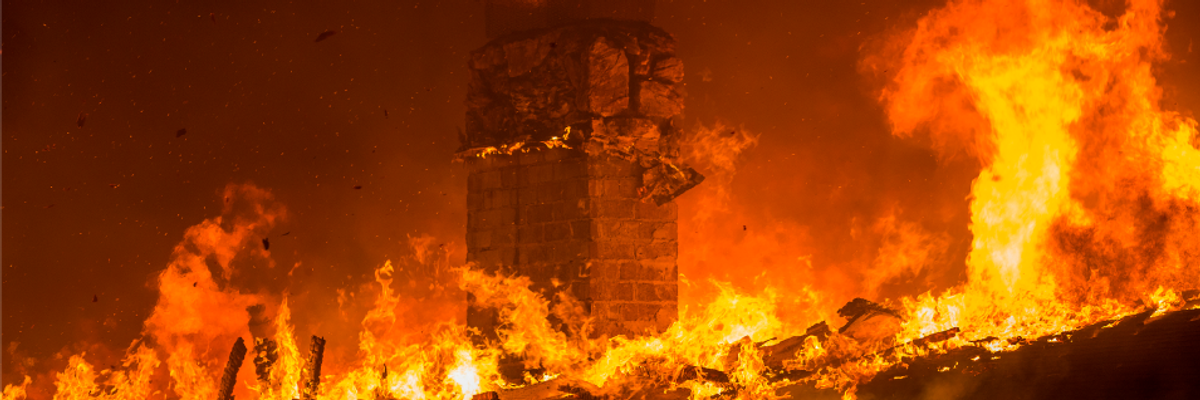
While a rapidly rising number of people across the globe are worried about the climate crisis--prompting warnings from scientists, demands for robust action, and sweeping legislative proposals such as the Green New Deal--there are also mounting concerns about the United States in the era of President Donald Trump, according to new polling from the Pew Research Center.
The survey results, released Monday, show that while U.S. power and influence still isn't the primary worry among people beyond the United States, concern about it has skyrocketed since Trump took office. As Pew's report (pdf) noted, "In 2013, only a quarter across 22 nations saw American power as a major threat to their country, but that jumped substantially to 38 percent in 2017, the year after Trump was elected president, and to 45 percent in 2018."
The report also pointed out "a strong connection" between seeing the U.S. as a threat and lacking confidence in Trump, particularly "among America's traditional allies, such as Canada, the U.K., and Australia, where overall views of the U.S. and its president have plummeted in recent years." A majority of those polled from Argentina, Mexico, Brazil, Tunisia, South Korea, Japan, and Indonesia as well as nearly half from Canada, France, Germany, and Greece expressed concern over U.S. power in 2018.
As the global community frets about the United States flexing its geopolitical muscles under Trump--from ditching the Paris climate agreement and global treaties to backing an effort to overthrow the Venezuelan government--Pew also found that both Americans and people around the world perceive the human-caused climate crisis as a top security risk. In half of the 26 nations where the survey was conducted from May to August of 2018, the greatest number of respondents selected climate change as posing a major threat.
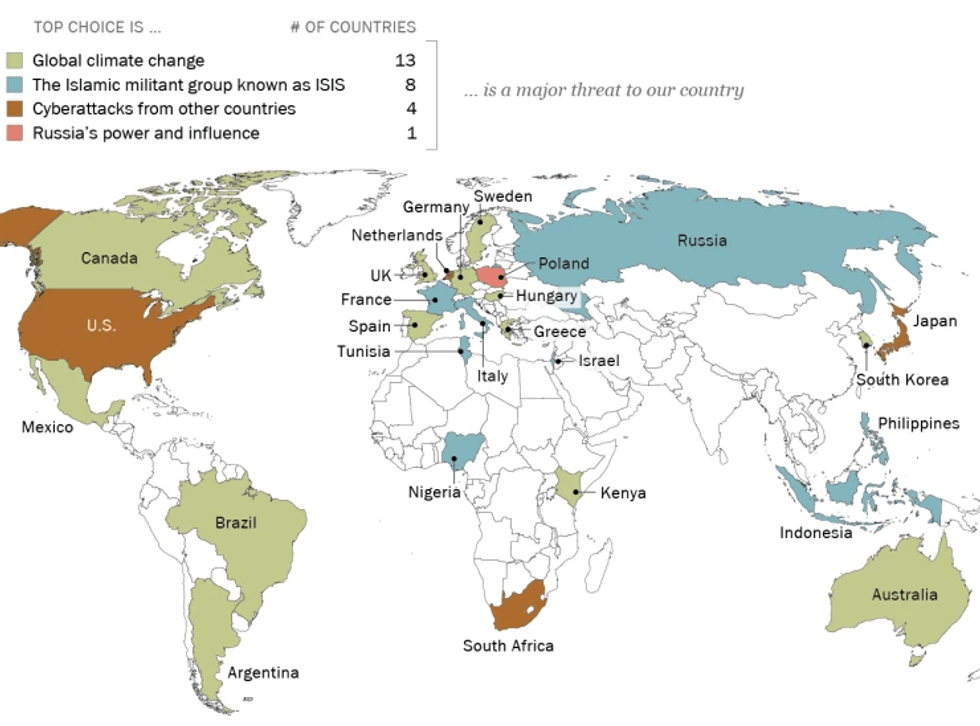
"Since 2013, worries about the climate threat have increased significantly in 13 of the countries where data are available," according to Pew. "In 2013, well before the Paris climate agreement was signed, a median of 56 percent across 23 countries surveyed said global climate change was a major threat to their country. That climbed to 63 percent in 2017, and in 2018 it stands at 67 percent."
In the United States, Canada, Mexico, France, Germany, Poland, Spain, the United Kingdom, Kenya, and South Africa, the number of people concerned about the climate crisis has soared, rising by double-digits over just five years. Across Latin America, the Middle East, and Africa--which are increasingly at risk for extreme weather exacerbated by rising temperatures--climate change has continuously ranked as a top concern.
Although the largest portion of Americans said they are worried about cyberattacks--aligned with the global trend of rising cybersecurity concerns--59 percent of U.S. respondents expressed alarm over human-caused climate change. While the majority of Americans in this poll and other recent surveys recognized the dangers of the global crisis, Pew found that "there are sharp ideological and partisan divides in Europe and North America" between those who are and are not concerned.
As the Pew report outlines:
In nine of the 12 European and North American countries surveyed, those on the ideological left are more concerned about the threat of global climate change than those on the right. This is especially the case in the U.S., where nearly nine-in-ten (87 percent) among those on the left say global warming is a top concern, versus only 31 percent on the right who say this.
Additionally, the researchers found, "a slight education divide on the threat of climate change exists in many European and North American countries surveyed, where those with more education are more inclined to say it is a threat than those with less education."
While a rapidly rising number of people across the globe are worried about the climate crisis--prompting warnings from scientists, demands for robust action, and sweeping legislative proposals such as the Green New Deal--there are also mounting concerns about the United States in the era of President Donald Trump, according to new polling from the Pew Research Center.
The survey results, released Monday, show that while U.S. power and influence still isn't the primary worry among people beyond the United States, concern about it has skyrocketed since Trump took office. As Pew's report (pdf) noted, "In 2013, only a quarter across 22 nations saw American power as a major threat to their country, but that jumped substantially to 38 percent in 2017, the year after Trump was elected president, and to 45 percent in 2018."
The report also pointed out "a strong connection" between seeing the U.S. as a threat and lacking confidence in Trump, particularly "among America's traditional allies, such as Canada, the U.K., and Australia, where overall views of the U.S. and its president have plummeted in recent years." A majority of those polled from Argentina, Mexico, Brazil, Tunisia, South Korea, Japan, and Indonesia as well as nearly half from Canada, France, Germany, and Greece expressed concern over U.S. power in 2018.
As the global community frets about the United States flexing its geopolitical muscles under Trump--from ditching the Paris climate agreement and global treaties to backing an effort to overthrow the Venezuelan government--Pew also found that both Americans and people around the world perceive the human-caused climate crisis as a top security risk. In half of the 26 nations where the survey was conducted from May to August of 2018, the greatest number of respondents selected climate change as posing a major threat.
"Since 2013, worries about the climate threat have increased significantly in 13 of the countries where data are available," according to Pew. "In 2013, well before the Paris climate agreement was signed, a median of 56 percent across 23 countries surveyed said global climate change was a major threat to their country. That climbed to 63 percent in 2017, and in 2018 it stands at 67 percent."
In the United States, Canada, Mexico, France, Germany, Poland, Spain, the United Kingdom, Kenya, and South Africa, the number of people concerned about the climate crisis has soared, rising by double-digits over just five years. Across Latin America, the Middle East, and Africa--which are increasingly at risk for extreme weather exacerbated by rising temperatures--climate change has continuously ranked as a top concern.
Although the largest portion of Americans said they are worried about cyberattacks--aligned with the global trend of rising cybersecurity concerns--59 percent of U.S. respondents expressed alarm over human-caused climate change. While the majority of Americans in this poll and other recent surveys recognized the dangers of the global crisis, Pew found that "there are sharp ideological and partisan divides in Europe and North America" between those who are and are not concerned.
As the Pew report outlines:
In nine of the 12 European and North American countries surveyed, those on the ideological left are more concerned about the threat of global climate change than those on the right. This is especially the case in the U.S., where nearly nine-in-ten (87 percent) among those on the left say global warming is a top concern, versus only 31 percent on the right who say this.
Additionally, the researchers found, "a slight education divide on the threat of climate change exists in many European and North American countries surveyed, where those with more education are more inclined to say it is a threat than those with less education."