SUBSCRIBE TO OUR FREE NEWSLETTER
Daily news & progressive opinion—funded by the people, not the corporations—delivered straight to your inbox.
5
#000000
#FFFFFF
To donate by check, phone, or other method, see our More Ways to Give page.
Daily news & progressive opinion—funded by the people, not the corporations—delivered straight to your inbox.
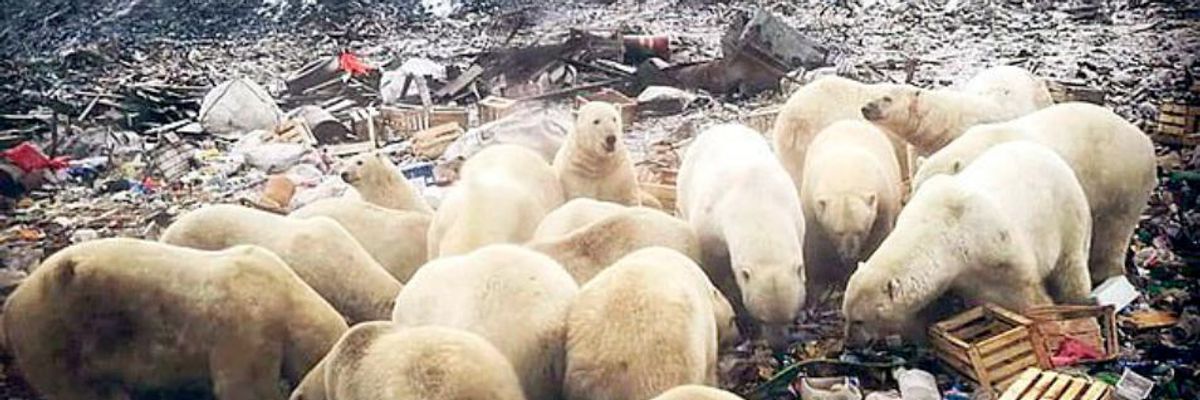
An "invasion" of hungry polar bears has led a region in Russia to declare a state of emergency. (Photo: Daily Mail)
As human activity continues to drive the climate crisis that is causing rapid ice loss at both poles and in other cold regions, destroying the habitats of animals who live there, Russian islands in the Novaya Zemlya archipelago have declared a state of emergency in response to a "mass invasion" of dozens of starving polar bears who have been "chasing people and entering residential buildings."
With rising temperatures increasingly destroying the bears' Arctic habitats, interactions with humans are becoming more common. As Liz Greengrass, a director at the U.K.-based Born Free Foundation, told CNN last year: "Polar bears are reliant on seals for food and seals rely on sea ice. Global warming is melting the ice so it has a chain reaction on how polar bears can survive."
Because residents of the Russian region are banned from shooting the bears, which are classified by the country's environmental watchdog as an endangered species, a team of experts is being dispatched to the archipelago--home to about 3,000 people--in hopes of preventing animal attacks, according to the Russian news agency TASS.
"I have been in Novaya Zemlya since 1983, but there has never been so many polar bears in the vicinity," local leader Zhigansha Musin told the news agency. "A total of 50 polar bears are near the human settlements so we have loads of work ahead."
Since December, those living around the area's largest settlement--Belushya Guba, which has a population of about 2,500--have reported seeing at least 52 polar bears. Attempts to scare the hungry bears away with vehicle patrols and dogs have failed.
"The decision to declare an emergency situation on the territory of Novaya Zemlya from February 9 was taken at a meeting of the commission tasked to prevent emergencies and ensure fire safety," said a statement from the regional government released on Saturday.
"Residents, schools, and kindergartens are submitting numerous oral and written complaints demanding to ensure safety in the settlement," the statement continued. "The people are scared. They are frightened to leave homes and their daily routines are broken. Parents are afraid to let the children go to school or kindergarten."
The specialists hope to prevent attacks without having to shoot any bears, though reportedly acknowledge that a cull may be necessary. It is not yet clear how long the state of emergency will last in the region, which was once used for Soviet nuclear tests and is now a Russian military garrison.
Dear Common Dreams reader, It’s been nearly 30 years since I co-founded Common Dreams with my late wife, Lina Newhouser. We had the radical notion that journalism should serve the public good, not corporate profits. It was clear to us from the outset what it would take to build such a project. No paid advertisements. No corporate sponsors. No millionaire publisher telling us what to think or do. Many people said we wouldn't last a year, but we proved those doubters wrong. Together with a tremendous team of journalists and dedicated staff, we built an independent media outlet free from the constraints of profits and corporate control. Our mission has always been simple: To inform. To inspire. To ignite change for the common good. Building Common Dreams was not easy. Our survival was never guaranteed. When you take on the most powerful forces—Wall Street greed, fossil fuel industry destruction, Big Tech lobbyists, and uber-rich oligarchs who have spent billions upon billions rigging the economy and democracy in their favor—the only bulwark you have is supporters who believe in your work. But here’s the urgent message from me today. It's never been this bad out there. And it's never been this hard to keep us going. At the very moment Common Dreams is most needed, the threats we face are intensifying. We need your support now more than ever. We don't accept corporate advertising and never will. We don't have a paywall because we don't think people should be blocked from critical news based on their ability to pay. Everything we do is funded by the donations of readers like you. When everyone does the little they can afford, we are strong. But if that support retreats or dries up, so do we. Will you donate now to make sure Common Dreams not only survives but thrives? —Craig Brown, Co-founder |
As human activity continues to drive the climate crisis that is causing rapid ice loss at both poles and in other cold regions, destroying the habitats of animals who live there, Russian islands in the Novaya Zemlya archipelago have declared a state of emergency in response to a "mass invasion" of dozens of starving polar bears who have been "chasing people and entering residential buildings."
With rising temperatures increasingly destroying the bears' Arctic habitats, interactions with humans are becoming more common. As Liz Greengrass, a director at the U.K.-based Born Free Foundation, told CNN last year: "Polar bears are reliant on seals for food and seals rely on sea ice. Global warming is melting the ice so it has a chain reaction on how polar bears can survive."
Because residents of the Russian region are banned from shooting the bears, which are classified by the country's environmental watchdog as an endangered species, a team of experts is being dispatched to the archipelago--home to about 3,000 people--in hopes of preventing animal attacks, according to the Russian news agency TASS.
"I have been in Novaya Zemlya since 1983, but there has never been so many polar bears in the vicinity," local leader Zhigansha Musin told the news agency. "A total of 50 polar bears are near the human settlements so we have loads of work ahead."
Since December, those living around the area's largest settlement--Belushya Guba, which has a population of about 2,500--have reported seeing at least 52 polar bears. Attempts to scare the hungry bears away with vehicle patrols and dogs have failed.
"The decision to declare an emergency situation on the territory of Novaya Zemlya from February 9 was taken at a meeting of the commission tasked to prevent emergencies and ensure fire safety," said a statement from the regional government released on Saturday.
"Residents, schools, and kindergartens are submitting numerous oral and written complaints demanding to ensure safety in the settlement," the statement continued. "The people are scared. They are frightened to leave homes and their daily routines are broken. Parents are afraid to let the children go to school or kindergarten."
The specialists hope to prevent attacks without having to shoot any bears, though reportedly acknowledge that a cull may be necessary. It is not yet clear how long the state of emergency will last in the region, which was once used for Soviet nuclear tests and is now a Russian military garrison.
As human activity continues to drive the climate crisis that is causing rapid ice loss at both poles and in other cold regions, destroying the habitats of animals who live there, Russian islands in the Novaya Zemlya archipelago have declared a state of emergency in response to a "mass invasion" of dozens of starving polar bears who have been "chasing people and entering residential buildings."
With rising temperatures increasingly destroying the bears' Arctic habitats, interactions with humans are becoming more common. As Liz Greengrass, a director at the U.K.-based Born Free Foundation, told CNN last year: "Polar bears are reliant on seals for food and seals rely on sea ice. Global warming is melting the ice so it has a chain reaction on how polar bears can survive."
Because residents of the Russian region are banned from shooting the bears, which are classified by the country's environmental watchdog as an endangered species, a team of experts is being dispatched to the archipelago--home to about 3,000 people--in hopes of preventing animal attacks, according to the Russian news agency TASS.
"I have been in Novaya Zemlya since 1983, but there has never been so many polar bears in the vicinity," local leader Zhigansha Musin told the news agency. "A total of 50 polar bears are near the human settlements so we have loads of work ahead."
Since December, those living around the area's largest settlement--Belushya Guba, which has a population of about 2,500--have reported seeing at least 52 polar bears. Attempts to scare the hungry bears away with vehicle patrols and dogs have failed.
"The decision to declare an emergency situation on the territory of Novaya Zemlya from February 9 was taken at a meeting of the commission tasked to prevent emergencies and ensure fire safety," said a statement from the regional government released on Saturday.
"Residents, schools, and kindergartens are submitting numerous oral and written complaints demanding to ensure safety in the settlement," the statement continued. "The people are scared. They are frightened to leave homes and their daily routines are broken. Parents are afraid to let the children go to school or kindergarten."
The specialists hope to prevent attacks without having to shoot any bears, though reportedly acknowledge that a cull may be necessary. It is not yet clear how long the state of emergency will last in the region, which was once used for Soviet nuclear tests and is now a Russian military garrison.