SUBSCRIBE TO OUR FREE NEWSLETTER
Daily news & progressive opinion—funded by the people, not the corporations—delivered straight to your inbox.
5
#000000
#FFFFFF
To donate by check, phone, or other method, see our More Ways to Give page.
Daily news & progressive opinion—funded by the people, not the corporations—delivered straight to your inbox.
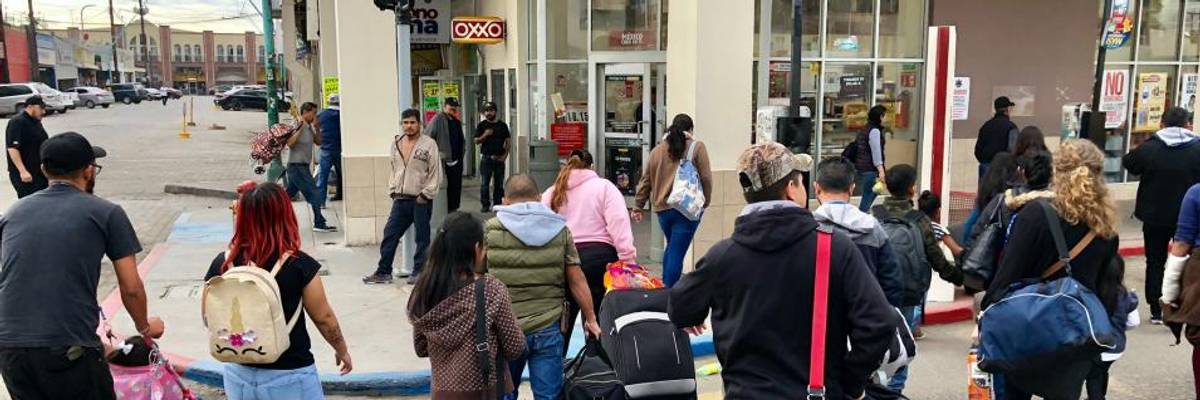
Twenty-nine parents traveled to the U.S.-Mexico border on Saturday to seek asylum in hopes of being reunited with their children, who were ripped away by federal agents under the Trump administration's "zero-tolerance" policy. (Photo: Families Belong Together/Twitter)
After spending several hours at the U.S.-Mexico border with attorneys and immigrant rights advocates on Saturday, 29 parents separated from their children then deported under President Donald Trump's so-called "zero tolerance" policy were allowed to take a crucial step toward applying for asylum and reuniting with their kids.
Families Belong Together, a coalition that formed in response to the cruel policy that Trump rolled back after international outrage, announced on Twitter late Saturday that U.S. Customs and Border Protection (CBP) had begun processing the parents. As the coalition said, "This is a great step--but we also need to keep the pressure on to ensure they make it through and are reunited with their children in the U.S."
The news came after "the group of parents quietly traveled north over the past month, assisted by a team of immigration lawyers who hatched a high-stakes plan to reunify families," as the Washington Post reported. "Now, they will pose a significant test to the embattled American asylum system, arguing that they deserve another chance at refuge in the United States, something rarely offered to deportees."
Outlining what led to the current situation, the Post explained:
Before the Trump administration, families had never been systematically separated at the border. And before Saturday, those families had never returned to the border en masse.
More than 2,700 children were separated from their families along the border last year, according to the Department of Health and Human Services. About 430 of the parents were deported without their children, and at least 200 of them remain separated today. Some waited in the hope that U.S. courts would allow them to return to the United States. Others paid smugglers to get them back to the border. Then came Saturday's confrontation.
The parents are from Honduras, Guatemala, and El Salvador. Collectively, they have 27 children who are living in the United States in shelters or foster homes, or with relatives. Ahead of the confrontation in Mexicali on Saturday, the group spent three weeks at a hotel in Tijuana, Mexico to prepare for asylum hearings.
"They're standing right at the border, preparing to reenter a system that traumatized their families months earlier," Lindsay Toczylowski, executive director of the Immigrant Defenders Law Center, who counseled the parents in Tijuana, told the Post before the parents crossed into the United States. "It says a lot about what they're fleeing, and what they lost."
As the parents arrived at the U.S. border with advocates, those supporting them in the fight to reunite their families urged critics of Trump's anti-immigrant policies to contact CBP--an agency under Department of Homeland Security (DHS)--to pressure federal officials to allow the parents entry into the country. For hours, CBP agents claimed they did not have the capacity to process their parents, according to the advocacy groups.
Multiple congressional Democrats added their voices to the chorus demanding that the parents be allowed to submit asylum claims.
After CBP began allowing the parents in, rights advocates celebrated but also emphasized that there is a long road ahead for these and other families torn apart on the president's orders. They vowed to continue aiding the parents as their asylum claims move forward but also encouraged voters to contact their members of Congress with concerns about Immigration and Customs Enforcement (ICE), another DHS agency that has been widely criticized over its treatment of detained migrants.
This country and this world are at a monumental crossroads. US voters have an opportunity to beat back the forces of fascism and confront the billionaires who are rigging the economy, our media system, and our democracy, making it increasingly impossible for ordinary people to get by. We’re not just talking about the election. We’re talking about what must be done once these fascist elements are vanquished from power. We need a bolder set of solutions than what either major party has so far been willing to offer and a working-class movement ready to fight like hell for it. Trump didn't emerge from nowhere. The conditions that fueled MAGA authoritarianism were created by decades of radical neoliberal economic policies and a corrupt political system dominated by corporate interests. They slashed taxes on the super-rich, promising that the benefits would trickle down. They said giveaways to the corporate titans would make life more affordable for the rest of us. It was all bullshit. And when a bitter, betrayed populace searches for someone to blame, right-wing demagogues have little trouble finding scapegoats. People know when they're being lied to, but you won't hear any of this from the corporate media. Only independent journalism—powered and funded by people who believe in building a better world—can deliver truly trustworthy daily news. If you share our vision, please contribute whatever you can to sustain our work. |
After spending several hours at the U.S.-Mexico border with attorneys and immigrant rights advocates on Saturday, 29 parents separated from their children then deported under President Donald Trump's so-called "zero tolerance" policy were allowed to take a crucial step toward applying for asylum and reuniting with their kids.
Families Belong Together, a coalition that formed in response to the cruel policy that Trump rolled back after international outrage, announced on Twitter late Saturday that U.S. Customs and Border Protection (CBP) had begun processing the parents. As the coalition said, "This is a great step--but we also need to keep the pressure on to ensure they make it through and are reunited with their children in the U.S."
The news came after "the group of parents quietly traveled north over the past month, assisted by a team of immigration lawyers who hatched a high-stakes plan to reunify families," as the Washington Post reported. "Now, they will pose a significant test to the embattled American asylum system, arguing that they deserve another chance at refuge in the United States, something rarely offered to deportees."
Outlining what led to the current situation, the Post explained:
Before the Trump administration, families had never been systematically separated at the border. And before Saturday, those families had never returned to the border en masse.
More than 2,700 children were separated from their families along the border last year, according to the Department of Health and Human Services. About 430 of the parents were deported without their children, and at least 200 of them remain separated today. Some waited in the hope that U.S. courts would allow them to return to the United States. Others paid smugglers to get them back to the border. Then came Saturday's confrontation.
The parents are from Honduras, Guatemala, and El Salvador. Collectively, they have 27 children who are living in the United States in shelters or foster homes, or with relatives. Ahead of the confrontation in Mexicali on Saturday, the group spent three weeks at a hotel in Tijuana, Mexico to prepare for asylum hearings.
"They're standing right at the border, preparing to reenter a system that traumatized their families months earlier," Lindsay Toczylowski, executive director of the Immigrant Defenders Law Center, who counseled the parents in Tijuana, told the Post before the parents crossed into the United States. "It says a lot about what they're fleeing, and what they lost."
As the parents arrived at the U.S. border with advocates, those supporting them in the fight to reunite their families urged critics of Trump's anti-immigrant policies to contact CBP--an agency under Department of Homeland Security (DHS)--to pressure federal officials to allow the parents entry into the country. For hours, CBP agents claimed they did not have the capacity to process their parents, according to the advocacy groups.
Multiple congressional Democrats added their voices to the chorus demanding that the parents be allowed to submit asylum claims.
After CBP began allowing the parents in, rights advocates celebrated but also emphasized that there is a long road ahead for these and other families torn apart on the president's orders. They vowed to continue aiding the parents as their asylum claims move forward but also encouraged voters to contact their members of Congress with concerns about Immigration and Customs Enforcement (ICE), another DHS agency that has been widely criticized over its treatment of detained migrants.