SUBSCRIBE TO OUR FREE NEWSLETTER
Daily news & progressive opinion—funded by the people, not the corporations—delivered straight to your inbox.
5
#000000
#FFFFFF
To donate by check, phone, or other method, see our More Ways to Give page.
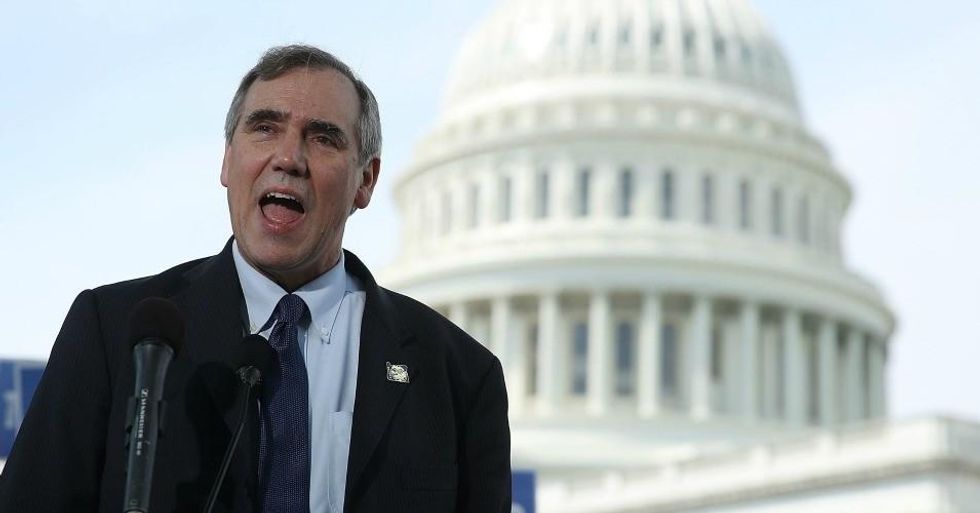
Denouncing what we called the nation's "profoundly unfair" system of electing presidents, Sen. Jeff Merkley on Friday introduced legislation that, along with a number of pro-democracy reforms, would abolish the electoral college.
The proposal, Merkley said, includes a constitutional amendment establishing that the president beelected according to the popular vote.
"We need real, equal representation if we want a government that responds to the big issues impacting working families' lives, like health care, housing, education, living-wage jobs, and climate chaos." --Sen. Jeff Merkley (D-Ore.)
"The idea of democracy is simple and obvious even to young kids on a playground--whoever gets the most votes should win," the Oregon Democrat said. "But way too often, that's not how our system of government is working. And we see the results all around us--the privileged and powerful taking care of themselves while most people work longer hours for the same pay at best, while costs keep going up."
The proposal is part of the Blueprint for Democracy that Merkley introduced in January as the Democratic Party turned its attention, through its For the People Act (H.R. 1)., to confronting a political system stacked against the common good and in favor of corporations and the wealthiest Americans.
The package of bills also calls for a commission to give full representation to Puerto Rico, Washington, D.C., and several U.S. territories; expand early voting; and end purges of voter rolls.
Merkley is the latest lawmaker to call for an end to the electoral system that was put in place in the 18th century, critics say, to allow states that permitted slavery to sway elections and has been retained in part to ensure that states in the middle of the country are considered equal to those on the coasts, despite population differences.
Opponents of the system have pointed out that two presidential elections in the past two decades have elected presidents who fell far short of winning popular support from American voters. President Donald Trump won just 46.4 percent of the popular vote and 74 more electoral votes than Hillary Clinton, while former President George W. Bush won 500,000 fewer votes than Al Gore but captured 271 electoral votes.
"We need real, equal representation if we want a government that responds to the big issues impacting working families' lives, like health care, housing, education, living-wage jobs, and climate chaos," said Merkley in a statement. "It's time to end the undemocratic electoral college."
In recent weeks a number of Democratic presidential candidates have voiced support for doing away with the electoral college. Sen. Elizabeth Warren (D-Mass.) called on supporters to sign a petition demanding an end to the system at a CNN town hall meeting earlier this month, while South Bend, Indiana, Mayor Pete Buttigieg told "CBS This Morning" on January that the electoral college "needs to go."
Meanwhile, on Thursday, Delaware became the 21st state to join the National Popular Vote Interstate Compact, which would allocate the participating states' electoral votes to the winner of the national popular vote. Currently, states representing 184 electoral votes have signed on to the compact. The states need to represent at least 270 electoral votes in order to swing an election.
Republicans have strongly opposed the anti-electoral college movement as well as other aspects of H.R. 1, with Senate Majority Leader Mitch McConnell suggesting on the Senate floor that pro-democracy, anti-corruption legislation would harm the GOP--confirming the widespread belief among critics that the party relies on mass disenfranchisement to stay in power.