

SUBSCRIBE TO OUR FREE NEWSLETTER
Daily news & progressive opinion—funded by the people, not the corporations—delivered straight to your inbox.
5
#000000
#FFFFFF
To donate by check, phone, or other method, see our More Ways to Give page.
Daily news & progressive opinion—funded by the people, not the corporations—delivered straight to your inbox.
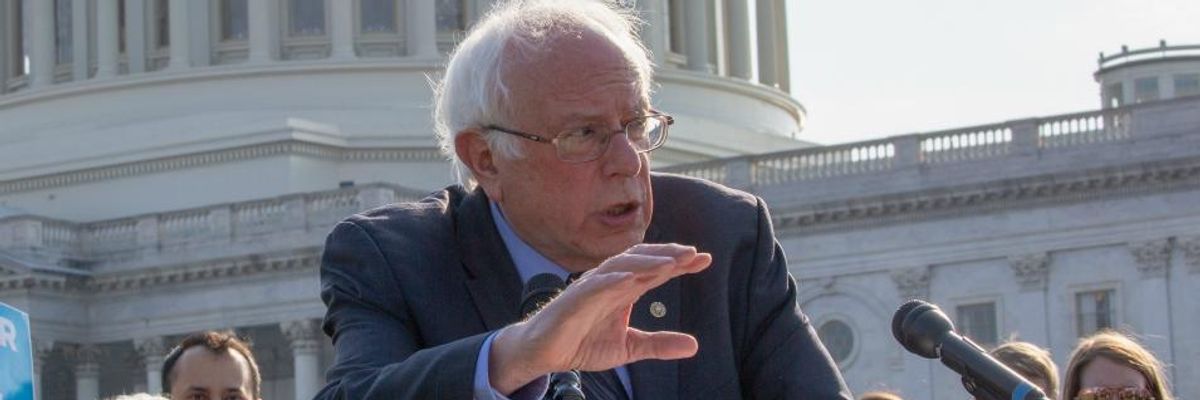
Sen. Bernie Sanders (I-VT) speaks at a rally with MoveOn members and allies gather with leading senators to demand that the Senate vote to reject Mike PompeoOs nomination for Secretary of State at US Capitol on April 11, 2018 in Washington, DC. (Photo: Tasos Katopodis/Getty Images for MoveOn.org)
Following recent efforts by media outlets to paint a picture that his opposition to past U.S. wars--from the Vietnam War when he was a young man to voting against the 2003 invasion of Iraq as a member of Congress--was something he might want to apologize or account for, Bernie Sanders on Friday released a video on Friday to make clear why he opposed those "disastrous" military misadventures and will continue to fight against similar follies in the future.
"I make no apologies to anybody, that when I was a young man--before I was elected to anything--I opposed the war in Vietnam," says Sanders, a 2020 Democratic presidential candidate, in the less than two-minute video. "And I know what that war did to my generation. And when I was a member of the House, I helped lead the effort against the war in Iraq, because I knew that Cheney and Bush and these other folks were lying about weapons of mass destruction."
The decision to invade Iraq in 2003, Sanders adds, was the "worst foreign policy blunder in the modern history of the United States."
Watch:
"This is great: Bernie tell tells the pro-war crowd and their enablers to bring it on," tweeted Mark Weisbrot, co-director of the Center for Economic and Policy Research, in response to the video. "Can't remember when a presidential candidate of his stature (he got 43% percent of the vote the 2016 Democratic primary) said something this honest about US wars."
In addition to noting his recent efforts to end U.S. complicity in the Saudi-led coalition's brutal assault on Yemen--a war that experts say is fueling tens of thousands of deaths and exacerbating the "worst humanitarian crisis in the world"--Sanders also vows in the video to do everything in his power to prevent any future war with Iran, something the Trump administration in recent weeks has made increasingly more likely.
"If you think the war in Iraq was a disaster," he warns in the video, "my guess is that the war in Iran would be even worse."
According to John Nichols, writing for The Nation this week, Sanders has no reason whatsoever to be sorry when it comes to his anti-war record.
"Sanders should never apologize for the anti-war stances he took in the past," wrote Nichols, "just as he should never apologize for the anti-war stances he is taking today as a leading contender for the Democratic presidential nomination."
Referencing his appearance on NBC's "Meet The Press" last Sunday, Nichols said it was nice to see a high-profile candidate like Sanders not cowing from subtle accusations that being opposed to war or militarism is politically problematic.
"[Sanders'] willingness to defend an anti-war stance on a Sunday-morning talk show," wrote Nichols, "was a refreshing rejoinder to the casually militaristic approach that characterizes so many media discussions of foreign policy."
This country and this world are at a monumental crossroads. US voters have an opportunity to beat back the forces of fascism and confront the billionaires who are rigging the economy, our media system, and our democracy, making it increasingly impossible for ordinary people to get by. We’re not just talking about the election. We’re talking about what must be done once these fascist elements are vanquished from power. We need a bolder set of solutions than what either major party has so far been willing to offer and a working-class movement ready to fight like hell for it. Trump didn't emerge from nowhere. The conditions that fueled MAGA authoritarianism were created by decades of radical neoliberal economic policies and a corrupt political system dominated by corporate interests. They slashed taxes on the super-rich, promising that the benefits would trickle down. They said giveaways to the corporate titans would make life more affordable for the rest of us. It was all bullshit. And when a bitter, betrayed populace searches for someone to blame, right-wing demagogues have little trouble finding scapegoats. People know when they're being lied to, but you won't hear any of this from the corporate media. Only independent journalism—powered and funded by people who believe in building a better world—can deliver truly trustworthy daily news. If you share our vision, please contribute whatever you can to sustain our work. |
Following recent efforts by media outlets to paint a picture that his opposition to past U.S. wars--from the Vietnam War when he was a young man to voting against the 2003 invasion of Iraq as a member of Congress--was something he might want to apologize or account for, Bernie Sanders on Friday released a video on Friday to make clear why he opposed those "disastrous" military misadventures and will continue to fight against similar follies in the future.
"I make no apologies to anybody, that when I was a young man--before I was elected to anything--I opposed the war in Vietnam," says Sanders, a 2020 Democratic presidential candidate, in the less than two-minute video. "And I know what that war did to my generation. And when I was a member of the House, I helped lead the effort against the war in Iraq, because I knew that Cheney and Bush and these other folks were lying about weapons of mass destruction."
The decision to invade Iraq in 2003, Sanders adds, was the "worst foreign policy blunder in the modern history of the United States."
Watch:
"This is great: Bernie tell tells the pro-war crowd and their enablers to bring it on," tweeted Mark Weisbrot, co-director of the Center for Economic and Policy Research, in response to the video. "Can't remember when a presidential candidate of his stature (he got 43% percent of the vote the 2016 Democratic primary) said something this honest about US wars."
In addition to noting his recent efforts to end U.S. complicity in the Saudi-led coalition's brutal assault on Yemen--a war that experts say is fueling tens of thousands of deaths and exacerbating the "worst humanitarian crisis in the world"--Sanders also vows in the video to do everything in his power to prevent any future war with Iran, something the Trump administration in recent weeks has made increasingly more likely.
"If you think the war in Iraq was a disaster," he warns in the video, "my guess is that the war in Iran would be even worse."
According to John Nichols, writing for The Nation this week, Sanders has no reason whatsoever to be sorry when it comes to his anti-war record.
"Sanders should never apologize for the anti-war stances he took in the past," wrote Nichols, "just as he should never apologize for the anti-war stances he is taking today as a leading contender for the Democratic presidential nomination."
Referencing his appearance on NBC's "Meet The Press" last Sunday, Nichols said it was nice to see a high-profile candidate like Sanders not cowing from subtle accusations that being opposed to war or militarism is politically problematic.
"[Sanders'] willingness to defend an anti-war stance on a Sunday-morning talk show," wrote Nichols, "was a refreshing rejoinder to the casually militaristic approach that characterizes so many media discussions of foreign policy."

