SUBSCRIBE TO OUR FREE NEWSLETTER
Daily news & progressive opinion—funded by the people, not the corporations—delivered straight to your inbox.
5
#000000
#FFFFFF
To donate by check, phone, or other method, see our More Ways to Give page.
Daily news & progressive opinion—funded by the people, not the corporations—delivered straight to your inbox.
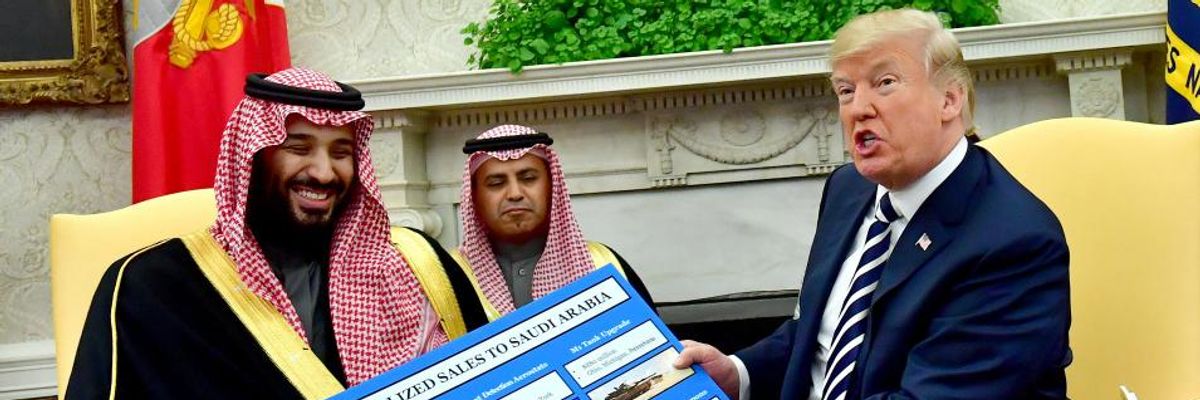
President Donald Trump holds up a chart of military hardware sales as he meets with Crown Prince Mohammed bin Salman of the Kingdom of Saudi Arabia in the Oval Office at the White House on March 20, 2018 in Washington, D.C. (Photo: Kevin Dietsch-Pool/Getty Images)
In a move critics warned could empower the Saudis to manufacture their own high-tech weaponry for use in their assault on Yemen, the Trump administration reportedly wants to allow the American arms giant Raytheon to work with the kingdom to construct bomb and missile parts inside Saudi Arabia.
As The New York Times reported Friday, President Donald Trump's emergency declaration last month greenlighting billions of dollars in U.S. weapons sales to Saudi Arabia without congressional approval contained a provision that permits Raytheon to "team up with the Saudis to build high-tech bomb parts in Saudi Arabia."
The provision, according to the Times, immediately "raised concerns that the Saudis could gain access to technology that would let them produce their own versions of American precision-guided bombs--weapons they have used in strikes on civilians since they began fighting a war in Yemen four years ago."
"The move grants Raytheon and the Saudis sweeping permission to begin assembling the control systems, guidance electronics, and circuit cards that are essential to the company's Paveway smart bombs," the Times reported. "The United States has closely guarded such technology for national security reasons."
In a detailed investigation published last month, In These Times found that the Saudi kingdom has "ordered more than 27,000 missiles worth at least $1.8 billion from Raytheon alone."
"About $650 million of those Raytheon orders," In These Times reported, "came after the Saudi war in Yemen began."
William Hartung, director of the Arms and Security Project at the Center for International Policy, warned that handing the Saudis the capacity to develop high-tech bombs on the level of U.S. weaponry could have disastrous consequences for the people of Yemen, who are already suffering from the world's worst humanitarian crisis.
"If Saudi Arabia is able to develop an indigenous bomb-making capability as a result of this deal," Hartung said, "it will undermine U.S. leverage to prevent them from engaging in indiscriminate strikes of the kind it has carried out in Yemen."
According to the Times, the Trump administration's agreement with Raytheon "is part of a larger arms package, previously blocked by Congress, that includes 120,000 precision-guided bombs that Raytheon is prepared to ship to the coalition."
"These will add to the tens of thousands of bombs that Saudi Arabia and the United Arab Emirates have already stockpiled," the Times reported, "and some in Congress fear the surplus would let the countries continue fighting in Yemen long into the future."
As Common Dreams reported in April, Trump vetoed a congressional effort--led by Sen. Bernie Sanders (I-Vt.) and Rep. Ro Khanna (D-Calif.)--to end U.S. complicity in the Saudi assault on Yemen by halting military assistance to the kingdom.
A bipartisan group of lawmakers is now planning a series of votes in an attempt to block Trump's emergency declaration on Saudi arms sales.
"We will not stand idly by and allow the president or the secretary of state to further erode congressional review and oversight of arm sales," said Sen. Bob Menendez (D-N.J.), the top Democrat on the Senate Foreign Relations Committee.
This country and this world are at a monumental crossroads. US voters have an opportunity to beat back the forces of fascism and confront the billionaires who are rigging the economy, our media system, and our democracy, making it increasingly impossible for ordinary people to get by. We’re not just talking about the election. We’re talking about what must be done once these fascist elements are vanquished from power. We need a bolder set of solutions than what either major party has so far been willing to offer and a working-class movement ready to fight like hell for it. Trump didn't emerge from nowhere. The conditions that fueled MAGA authoritarianism were created by decades of radical neoliberal economic policies and a corrupt political system dominated by corporate interests. They slashed taxes on the super-rich, promising that the benefits would trickle down. They said giveaways to the corporate titans would make life more affordable for the rest of us. It was all bullshit. And when a bitter, betrayed populace searches for someone to blame, right-wing demagogues have little trouble finding scapegoats. People know when they're being lied to, but you won't hear any of this from the corporate media. Only independent journalism—powered and funded by people who believe in building a better world—can deliver truly trustworthy daily news. If you share our vision, please contribute whatever you can to sustain our work. |
In a move critics warned could empower the Saudis to manufacture their own high-tech weaponry for use in their assault on Yemen, the Trump administration reportedly wants to allow the American arms giant Raytheon to work with the kingdom to construct bomb and missile parts inside Saudi Arabia.
As The New York Times reported Friday, President Donald Trump's emergency declaration last month greenlighting billions of dollars in U.S. weapons sales to Saudi Arabia without congressional approval contained a provision that permits Raytheon to "team up with the Saudis to build high-tech bomb parts in Saudi Arabia."
The provision, according to the Times, immediately "raised concerns that the Saudis could gain access to technology that would let them produce their own versions of American precision-guided bombs--weapons they have used in strikes on civilians since they began fighting a war in Yemen four years ago."
"The move grants Raytheon and the Saudis sweeping permission to begin assembling the control systems, guidance electronics, and circuit cards that are essential to the company's Paveway smart bombs," the Times reported. "The United States has closely guarded such technology for national security reasons."
In a detailed investigation published last month, In These Times found that the Saudi kingdom has "ordered more than 27,000 missiles worth at least $1.8 billion from Raytheon alone."
"About $650 million of those Raytheon orders," In These Times reported, "came after the Saudi war in Yemen began."
William Hartung, director of the Arms and Security Project at the Center for International Policy, warned that handing the Saudis the capacity to develop high-tech bombs on the level of U.S. weaponry could have disastrous consequences for the people of Yemen, who are already suffering from the world's worst humanitarian crisis.
"If Saudi Arabia is able to develop an indigenous bomb-making capability as a result of this deal," Hartung said, "it will undermine U.S. leverage to prevent them from engaging in indiscriminate strikes of the kind it has carried out in Yemen."
According to the Times, the Trump administration's agreement with Raytheon "is part of a larger arms package, previously blocked by Congress, that includes 120,000 precision-guided bombs that Raytheon is prepared to ship to the coalition."
"These will add to the tens of thousands of bombs that Saudi Arabia and the United Arab Emirates have already stockpiled," the Times reported, "and some in Congress fear the surplus would let the countries continue fighting in Yemen long into the future."
As Common Dreams reported in April, Trump vetoed a congressional effort--led by Sen. Bernie Sanders (I-Vt.) and Rep. Ro Khanna (D-Calif.)--to end U.S. complicity in the Saudi assault on Yemen by halting military assistance to the kingdom.
A bipartisan group of lawmakers is now planning a series of votes in an attempt to block Trump's emergency declaration on Saudi arms sales.
"We will not stand idly by and allow the president or the secretary of state to further erode congressional review and oversight of arm sales," said Sen. Bob Menendez (D-N.J.), the top Democrat on the Senate Foreign Relations Committee.