

SUBSCRIBE TO OUR FREE NEWSLETTER
Daily news & progressive opinion—funded by the people, not the corporations—delivered straight to your inbox.
5
#000000
#FFFFFF
To donate by check, phone, or other method, see our More Ways to Give page.
Daily news & progressive opinion—funded by the people, not the corporations—delivered straight to your inbox.
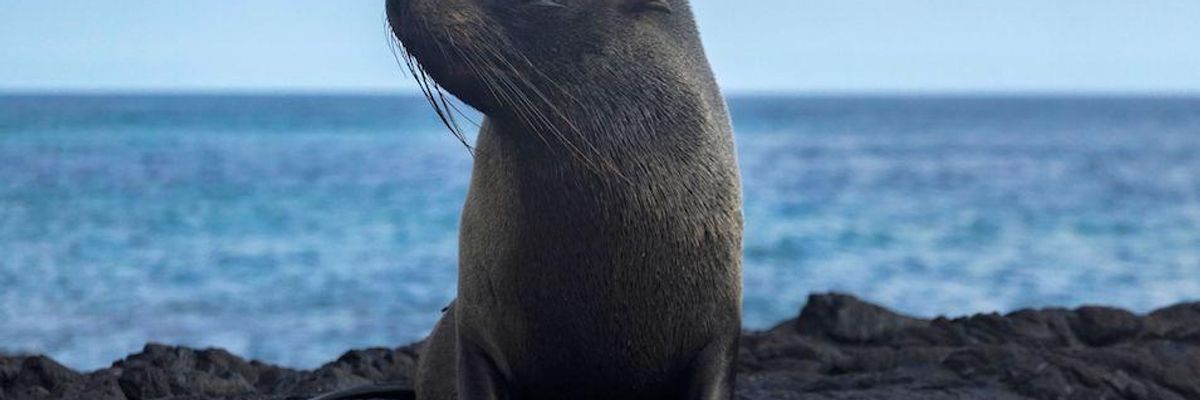
A Galapagos fur seal (Arctocephalus galapagoensis) at Isabela Island, Galapagos Archipelago, in the Pacific Ocean on February 21, 2019. The seal will share its environment with the Pentagon per a new plan from the Ecuadorian government that would extend a landing strip at the region's airport to accommodate U.S. military aircraft. (Photo: Rodrigo Buendia/AFP/Getty Images)
The Galapagos Islands archipelago in Ecuador is one of the most biodiverse regions in the entire world, home to a number of species found nowhere else on the planet, and a UNESCO World Heritage site.
So, naturally, the U.S. military wants to use one of its islands as an airstrip.
Ecuadorian defense minister Oswaldo Jarrin announced President Lenin Moreno's administration's decision to allow the Pentagon to expand an existing airfield on San Cristobal Island for U.S. spy planes targeting drug traffickers in comments to Telesur on June 12. The airport is at the southwest end of the island in the city of Puerto Baquerizo Moreno.
According to The Independent, "a U.S. air force Boeing 707 plane carrying radar surveillance and a Lockheed P-3 Orion plane will patrol the Pacific Ocean, using the Galapagos as a launching off point."
The Ecuadorian National Assembly isn't sold on the proposal. In a vote on June 13, El Universo reported, 106 of the assembly's 137 members cleared the way for calling on Jarrin and environmental minister Marcelo Mata to appear before the chamber's Commission of Sovereignty and International Relations.
Carlos Viteri, an assembly member from the southern region of Sarayacu, Pastaza, and a member of the Revolucion Ciudadana party, said that allowing the U.S. to operate off of the airstrip was "vassalage."
"What is being proposed by the government through the Ministry of Defense is unacceptable," Viteri told El Universo, "and the fact that it intends to cede an inch of Ecuadorian territory should be prohibited."
In his remarks, Jarrin said that the Galapagos Islands are a "natural aircraft carrier because it ensures permanence, replenishment, interception facilities, and is 1,000 kilometers from our coasts."
That aircraft carrier could have an extended landing strip built on it to accommodate U.S. planes. Jarrin said that the Pentagon would pay for any needed "readjustments" to the airfield, raising concerns that Galapagos will be used as a permanent base for the U.S. military--a violation of Ecuador's constitution, which says in Article Five that "the establishment of foreign military bases or foreign installations for military purposes will not be allowed. In addition, it is prohibited to cede national military bases to foreign armed or security forces."
"A base means permanence, there will be no permanence," said Jarrin.
That line of reasoning was dismissed by journalist Ben Norton, who called the decision "another sign of Ecuadorian President Moreno's total capitulation to neocolonialism."
Moreno, a right-wing politician, won election in 2017 on a center-left platform but quickly shifted gears away from his predecessor Rafael Correa's policies--including allowing WikiLeaks founder Julian Assange to claim asylum in the Ecuadorian embassy in London--and to the right.
In a tweet, Correa weighed in on the controversy, calling Jarrin a man with a "vassal soul."
"Galapagos is NOT an 'aircraft carrier' for gringo use," tweeted Correa. "It is an Ecuadorian province, patrimony of the humanity, patriotic ground."
In a tweet, University of London professor Laleh Khalili tweaked a Joni Mitchell lyric to describe the decision.
"They paved paradise and put up a landing strip," said Khalili.
This country and this world are at a monumental crossroads. US voters have an opportunity to beat back the forces of fascism and confront the billionaires who are rigging the economy, our media system, and our democracy, making it increasingly impossible for ordinary people to get by. We’re not just talking about the election. We’re talking about what must be done once these fascist elements are vanquished from power. We need a bolder set of solutions than what either major party has so far been willing to offer and a working-class movement ready to fight like hell for it. Trump didn't emerge from nowhere. The conditions that fueled MAGA authoritarianism were created by decades of radical neoliberal economic policies and a corrupt political system dominated by corporate interests. They slashed taxes on the super-rich, promising that the benefits would trickle down. They said giveaways to the corporate titans would make life more affordable for the rest of us. It was all bullshit. And when a bitter, betrayed populace searches for someone to blame, right-wing demagogues have little trouble finding scapegoats. People know when they're being lied to, but you won't hear any of this from the corporate media. Only independent journalism—powered and funded by people who believe in building a better world—can deliver truly trustworthy daily news. If you share our vision, please contribute whatever you can to sustain our work. |
The Galapagos Islands archipelago in Ecuador is one of the most biodiverse regions in the entire world, home to a number of species found nowhere else on the planet, and a UNESCO World Heritage site.
So, naturally, the U.S. military wants to use one of its islands as an airstrip.
Ecuadorian defense minister Oswaldo Jarrin announced President Lenin Moreno's administration's decision to allow the Pentagon to expand an existing airfield on San Cristobal Island for U.S. spy planes targeting drug traffickers in comments to Telesur on June 12. The airport is at the southwest end of the island in the city of Puerto Baquerizo Moreno.
According to The Independent, "a U.S. air force Boeing 707 plane carrying radar surveillance and a Lockheed P-3 Orion plane will patrol the Pacific Ocean, using the Galapagos as a launching off point."
The Ecuadorian National Assembly isn't sold on the proposal. In a vote on June 13, El Universo reported, 106 of the assembly's 137 members cleared the way for calling on Jarrin and environmental minister Marcelo Mata to appear before the chamber's Commission of Sovereignty and International Relations.
Carlos Viteri, an assembly member from the southern region of Sarayacu, Pastaza, and a member of the Revolucion Ciudadana party, said that allowing the U.S. to operate off of the airstrip was "vassalage."
"What is being proposed by the government through the Ministry of Defense is unacceptable," Viteri told El Universo, "and the fact that it intends to cede an inch of Ecuadorian territory should be prohibited."
In his remarks, Jarrin said that the Galapagos Islands are a "natural aircraft carrier because it ensures permanence, replenishment, interception facilities, and is 1,000 kilometers from our coasts."
That aircraft carrier could have an extended landing strip built on it to accommodate U.S. planes. Jarrin said that the Pentagon would pay for any needed "readjustments" to the airfield, raising concerns that Galapagos will be used as a permanent base for the U.S. military--a violation of Ecuador's constitution, which says in Article Five that "the establishment of foreign military bases or foreign installations for military purposes will not be allowed. In addition, it is prohibited to cede national military bases to foreign armed or security forces."
"A base means permanence, there will be no permanence," said Jarrin.
That line of reasoning was dismissed by journalist Ben Norton, who called the decision "another sign of Ecuadorian President Moreno's total capitulation to neocolonialism."
Moreno, a right-wing politician, won election in 2017 on a center-left platform but quickly shifted gears away from his predecessor Rafael Correa's policies--including allowing WikiLeaks founder Julian Assange to claim asylum in the Ecuadorian embassy in London--and to the right.
In a tweet, Correa weighed in on the controversy, calling Jarrin a man with a "vassal soul."
"Galapagos is NOT an 'aircraft carrier' for gringo use," tweeted Correa. "It is an Ecuadorian province, patrimony of the humanity, patriotic ground."
In a tweet, University of London professor Laleh Khalili tweaked a Joni Mitchell lyric to describe the decision.
"They paved paradise and put up a landing strip," said Khalili.

