SUBSCRIBE TO OUR FREE NEWSLETTER
Daily news & progressive opinion—funded by the people, not the corporations—delivered straight to your inbox.
5
#000000
#FFFFFF
To donate by check, phone, or other method, see our More Ways to Give page.
Daily news & progressive opinion—funded by the people, not the corporations—delivered straight to your inbox.
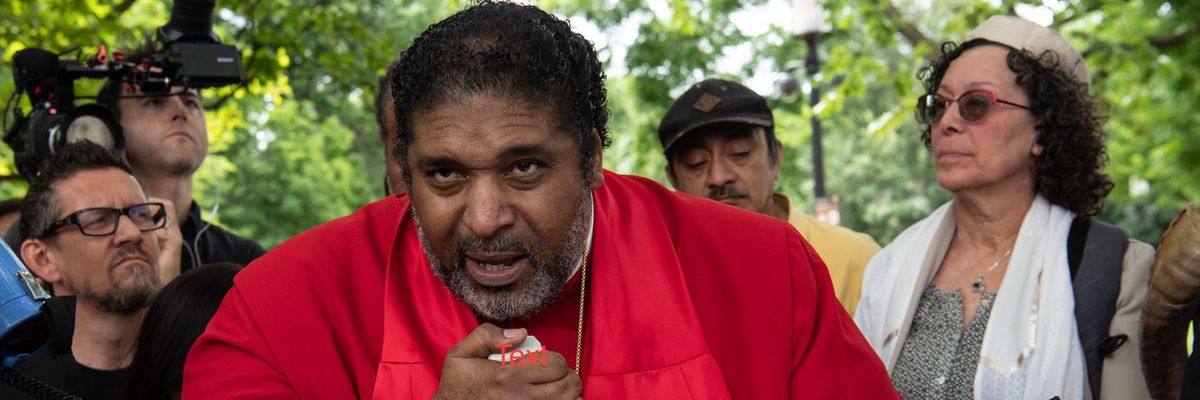
Rev. William Barber, president of Repairers of the Breach, speaks during the Repairers of the Breach for a Moral Witness Wednesday rally in Washington, D.C, on June 12, 2019. (Photo: Nicholas Kamm/AFP/Getty )Images)
The heads of the Poor People's Campaign reiterated their call for a moral budget on Wednesday as they testified before a Congressional hearing and decried the "moral crisis" of poverty in the U.S.
The goal of the testimony before the House Budget Committee, said Rev. Dr. William Barber, co-chair of the social justice organization, in a tweet, was "not to lobby Congress, but to reveal the faces behind the facts of poverty."
"It is time for Americans to find out the truth about poverty for all Americans," said Barber. There are 140 million poor and low-wealth Americans, said Barber, adding that the extreme wealth gap in the country is a "direct result of policy decisions" that are "supported by well-funded myths."
"The truth is," said Barber, "we must take a collective responsibility for the inequality, the unjust laws, and systems created."
He said there are "systemic realities that connect systemic racism, systemic poverty, ecological devastation, the war economy, and the false moral narratives that suggest that somehow you can ignore poverty."
"We do not need more tax cuts for the rich," added Barber. "We must end this systemic policy violence against poor and low-wealth people."
Taking action on poverty, said Barber, "is the moral mandate for our nation at this moment. Nothing less than he promise of our democracy is at stake."
Failing to do so, he said, "is constitutionally inconsistent, it is economically insane, and it is morally, morally, morally wrong."
As for the blueprint for action, the Poor People's Campaign laid that out earlier this week with a report released with the Institute for Policy Studies.
It lays out a number of proposals to address "interlocking injustices," including expanding and strengthening access to the ballot, boosting the minimum wage, and expanding Medicaid.
Enacting these changes should not be seen as costly, stressed Rev. Dr. Liz Theoharis, fellow co-chair of the Poor People's Campaign.
"The benefits of our agenda by far outweigh the costs; in fact, it is the cost of continuing immoral policies and misguided priorities that we cannot afford," she said in her prepared testimony.
"You on this committee know that talk is cheap; ultimately it is our deeds that matter and come with a cost," said Theoharis. "Budgets reflect our deepest values and priorities. And we are here to say that our nation's budget as it now stands reflects the values of the rich, large corporations, and military contractors at the expense of the poor," she continued.
"We are here to say we need a moral revolution of values," Theoharis said, "that instead places the needs and demands of the poor and the planet at the heart of our budget."
Among the lawmakers taking part in the hearing was Rep. Pramila Jayapal (D-Wash.), who agreed with the Poor People's Campaign in its assessment that "poverty is a willful act of policy violence."
The testimony, which capped off the group's three-day Poor People's Moral Action Congress, came the same day they announced a "People's Mass Assembly" and march on Washington, D.C. for June 20, 2020.
"We're going to spend a year organizing, mobilizing, & educating in all our states," said the group, and "then we're going to return to D.C. to demand an end to the war on the poor!
This country and this world are at a monumental crossroads. US voters have an opportunity to beat back the forces of fascism and confront the billionaires who are rigging the economy, our media system, and our democracy, making it increasingly impossible for ordinary people to get by. We’re not just talking about the election. We’re talking about what must be done once these fascist elements are vanquished from power. We need a bolder set of solutions than what either major party has so far been willing to offer and a working-class movement ready to fight like hell for it. Trump didn't emerge from nowhere. The conditions that fueled MAGA authoritarianism were created by decades of radical neoliberal economic policies and a corrupt political system dominated by corporate interests. They slashed taxes on the super-rich, promising that the benefits would trickle down. They said giveaways to the corporate titans would make life more affordable for the rest of us. It was all bullshit. And when a bitter, betrayed populace searches for someone to blame, right-wing demagogues have little trouble finding scapegoats. People know when they're being lied to, but you won't hear any of this from the corporate media. Only independent journalism—powered and funded by people who believe in building a better world—can deliver truly trustworthy daily news. If you share our vision, please contribute whatever you can to sustain our work. |
The heads of the Poor People's Campaign reiterated their call for a moral budget on Wednesday as they testified before a Congressional hearing and decried the "moral crisis" of poverty in the U.S.
The goal of the testimony before the House Budget Committee, said Rev. Dr. William Barber, co-chair of the social justice organization, in a tweet, was "not to lobby Congress, but to reveal the faces behind the facts of poverty."
"It is time for Americans to find out the truth about poverty for all Americans," said Barber. There are 140 million poor and low-wealth Americans, said Barber, adding that the extreme wealth gap in the country is a "direct result of policy decisions" that are "supported by well-funded myths."
"The truth is," said Barber, "we must take a collective responsibility for the inequality, the unjust laws, and systems created."
He said there are "systemic realities that connect systemic racism, systemic poverty, ecological devastation, the war economy, and the false moral narratives that suggest that somehow you can ignore poverty."
"We do not need more tax cuts for the rich," added Barber. "We must end this systemic policy violence against poor and low-wealth people."
Taking action on poverty, said Barber, "is the moral mandate for our nation at this moment. Nothing less than he promise of our democracy is at stake."
Failing to do so, he said, "is constitutionally inconsistent, it is economically insane, and it is morally, morally, morally wrong."
As for the blueprint for action, the Poor People's Campaign laid that out earlier this week with a report released with the Institute for Policy Studies.
It lays out a number of proposals to address "interlocking injustices," including expanding and strengthening access to the ballot, boosting the minimum wage, and expanding Medicaid.
Enacting these changes should not be seen as costly, stressed Rev. Dr. Liz Theoharis, fellow co-chair of the Poor People's Campaign.
"The benefits of our agenda by far outweigh the costs; in fact, it is the cost of continuing immoral policies and misguided priorities that we cannot afford," she said in her prepared testimony.
"You on this committee know that talk is cheap; ultimately it is our deeds that matter and come with a cost," said Theoharis. "Budgets reflect our deepest values and priorities. And we are here to say that our nation's budget as it now stands reflects the values of the rich, large corporations, and military contractors at the expense of the poor," she continued.
"We are here to say we need a moral revolution of values," Theoharis said, "that instead places the needs and demands of the poor and the planet at the heart of our budget."
Among the lawmakers taking part in the hearing was Rep. Pramila Jayapal (D-Wash.), who agreed with the Poor People's Campaign in its assessment that "poverty is a willful act of policy violence."
The testimony, which capped off the group's three-day Poor People's Moral Action Congress, came the same day they announced a "People's Mass Assembly" and march on Washington, D.C. for June 20, 2020.
"We're going to spend a year organizing, mobilizing, & educating in all our states," said the group, and "then we're going to return to D.C. to demand an end to the war on the poor!