SUBSCRIBE TO OUR FREE NEWSLETTER
Daily news & progressive opinion—funded by the people, not the corporations—delivered straight to your inbox.
5
#000000
#FFFFFF
To donate by check, phone, or other method, see our More Ways to Give page.
Daily news & progressive opinion—funded by the people, not the corporations—delivered straight to your inbox.
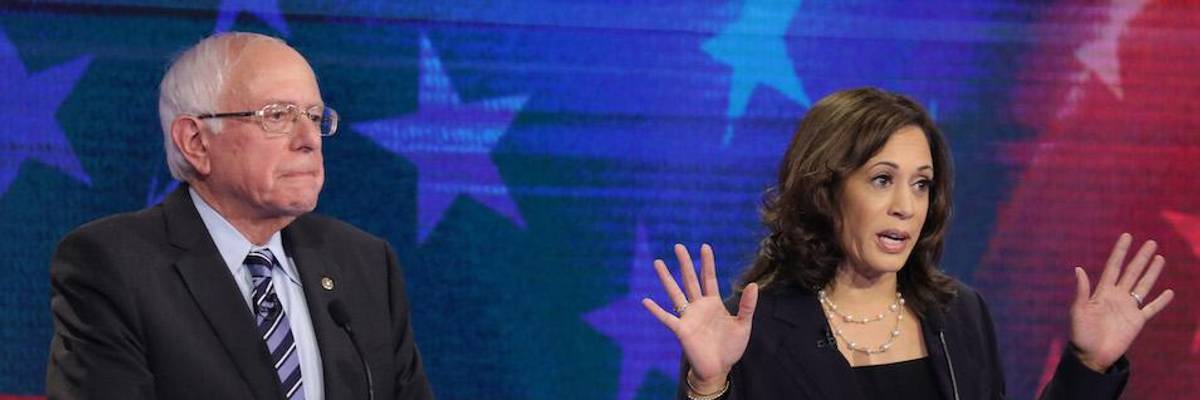
Democratic presidential candidates Sen. Bernie Sanders (I-Vt.) and Sen. Kamala Harris (D-Calif.) take part in the second night of the first Democratic presidential debate on June 27, 2019 in Miami, Florida. (Photo: Drew Angerer/Getty Images)
It wasn't quite a "blink and you'll miss it" moment, but it was close: Democrats in the second of the first primary debates on Thursday only spent eight minutes of the 120-minute debate on the climate crisis, an indication to many progressive groups and commentators that the planetary catastrophe just isn't a major priority for the party.
"This is not how you behave in an emergency," Greenpeace U.S.A. climate campaign director Janet Redman said in a statement.
"Despite the candidates' acknowledgement of the existential threat that climate change represents to humanity, we heard next to nothing over two days about how they would actually address this monumental challenge," Redman said. "Talking points and soundbites do not cut it anymore."
The Miami debate, which aired on MSNBC Thursday night, featured candidates referring to the crisis in response to questions from moderators Chuck Todd and Rachel Maddow about halfway through the second hour.
But, as The Guardian's Emily Holden pointed out in her analysis of the contest, while the candidates "accurately conveyed the rapidly approaching deadlines scientists have said the world faces in limiting the most dangerous effects of the crisis," the 10 Democrats "missed multiple opportunities to discuss how rising temperatures play into other hot button political issues."
The issue, wrote Holder, is that "the discussion largely pigeonholed the climate crisis as a single issue and an environmental problem."
Other advocates agreed.
"Not one of the candidates vying for the highest office emerged as the climate champion we need during tonight's Democratic debate," 350 Action director Tamara Toles O'Laughlin said. "Question after question, the debate failed to make connections between climate and health, jobs, energy choice, investments, and the total disaster that is the status quo on immigration."
O'Laughlin called for a climate-focused debate, a proposal that was rejected by DNC chair Tom Perez. As Common Dreams reported on June 10, that stance has driven criticism from the party's grassroots, including the youth-led Sunrise Movement.
In a statement Friday, Sunrise executive director Varshini Prakash decried the lack of discussion of climate crisis in both Thursday and Wednesday's debates, calling the topic's absence "the clearest evidence we have that we need a climate-specific debate."
"Before these debates, the Democratic National Committee could say that this year would be different and there would be a meaningful debate on climate change," said Prakash. "As of last night, they can no longer credibly do that."
David Turnbull, strategic communications director for Oil Change U.S., in a statement criticized the debate format and called for a climate-centric debate.
"The climate questions asked were far too simplistic, and missed the chance to challenge candidates to demonstrate how committed they are to tackling the climate crisis, and what their plans are to take on the fossil fuel industry," said Turnbull.
"The only thing we learned about the climate crisis this week was that we need a DNC-sanctioned climate debate," Turnbull said, "moderated by journalists who understand the issue."
This country and this world are at a monumental crossroads. US voters have an opportunity to beat back the forces of fascism and confront the billionaires who are rigging the economy, our media system, and our democracy, making it increasingly impossible for ordinary people to get by. We’re not just talking about the election. We’re talking about what must be done once these fascist elements are vanquished from power. We need a bolder set of solutions than what either major party has so far been willing to offer and a working-class movement ready to fight like hell for it. Trump didn't emerge from nowhere. The conditions that fueled MAGA authoritarianism were created by decades of radical neoliberal economic policies and a corrupt political system dominated by corporate interests. They slashed taxes on the super-rich, promising that the benefits would trickle down. They said giveaways to the corporate titans would make life more affordable for the rest of us. It was all bullshit. And when a bitter, betrayed populace searches for someone to blame, right-wing demagogues have little trouble finding scapegoats. People know when they're being lied to, but you won't hear any of this from the corporate media. Only independent journalism—powered and funded by people who believe in building a better world—can deliver truly trustworthy daily news. If you share our vision, please contribute whatever you can to sustain our work. |
It wasn't quite a "blink and you'll miss it" moment, but it was close: Democrats in the second of the first primary debates on Thursday only spent eight minutes of the 120-minute debate on the climate crisis, an indication to many progressive groups and commentators that the planetary catastrophe just isn't a major priority for the party.
"This is not how you behave in an emergency," Greenpeace U.S.A. climate campaign director Janet Redman said in a statement.
"Despite the candidates' acknowledgement of the existential threat that climate change represents to humanity, we heard next to nothing over two days about how they would actually address this monumental challenge," Redman said. "Talking points and soundbites do not cut it anymore."
The Miami debate, which aired on MSNBC Thursday night, featured candidates referring to the crisis in response to questions from moderators Chuck Todd and Rachel Maddow about halfway through the second hour.
But, as The Guardian's Emily Holden pointed out in her analysis of the contest, while the candidates "accurately conveyed the rapidly approaching deadlines scientists have said the world faces in limiting the most dangerous effects of the crisis," the 10 Democrats "missed multiple opportunities to discuss how rising temperatures play into other hot button political issues."
The issue, wrote Holder, is that "the discussion largely pigeonholed the climate crisis as a single issue and an environmental problem."
Other advocates agreed.
"Not one of the candidates vying for the highest office emerged as the climate champion we need during tonight's Democratic debate," 350 Action director Tamara Toles O'Laughlin said. "Question after question, the debate failed to make connections between climate and health, jobs, energy choice, investments, and the total disaster that is the status quo on immigration."
O'Laughlin called for a climate-focused debate, a proposal that was rejected by DNC chair Tom Perez. As Common Dreams reported on June 10, that stance has driven criticism from the party's grassroots, including the youth-led Sunrise Movement.
In a statement Friday, Sunrise executive director Varshini Prakash decried the lack of discussion of climate crisis in both Thursday and Wednesday's debates, calling the topic's absence "the clearest evidence we have that we need a climate-specific debate."
"Before these debates, the Democratic National Committee could say that this year would be different and there would be a meaningful debate on climate change," said Prakash. "As of last night, they can no longer credibly do that."
David Turnbull, strategic communications director for Oil Change U.S., in a statement criticized the debate format and called for a climate-centric debate.
"The climate questions asked were far too simplistic, and missed the chance to challenge candidates to demonstrate how committed they are to tackling the climate crisis, and what their plans are to take on the fossil fuel industry," said Turnbull.
"The only thing we learned about the climate crisis this week was that we need a DNC-sanctioned climate debate," Turnbull said, "moderated by journalists who understand the issue."