SUBSCRIBE TO OUR FREE NEWSLETTER
Daily news & progressive opinion—funded by the people, not the corporations—delivered straight to your inbox.
5
#000000
#FFFFFF
To donate by check, phone, or other method, see our More Ways to Give page.


Daily news & progressive opinion—funded by the people, not the corporations—delivered straight to your inbox.

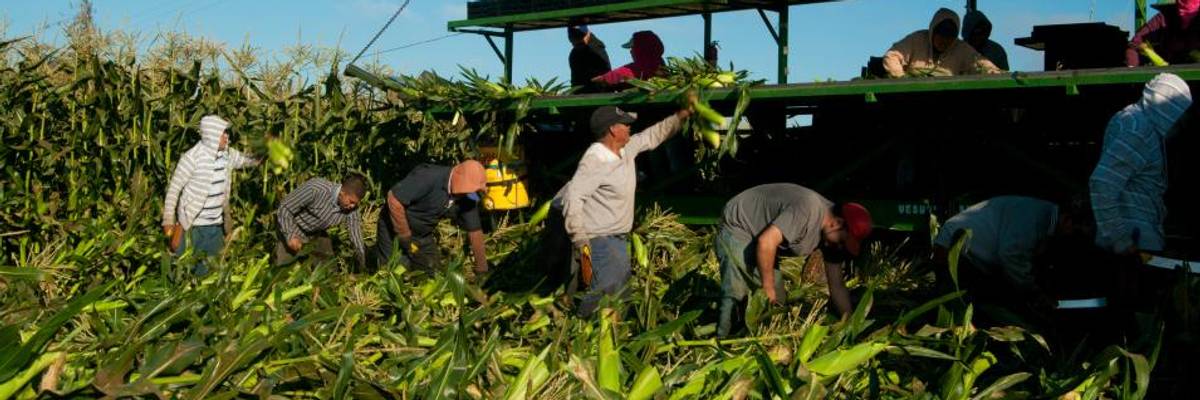
Migrant workers harvest corn on Uesugi Farms in Gilroy, California on Aug. 28, 2013. (Photo: Bob Nichols/USDA/Flickr/cc)
A new United Nations analysis warns that by 2030, labor impacts of rising temperatures and extreme weather tied to the human-caused climate crisis are projected to cost the global economy $2.4 trillion and exacerbate inequality worldwide.
The report, entitled Working on a Warmer Planet: The Impact of Heat Stress on Labor Productivity and Decent Work (pdf), was published Monday by the Geneva-based International Labor Organization (ILO).
"Heat stress refers to heat received in excess of that which the body can tolerate without suffering physiological impairment," the report explains. "Such excess heat increases workers' occupational risks and vulnerability; it can lead to heatstroke and, ultimately, even to death."
In what the report frames as a "conservative estimate," researchers found that "projections based on a global temperature rise of 1.5degC by the end of the twenty-first century, and also on labor force trends, suggest that, in 2030, 2.2 percent of total working hours worldwide will be lost to high temperatures--a productivity loss equivalent to 80 million full-time jobs."
The anticipated economic losses, the report notes, are expected to disproportionately impact certain sectors and regions--particularly Southern Asia and Western Africa.
Workers in all sectors are affected, but certain occupations are especially at risk because they involve more physical effort and/or take place outdoors. Such jobs are typically found in agriculture, environmental goods and services (natural resource management), construction, refuse collection, emergency repair work, transport, tourism, and sports. Industrial workers in indoor settings are also at risk if temperature levels inside factories and workshops are not regulated properly...
On the whole, the countries that are most affected by heat stress have higher rates of working poverty, informal employment, and subsistence agriculture. In addition, disadvantaged and vulnerable population groups and communities--including indigenous and tribal peoples who are dependent on agricultural or coastal livelihoods--are at greater risk of suffering the adverse consequences of rising temperatures.
Given how many women around the world are employed in subsistence agriculture, the report also points out that heat stress could widen existing gender gaps in the global workforce.
"The impact of heat stress on labor productivity is a serious consequence of climate change, which adds to other adverse impacts such as changing rain patterns, raising sea levels, and loss of biodiversity," Catherine Saget, report co-author and chief of unit in the ILO's research department, said in a statement. "To adapt to this new reality, appropriate measures by governments, employers, and workers, focusing on protecting the most vulnerable, are urgently needed."
Alongside the warnings about the projected consequences of heat stress globally, the report calls for global cooperation in pursuit of adaptation and mitigation. It also highlights some potential solutions.
The long-term options for reducing the impact of heat stress on agriculture include promoting mechanization and skills development in order to ensure higher productivity and food security. Measures for monitoring and raising awareness of local weather conditions, such as those currently being applied in Kenya, can help rural households to adapt to heat stress conditions.
As for the construction sector, smart urban planning could help significantly to mitigate heat stress on construction sites in large cities in the medium and long term. Moreover, specific measures for the monitoring of on-site weather conditions, enhanced information sharing and communication, and technological improvements can enable construction workers and their employers to adapt more effectively to heat stress.
The loss of jobs and productivity is just one result of changes in the global climate--from rising temperatures to more frequent and intense extreme weather events like heat waves--driven by human behavior, particularly the continued use of fossil fuels.
The ILO report was released as India experiences record temperatures and the city of Chennai--whose metropolitan area has a population of 9 million people--suffers a severe water crisis.
It also comes as a new rapid analysis from European researchers determined that anthropogenic climate change made the heat wave which struck the continent last month at least five times more likely.
University of Oxford's Friederike Otto, who contributed to World Weather Attribution's heat wave analysis, told New Scientist that "this is a strong reminder again, that climate change is happening here and now."

Dear Common Dreams reader, It’s been nearly 30 years since I co-founded Common Dreams with my late wife, Lina Newhouser. We had the radical notion that journalism should serve the public good, not corporate profits. It was clear to us from the outset what it would take to build such a project. No paid advertisements. No corporate sponsors. No millionaire publisher telling us what to think or do. Many people said we wouldn't last a year, but we proved those doubters wrong. Together with a tremendous team of journalists and dedicated staff, we built an independent media outlet free from the constraints of profits and corporate control. Our mission has always been simple: To inform. To inspire. To ignite change for the common good. Building Common Dreams was not easy. Our survival was never guaranteed. When you take on the most powerful forces—Wall Street greed, fossil fuel industry destruction, Big Tech lobbyists, and uber-rich oligarchs who have spent billions upon billions rigging the economy and democracy in their favor—the only bulwark you have is supporters who believe in your work. But here’s the urgent message from me today. It's never been this bad out there. And it's never been this hard to keep us going. At the very moment Common Dreams is most needed, the threats we face are intensifying. We need your support now more than ever. We don't accept corporate advertising and never will. We don't have a paywall because we don't think people should be blocked from critical news based on their ability to pay. Everything we do is funded by the donations of readers like you. When everyone does the little they can afford, we are strong. But if that support retreats or dries up, so do we. Will you donate now to make sure Common Dreams not only survives but thrives? —Craig Brown, Co-founder |
A new United Nations analysis warns that by 2030, labor impacts of rising temperatures and extreme weather tied to the human-caused climate crisis are projected to cost the global economy $2.4 trillion and exacerbate inequality worldwide.
The report, entitled Working on a Warmer Planet: The Impact of Heat Stress on Labor Productivity and Decent Work (pdf), was published Monday by the Geneva-based International Labor Organization (ILO).
"Heat stress refers to heat received in excess of that which the body can tolerate without suffering physiological impairment," the report explains. "Such excess heat increases workers' occupational risks and vulnerability; it can lead to heatstroke and, ultimately, even to death."
In what the report frames as a "conservative estimate," researchers found that "projections based on a global temperature rise of 1.5degC by the end of the twenty-first century, and also on labor force trends, suggest that, in 2030, 2.2 percent of total working hours worldwide will be lost to high temperatures--a productivity loss equivalent to 80 million full-time jobs."
The anticipated economic losses, the report notes, are expected to disproportionately impact certain sectors and regions--particularly Southern Asia and Western Africa.
Workers in all sectors are affected, but certain occupations are especially at risk because they involve more physical effort and/or take place outdoors. Such jobs are typically found in agriculture, environmental goods and services (natural resource management), construction, refuse collection, emergency repair work, transport, tourism, and sports. Industrial workers in indoor settings are also at risk if temperature levels inside factories and workshops are not regulated properly...
On the whole, the countries that are most affected by heat stress have higher rates of working poverty, informal employment, and subsistence agriculture. In addition, disadvantaged and vulnerable population groups and communities--including indigenous and tribal peoples who are dependent on agricultural or coastal livelihoods--are at greater risk of suffering the adverse consequences of rising temperatures.
Given how many women around the world are employed in subsistence agriculture, the report also points out that heat stress could widen existing gender gaps in the global workforce.
"The impact of heat stress on labor productivity is a serious consequence of climate change, which adds to other adverse impacts such as changing rain patterns, raising sea levels, and loss of biodiversity," Catherine Saget, report co-author and chief of unit in the ILO's research department, said in a statement. "To adapt to this new reality, appropriate measures by governments, employers, and workers, focusing on protecting the most vulnerable, are urgently needed."
Alongside the warnings about the projected consequences of heat stress globally, the report calls for global cooperation in pursuit of adaptation and mitigation. It also highlights some potential solutions.
The long-term options for reducing the impact of heat stress on agriculture include promoting mechanization and skills development in order to ensure higher productivity and food security. Measures for monitoring and raising awareness of local weather conditions, such as those currently being applied in Kenya, can help rural households to adapt to heat stress conditions.
As for the construction sector, smart urban planning could help significantly to mitigate heat stress on construction sites in large cities in the medium and long term. Moreover, specific measures for the monitoring of on-site weather conditions, enhanced information sharing and communication, and technological improvements can enable construction workers and their employers to adapt more effectively to heat stress.
The loss of jobs and productivity is just one result of changes in the global climate--from rising temperatures to more frequent and intense extreme weather events like heat waves--driven by human behavior, particularly the continued use of fossil fuels.
The ILO report was released as India experiences record temperatures and the city of Chennai--whose metropolitan area has a population of 9 million people--suffers a severe water crisis.
It also comes as a new rapid analysis from European researchers determined that anthropogenic climate change made the heat wave which struck the continent last month at least five times more likely.
University of Oxford's Friederike Otto, who contributed to World Weather Attribution's heat wave analysis, told New Scientist that "this is a strong reminder again, that climate change is happening here and now."

A new United Nations analysis warns that by 2030, labor impacts of rising temperatures and extreme weather tied to the human-caused climate crisis are projected to cost the global economy $2.4 trillion and exacerbate inequality worldwide.
The report, entitled Working on a Warmer Planet: The Impact of Heat Stress on Labor Productivity and Decent Work (pdf), was published Monday by the Geneva-based International Labor Organization (ILO).
"Heat stress refers to heat received in excess of that which the body can tolerate without suffering physiological impairment," the report explains. "Such excess heat increases workers' occupational risks and vulnerability; it can lead to heatstroke and, ultimately, even to death."
In what the report frames as a "conservative estimate," researchers found that "projections based on a global temperature rise of 1.5degC by the end of the twenty-first century, and also on labor force trends, suggest that, in 2030, 2.2 percent of total working hours worldwide will be lost to high temperatures--a productivity loss equivalent to 80 million full-time jobs."
The anticipated economic losses, the report notes, are expected to disproportionately impact certain sectors and regions--particularly Southern Asia and Western Africa.
Workers in all sectors are affected, but certain occupations are especially at risk because they involve more physical effort and/or take place outdoors. Such jobs are typically found in agriculture, environmental goods and services (natural resource management), construction, refuse collection, emergency repair work, transport, tourism, and sports. Industrial workers in indoor settings are also at risk if temperature levels inside factories and workshops are not regulated properly...
On the whole, the countries that are most affected by heat stress have higher rates of working poverty, informal employment, and subsistence agriculture. In addition, disadvantaged and vulnerable population groups and communities--including indigenous and tribal peoples who are dependent on agricultural or coastal livelihoods--are at greater risk of suffering the adverse consequences of rising temperatures.
Given how many women around the world are employed in subsistence agriculture, the report also points out that heat stress could widen existing gender gaps in the global workforce.
"The impact of heat stress on labor productivity is a serious consequence of climate change, which adds to other adverse impacts such as changing rain patterns, raising sea levels, and loss of biodiversity," Catherine Saget, report co-author and chief of unit in the ILO's research department, said in a statement. "To adapt to this new reality, appropriate measures by governments, employers, and workers, focusing on protecting the most vulnerable, are urgently needed."
Alongside the warnings about the projected consequences of heat stress globally, the report calls for global cooperation in pursuit of adaptation and mitigation. It also highlights some potential solutions.
The long-term options for reducing the impact of heat stress on agriculture include promoting mechanization and skills development in order to ensure higher productivity and food security. Measures for monitoring and raising awareness of local weather conditions, such as those currently being applied in Kenya, can help rural households to adapt to heat stress conditions.
As for the construction sector, smart urban planning could help significantly to mitigate heat stress on construction sites in large cities in the medium and long term. Moreover, specific measures for the monitoring of on-site weather conditions, enhanced information sharing and communication, and technological improvements can enable construction workers and their employers to adapt more effectively to heat stress.
The loss of jobs and productivity is just one result of changes in the global climate--from rising temperatures to more frequent and intense extreme weather events like heat waves--driven by human behavior, particularly the continued use of fossil fuels.
The ILO report was released as India experiences record temperatures and the city of Chennai--whose metropolitan area has a population of 9 million people--suffers a severe water crisis.
It also comes as a new rapid analysis from European researchers determined that anthropogenic climate change made the heat wave which struck the continent last month at least five times more likely.
University of Oxford's Friederike Otto, who contributed to World Weather Attribution's heat wave analysis, told New Scientist that "this is a strong reminder again, that climate change is happening here and now."