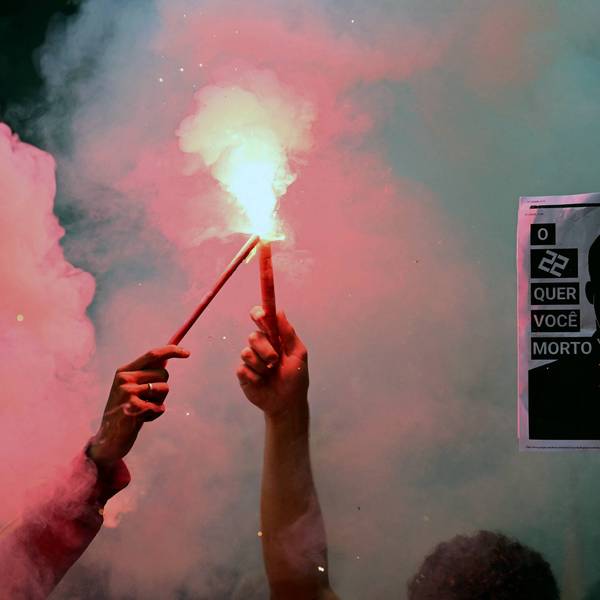

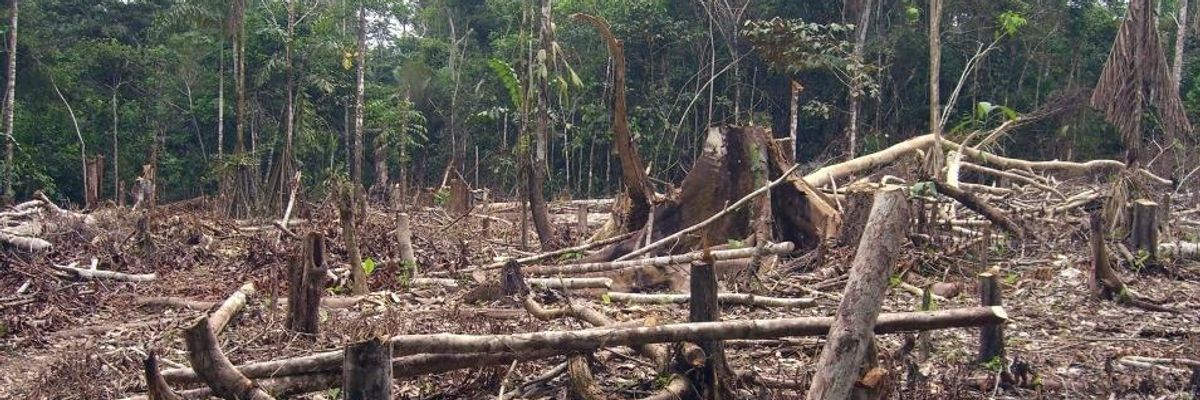
"The catastrophic loss of another fifth of Brazil's rainforest could happen within one generation. It's happened before. It's happening now." (Photo: Matt Zimmerman/flickr/cc)
As Brazil's Bolsonaro Wages War on the Amazon, Rainforest Communities Battle Climate Emergency
"We know what happens when the state does nothing. We know how quickly the forest can disappear."
The River Basin at the center of Latin America called the Amazon is roughly the size of Australia. Created at the beginning of the world by a smashing of tectonic plates, it was the cradle of inland seas and continental lakes. For the last several million years, it has been blanketed by a teeming tropical biome of 400 billion trees and vegetation so dense and heavy with water, it exhales a fifth of Earth's oxygen, stores centuries of carbon, and deflects and consumes an unknown but significant amount of solar heat. Twenty percent of the world's fresh water cycles through its rivers, plants, soils, and air. This moisture fuels and regulates multiple planet-scale systems, including the production of "rivers in the air" by evapotranspiration, a ceaseless churning flux in which the forest breathes its water into great hemispheric conveyor belts that carry it as far as the breadbaskets of Argentina and the American Midwest, where it is released as rain.
In the last half-century, about one-fifth of this forest, or some 300,000 square miles, has been cut and burned in Brazil, whose borders contain almost two-thirds of the Amazon basin. This is an area larger than Texas, the U.S. state that Brazil's denuded lands most resemble, with their post-forest landscapes of silent sunbaked pasture, bean fields, and evangelical churches. This epochal deforestation--matched by harder to quantify but similar levels of forest degradation and fragmentation--has caused measurable disruptions to regional climates and rainfall. It has set loose so much stored carbon that it has negated the forest's benefit as a carbon sink, the world's largest after the oceans. Scientists warn that losing another fifth of Brazil's rainforest will trigger the feedback loop known as dieback, in which the forest begins to dry out and burn in a cascading system collapse, beyond the reach of any subsequent human intervention or regret. This would release a doomsday bomb of stored carbon, disappear the cloud vapor that consumes the sun's radiation before it can be absorbed as heat, and shrivel the rivers in the basin and in the sky.
The catastrophic loss of another fifth of Brazil's rainforest could happen within one generation. It's happened before. It's happening now.
Mauro Toledo Rodrigues contributed reporting. Read the full article here.
We are at a crossroads
This country and this world are at a monumental crossroads. In a few short weeks, US voters will have an opportunity to beat back the forces of fascism and confront the billionaires who are rigging the economy, our media system, and our democracy, making it increasingly impossible for ordinary people to get by. We’re not just talking about the election. We’re talking about what must be done once these fascist elements are vanquished from power. We need a bolder set of solutions than what either major party has so far been willing to offer and a working-class movement ready to fight like hell for it. Trump didn't emerge from nowhere. The conditions that fueled MAGA authoritarianism were created by decades of radical neoliberal economic policies and a corrupt political system dominated by corporate interests. They slashed taxes on the super-rich, promising that the benefits would trickle down. They said giveaways to the corporate titans would make life more affordable for the rest of us. It was all bullshit. And when a bitter, betrayed populace searches for someone to blame, right-wing demagogues have little trouble finding scapegoats. People know when they're being lied to, but you won't hear any of this from the corporate media. Only independent journalism—powered and funded by people who believe in building a better world—can deliver truly trustworthy daily news. Our Fall Campaign is underway, and we need your help. To power our newsroom through the rest of the year, we need to raise $125,000 by midnight on October 31. So if you share our vision, please contribute whatever you can to sustain our work. |
The River Basin at the center of Latin America called the Amazon is roughly the size of Australia. Created at the beginning of the world by a smashing of tectonic plates, it was the cradle of inland seas and continental lakes. For the last several million years, it has been blanketed by a teeming tropical biome of 400 billion trees and vegetation so dense and heavy with water, it exhales a fifth of Earth's oxygen, stores centuries of carbon, and deflects and consumes an unknown but significant amount of solar heat. Twenty percent of the world's fresh water cycles through its rivers, plants, soils, and air. This moisture fuels and regulates multiple planet-scale systems, including the production of "rivers in the air" by evapotranspiration, a ceaseless churning flux in which the forest breathes its water into great hemispheric conveyor belts that carry it as far as the breadbaskets of Argentina and the American Midwest, where it is released as rain.
In the last half-century, about one-fifth of this forest, or some 300,000 square miles, has been cut and burned in Brazil, whose borders contain almost two-thirds of the Amazon basin. This is an area larger than Texas, the U.S. state that Brazil's denuded lands most resemble, with their post-forest landscapes of silent sunbaked pasture, bean fields, and evangelical churches. This epochal deforestation--matched by harder to quantify but similar levels of forest degradation and fragmentation--has caused measurable disruptions to regional climates and rainfall. It has set loose so much stored carbon that it has negated the forest's benefit as a carbon sink, the world's largest after the oceans. Scientists warn that losing another fifth of Brazil's rainforest will trigger the feedback loop known as dieback, in which the forest begins to dry out and burn in a cascading system collapse, beyond the reach of any subsequent human intervention or regret. This would release a doomsday bomb of stored carbon, disappear the cloud vapor that consumes the sun's radiation before it can be absorbed as heat, and shrivel the rivers in the basin and in the sky.
The catastrophic loss of another fifth of Brazil's rainforest could happen within one generation. It's happened before. It's happening now.
Mauro Toledo Rodrigues contributed reporting. Read the full article here.