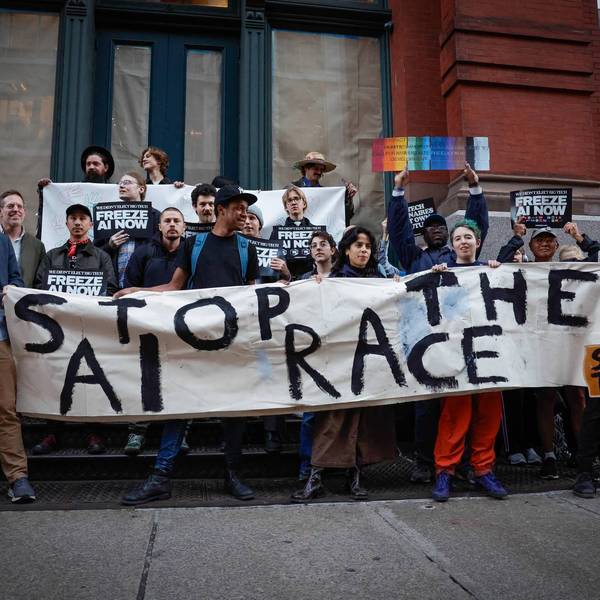

A protester is seen during a climate change demonstration holding a placard that says, 'There Is No Planet B.' (Photo by Ronen Tivony/SOPA Images/LightRocket via Getty Images)
'If Environment Were a Bank,' Says Bernie Sanders, 'It Would Have Been Saved Already'
Sanders has introduced a $16.3 trillion Green New Deal plan to avert climate catastrophe and create 20 million jobs in the process
The U.S. government took decisive action and spent trillions of dollars to bail out Wall Street banks in the midst of the 2008 financial crisis, but it has refused to do the same to rescue the planet from climate catastrophe--a fact Sen. Bernie Sanders highlighted in a pithy tweet on Friday.
"If the environment were a bank," wrote the 2020 Democratic presidential candidate, "it would have been saved already."
Estimates of the size of the Wall Street bailout vary widely. When Federal Reserve loans are included in the bailout figures, some estimates put the total number as high as $29 trillion.
Sanders' Green New Deal plan, which the senator released last week, would aim to invest $16.3 trillion in a decade-long effort to transition the U.S. economy to 100 percent renewable energy and create 20 million well-paying union jobs.
According to the Sanders campaign, the proposal would "pay for itself over 15 years" by hiking taxes on the rich and large corporations, slashing military spending, and boosting economic activity with massive public investment.
On top of the human costs of climate inaction, the economic toll would be "unacceptable," the Sanders campaign notes in its Green New Deal platform.
"Economists estimate that if we do not take action, we will lose $34.5 trillion in economic activity by the end of the century," the platform states. "And the benefits are enormous: by taking bold and decisive action, we will save $2.9 trillion over 10 years, $21 trillion over 30 years, and $70.4 trillion over 80 years."
We are at a crossroads
This country and this world are at a monumental crossroads. US voters have an opportunity to beat back the forces of fascism and confront the billionaires who are rigging the economy, our media system, and our democracy, making it increasingly impossible for ordinary people to get by. We’re not just talking about the election. We’re talking about what must be done once these fascist elements are vanquished from power. We need a bolder set of solutions than what either major party has so far been willing to offer and a working-class movement ready to fight like hell for it. Trump didn't emerge from nowhere. The conditions that fueled MAGA authoritarianism were created by decades of radical neoliberal economic policies and a corrupt political system dominated by corporate interests. They slashed taxes on the super-rich, promising that the benefits would trickle down. They said giveaways to the corporate titans would make life more affordable for the rest of us. It was all bullshit. And when a bitter, betrayed populace searches for someone to blame, right-wing demagogues have little trouble finding scapegoats. People know when they're being lied to, but you won't hear any of this from the corporate media. Only independent journalism—powered and funded by people who believe in building a better world—can deliver truly trustworthy daily news. Our Fall Campaign is underway, and we need your help. To power our newsroom through the rest of the year, we need to raise $125,000 by midnight on October 31. So if you share our vision, please contribute whatever you can to sustain our work. |
The U.S. government took decisive action and spent trillions of dollars to bail out Wall Street banks in the midst of the 2008 financial crisis, but it has refused to do the same to rescue the planet from climate catastrophe--a fact Sen. Bernie Sanders highlighted in a pithy tweet on Friday.
"If the environment were a bank," wrote the 2020 Democratic presidential candidate, "it would have been saved already."
Estimates of the size of the Wall Street bailout vary widely. When Federal Reserve loans are included in the bailout figures, some estimates put the total number as high as $29 trillion.
Sanders' Green New Deal plan, which the senator released last week, would aim to invest $16.3 trillion in a decade-long effort to transition the U.S. economy to 100 percent renewable energy and create 20 million well-paying union jobs.
According to the Sanders campaign, the proposal would "pay for itself over 15 years" by hiking taxes on the rich and large corporations, slashing military spending, and boosting economic activity with massive public investment.
On top of the human costs of climate inaction, the economic toll would be "unacceptable," the Sanders campaign notes in its Green New Deal platform.
"Economists estimate that if we do not take action, we will lose $34.5 trillion in economic activity by the end of the century," the platform states. "And the benefits are enormous: by taking bold and decisive action, we will save $2.9 trillion over 10 years, $21 trillion over 30 years, and $70.4 trillion over 80 years."