
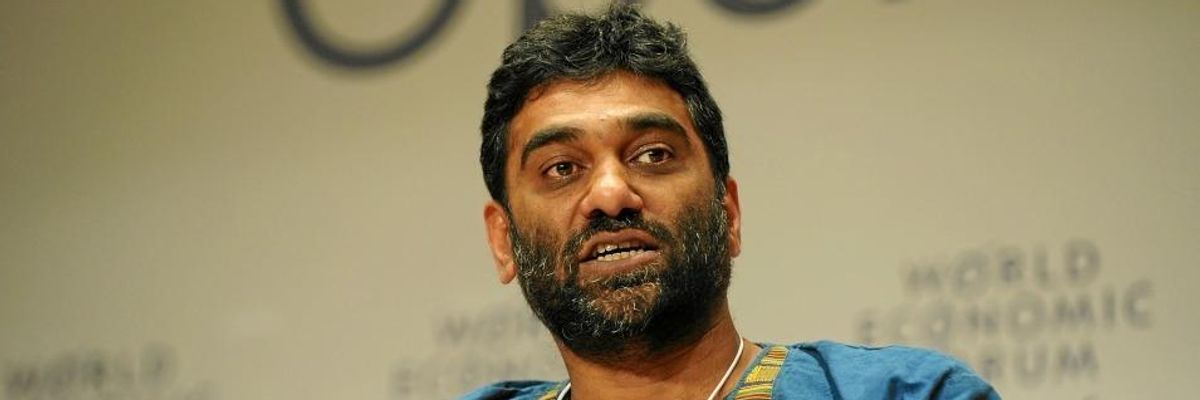
Kumi Naidoo, then-executive director of Greenpeace International, attended the World Economic Forum in 2013. (Photo: World Economic Forum/Flickr/cc)
Amnesty International Chief's Plea to 30,000+ Schools Worldwide: Let the Students Climate Strike!
"Children should not be punished for speaking out about the great injustices of our age."
In a personal plea sent to tens of thousands of schools around the world Wednesday, Amnesty International secretary general Kumi Naidoo called on educators and administrators to allow students to join global climate strikes later this month.
"The climate emergency is the defining human rights issue for this generation of children."
--Kumi Naidoo, Amnesty International
"I believe that the cause for which these children are fighting is of such historic significance that I am writing to you today with a request to neither prevent nor punish your pupils from taking part in the global days of strikes planned for September 20 and 27," wrote Naidoo, whose letter has been sent to school officials in Canada, Hungary, Spain, New Zealand, and the United Kingdom.
Inspired by the Fridays for Future school strikes that launched last year--for which students worldwide have taken to the streets to demand that governments pursue more ambitious climate policies--campaigners of all ages have registered thousands of events across the globe that coincide with an upcoming United Nations climate summit in New York City. The week of action will be bookended by the strikes Naidoo mentioned in his letter.
"The climate emergency is the defining human rights issue for this generation of children," wrote the leader of the world's largest human rights group. "Its consequences will shape their lives in almost every way imaginable. The failure of most governments to act in the face of overwhelming scientific evidence is arguably the biggest inter-generational human rights violation in history."
"By taking part in these protests, children are exercising their human rights to freedom of expression, peaceful assembly, and to have a say in decisions and matters that affect their lives," he continued. "In doing so, they are teaching us all a valuable lesson: the importance of coming together to campaign for a better future."
Naidoo has long history of campaigning for social justice issues. He became the head of Amnesty in December of 2017, after serving as executive director of the global environmental organization Greenpeace International. In his letter to schools, Naidoo recalled his experience being expelled at age 15 for organizing an anti-apartheid protest at his school in Durban, South Africa.
This setback redoubled my commitment to learning, and thankfully I was able to complete my studies and ultimately take up the role I have the honor of holding today. But I also had something that children of this generation do not have: the chance to imagine a future that is not overshadowed by the prospect of a climate emergency.
My experience also informed my strong belief that children should not be punished for speaking out about the great injustices of our age. In fact, when it has fallen on young people to show the leadership that many adults who hold great positions of power have failed to, it is not young people's behavior we should be questioning. It is ours.
Naidoo returned to his home country this week to attend Financing the Future, a historic divest-invest summit in Cape Town that began Tuesday--which came after Amnesty's Global Assembly voted last month to divest from the dirty energy industry.
"Every person facing deeper levels of drought, stronger hurricanes, or conflict has been wronged by these fossil fuel companies," Naidoo said Monday. "Their rights to health, water, food, housing, and even life have been harmed, which is why Amnesty International has decided to divest from fossil fuel companies."
Like the climate strikes, the global divestment movement began with young people. A report released Monday by 350.org and DivestInvest detailing divestment commitments worldwide noted that "what began as a moral call to action by students is now a mainstream financial response to growing climate risk to portfolios, the people, and the planet."
We are at a crossroads
This country and this world are at a monumental crossroads. US voters have an opportunity to beat back the forces of fascism and confront the billionaires who are rigging the economy, our media system, and our democracy, making it increasingly impossible for ordinary people to get by. We’re not just talking about the election. We’re talking about what must be done once these fascist elements are vanquished from power. We need a bolder set of solutions than what either major party has so far been willing to offer and a working-class movement ready to fight like hell for it. Trump didn't emerge from nowhere. The conditions that fueled MAGA authoritarianism were created by decades of radical neoliberal economic policies and a corrupt political system dominated by corporate interests. They slashed taxes on the super-rich, promising that the benefits would trickle down. They said giveaways to the corporate titans would make life more affordable for the rest of us. It was all bullshit. And when a bitter, betrayed populace searches for someone to blame, right-wing demagogues have little trouble finding scapegoats. People know when they're being lied to, but you won't hear any of this from the corporate media. Only independent journalism—powered and funded by people who believe in building a better world—can deliver truly trustworthy daily news. Our Fall Campaign is underway, and we need your help. To power our newsroom through the rest of the year, we need to raise $125,000 by midnight on October 31. So if you share our vision, please contribute whatever you can to sustain our work. |
In a personal plea sent to tens of thousands of schools around the world Wednesday, Amnesty International secretary general Kumi Naidoo called on educators and administrators to allow students to join global climate strikes later this month.
"The climate emergency is the defining human rights issue for this generation of children."
--Kumi Naidoo, Amnesty International
"I believe that the cause for which these children are fighting is of such historic significance that I am writing to you today with a request to neither prevent nor punish your pupils from taking part in the global days of strikes planned for September 20 and 27," wrote Naidoo, whose letter has been sent to school officials in Canada, Hungary, Spain, New Zealand, and the United Kingdom.
Inspired by the Fridays for Future school strikes that launched last year--for which students worldwide have taken to the streets to demand that governments pursue more ambitious climate policies--campaigners of all ages have registered thousands of events across the globe that coincide with an upcoming United Nations climate summit in New York City. The week of action will be bookended by the strikes Naidoo mentioned in his letter.
"The climate emergency is the defining human rights issue for this generation of children," wrote the leader of the world's largest human rights group. "Its consequences will shape their lives in almost every way imaginable. The failure of most governments to act in the face of overwhelming scientific evidence is arguably the biggest inter-generational human rights violation in history."
"By taking part in these protests, children are exercising their human rights to freedom of expression, peaceful assembly, and to have a say in decisions and matters that affect their lives," he continued. "In doing so, they are teaching us all a valuable lesson: the importance of coming together to campaign for a better future."
Naidoo has long history of campaigning for social justice issues. He became the head of Amnesty in December of 2017, after serving as executive director of the global environmental organization Greenpeace International. In his letter to schools, Naidoo recalled his experience being expelled at age 15 for organizing an anti-apartheid protest at his school in Durban, South Africa.
This setback redoubled my commitment to learning, and thankfully I was able to complete my studies and ultimately take up the role I have the honor of holding today. But I also had something that children of this generation do not have: the chance to imagine a future that is not overshadowed by the prospect of a climate emergency.
My experience also informed my strong belief that children should not be punished for speaking out about the great injustices of our age. In fact, when it has fallen on young people to show the leadership that many adults who hold great positions of power have failed to, it is not young people's behavior we should be questioning. It is ours.
Naidoo returned to his home country this week to attend Financing the Future, a historic divest-invest summit in Cape Town that began Tuesday--which came after Amnesty's Global Assembly voted last month to divest from the dirty energy industry.
"Every person facing deeper levels of drought, stronger hurricanes, or conflict has been wronged by these fossil fuel companies," Naidoo said Monday. "Their rights to health, water, food, housing, and even life have been harmed, which is why Amnesty International has decided to divest from fossil fuel companies."
Like the climate strikes, the global divestment movement began with young people. A report released Monday by 350.org and DivestInvest detailing divestment commitments worldwide noted that "what began as a moral call to action by students is now a mainstream financial response to growing climate risk to portfolios, the people, and the planet."