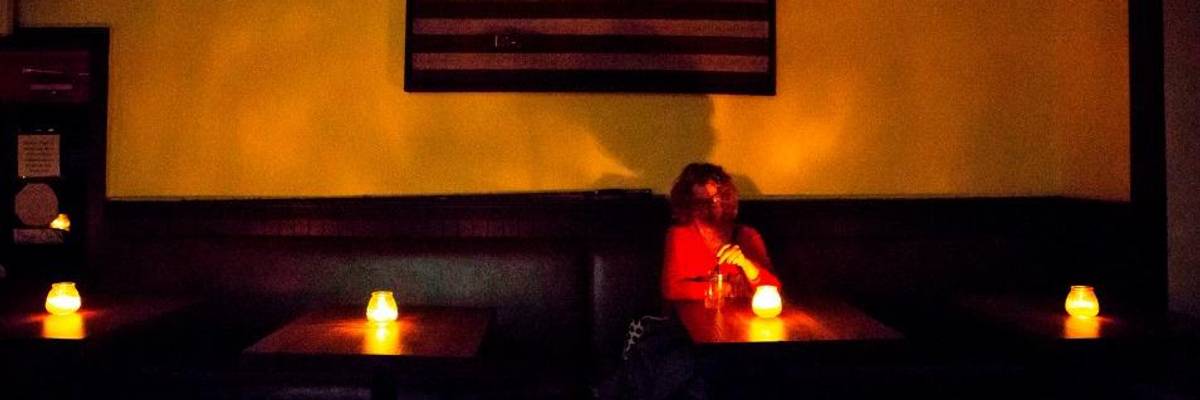
Judy Aquiline sits in the candle-lit restaurant Reel and Brand in Sonoma, California, on October 9, 2019, during a planned power outage by the Pacific Gas & Electric (PG&E) utility company. (Photo: Brittany Hosea-Small/AFP via Getty Images)
'A New Normal That Is Not Normal': 2.5 Million to Lose Power Across Northern California to Prevent Wildfires
"Climate change isn't tomorrow. Climate change is now. This is it."
The reality that an estimated half million people or more across North California on Thursday entered the second day of planned power outages in order to prevent a repeat of deadly and extreme wildfires in the region is prompting outrage across the region as critics condemn the failures and greed of PG&E, the state's largest utility, as unacceptable in this age of climate-related disasters.
The scheduled power outage over the coming days could affect 34 of California's 58 counties and 2.5 million people by the time it ends.
"We can't keep hopping from crisis to crisis like this. We need to realize that we are living in climate change, and this is the cost."
--April Glaser, Slate
In the Sacramento Bee, columnist Marcos Breton wrote an op-ed calling the controlled outage, the largest blackout in California history, "a new normal that is not normal."
"Climate change isn't tomorrow," Breton wrote. "Climate change is now. This is it. We're living it now. And if that sounds like stating the obvious, well, then it's still worth repeating because not enough people believe the obvious."
PG&E commenced the blackout amid 20 to 45 mile-per-hour wind forecasts that were similar to those which affected the area two years ago and contributed to wildfires that tore through 1.2 million acres of forested land. Last year, historic wildfires in California destroyed at least one town and killed 86 people.
It continues, "the size of the shutdown is an admission that PG&E has yet again failed to adequately maintain its power lines. Consumers should be outraged that the utility, a convicted felon, has subjected them to some of the highest rates in the nation and then routinely failed to meet basic safety standards."
The outage has already been linked to a number of traffic accidents as Californians navigate intersections where stop lights are not working and grocery store customers reported hours-long lines as they attempt to stock up on essentials. Lines at gas stations "were 20 cars deep on Tuesday night" as residents prepared for shortages, the New York Times reported.
Rafael Navar, California State Director for Sen. Bernie Sanders's (I-Vt.) presidential campaign, released a statement Wednesday saying Sanders's Green New Deal proposal and plan to invest $526 billion in a modern electrical grid could prevent PG&E from using controlled blackouts as a means to stem the deadly impact of the climate crisis.
Sanders "is the only candidate with a plan that will end the greed in our energy system and will distribute power through public power districts, municipally- and cooperatively-owned utilities with democratic, public ownership, and other existing utilities that demonstrate a commitment to the public interest," Navar said.
"No one in this country should be losing power in their home because large corporations have failed to invest in a smart, safe, and modern electrical grid," he added.
Earlier this year, a federal judge slammed PG&E for doling out $4.5 billion in dividends to its shareholders while spending insufficient funds on its tree-trimming budget in an effect to prevent forest fires.
But Breton warned that to solely blame PG&E for its neglect and its handling of the blackout was akin to ignoring the true culprits behind more frequent and destructive wildfires as well as other extreme weather events:
Do we fully understand what is amiss here? If your answer stops at PG&E then the answer is no. We don't get it.
Too many of us--myself included--have viewed climate change as a tomorrow problem. Or as a partisan argument.
But that's where we've been wrong--terribly, frighteningly, mortally wrong.
At Slate, April Glaser expressed hope that millions of Californians who could be without power for days would help convince lawmakers of the numerous present-day effects of the climate crisis and continued investment in climate-warming fossil fuels.
"What we do need is for our federal, state, and local politicians to feel immense pressure now to realize this problem is only going to keep getting worse, unless they do something," Glaser wrote. "We can't keep hopping from crisis to crisis like this. We need to realize that we are living in climate change, and this is the cost. But my fear is that once the lights go back on, things will go back to normal until the next disaster strikes again."
Breton pointed out that while the phrase "new normal" has been used in recent years for drought, extreme heat, and wildfires, it must now be applied to "going dark."
"We have a new normal in which our lives are disrupted by climate change," Breton wrote. "The science is irrefutable and the impacts are being felt by Californians today. They are sitting in darkened houses. They are stuck at intersections where the signal lights are off. They are paying through the nose for generators. They are frightened by high winds, praying for rain."
We are at a crossroads
This country and this world are at a monumental crossroads. US voters have an opportunity to beat back the forces of fascism and confront the billionaires who are rigging the economy, our media system, and our democracy, making it increasingly impossible for ordinary people to get by. We’re not just talking about the election. We’re talking about what must be done once these fascist elements are vanquished from power. We need a bolder set of solutions than what either major party has so far been willing to offer and a working-class movement ready to fight like hell for it. Trump didn't emerge from nowhere. The conditions that fueled MAGA authoritarianism were created by decades of radical neoliberal economic policies and a corrupt political system dominated by corporate interests. They slashed taxes on the super-rich, promising that the benefits would trickle down. They said giveaways to the corporate titans would make life more affordable for the rest of us. It was all bullshit. And when a bitter, betrayed populace searches for someone to blame, right-wing demagogues have little trouble finding scapegoats. People know when they're being lied to, but you won't hear any of this from the corporate media. Only independent journalism—powered and funded by people who believe in building a better world—can deliver truly trustworthy daily news. Our Fall Campaign is underway, and we need your help. To power our newsroom through the rest of the year, we need to raise $125,000 by midnight on October 31. So if you share our vision, please contribute whatever you can to sustain our work. |
The reality that an estimated half million people or more across North California on Thursday entered the second day of planned power outages in order to prevent a repeat of deadly and extreme wildfires in the region is prompting outrage across the region as critics condemn the failures and greed of PG&E, the state's largest utility, as unacceptable in this age of climate-related disasters.
The scheduled power outage over the coming days could affect 34 of California's 58 counties and 2.5 million people by the time it ends.
"We can't keep hopping from crisis to crisis like this. We need to realize that we are living in climate change, and this is the cost."
--April Glaser, Slate
In the Sacramento Bee, columnist Marcos Breton wrote an op-ed calling the controlled outage, the largest blackout in California history, "a new normal that is not normal."
"Climate change isn't tomorrow," Breton wrote. "Climate change is now. This is it. We're living it now. And if that sounds like stating the obvious, well, then it's still worth repeating because not enough people believe the obvious."
PG&E commenced the blackout amid 20 to 45 mile-per-hour wind forecasts that were similar to those which affected the area two years ago and contributed to wildfires that tore through 1.2 million acres of forested land. Last year, historic wildfires in California destroyed at least one town and killed 86 people.
It continues, "the size of the shutdown is an admission that PG&E has yet again failed to adequately maintain its power lines. Consumers should be outraged that the utility, a convicted felon, has subjected them to some of the highest rates in the nation and then routinely failed to meet basic safety standards."
The outage has already been linked to a number of traffic accidents as Californians navigate intersections where stop lights are not working and grocery store customers reported hours-long lines as they attempt to stock up on essentials. Lines at gas stations "were 20 cars deep on Tuesday night" as residents prepared for shortages, the New York Times reported.
Rafael Navar, California State Director for Sen. Bernie Sanders's (I-Vt.) presidential campaign, released a statement Wednesday saying Sanders's Green New Deal proposal and plan to invest $526 billion in a modern electrical grid could prevent PG&E from using controlled blackouts as a means to stem the deadly impact of the climate crisis.
Sanders "is the only candidate with a plan that will end the greed in our energy system and will distribute power through public power districts, municipally- and cooperatively-owned utilities with democratic, public ownership, and other existing utilities that demonstrate a commitment to the public interest," Navar said.
"No one in this country should be losing power in their home because large corporations have failed to invest in a smart, safe, and modern electrical grid," he added.
Earlier this year, a federal judge slammed PG&E for doling out $4.5 billion in dividends to its shareholders while spending insufficient funds on its tree-trimming budget in an effect to prevent forest fires.
But Breton warned that to solely blame PG&E for its neglect and its handling of the blackout was akin to ignoring the true culprits behind more frequent and destructive wildfires as well as other extreme weather events:
Do we fully understand what is amiss here? If your answer stops at PG&E then the answer is no. We don't get it.
Too many of us--myself included--have viewed climate change as a tomorrow problem. Or as a partisan argument.
But that's where we've been wrong--terribly, frighteningly, mortally wrong.
At Slate, April Glaser expressed hope that millions of Californians who could be without power for days would help convince lawmakers of the numerous present-day effects of the climate crisis and continued investment in climate-warming fossil fuels.
"What we do need is for our federal, state, and local politicians to feel immense pressure now to realize this problem is only going to keep getting worse, unless they do something," Glaser wrote. "We can't keep hopping from crisis to crisis like this. We need to realize that we are living in climate change, and this is the cost. But my fear is that once the lights go back on, things will go back to normal until the next disaster strikes again."
Breton pointed out that while the phrase "new normal" has been used in recent years for drought, extreme heat, and wildfires, it must now be applied to "going dark."
"We have a new normal in which our lives are disrupted by climate change," Breton wrote. "The science is irrefutable and the impacts are being felt by Californians today. They are sitting in darkened houses. They are stuck at intersections where the signal lights are off. They are paying through the nose for generators. They are frightened by high winds, praying for rain."