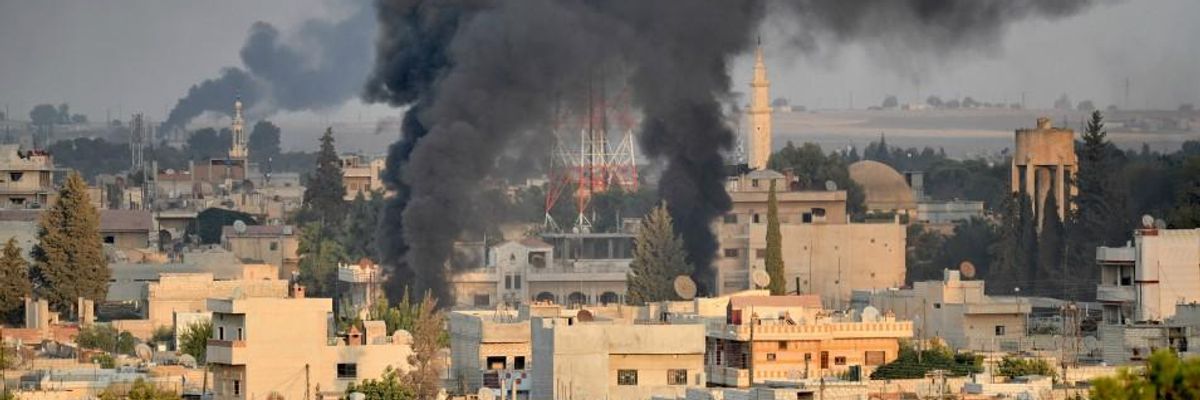
A photo taken from Turkey's Sanliurfa province on October 09, 2019 shows smoke rising at the site of Ras al-Ayn city of Syria as Turkish forces began bombing northern Syria. (Photo by Kerem Kocalar/Anadolu Agency via Getty Images)
'Too Little, Too Late': Critics Pan Trump Plan to Sanction Turkey
"Trump's statement on hitting Turkey with sanctions over the military operation in Syria does not mention the Kurds once."
In a late afternoon announcement Monday, President Donald Trump declared he would sanction Turkey, a NATO ally of the U.S., for its attack on the Kurdish people in northeast Syria--an attack that took place after Trump greenlit the assault on October 7 by withdrawing American personnel from the area.
"Too little, too late," tweeted Harvard's Nicholas Burns. "None of this would have been necessary if Trump had kept our troops in place."
Trump reportedly made the decision after a phone call with Turkish President Recep Erdogan on October 6. By Monday, domestic political backlash was overwhelming and Trump offered up sanctions.
Promising to "swiftly destroy Turkey's economy if Turkish leaders continue down this dangerous and destructive path," Trump announced imminent sanctions that would address "Turkey's destabilizing actions in northeast Syria."
Turkish attacks on the Kurds in Syria have horrified the world since beginning last week. The assault has been by all accounts relentless and has resulted in a number of ISIS prisoners being set free from their prisons. Kurdish forces have been at the frontline of fighting the extremist group.
While the U.S. has withdrawn military personnel from the area, the answer isn't to reintroduce soldiers, Khury Petersen-Smith wrote for In These Times.
"If the U.S. wants to help the Kurds today, the answer is not more permanent war -- that's part of what's made life so miserable for Kurds and so many others across the Middle East to begin with," wrote Petersen-Smith.
And of course the president is disinterested in the human cost of the attacks, as Business Insider reporter John Haltiwanger pointed out.
"Trump's statement on hitting Turkey with sanctions over the military operation in Syria does not mention the Kurds once," said Haltiwanger.
NBC reporter Richard Engel observed that the conflagration in northeast Syria is part of a broader theme emerging across the region where borders are being redrawn. It's not just Turkey--as Common Dreams reported on Sunday, Kurdish forces in northeast Syria joined forces with the Syrian government to fight back against Turkey, a major diplomatic move that will have consequences for the entire Middle East.
"Turkey is grabbing a piece of Syria," said Engel. "The Kurds and Syrian army, now aligned, are fighting to hold on to what they can."
We are at a crossroads
This country and this world are at a monumental crossroads. US voters have an opportunity to beat back the forces of fascism and confront the billionaires who are rigging the economy, our media system, and our democracy, making it increasingly impossible for ordinary people to get by. We’re not just talking about the election. We’re talking about what must be done once these fascist elements are vanquished from power. We need a bolder set of solutions than what either major party has so far been willing to offer and a working-class movement ready to fight like hell for it. Trump didn't emerge from nowhere. The conditions that fueled MAGA authoritarianism were created by decades of radical neoliberal economic policies and a corrupt political system dominated by corporate interests. They slashed taxes on the super-rich, promising that the benefits would trickle down. They said giveaways to the corporate titans would make life more affordable for the rest of us. It was all bullshit. And when a bitter, betrayed populace searches for someone to blame, right-wing demagogues have little trouble finding scapegoats. People know when they're being lied to, but you won't hear any of this from the corporate media. Only independent journalism—powered and funded by people who believe in building a better world—can deliver truly trustworthy daily news. Our Fall Campaign is underway, and we need your help. To power our newsroom through the rest of the year, we need to raise $125,000 by midnight on October 31. So if you share our vision, please contribute whatever you can to sustain our work. |
In a late afternoon announcement Monday, President Donald Trump declared he would sanction Turkey, a NATO ally of the U.S., for its attack on the Kurdish people in northeast Syria--an attack that took place after Trump greenlit the assault on October 7 by withdrawing American personnel from the area.
"Too little, too late," tweeted Harvard's Nicholas Burns. "None of this would have been necessary if Trump had kept our troops in place."
Trump reportedly made the decision after a phone call with Turkish President Recep Erdogan on October 6. By Monday, domestic political backlash was overwhelming and Trump offered up sanctions.
Promising to "swiftly destroy Turkey's economy if Turkish leaders continue down this dangerous and destructive path," Trump announced imminent sanctions that would address "Turkey's destabilizing actions in northeast Syria."
Turkish attacks on the Kurds in Syria have horrified the world since beginning last week. The assault has been by all accounts relentless and has resulted in a number of ISIS prisoners being set free from their prisons. Kurdish forces have been at the frontline of fighting the extremist group.
While the U.S. has withdrawn military personnel from the area, the answer isn't to reintroduce soldiers, Khury Petersen-Smith wrote for In These Times.
"If the U.S. wants to help the Kurds today, the answer is not more permanent war -- that's part of what's made life so miserable for Kurds and so many others across the Middle East to begin with," wrote Petersen-Smith.
And of course the president is disinterested in the human cost of the attacks, as Business Insider reporter John Haltiwanger pointed out.
"Trump's statement on hitting Turkey with sanctions over the military operation in Syria does not mention the Kurds once," said Haltiwanger.
NBC reporter Richard Engel observed that the conflagration in northeast Syria is part of a broader theme emerging across the region where borders are being redrawn. It's not just Turkey--as Common Dreams reported on Sunday, Kurdish forces in northeast Syria joined forces with the Syrian government to fight back against Turkey, a major diplomatic move that will have consequences for the entire Middle East.
"Turkey is grabbing a piece of Syria," said Engel. "The Kurds and Syrian army, now aligned, are fighting to hold on to what they can."