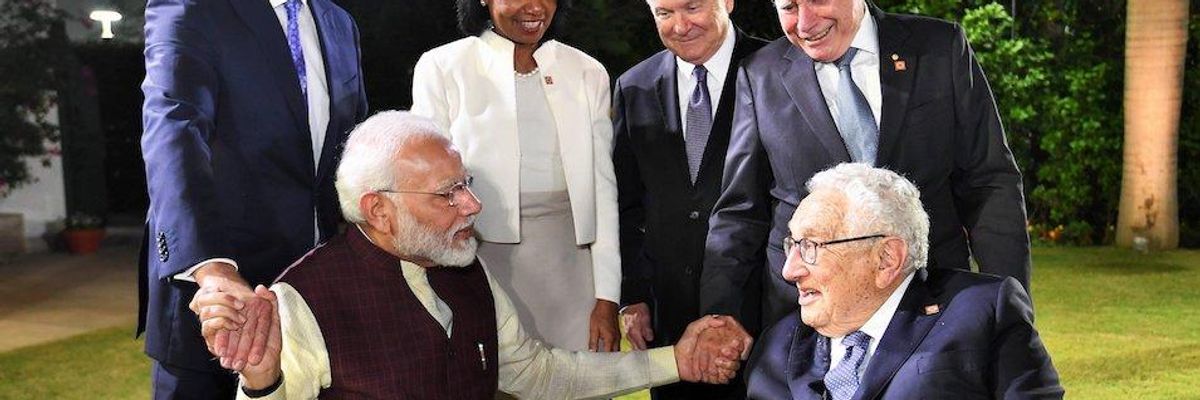
Modi and Kissinger are joined by friends. (Photo: Narendra Modi/Twitter)
As Modi Hobnobs With Kissinger and Other War Criminals, Ilhan Omar and Pramila Jayapal Criticize US Support for Indian Regime
"At what point do we no longer share values with India? Are we waiting for the Muslims in Assam to be put in those camps?"
As Indian Prime Minister Narendra Modi rubbed shoulders with Henry Kissinger and other former world leaders in India on Tuesday, Reps. Pramila Jayapal and Ilhan Omar questioned State Department officials on U.S. support for the Modi regime during a hearing on Capitol Hill.
Omar took particular aim at the Modi government's recent moves to strip Muslims in the country's northeast state of Assam and the building of camps in the region that critics of the Indian government fear may be used to house those decided as non-citizens by the regime.
"At what point do we no longer share values with India?" Omar asked assistant secretary of state for South Asia Alice Wells. "Are we waiting for the Muslims in Assam to be put in those camps?"
Wells, in reply, said that the U.S. was satisfied that the decisions by the Modi government were legitimate due to the fact that they were legal under Indian law.
"As a democracy, we respect other democracies' abilities to self-police and self-regulate," said Wells.
House subcommittee on Asian affairs chair Rep. Brad Sherman (D-Calif.) was unsatisfied with that response.
"A human rights abuse doesn't cease to be a human rights abuse just because it's being done pursuant to the law or court rulings of the country committing the abuse," Sherman said.
Jayapal took issue with the U.S. inaction on India's unilateral invasion and occupation of Kashmir in her remarks.
"I recognize the situation is complex," said Jayapal, adding that, however, "India as the world's largest democracy and a critical ally for the U.S. needs to uphold its commitment to human rights."
While the hearing was taking place in Washington, Modi was hobnobbing with the global elite at the JP Morgan International Council meeting in New Delhi. The prime minister posed with Kissinger, one of the most notorious U.S. leaders whose tenure was marked by scores of deaths across the world due to U.S. military action, particularly in southeast Asia.
Modi and Kissinger later posed for a picture with cadre of Iraq War boosters, including former U.K. Prime Minister Tony Blair, former Australian Prime Minister John Howard, and former U.S. Secretary of State Condoleeza Rice, and former U.S. Secretary of Defense Robert Gates.
Canadian journalist Usaid Siddiqui noted the irony of the photograph.
"A reminder that it was under George Bush, the man who invaded Iraq leaving behind a million corpses, that Narendra Modi was banned from the U.S. for Gujarat," Siddiqui tweeted.
Watch Omar and Jayapal in Tuesday's hearing:
We are at a crossroads
This country and this world are at a monumental crossroads. In a few short weeks, US voters will have an opportunity to beat back the forces of fascism and confront the billionaires who are rigging the economy, our media system, and our democracy, making it increasingly impossible for ordinary people to get by. We’re not just talking about the election. We’re talking about what must be done once these fascist elements are vanquished from power. We need a bolder set of solutions than what either major party has so far been willing to offer and a working-class movement ready to fight like hell for it. Trump didn't emerge from nowhere. The conditions that fueled MAGA authoritarianism were created by decades of radical neoliberal economic policies and a corrupt political system dominated by corporate interests. They slashed taxes on the super-rich, promising that the benefits would trickle down. They said giveaways to the corporate titans would make life more affordable for the rest of us. It was all bullshit. And when a bitter, betrayed populace searches for someone to blame, right-wing demagogues have little trouble finding scapegoats. People know when they're being lied to, but you won't hear any of this from the corporate media. Only independent journalism—powered and funded by people who believe in building a better world—can deliver truly trustworthy daily news. Our Fall Campaign is underway, and we need your help. To power our newsroom through the rest of the year, we need to raise $125,000 by midnight on October 31. So if you share our vision, please contribute whatever you can to sustain our work. |
As Indian Prime Minister Narendra Modi rubbed shoulders with Henry Kissinger and other former world leaders in India on Tuesday, Reps. Pramila Jayapal and Ilhan Omar questioned State Department officials on U.S. support for the Modi regime during a hearing on Capitol Hill.
Omar took particular aim at the Modi government's recent moves to strip Muslims in the country's northeast state of Assam and the building of camps in the region that critics of the Indian government fear may be used to house those decided as non-citizens by the regime.
"At what point do we no longer share values with India?" Omar asked assistant secretary of state for South Asia Alice Wells. "Are we waiting for the Muslims in Assam to be put in those camps?"
Wells, in reply, said that the U.S. was satisfied that the decisions by the Modi government were legitimate due to the fact that they were legal under Indian law.
"As a democracy, we respect other democracies' abilities to self-police and self-regulate," said Wells.
House subcommittee on Asian affairs chair Rep. Brad Sherman (D-Calif.) was unsatisfied with that response.
"A human rights abuse doesn't cease to be a human rights abuse just because it's being done pursuant to the law or court rulings of the country committing the abuse," Sherman said.
Jayapal took issue with the U.S. inaction on India's unilateral invasion and occupation of Kashmir in her remarks.
"I recognize the situation is complex," said Jayapal, adding that, however, "India as the world's largest democracy and a critical ally for the U.S. needs to uphold its commitment to human rights."
While the hearing was taking place in Washington, Modi was hobnobbing with the global elite at the JP Morgan International Council meeting in New Delhi. The prime minister posed with Kissinger, one of the most notorious U.S. leaders whose tenure was marked by scores of deaths across the world due to U.S. military action, particularly in southeast Asia.
Modi and Kissinger later posed for a picture with cadre of Iraq War boosters, including former U.K. Prime Minister Tony Blair, former Australian Prime Minister John Howard, and former U.S. Secretary of State Condoleeza Rice, and former U.S. Secretary of Defense Robert Gates.
Canadian journalist Usaid Siddiqui noted the irony of the photograph.
"A reminder that it was under George Bush, the man who invaded Iraq leaving behind a million corpses, that Narendra Modi was banned from the U.S. for Gujarat," Siddiqui tweeted.
Watch Omar and Jayapal in Tuesday's hearing: