SUBSCRIBE TO OUR FREE NEWSLETTER
Daily news & progressive opinion—funded by the people, not the corporations—delivered straight to your inbox.
5
#000000
#FFFFFF
To donate by check, phone, or other method, see our More Ways to Give page.
Daily news & progressive opinion—funded by the people, not the corporations—delivered straight to your inbox.
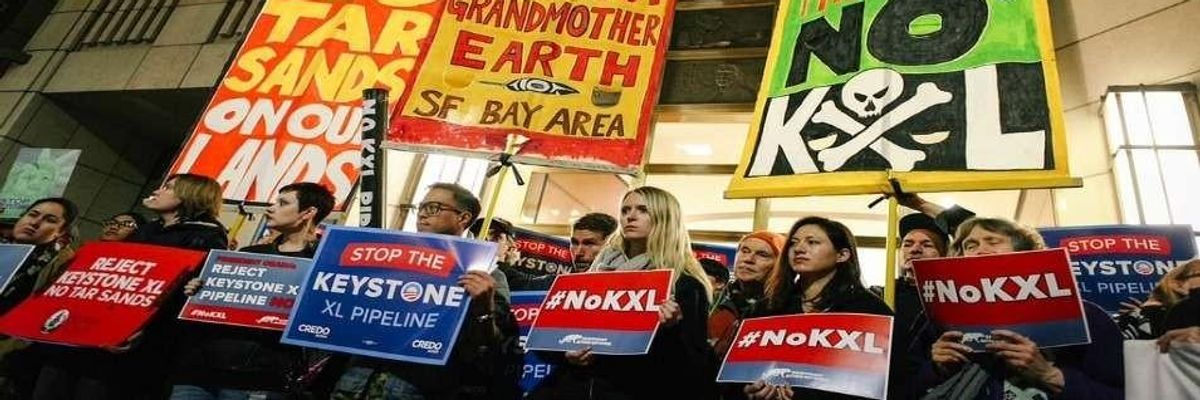
Demonstrators protest against the Keystone XL pipeline, which the Trump administration is attempting to approve despite its disastrous environmental impact. (Photo: Rainforest Action Network/Bonnie Chan/flickr/cc)
The ACLU and environmental activists celebrated Thursday after reaching a settlement agreement with South Dakota's Republican Gov. Kristi Noem and state Attorney General Jason Ravnesborg to end what critics called "their unconstitutional attempts to silence pipeline protestors."
"We will celebrate this win but remain vigilant against further government attempts to outlaw our right to peacefully assemble."
--Dallas Goldtooth, IEN
The settlement is a result of a lawsuit filed by the national ACLU, the group's state chapter, and the Robins Kaplan law firm challenging provisions from various state laws, including South Dakota's "Riot Boosting" Act, which threatened activists with up to 25 years in prison. It follows a federal court ruling last month that temporarily blocked enforcement of the provisions.
"The state's anti-protest efforts were plainly unconstitutional," Stephen Pevar, senior staff attorney with the ACLU's Racial Justice Program, said in a statement Thursday.
"This settlement helps ensure that no one has to fear the government coming after them for exercising their First Amendment right to protest," he said. "This settlement should also serve as a lesson for other legislatures considering similar anti-protest efforts."
The contested provisions of South Dakota's laws are part of a trend of recently enacted, highly controversial legislation in a number of Republican-controlled states to criminalize protests, particularly those targeting "critical infrastructure" such as fossil fuel pipelines.
As ACLU staff attorney Vera Eidelman explained in a blog post Thursday:
In the last few years, we have witnessed a legislative trend of states seeking to criminalize protest, deter political participation, and curtail freedom of association. These bills appear to be a direct reaction from politicians and corporations to some of the most effective tactics of those speaking out today, including water protectors challenging pipeline construction, Black Lives Matter, and those calling for boycotts of Israel. These legislative moves are aimed at suppressing dissent and undercutting marginalized and over-policed groups voicing concerns that disrupt current power dynamics.
In South Dakota specifically, several environmental and Indigenous groups--including those involved in the lawsuit that led to the settlement--have spent years protesting the long-delayed Keystone XL pipeline.
Brendan Johnson, a partner with the Robins Kaplan law firm, said Thursday that "by equating peaceful organization and support of protest with 'riot boosting' and incitement to riot, the government stifled our clients' abilities to speak out against the Keystone XL pipeline."
"By equating peaceful organization and support of protest with 'riot boosting' and incitement to riot, the government stifled our clients' abilities to speak out against the Keystone XL pipeline."
--Brendan Johnson, attorney
Johnson's firm and the ACLU represented the Sierra Club, Dakota Rural Action, the Indigenous Environmental Network (IEN), and NDN Collective, as well as two individuals from those groups.
"South Dakota knew these laws couldn't stand up to our legal challenge so rather than face embarrassment they decided to capitulate," one of the individual plaintiffs, IEN's Dallas Goldtooth, said of the settlement, which still needs final approval from a federal court.
"We will celebrate this win," Goldtooth added, "but remain vigilant against further government attempts to outlaw our right to peacefully assemble."
The other individual plaintiff, Nick Tilsen of NDN Collective, called the state's Riot Boosting Act "an insult to the Constitution and an attempt to muzzle the voices of the people and our movement to defend Mother Earth."
"This settlement accomplishes everything that we set out do with the lawsuit and makes the temporary injunction a permanent one," said Tilsen. "Onward, we will continue to fight for air, land, water, and our rights."
Pre-construction activities are already underway for the Keystone XL pipeline, which when completed would carry up to 830,000 barrels of crude oil daily from the Alberta tar sands, across Montana and South Dakota, to Nebraska.
Dear Common Dreams reader, It’s been nearly 30 years since I co-founded Common Dreams with my late wife, Lina Newhouser. We had the radical notion that journalism should serve the public good, not corporate profits. It was clear to us from the outset what it would take to build such a project. No paid advertisements. No corporate sponsors. No millionaire publisher telling us what to think or do. Many people said we wouldn't last a year, but we proved those doubters wrong. Together with a tremendous team of journalists and dedicated staff, we built an independent media outlet free from the constraints of profits and corporate control. Our mission has always been simple: To inform. To inspire. To ignite change for the common good. Building Common Dreams was not easy. Our survival was never guaranteed. When you take on the most powerful forces—Wall Street greed, fossil fuel industry destruction, Big Tech lobbyists, and uber-rich oligarchs who have spent billions upon billions rigging the economy and democracy in their favor—the only bulwark you have is supporters who believe in your work. But here’s the urgent message from me today. It's never been this bad out there. And it's never been this hard to keep us going. At the very moment Common Dreams is most needed, the threats we face are intensifying. We need your support now more than ever. We don't accept corporate advertising and never will. We don't have a paywall because we don't think people should be blocked from critical news based on their ability to pay. Everything we do is funded by the donations of readers like you. When everyone does the little they can afford, we are strong. But if that support retreats or dries up, so do we. Will you donate now to make sure Common Dreams not only survives but thrives? —Craig Brown, Co-founder |
The ACLU and environmental activists celebrated Thursday after reaching a settlement agreement with South Dakota's Republican Gov. Kristi Noem and state Attorney General Jason Ravnesborg to end what critics called "their unconstitutional attempts to silence pipeline protestors."
"We will celebrate this win but remain vigilant against further government attempts to outlaw our right to peacefully assemble."
--Dallas Goldtooth, IEN
The settlement is a result of a lawsuit filed by the national ACLU, the group's state chapter, and the Robins Kaplan law firm challenging provisions from various state laws, including South Dakota's "Riot Boosting" Act, which threatened activists with up to 25 years in prison. It follows a federal court ruling last month that temporarily blocked enforcement of the provisions.
"The state's anti-protest efforts were plainly unconstitutional," Stephen Pevar, senior staff attorney with the ACLU's Racial Justice Program, said in a statement Thursday.
"This settlement helps ensure that no one has to fear the government coming after them for exercising their First Amendment right to protest," he said. "This settlement should also serve as a lesson for other legislatures considering similar anti-protest efforts."
The contested provisions of South Dakota's laws are part of a trend of recently enacted, highly controversial legislation in a number of Republican-controlled states to criminalize protests, particularly those targeting "critical infrastructure" such as fossil fuel pipelines.
As ACLU staff attorney Vera Eidelman explained in a blog post Thursday:
In the last few years, we have witnessed a legislative trend of states seeking to criminalize protest, deter political participation, and curtail freedom of association. These bills appear to be a direct reaction from politicians and corporations to some of the most effective tactics of those speaking out today, including water protectors challenging pipeline construction, Black Lives Matter, and those calling for boycotts of Israel. These legislative moves are aimed at suppressing dissent and undercutting marginalized and over-policed groups voicing concerns that disrupt current power dynamics.
In South Dakota specifically, several environmental and Indigenous groups--including those involved in the lawsuit that led to the settlement--have spent years protesting the long-delayed Keystone XL pipeline.
Brendan Johnson, a partner with the Robins Kaplan law firm, said Thursday that "by equating peaceful organization and support of protest with 'riot boosting' and incitement to riot, the government stifled our clients' abilities to speak out against the Keystone XL pipeline."
"By equating peaceful organization and support of protest with 'riot boosting' and incitement to riot, the government stifled our clients' abilities to speak out against the Keystone XL pipeline."
--Brendan Johnson, attorney
Johnson's firm and the ACLU represented the Sierra Club, Dakota Rural Action, the Indigenous Environmental Network (IEN), and NDN Collective, as well as two individuals from those groups.
"South Dakota knew these laws couldn't stand up to our legal challenge so rather than face embarrassment they decided to capitulate," one of the individual plaintiffs, IEN's Dallas Goldtooth, said of the settlement, which still needs final approval from a federal court.
"We will celebrate this win," Goldtooth added, "but remain vigilant against further government attempts to outlaw our right to peacefully assemble."
The other individual plaintiff, Nick Tilsen of NDN Collective, called the state's Riot Boosting Act "an insult to the Constitution and an attempt to muzzle the voices of the people and our movement to defend Mother Earth."
"This settlement accomplishes everything that we set out do with the lawsuit and makes the temporary injunction a permanent one," said Tilsen. "Onward, we will continue to fight for air, land, water, and our rights."
Pre-construction activities are already underway for the Keystone XL pipeline, which when completed would carry up to 830,000 barrels of crude oil daily from the Alberta tar sands, across Montana and South Dakota, to Nebraska.
The ACLU and environmental activists celebrated Thursday after reaching a settlement agreement with South Dakota's Republican Gov. Kristi Noem and state Attorney General Jason Ravnesborg to end what critics called "their unconstitutional attempts to silence pipeline protestors."
"We will celebrate this win but remain vigilant against further government attempts to outlaw our right to peacefully assemble."
--Dallas Goldtooth, IEN
The settlement is a result of a lawsuit filed by the national ACLU, the group's state chapter, and the Robins Kaplan law firm challenging provisions from various state laws, including South Dakota's "Riot Boosting" Act, which threatened activists with up to 25 years in prison. It follows a federal court ruling last month that temporarily blocked enforcement of the provisions.
"The state's anti-protest efforts were plainly unconstitutional," Stephen Pevar, senior staff attorney with the ACLU's Racial Justice Program, said in a statement Thursday.
"This settlement helps ensure that no one has to fear the government coming after them for exercising their First Amendment right to protest," he said. "This settlement should also serve as a lesson for other legislatures considering similar anti-protest efforts."
The contested provisions of South Dakota's laws are part of a trend of recently enacted, highly controversial legislation in a number of Republican-controlled states to criminalize protests, particularly those targeting "critical infrastructure" such as fossil fuel pipelines.
As ACLU staff attorney Vera Eidelman explained in a blog post Thursday:
In the last few years, we have witnessed a legislative trend of states seeking to criminalize protest, deter political participation, and curtail freedom of association. These bills appear to be a direct reaction from politicians and corporations to some of the most effective tactics of those speaking out today, including water protectors challenging pipeline construction, Black Lives Matter, and those calling for boycotts of Israel. These legislative moves are aimed at suppressing dissent and undercutting marginalized and over-policed groups voicing concerns that disrupt current power dynamics.
In South Dakota specifically, several environmental and Indigenous groups--including those involved in the lawsuit that led to the settlement--have spent years protesting the long-delayed Keystone XL pipeline.
Brendan Johnson, a partner with the Robins Kaplan law firm, said Thursday that "by equating peaceful organization and support of protest with 'riot boosting' and incitement to riot, the government stifled our clients' abilities to speak out against the Keystone XL pipeline."
"By equating peaceful organization and support of protest with 'riot boosting' and incitement to riot, the government stifled our clients' abilities to speak out against the Keystone XL pipeline."
--Brendan Johnson, attorney
Johnson's firm and the ACLU represented the Sierra Club, Dakota Rural Action, the Indigenous Environmental Network (IEN), and NDN Collective, as well as two individuals from those groups.
"South Dakota knew these laws couldn't stand up to our legal challenge so rather than face embarrassment they decided to capitulate," one of the individual plaintiffs, IEN's Dallas Goldtooth, said of the settlement, which still needs final approval from a federal court.
"We will celebrate this win," Goldtooth added, "but remain vigilant against further government attempts to outlaw our right to peacefully assemble."
The other individual plaintiff, Nick Tilsen of NDN Collective, called the state's Riot Boosting Act "an insult to the Constitution and an attempt to muzzle the voices of the people and our movement to defend Mother Earth."
"This settlement accomplishes everything that we set out do with the lawsuit and makes the temporary injunction a permanent one," said Tilsen. "Onward, we will continue to fight for air, land, water, and our rights."
Pre-construction activities are already underway for the Keystone XL pipeline, which when completed would carry up to 830,000 barrels of crude oil daily from the Alberta tar sands, across Montana and South Dakota, to Nebraska.