SUBSCRIBE TO OUR FREE NEWSLETTER
Daily news & progressive opinion—funded by the people, not the corporations—delivered straight to your inbox.
5
#000000
#FFFFFF
To donate by check, phone, or other method, see our More Ways to Give page.
Daily news & progressive opinion—funded by the people, not the corporations—delivered straight to your inbox.
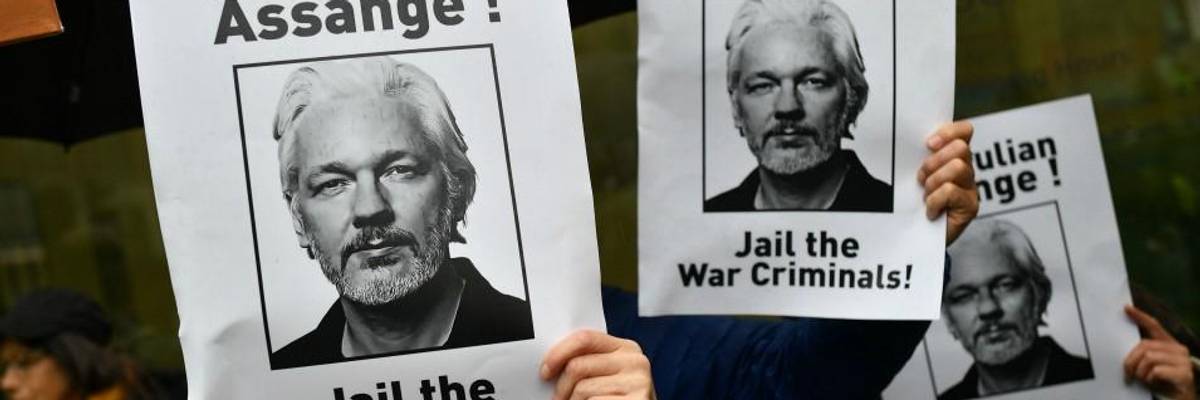
Demonstrators protest outside Westminster Magistrates Court in London on October 21, 2019. (Photo: Isabel Infantes/AFP via Getty Images)
The United Nations special rapporteur on torture reiterated Friday a warning that Julian Assange's life is at risk and said the WikiLeaks founder must not be extradited to the United States as a consequence of "exposing serious governmental misconduct."
"While the U.S. government prosecutes Mr. Assange for publishing information about serious human rights violations, including torture and murder, the officials responsible for these crimes continue to enjoy impunity," said special rapporteur Nils Melzer in a new statement.
Free press advocates see Assange as victim of an unprecedented assault on journalism because the WikiLeaks publisher faces 18 charges in the U.S. under the Espionage Act--making Assange the first publisher to face charges under that law. Currently in London's Belmarsh prison for skipping bail seven years ago when he first took refuge at the Ecuadorian Embassy in London, Assange last month lost a bid to postpone his U.S. extradition hearing in February.
Melzer's new comments come five months after he visited Assange in prison and said Assange exhibited "all symptoms typical for prolonged exposure to psychological torture." But warnings about Assange's treatment, the U.N. expert said, went unheeded.
The U.K. government has shown "outright contempt for Mr. Assange's rights and integrity," said Melzer, and failed to take "any measures of investigation, prevention, and redress required under international law."
Assange has also not been given his right to prepare his defense, Melzer said, because his "access to legal counsel and documents has been severely obstructed."
"In a cursory response sent nearly five months after my visit, the U.K. government flatly rejected my findings, without indicating any willingness to consider my recommendations, let alone to implement them, or even provide the additional information requested," said Melzer.
"He continues to be detained under oppressive conditions of isolation and surveillance, not justified by his detention status," Melzer said of Assange.
The driving force behind the harsh treatment and potential life behind bars appears evident to Melzer.
"In my view, this case has never been about Mr. Assange's guilt or innocence, but about making him pay the price for exposing serious governmental misconduct, including alleged war crimes and corruption," Melzer said. "Unless the U.K. urgently changes course and alleviates his inhumane situation, Mr. Assange's continued exposure to arbitrariness and abuse may soon end up costing his life."
Assange's case, argue WikiLeaks and whistleblowing researchers Felicity Ruby and Naomi Colvin, deserves the world's attention.
"The indictments for which Assange is now imprisoned have nothing to do with Sweden, Russia, Trump, or his cat," Ruby and Colvin wrote at New Internationalist. "They are a straightforward attempt to prosecute a publisher for committing acts of journalism: specifically the releases of 2010-11 on Guantanamo Bay, the wars in Afghanistan and Iraq, and Cablegate. These are the most significant series of public-interest disclosures of our times."
"For this journalism, he is held, alone for more than 20 hours a day in a cell on the health ward of Belmarsh, only just able to receive documents from his lawyers. Years of unsympathetic and hostile treatment from his peers have left him almost as alone in the public realm as he is now in Belmarsh," wrote Ruby and Colvin. "And yet it is on this man, resilient but much weakened after a decade of unrelenting pressure that the future of the freedom to report, and to read, rests."
Dear Common Dreams reader, It’s been nearly 30 years since I co-founded Common Dreams with my late wife, Lina Newhouser. We had the radical notion that journalism should serve the public good, not corporate profits. It was clear to us from the outset what it would take to build such a project. No paid advertisements. No corporate sponsors. No millionaire publisher telling us what to think or do. Many people said we wouldn't last a year, but we proved those doubters wrong. Together with a tremendous team of journalists and dedicated staff, we built an independent media outlet free from the constraints of profits and corporate control. Our mission has always been simple: To inform. To inspire. To ignite change for the common good. Building Common Dreams was not easy. Our survival was never guaranteed. When you take on the most powerful forces—Wall Street greed, fossil fuel industry destruction, Big Tech lobbyists, and uber-rich oligarchs who have spent billions upon billions rigging the economy and democracy in their favor—the only bulwark you have is supporters who believe in your work. But here’s the urgent message from me today. It's never been this bad out there. And it's never been this hard to keep us going. At the very moment Common Dreams is most needed, the threats we face are intensifying. We need your support now more than ever. We don't accept corporate advertising and never will. We don't have a paywall because we don't think people should be blocked from critical news based on their ability to pay. Everything we do is funded by the donations of readers like you. When everyone does the little they can afford, we are strong. But if that support retreats or dries up, so do we. Will you donate now to make sure Common Dreams not only survives but thrives? —Craig Brown, Co-founder |
The United Nations special rapporteur on torture reiterated Friday a warning that Julian Assange's life is at risk and said the WikiLeaks founder must not be extradited to the United States as a consequence of "exposing serious governmental misconduct."
"While the U.S. government prosecutes Mr. Assange for publishing information about serious human rights violations, including torture and murder, the officials responsible for these crimes continue to enjoy impunity," said special rapporteur Nils Melzer in a new statement.
Free press advocates see Assange as victim of an unprecedented assault on journalism because the WikiLeaks publisher faces 18 charges in the U.S. under the Espionage Act--making Assange the first publisher to face charges under that law. Currently in London's Belmarsh prison for skipping bail seven years ago when he first took refuge at the Ecuadorian Embassy in London, Assange last month lost a bid to postpone his U.S. extradition hearing in February.
Melzer's new comments come five months after he visited Assange in prison and said Assange exhibited "all symptoms typical for prolonged exposure to psychological torture." But warnings about Assange's treatment, the U.N. expert said, went unheeded.
The U.K. government has shown "outright contempt for Mr. Assange's rights and integrity," said Melzer, and failed to take "any measures of investigation, prevention, and redress required under international law."
Assange has also not been given his right to prepare his defense, Melzer said, because his "access to legal counsel and documents has been severely obstructed."
"In a cursory response sent nearly five months after my visit, the U.K. government flatly rejected my findings, without indicating any willingness to consider my recommendations, let alone to implement them, or even provide the additional information requested," said Melzer.
"He continues to be detained under oppressive conditions of isolation and surveillance, not justified by his detention status," Melzer said of Assange.
The driving force behind the harsh treatment and potential life behind bars appears evident to Melzer.
"In my view, this case has never been about Mr. Assange's guilt or innocence, but about making him pay the price for exposing serious governmental misconduct, including alleged war crimes and corruption," Melzer said. "Unless the U.K. urgently changes course and alleviates his inhumane situation, Mr. Assange's continued exposure to arbitrariness and abuse may soon end up costing his life."
Assange's case, argue WikiLeaks and whistleblowing researchers Felicity Ruby and Naomi Colvin, deserves the world's attention.
"The indictments for which Assange is now imprisoned have nothing to do with Sweden, Russia, Trump, or his cat," Ruby and Colvin wrote at New Internationalist. "They are a straightforward attempt to prosecute a publisher for committing acts of journalism: specifically the releases of 2010-11 on Guantanamo Bay, the wars in Afghanistan and Iraq, and Cablegate. These are the most significant series of public-interest disclosures of our times."
"For this journalism, he is held, alone for more than 20 hours a day in a cell on the health ward of Belmarsh, only just able to receive documents from his lawyers. Years of unsympathetic and hostile treatment from his peers have left him almost as alone in the public realm as he is now in Belmarsh," wrote Ruby and Colvin. "And yet it is on this man, resilient but much weakened after a decade of unrelenting pressure that the future of the freedom to report, and to read, rests."
The United Nations special rapporteur on torture reiterated Friday a warning that Julian Assange's life is at risk and said the WikiLeaks founder must not be extradited to the United States as a consequence of "exposing serious governmental misconduct."
"While the U.S. government prosecutes Mr. Assange for publishing information about serious human rights violations, including torture and murder, the officials responsible for these crimes continue to enjoy impunity," said special rapporteur Nils Melzer in a new statement.
Free press advocates see Assange as victim of an unprecedented assault on journalism because the WikiLeaks publisher faces 18 charges in the U.S. under the Espionage Act--making Assange the first publisher to face charges under that law. Currently in London's Belmarsh prison for skipping bail seven years ago when he first took refuge at the Ecuadorian Embassy in London, Assange last month lost a bid to postpone his U.S. extradition hearing in February.
Melzer's new comments come five months after he visited Assange in prison and said Assange exhibited "all symptoms typical for prolonged exposure to psychological torture." But warnings about Assange's treatment, the U.N. expert said, went unheeded.
The U.K. government has shown "outright contempt for Mr. Assange's rights and integrity," said Melzer, and failed to take "any measures of investigation, prevention, and redress required under international law."
Assange has also not been given his right to prepare his defense, Melzer said, because his "access to legal counsel and documents has been severely obstructed."
"In a cursory response sent nearly five months after my visit, the U.K. government flatly rejected my findings, without indicating any willingness to consider my recommendations, let alone to implement them, or even provide the additional information requested," said Melzer.
"He continues to be detained under oppressive conditions of isolation and surveillance, not justified by his detention status," Melzer said of Assange.
The driving force behind the harsh treatment and potential life behind bars appears evident to Melzer.
"In my view, this case has never been about Mr. Assange's guilt or innocence, but about making him pay the price for exposing serious governmental misconduct, including alleged war crimes and corruption," Melzer said. "Unless the U.K. urgently changes course and alleviates his inhumane situation, Mr. Assange's continued exposure to arbitrariness and abuse may soon end up costing his life."
Assange's case, argue WikiLeaks and whistleblowing researchers Felicity Ruby and Naomi Colvin, deserves the world's attention.
"The indictments for which Assange is now imprisoned have nothing to do with Sweden, Russia, Trump, or his cat," Ruby and Colvin wrote at New Internationalist. "They are a straightforward attempt to prosecute a publisher for committing acts of journalism: specifically the releases of 2010-11 on Guantanamo Bay, the wars in Afghanistan and Iraq, and Cablegate. These are the most significant series of public-interest disclosures of our times."
"For this journalism, he is held, alone for more than 20 hours a day in a cell on the health ward of Belmarsh, only just able to receive documents from his lawyers. Years of unsympathetic and hostile treatment from his peers have left him almost as alone in the public realm as he is now in Belmarsh," wrote Ruby and Colvin. "And yet it is on this man, resilient but much weakened after a decade of unrelenting pressure that the future of the freedom to report, and to read, rests."