
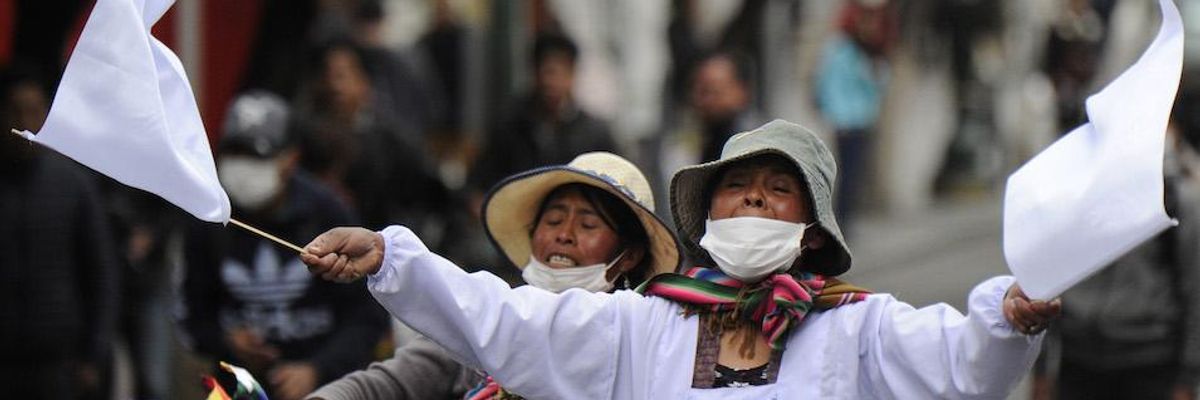
A supporter of Bolivian ex-President Evo Morales waves white flags during clashes with riot police following a protest in La Paz on November 13, 2019. (Photo: Jorge Bernl/AFP/Getty Images)
'We Don't Want Any Dictators': Bolivians Flood Streets to Protest Right-Wing, Anti-Indigenous Coup
"Anti-Indigenous racism is at the heart of what's happening in Bolivia."
Unrest continued in Bolivia Thursday as protests against the right-wing coup that unseated democratically-elected President Evo Morales on Sunday and the anti-Indigenous ideology behind it entered their fourth day.
Demonstrators filled the streets of the Bolivian capitol, La Paz, waving the indigenous wiphala flag and registering their disapproval of the new interim government of Jeanine Anez.
"We don't want any dictators," protester Paulina Luchampe told Time Magazine on Wednesday. "This lady has stepped on us--that's why we're so mad."
New president Anez has come under criticism for a history of comments promoting an extreme right-wing Christian theocratic ideology, including referring to the country's Indigenous population as "satanic."
Members of the country's police and military forces, whose support for the coup over the weekend precipitated Morales' resignation Sunday, have been photographed cutting the wiphala flag off of their uniforms.
"Anti-Indigenous racism is at the heart of what's happening in Bolivia," tweeted Cherokee activist and writer Rebecca Nagle.
Right-wing militias burning the flag and attacking the country's Indigenous protest movement mean that the conflict is more than just about political differences, said Bolivian feminist Adriana Guzman--it's about the country's right-wing being opposed to everything the Morales government stood for.
"The coup d'etat is against all of that," said Guzman. "That's why they degrade. That's why they punish. That's why they burn the Indigenous wiphala flag."
Protests continued on Thursday.
In an opinion piece for The Guardian, Nick Estes, co-founder and editor of The Red Nation, said that the difference between the two camps in Bolivia is clear.
"The future of Bolivia is currently marching in the streets, the millions of people who voted for Evo in the last elections, the 47% whose voices and votes were stolen by the violent return of the old, colonial oligarchy," wrote Estes.
Protester Luchampe said she hoped the protests would continue until there is a resolution to the conflict that undoes the coup.
"We're going to fight with our brothers and sisters until Evo Morales is back," said Luchampe. "We ask for his return. He needs to put the house in order."
An Urgent Message From Our Co-Founder
Dear Common Dreams reader, It’s been nearly 30 years since I co-founded Common Dreams with my late wife, Lina Newhouser. We had the radical notion that journalism should serve the public good, not corporate profits. It was clear to us from the outset what it would take to build such a project. No paid advertisements. No corporate sponsors. No millionaire publisher telling us what to think or do. Many people said we wouldn't last a year, but we proved those doubters wrong. Together with a tremendous team of journalists and dedicated staff, we built an independent media outlet free from the constraints of profits and corporate control. Our mission has always been simple: To inform. To inspire. To ignite change for the common good. Building Common Dreams was not easy. Our survival was never guaranteed. When you take on the most powerful forces—Wall Street greed, fossil fuel industry destruction, Big Tech lobbyists, and uber-rich oligarchs who have spent billions upon billions rigging the economy and democracy in their favor—the only bulwark you have is supporters who believe in your work. But here’s the urgent message from me today. It's never been this bad out there. And it's never been this hard to keep us going. At the very moment Common Dreams is most needed, the threats we face are intensifying. We need your support now more than ever. We don't accept corporate advertising and never will. We don't have a paywall because we don't think people should be blocked from critical news based on their ability to pay. Everything we do is funded by the donations of readers like you. When everyone does the little they can afford, we are strong. But if that support retreats or dries up, so do we. Will you donate now to make sure Common Dreams not only survives but thrives? —Craig Brown, Co-founder |
Unrest continued in Bolivia Thursday as protests against the right-wing coup that unseated democratically-elected President Evo Morales on Sunday and the anti-Indigenous ideology behind it entered their fourth day.
Demonstrators filled the streets of the Bolivian capitol, La Paz, waving the indigenous wiphala flag and registering their disapproval of the new interim government of Jeanine Anez.
"We don't want any dictators," protester Paulina Luchampe told Time Magazine on Wednesday. "This lady has stepped on us--that's why we're so mad."
New president Anez has come under criticism for a history of comments promoting an extreme right-wing Christian theocratic ideology, including referring to the country's Indigenous population as "satanic."
Members of the country's police and military forces, whose support for the coup over the weekend precipitated Morales' resignation Sunday, have been photographed cutting the wiphala flag off of their uniforms.
"Anti-Indigenous racism is at the heart of what's happening in Bolivia," tweeted Cherokee activist and writer Rebecca Nagle.
Right-wing militias burning the flag and attacking the country's Indigenous protest movement mean that the conflict is more than just about political differences, said Bolivian feminist Adriana Guzman--it's about the country's right-wing being opposed to everything the Morales government stood for.
"The coup d'etat is against all of that," said Guzman. "That's why they degrade. That's why they punish. That's why they burn the Indigenous wiphala flag."
Protests continued on Thursday.
In an opinion piece for The Guardian, Nick Estes, co-founder and editor of The Red Nation, said that the difference between the two camps in Bolivia is clear.
"The future of Bolivia is currently marching in the streets, the millions of people who voted for Evo in the last elections, the 47% whose voices and votes were stolen by the violent return of the old, colonial oligarchy," wrote Estes.
Protester Luchampe said she hoped the protests would continue until there is a resolution to the conflict that undoes the coup.
"We're going to fight with our brothers and sisters until Evo Morales is back," said Luchampe. "We ask for his return. He needs to put the house in order."
Unrest continued in Bolivia Thursday as protests against the right-wing coup that unseated democratically-elected President Evo Morales on Sunday and the anti-Indigenous ideology behind it entered their fourth day.
Demonstrators filled the streets of the Bolivian capitol, La Paz, waving the indigenous wiphala flag and registering their disapproval of the new interim government of Jeanine Anez.
"We don't want any dictators," protester Paulina Luchampe told Time Magazine on Wednesday. "This lady has stepped on us--that's why we're so mad."
New president Anez has come under criticism for a history of comments promoting an extreme right-wing Christian theocratic ideology, including referring to the country's Indigenous population as "satanic."
Members of the country's police and military forces, whose support for the coup over the weekend precipitated Morales' resignation Sunday, have been photographed cutting the wiphala flag off of their uniforms.
"Anti-Indigenous racism is at the heart of what's happening in Bolivia," tweeted Cherokee activist and writer Rebecca Nagle.
Right-wing militias burning the flag and attacking the country's Indigenous protest movement mean that the conflict is more than just about political differences, said Bolivian feminist Adriana Guzman--it's about the country's right-wing being opposed to everything the Morales government stood for.
"The coup d'etat is against all of that," said Guzman. "That's why they degrade. That's why they punish. That's why they burn the Indigenous wiphala flag."
Protests continued on Thursday.
In an opinion piece for The Guardian, Nick Estes, co-founder and editor of The Red Nation, said that the difference between the two camps in Bolivia is clear.
"The future of Bolivia is currently marching in the streets, the millions of people who voted for Evo in the last elections, the 47% whose voices and votes were stolen by the violent return of the old, colonial oligarchy," wrote Estes.
Protester Luchampe said she hoped the protests would continue until there is a resolution to the conflict that undoes the coup.
"We're going to fight with our brothers and sisters until Evo Morales is back," said Luchampe. "We ask for his return. He needs to put the house in order."