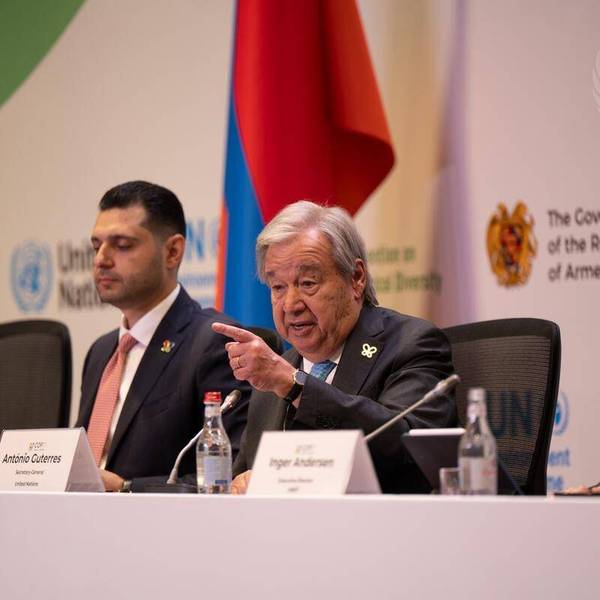


United Nations Secretary-General Antonio Guterres gave a press conference in Madrid on Dec. 1, 2019, the eve of the opening of the U.N. Climate Change Conference (COP 25). (Photo: Cristina Quicler/AFP via Getty Images)
Decrying 'Utterly Inadequate' Efforts to Tackle Climate Crisis, UN Chief Declares 'Our War Against Nature Must Stop'
"The point of no return is no longer over the horizon," António Guterres warned ahead of COP 25. "It is in sight and hurtling toward us."
On the eve of the United Nations Climate Change Conference, U.N. Secretary-General Antonio Guterres decried the "utterly inadequate" efforts of governments to curb planet-heating emissions and called for "a clear demonstration of increased ambition and commitment" from world leaders to tackle the crisis.
"For many decades the human species has been at war with the planet. And the planet is fighting back," Guterres told reporters in Madrid Sunday. "We are confronted now with a global climate crisis. The point of no return is no longer over the horizon. It is in sight and hurtling towards us."
"Our war against nature must stop," he declared. "And we know that that is possible. The scientific community has provided us with the roadmap to achieve this."
Guterres referenced various U.N.-affiliated reports from recent years, including three released in the weeks leading up to COP 25, the climate conference that will begin Monday and run through Dec. 13.
The annual Emissions Gap report, published Tuesday by the U.N. Environment Program (UNEP), warned that global temperatures are on track to rise as much as 3.2degC by the end of the century and countries' commitments under the 2015 Paris agreement--a key focus of the upcoming conference--are insufficient to avert climate catastrophe.
The latest Greenhouse Gas Bulletin, published Monday by the World Meteorological Organization, revealed that levels of long-lived greenhouse gases in the atmosphere hit record highs in 2018. The previous week, the UNEP and leading research organizations published The Production Gap, which found that planned levels of fossil fuel production through 2030 are "dangerously out of step" with the Paris accord goals.
"According to the Intergovernmental Panel on Climate Change, we must limit global temperature rise to 1.5 degrees Celsius, reach carbon neutrality by 2050, and reduce greenhouse gas emissions by 45 percent from 2010 levels by 2030," Guterres noted. "The commitments made in Paris would still lead to an increase in temperature above three degrees Celsius. But many countries are not even meeting those commitments."
"We simply have to stop digging and drilling and take advantage of the vast possibilities offered by renewable energy and nature-based solutions."
--U.N. Secretary-General Antonio Guterres
Expressing concern about the "alarming rate" at which greenhouse gas emissions are growing, the U.N. chief highlighted The Production Gap's finding that the world is set to produce 120 percent more fossil fuels over the next decade than what is consistent with a 1.5-degree pathway.
As coal, gas, and oil production continues, "climate-related natural disasters are becoming more frequent, more deadly, more destructive, with growing human and financial costs," Guterres pointed out. "Drought in some parts of the world is progressing at alarming rates destroying human habitats and endangering food security. Every year, air pollution, associated to climate change, kills seven million people. Climate change has become a dramatic threat to human health and security."
Guterres called for ensuring that $100 billion dollars is available for developing countries to use for mitigation and adaptation to the climate crisis. He also emphasized the need for "more ambitious national commitments" to reduce emissions--especially from major polluters--and stressed that such commitments should "include a just transition for people whose jobs and livelihoods are affected as we move from the grey to the green economy."
Governments across the globe face growing pressure from the public--particularly young people--to step up their climate action to meet the level of the crisis, noted Guterres, whose remarks to reporters Sunday came just two days after a youth-led worldwide climate strike that aimed to push COP 25 attendees to pursue more ambitious policies.
"What is still lacking is political will," Guterres said. "Political will to put a price on carbon. Political will to stop subsidies on fossil fuels. Political will to stop building coal power plants from 2020 onwards. Political will to shift taxation from income to carbon--taxing pollution instead of people. We simply have to stop digging and drilling and take advantage of the vast possibilities offered by renewable energy and nature-based solutions."
Although Guterres didn't criticize any nations or leaders by name--including U.S. President Donald Trump, who began formally withdrawing the United States from the Paris accord last month--the secretary-general chided the world's largest emitters for "not pulling their weight" and warned that "without them, our goal is unreachable."
We are at a crossroads
This country and this world are at a monumental crossroads. In a few short weeks, US voters will have an opportunity to beat back the forces of fascism and confront the billionaires who are rigging the economy, our media system, and our democracy, making it increasingly impossible for ordinary people to get by. We’re not just talking about the election. We’re talking about what must be done once these fascist elements are vanquished from power. We need a bolder set of solutions than what either major party has so far been willing to offer and a working-class movement ready to fight like hell for it. Trump didn't emerge from nowhere. The conditions that fueled MAGA authoritarianism were created by decades of radical neoliberal economic policies and a corrupt political system dominated by corporate interests. They slashed taxes on the super-rich, promising that the benefits would trickle down. They said giveaways to the corporate titans would make life more affordable for the rest of us. It was all bullshit. And when a bitter, betrayed populace searches for someone to blame, right-wing demagogues have little trouble finding scapegoats. People know when they're being lied to, but you won't hear any of this from the corporate media. Only independent journalism—powered and funded by people who believe in building a better world—can deliver truly trustworthy daily news. Our Fall Campaign is underway, and we need your help. To power our newsroom through the rest of the year, we need to raise $125,000 by midnight on October 31. So if you share our vision, please contribute whatever you can to sustain our work. |
On the eve of the United Nations Climate Change Conference, U.N. Secretary-General Antonio Guterres decried the "utterly inadequate" efforts of governments to curb planet-heating emissions and called for "a clear demonstration of increased ambition and commitment" from world leaders to tackle the crisis.
"For many decades the human species has been at war with the planet. And the planet is fighting back," Guterres told reporters in Madrid Sunday. "We are confronted now with a global climate crisis. The point of no return is no longer over the horizon. It is in sight and hurtling towards us."
"Our war against nature must stop," he declared. "And we know that that is possible. The scientific community has provided us with the roadmap to achieve this."
Guterres referenced various U.N.-affiliated reports from recent years, including three released in the weeks leading up to COP 25, the climate conference that will begin Monday and run through Dec. 13.
The annual Emissions Gap report, published Tuesday by the U.N. Environment Program (UNEP), warned that global temperatures are on track to rise as much as 3.2degC by the end of the century and countries' commitments under the 2015 Paris agreement--a key focus of the upcoming conference--are insufficient to avert climate catastrophe.
The latest Greenhouse Gas Bulletin, published Monday by the World Meteorological Organization, revealed that levels of long-lived greenhouse gases in the atmosphere hit record highs in 2018. The previous week, the UNEP and leading research organizations published The Production Gap, which found that planned levels of fossil fuel production through 2030 are "dangerously out of step" with the Paris accord goals.
"According to the Intergovernmental Panel on Climate Change, we must limit global temperature rise to 1.5 degrees Celsius, reach carbon neutrality by 2050, and reduce greenhouse gas emissions by 45 percent from 2010 levels by 2030," Guterres noted. "The commitments made in Paris would still lead to an increase in temperature above three degrees Celsius. But many countries are not even meeting those commitments."
"We simply have to stop digging and drilling and take advantage of the vast possibilities offered by renewable energy and nature-based solutions."
--U.N. Secretary-General Antonio Guterres
Expressing concern about the "alarming rate" at which greenhouse gas emissions are growing, the U.N. chief highlighted The Production Gap's finding that the world is set to produce 120 percent more fossil fuels over the next decade than what is consistent with a 1.5-degree pathway.
As coal, gas, and oil production continues, "climate-related natural disasters are becoming more frequent, more deadly, more destructive, with growing human and financial costs," Guterres pointed out. "Drought in some parts of the world is progressing at alarming rates destroying human habitats and endangering food security. Every year, air pollution, associated to climate change, kills seven million people. Climate change has become a dramatic threat to human health and security."
Guterres called for ensuring that $100 billion dollars is available for developing countries to use for mitigation and adaptation to the climate crisis. He also emphasized the need for "more ambitious national commitments" to reduce emissions--especially from major polluters--and stressed that such commitments should "include a just transition for people whose jobs and livelihoods are affected as we move from the grey to the green economy."
Governments across the globe face growing pressure from the public--particularly young people--to step up their climate action to meet the level of the crisis, noted Guterres, whose remarks to reporters Sunday came just two days after a youth-led worldwide climate strike that aimed to push COP 25 attendees to pursue more ambitious policies.
"What is still lacking is political will," Guterres said. "Political will to put a price on carbon. Political will to stop subsidies on fossil fuels. Political will to stop building coal power plants from 2020 onwards. Political will to shift taxation from income to carbon--taxing pollution instead of people. We simply have to stop digging and drilling and take advantage of the vast possibilities offered by renewable energy and nature-based solutions."
Although Guterres didn't criticize any nations or leaders by name--including U.S. President Donald Trump, who began formally withdrawing the United States from the Paris accord last month--the secretary-general chided the world's largest emitters for "not pulling their weight" and warned that "without them, our goal is unreachable."